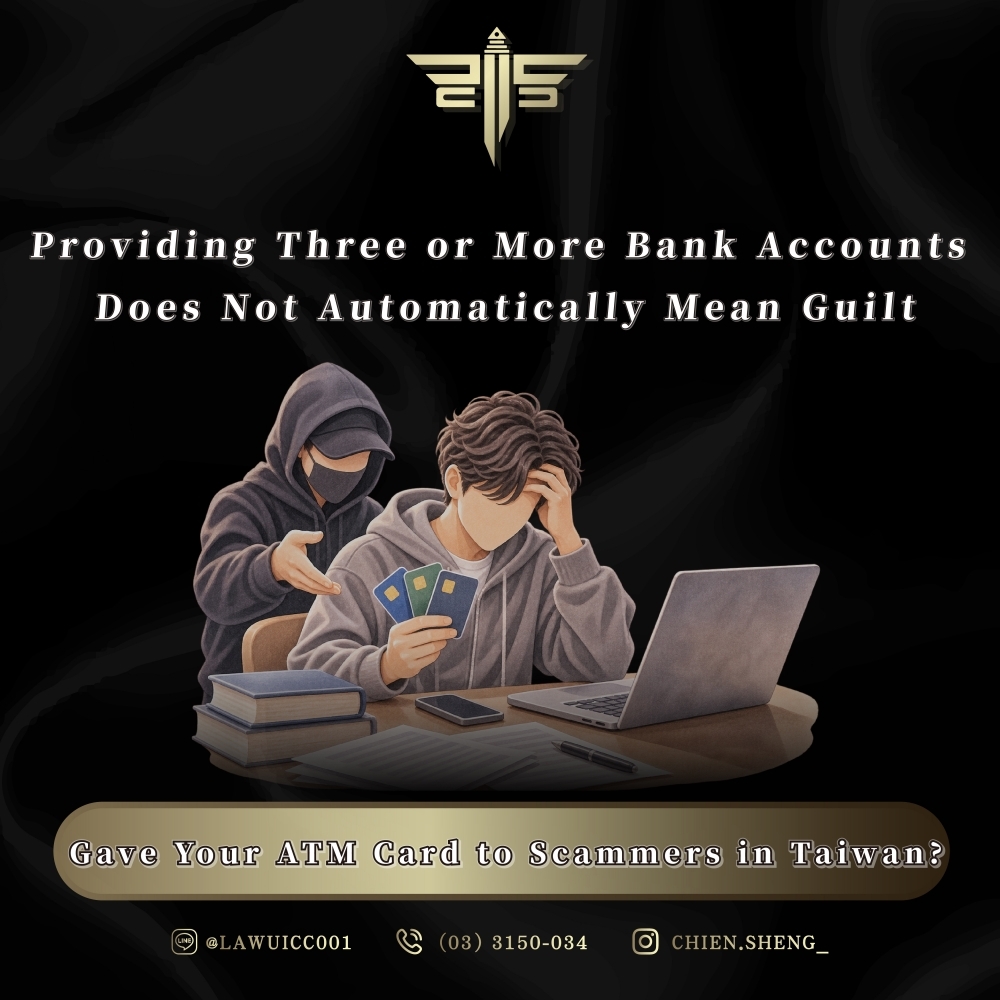
Gave Your ATM Card to Scammers in Taiwan? Providing Three or More Bank Accounts Does Not Automatically Mean Guilt | Fraud and Money Laundering Defense
商品圖像
-
商品資訊
Table of contents
- 1. Why Providing an ATM Card Can Lead to Criminal Charges
- 2. Common Scams Used to Obtain Bank Accounts
- 3. Does Providing Three or More Accounts Automatically Constitute a Crime?
- 4. What to Do After Giving Your ATM Card to Scammers
- 5. Why Police Interviews and Prosecutor Questioning Matter
- 6. What If You Also Withdrew or Transferred Money?
- 7. Defense Strategies for Non-Prosecution or Acquittal
- 8. Lost or Stolen ATM Cards
- 9. When to Contact a Criminal Defense Lawyer
- 10. Frequently Asked Questions About Providing ATM Cards to Scammers in Taiwan
- 11. Conclusion: Providing ATM Cards Does Not Automatically Establish Criminal Intent
If you gave your ATM card, bankbook, online banking credentials, or verification codes to someone who turned out to be a scammer, you may suddenly find yourself under criminal investigation.
➡︎ Your bank account may have been flagged, police may have requested an interview, or you may have received a summons from a district prosecutors' office.
Possible allegations include fraud, aiding fraud, money laundering, aiding money laundering, or violating Article 22 of Taiwan's Money Laundering Control Act.
Many people become involved in these cases after responding to fake job advertisements, loan offers, investment opportunities, or online relationships. They may have believed they were completing a legitimate application rather than helping a criminal organization.
Even if you provided three or more bank accounts, criminal liability is not automatic. Prosecutors must still establish the relevant statutory elements, including the required criminal intent.
➡︎ This article explains the legal risks of providing ATM cards to scammers, the significance of Article 22, and how criminal defense lawyers may seek non-prosecution or acquittal.
1. Why Providing an ATM Card Can Lead to Criminal Charges
1. How Scammers Use Other People's Bank Accounts
Fraud organizations frequently use bank accounts registered under other people's names to receive payments from victims.
These accounts are commonly called nominee accounts or mule accounts.
After victims transfer money into these accounts, other individuals may withdraw the funds or transfer them elsewhere to make the financial trail harder to trace.
➡︎ Because the account is registered under your name, investigators may initially identify you as a person connected to the suspicious transactions.
However, being the registered account holder does not automatically establish that you knowingly participated in fraud.
2. Aiding Fraud and Aiding Money Laundering
Under Article 30 of Taiwan's Criminal Code, a person who intentionally assists another person's criminal conduct may be liable as an aider or abettor. The punishment may be reduced in comparison with that of the principal offender.
Providing ATM cards, passwords, or account access may raise allegations of aiding fraud or aiding money laundering if the statutory requirements are met.
Nevertheless, the fact that scammers used your account does not, by itself, prove that you intended to assist their crimes.
Investigators must examine whether you knew, or at least foresaw and accepted the possibility, that your account would be used for fraud or money laundering.
➡︎ Where a person was genuinely deceived into providing account information without the required criminal intent, there may be grounds to challenge the allegations.
2. Common Scams Used to Obtain Bank Accounts
1. Fake Job Offers and Part-Time Employment
Scammers may advertise attractive salaries, easy remote work, or part-time positions requiring little experience.
After contacting applicants through LINE or other messaging platforms, they may claim that ATM cards or online banking credentials are needed for salary processing, account verification, or financial testing.
➡︎ The applicant may believe the request is part of a legitimate recruitment process.
2. Fake Loans and Account Verification
Loan scams frequently target individuals who urgently need financial assistance.
Fraudsters may claim that applicants must provide ATM cards, passwords, or bankbooks to improve their credit records, verify their accounts, or establish transaction histories before loan approval.
➡︎ These explanations may be used to obtain control over the applicant's bank accounts.
3. Romance, Investment, and Cryptocurrency Scams
Other schemes involve online relationships, investment platforms, or cryptocurrency services.
A scammer may ask someone to receive payments, provide exchange credentials, register financial accounts, or forward money to another person.
The key legal issue is not merely whether the account was provided, but why the individual provided it, what they understood at the time, and whether the surrounding evidence supports that explanation.
3. Does Providing Three or More Accounts Automatically Constitute a Crime?
1. Article 22 of Taiwan's Money Laundering Control Act
Article 22 regulates the provision of financial accounts, virtual asset accounts, and third-party payment accounts to others for use without legitimate justification.
➡︎ The law recognizes exceptions involving ordinary commercial or financial practices, relationships of trust between relatives or friends, and other legitimate reasons.
Under Article 22, Paragraph 3, certain violations may result in criminal penalties, including situations involving compensation, the provision of three or more accounts, or repeated conduct within the specified period after an administrative warning.The statutory penalty may include imprisonment of up to three years, short-term detention, or a fine of up to NT$1 million.
However, providing three or more accounts does not eliminate the need to establish the elements of the offense.
2. Why Criminal Intent Still Matters
The legislative explanation accompanying Article 22 specifically addresses people who provide bank accounts after being deceived by fake loan or employment arrangements.
It explains that providing ATM cards, passwords, or verification information is generally unnecessary for legitimate loan applications or employment.Therefore, such explanations do not automatically constitute legitimate reasons for transferring account control.
Importantly, the legislative explanation also recognizes that where a person was deceived and lacked awareness of the elements of the offense, the required criminal intent may be absent.
➡︎ This distinction is essential.
A person who knowingly sells multiple accounts to criminals is not necessarily in the same legal position as someone deceived into surrendering several accounts through a fraudulent loan or employment scheme.
➡︎ The court must evaluate the individual's actual knowledge, intent, conduct, and supporting evidence.
3. Why Three Accounts Increase Legal Risk
The legislature treats the provision of three or more accounts as a more serious situation because multiple accounts can facilitate fraud and money laundering.
However, the reasons for providing accounts and the degree of culpability may differ significantly between cases.
Defense arguments should therefore examine the complete circumstances rather than treating the number of accounts as conclusive proof of guilt.
4. What to Do After Giving Your ATM Card to Scammers
1. Preserve All Communications and Documents
Keep complete LINE, Telegram, Facebook, Instagram, email, and text message records.
Also preserve job advertisements, loan applications, contracts, website addresses, screenshots, delivery receipts, shipping records, and the other person's contact details.
➡︎ These materials may help explain how the scammer approached you, gained your trust, and persuaded you to provide account access.
Do not delete, alter, or selectively reevidence.
2. Contact Your Bank Promptly
➡︎ If another person may still control your account, contact the bank to report the situation and ask about available protective measures.
Preserve the bank's notifications, transaction records, and any documentation concerning account restrictions or loss reports.These records may help establish when suspicious transactions occurred and whether you personally conducted them.
3. Avoid Contacting Suspected Scammers to Coordinate Explanations
Do not contact suspected offenders to arrange matching statements, request that they change their accounts of events, or attempt to conceal relevant transactions.
➡︎ If you receive a police notice or prosecutor's summons, prepare the available evidence and consider consulting a criminal defense lawyer before questioning.
5. Why Police Interviews and Prosecutor Questioning Matter
1. Investigators Will Examine Your Knowledge and Intent
Police and prosecutors may ask why you provided your ATM card, how many accounts were involved, whether you disclosed passwords, whether you received compensation, and whether you knew the other person's identity.
They may also ask whether you verified the job or loan offer, reported suspicious activity, or participated in withdrawals and transfers.Your explanations should accurately distinguish what you knew when you provided the account from what you discovered afterward.
For example, regretting the decision to provide an ATM card does not necessarily mean you knew at the time that it would be used for fraud.
2. Review Interview Records Carefully
A police interview record may become important evidence in the subsequent investigation.Explain the relevant events according to your actual recollection and available documents.
➡︎ If you are uncertain about a date, amount, or conversation, do not guess.Before signing, review the record carefully and request corrections where necessary.
A lawyer may assist in identifying legally relevant facts and ensuring that the circumstances of the alleged deception are properly presented.
6. What If You Also Withdrew or Transferred Money?
Providing an ATM card and personally withdrawing or transferring suspicious funds can involve different levels of criminal risk.
Where someone follows instructions to withdraw money, transfer funds to another account, purchase cryptocurrency, or hand cash to another individual, investigators may examine whether that person directly participated in fraud or money laundering.
Depending on the facts, allegations may extend beyond aiding offenses to principal liability for fraud, money laundering, or aggravated fraud.
However, participation in a transaction does not automatically eliminate all possible defenses.
The investigation must still consider why the person acted, what they understood about the money, whether they received compensation, and whether they were deceived into believing the transactions involved legitimate loan processing, employment duties, or business payments.
➡︎ Because the potential charges may be more serious, early legal review is particularly important.
7. Defense Strategies for Non-Prosecution or Acquittal
1. Identify the Specific Criminal Allegations
The first step is to determine whether the investigation concerns aiding fraud, aiding money laundering, Article 22 of the Money Laundering Control Act, or direct participation in fraud or money laundering.
Each offense has different legal requirements.A defense strategy should address the precise allegations rather than relying solely on the statement, "I was also scammed."
2. Reconstruct the Complete Timeline
A detailed timeline may show when the individual first encountered the advertisement, communicated with the scammer, received instructions, provided the ATM cards, discovered suspicious transactions, and contacted the bank or police.
The timeline should be supported by original communications, delivery records, financial statements, and other reliable materials.
➡︎ This evidence may help establish what the individual actually understood at each stage.
3. Distinguish Deception From Selling Bank Accounts
Investigators may pay particular attention to whether the individual received money in exchange for providing account access.
However, the nature of any payment must be examined.
A transaction described as salary, a loan disbursement, reimbursement, or a testing payment may have a different factual context from an agreed fee for selling an account.
➡︎ The evidence should establish what the payment represented and whether the person possessed the required criminal intent.
4. Challenge Unsupported Conclusions About Criminal Intent
In cases involving three or more accounts, the defense may rely on the statutory requirements and legislative explanation of Article 22.
➡︎ Relevant evidence may demonstrate that the individual was deceived, lacked awareness of the criminal arrangement, received no improper compensation, or did not participate in the movement of fraudulent proceeds.
Where the prosecution cannot establish the required elements, non-prosecution or acquittal may be possible.
The outcome depends on the evidence, not simply the number of ATM cards provided.
8. Lost or Stolen ATM Cards
Some individuals discover that their accounts were used for fraud after an ATM card was lost, stolen, or used without authorization.
These cases may involve questions about how the card disappeared, whether the PIN was compromised, when suspicious transactions occurred, and whether the account holder reported the loss.
Relevant evidence may include bank statements, ATM surveillance footage, loss reports, the person's whereabouts, account usage patterns, and communications.
Claiming that a card was lost is not automatically sufficient to establish innocence.
However, objective evidence supporting unauthorized use may reasonable doubt about whether the account holder intentionally assisted criminal activity.
9. When to Contact a Criminal Defense Lawyer
Legal assistance is especially important where an individual has provided three or more accounts, participated in withdrawals or transfers, received payments from suspicious parties, or lost access to important communications.
Early consultation may also be useful when police have requested questioning, a bank account has been flagged, or a prosecutor's summons has been received.
 Chien Sheng International Law Firm handles criminal defense matters involving bank account fraud, ATM card transfers, fake loan schemes, employment scams, aiding fraud, and money laundering allegations.
Depending on the circumstances, legal counsel may assist with reviewing evidence, reconstructing the events, accompanying clients during questioning, preparing written defenses, and seeking non-prosecution, acquittal, or other legally available outcomes.
➡︎ No particular case result can be guaranteed.
10. Frequently Asked Questions About Providing ATM Cards to Scammers in Taiwan
Q1: Will I automatically be convicted if I gave my ATM card to scammers?
No. Criminal liability depends on the relevant offense, your conduct, the required criminal intent, and the available evidence.
Q2: Is providing three or more bank accounts automatically a crime in Taiwan?
No. Article 22 provides criminal penalties for specified conduct involving three or more accounts, but the prosecution must still establish the statutory elements, including criminal intent.
Q3: What if I provided my ATM card because of a fake job or loan offer?
Evidence showing how you were deceived and what you understood at the time may be important to determining whether criminal intent existed.
Q4: Can I be charged even if I received no money?
Yes. Receiving compensation is not a necessary element of every fraud or money laundering offense. The full circumstances must be examined.
Q5: What if I also withdrew or transferred money?
You may face more serious allegations involving direct participation in fraud or money laundering. Your actual knowledge, instructions, and conduct remain relevant.
Q6: Can I seek non-prosecution or acquittal after providing multiple ATM cards?
Potentially. A favorable outcome may be possible where the evidence does not establish the required criminal elements.
Q7: What should I do if my bank account becomes flagged?
Contact your bank, preserve transaction and communication records, confirm the relevant investigation details, and seek legal advice where appropriate.
11. Conclusion: Providing ATM Cards Does Not Automatically Establish Criminal Intent
Giving ATM cards or bank account information to scammers can lead to serious criminal investigations in Taiwan.
Providing three or more accounts may trigger the criminal provisions of Article 22 of the Money Laundering Control Act, while participating in withdrawals or transfers may raise additional fraud and money laundering allegations.
However, providing an account is not automatically equivalent to knowingly assisting a criminal organization.
➡︎ The key questions concern how the account was provided, what the individual knew, whether compensation was involved, whether the person participated in financial transactions, and whether the evidence supports the alleged criminal intent.
Individuals who were deceived through fake jobs, loans, investments, or online relationships should preserve the complete evidence and seek legal advice before responding to criminal allegations.
Chien Sheng International Law Firm provides criminal defense services and may assist clients in evaluating potential defenses, preparing for questioning, and pursuing legally available outcomes.※ This article provides general legal information about Taiwan's fraud and money laundering laws. It does not replace individualized legal advice or guarantee non-prosecution, acquittal, or any particular result.
This reduces both medical risks and potential legal exposure.
Chien Sheng International Law Firm

LINE Online Legal Consultation: @lawuicc001 (Click to consult)
Welcome to call to schedule a meeting: 03-3150-034
Multiple payment methods available: Cash, Credit Card, Bank Transfer
Facebook: Chien Sheng International Law Firm
Instagram: chien.sheng_
-
商品Q&A


