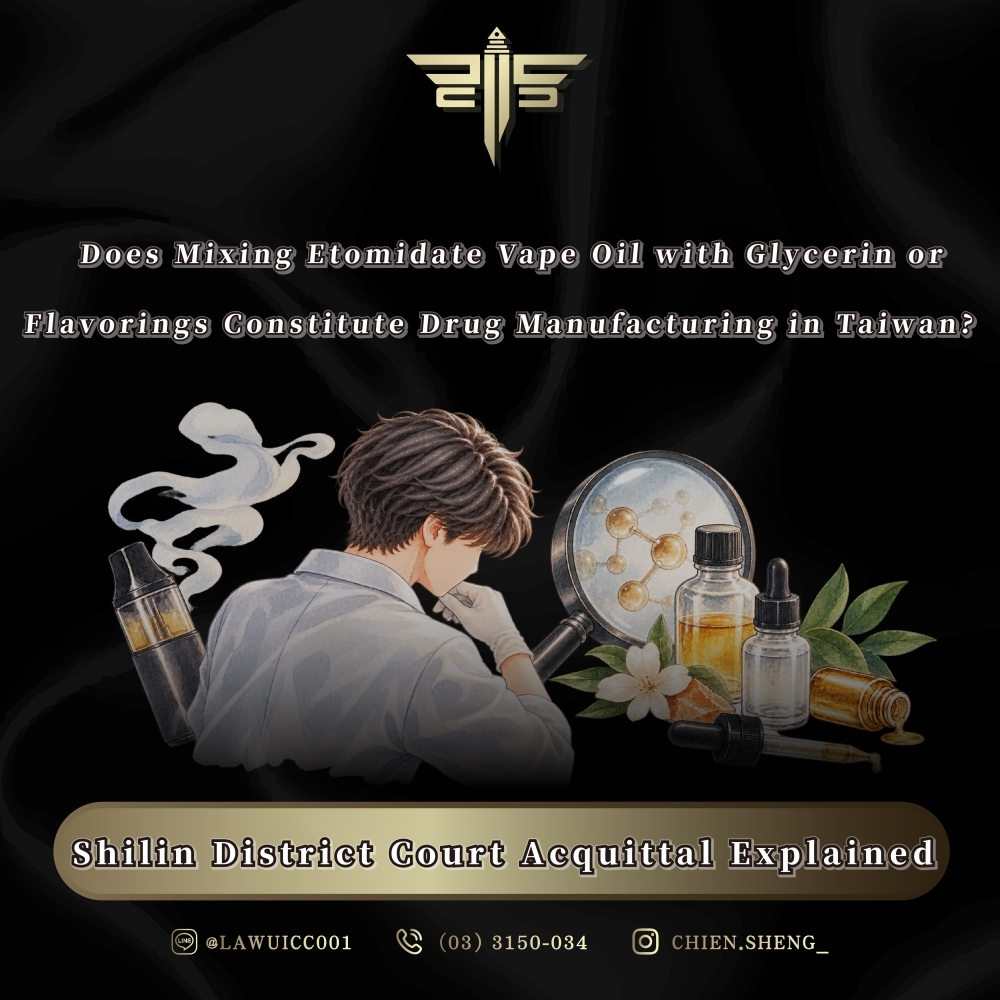
Does Mixing Etomidate Vape Oil with Glycerin or Flavorings Constitute Drug Manufacturing in Taiwan? Shilin District Court Acquittal Explained
商品圖像
-
商品資訊
目錄
- 1. Is Etomidate a Category 1 or Category 2 Drug in Taiwan?
- 2. Why Did the Shilin District Court Acquit the Defendant of Drug Manufacturing?
- 3. When Does Mixing or Processing Drugs Constitute Manufacturing?
- 4. Does Personal Use or Adding Non-Controlled Ingredients Guarantee an Acquittal?
- 5. Why Does a Positive Drug Test Not Automatically Prove Manufacturing?
- 6. Why Was the Possession Charge Dismissed While the Manufacturing Charge Resulted in an Acquittal?
- 7. What Should a Criminal Defense Lawyer Investigate in an Etomidate Manufacturing Case?
- 8. Chien Sheng International Law Firm's Legal Perspective
- 9. Frequently Asked Questions
Does adding glycerin, propylene glycol, or flavorings to vape oil containing etomidate automatically constitute drug manufacturing under Taiwanese law?
Not necessarily. Although physical processing can qualify as drug manufacturing, courts must examine whether the defendant's conduct actually meets the statutory elements of the offense.
In Taiwan Shilin District Court Criminal Judgment No. 115-Su-547 (2026), a defendant admitted adding non-controlled substances to previously purchased etomidate vape oil for personal use. Nevertheless, the court acquitted the defendant of manufacturing Category 2 narcotics.
The important legal principle is not that mixing etomidate with legal ingredients is always permitted. Rather, the prosecution must prove that the defendant's actual conduct constitutes drug manufacturing, not merely that mixing or packaging occurred.
※ Case disclosure: This case was not handled by Chien Sheng International Law Firm and is not presented as one of the firm's successful cases. The analysis is based on the first-instance judgment, and its appeal or finality status has not been confirmed.
1. Is Etomidate a Category 1 or Category 2 Drug in Taiwan?
The classification of etomidate in Taiwan has changed, making the date of the alleged offense particularly important.
The conduct examined in the Shilin District Court case occurred in 2025, when the relevant charges were considered under the rules governing Category 2 narcotics.
However, Taiwan's Executive Yuan announced a reclassification on June 25, 2026, which took effect on June 27, 2026, placing etomidate and the specified related substances in Category 1.
Under Article 4 of the Narcotics Hazard Prevention Act:
■ Manufacturing Category 1 narcotics: Death penalty or life imprisonment, with a possible fine of up to NT$30 million where life imprisonment is imposed.
■ Manufacturing Category 2 narcotics: Life imprisonment or at least 10 years' imprisonment, with a possible additional fine of up to NT$15 million.
Article 2 of Taiwan's Criminal Code generally requires the application of the law in effect when the offense occurred, unless a subsequent legal change is more favorable to the defendant.
Therefore, the later reclassification does not automatically justify applying a harsher penalty to conduct committed before the change.
The applicable drug category and whether manufacturing occurred are two separate legal questions. Even where a substance is classified as a serious controlled drug, the prosecution must still prove the elements of the charged offense.
2. Why Did the Shilin District Court Acquit the Defendant of Drug Manufacturing?
According to the judgment, the defendant had purchased vape oil that already contained etomidate.
The defendant acknowledged adding glycerin, propylene glycol, and flavorings but maintained that the purpose was to dilute the existing vape oil for personal consumption rather than manufacture products for sale.
The court did not dispute that mixing and repackaging had occurred or that the seized cartridges contained etomidate.
Instead, the central issue was whether those activities legally constituted manufacturing.
The court found that the evidence did not sufficiently establish that the defendant had created a new form of drug mixture or materially changed the original substance's composition, effects, or form.
It also distinguished the defendant's conduct from cases involving more extensive processing intended to different drug products.
The court therefore concluded that the evidence was insufficient to establish the charged manufacturing offense.
This ruling does not mean that adding legal ingredients to controlled drugs is always lawful. Its significance lies in the court's examination of the specific conduct and the evidence supporting the manufacturing allegation.
3. When Does Mixing or Processing Drugs Constitute Manufacturing?
1. Manufacturing Does Not Require a Chemical Reaction
In Supreme Court Criminal Judgment No. 110-Tai-Shang-521 (2021), Taiwan's Supreme Court explained that drug manufacturing is not limited to chemical synthesis or extraction.
Physical processing may also constitute manufacturing where the relevant conduct changes a drug's effects or method of use and satisfies the applicable legal requirements.
Consequently, a defendant cannot avoid manufacturing liability merely by arguing that no chemical reaction occurred.
2. Not Every Mixing or Packaging Activity Is Manufacturing
The same Supreme Court judgment also recognized that simple sealing, packaging, labeling, adding non-drug substances, or dividing and mixing drugs for personal consumption cannot automatically be treated as manufacturing.
Courts must consider the entire course of conduct.
Relevant questions include whether the substance was already in a usable form, whether processing changed its effects or method of administration, and what the defendant actually intended and performed.
3. Why Are Drug-Laced Coffee Packets Different?
In the Shilin case, prosecutors cited Supreme Court Judgments No. 112-Tai-Shang-1142 and No. 110-Tai-Shang-521 in support of the manufacturing charge.
However, the district court distinguished cases involving drug processing facilities, the preparation of drug-laced beverage packets, and products manufactured for distribution.
The defendant in the Shilin case had allegedly diluted vape oil that was already suitable for vaping.
The court considered that factual distinction important when evaluating whether the defendant had engaged in manufacturing.
Nevertheless, commercial distribution is not a mandatory element of drug manufacturing, and creating an entirely new chemical substance is not always necessary.
The correct approach is to compare the actual facts and legal reasoning of each judgment rather than applying isolated phrases from another decision.
4. Does Personal Use or Adding Non-Controlled Ingredients Guarantee an Acquittal?
No. Neither personal use nor the addition of non-controlled ingredients automatically excludes criminal liability.
Glycerin, propylene glycol, and flavorings may be lawful substances, but their use in processing controlled drugs can still be relevant to a manufacturing allegation.
If the resulting conduct satisfies the statutory definition of manufacturing, claiming that the product was intended only for personal use does not automatically eliminate the offense.
Likewise, the absence of two different controlled drugs does not by itself determine whether manufacturing occurred.
Article 9(3) of the Narcotics Hazard Prevention Act, concerning offenses involving mixtures of multiple drug categories, raises a different legal question from whether processing a single controlled drug with non-controlled ingredients constitutes manufacturing.
The Shilin judgment supports a narrower principle: the court must examine what the defendant actually did and whether those actions satisfy the manufacturing elements.
It does not establish a general exemption for personal-use dilution or the addition of legal ingredients.
5. Why Does a Positive Drug Test Not Automatically Prove Manufacturing?
A laboratory report confirming the presence of etomidate proves an important fact about the seized substance.
However, proving that a substance contains a controlled drug is different from proving that the defendant manufactured it.
The prosecution must still establish the defendant's relevant conduct, criminal intent, and the legal elements of manufacturing.
Under Taiwan's Code of Criminal Procedure:
■ Article 154: Criminal facts must be established through evidence, and defendants are presumed innocent until proven guilty.
■ Article 161: Prosecutors bear the burden of proving the charged criminal facts.
■ Article 301: An acquittal must be entered when the defendant's crime cannot be proven or the conduct is not punishable.
The principle of reasonable doubt does not mean that a defendant must be acquitted simply because they deny the allegation.
Rather, the court must determine whether the complete evidence establishes guilt to the required criminal standard.
1. Can a Defendant Admit Mixing but Deny Manufacturing?
Yes. Admitting a physical act does not necessarily mean accepting the prosecution's legal classification of that act.
In this case, the defendant acknowledged adding ingredients and handling the vape oil while disputing whether those actions constituted manufacturing.
The court separately examined the factual conduct and its legal significance.
Article 156 of the Code of Criminal Procedure also requires appropriate corroboration of confessions; a confession cannot serve as the sole basis for conviction.
A defense should therefore remain truthful, consistent with the evidence, and focused on the actual statutory elements rather than relying solely on the terminology used in interrogation records.
6. Why Was the Possession Charge Dismissed While the Manufacturing Charge Resulted in an Acquittal?
➡︎ The Shilin District Court judgment involved several different legal outcomes.
➡︎ The manufacturing charge resulted in an acquittal because the court found insufficient grounds to establish the manufacturing offense.
➡︎ The possession charge, however, resulted in a procedural dismissal rather than a separate acquittal on the merits.
According to the judgment, this issue involved the relationship between possession, drug use, and separate observation and rehabilitation proceedings.
➡︎ The court applied Article 303(1) of the Code of Criminal Procedure in addressing the possession prosecution.
➡︎ The seized etomidate cartridges were also ordered confiscated and destroyed.
➡︎ These outcomes must not be confused.
An acquittal on manufacturing does not mean that possession, use, distribution, or other drug-related conduct is necessarily lawful.
Likewise, the procedural dismissal of a possession charge in this particular case does not establish that all possession associated with drug use is exempt from prosecution.
The result depends on the specific facts and procedural circumstances.
7. What Should a Criminal Defense Lawyer Investigate in an Etomidate Manufacturing Case?
When a defendant is accused of manufacturing etomidate-containing vape oil or cartridges, the defense should first determine whether the manufacturing offense has actually been established.
Important questions include:
■ When did the alleged conduct occur? Which drug classification and legal provisions applied at that time?
■ What was the original substance? Was it already prepared vape oil, or was it a different material requiring further processing?
■ What did the defendant actually do? Did the conduct involve dilution, mixing, filling, packaging, or a more substantial transformation?
■ Did the processing materially change the substance's effects or method of use? What evidence supports that conclusion?
■ Does the claimed personal-use purpose match the objective evidence? Are there communications, transactions, or seized materials suggesting another purpose?
■ Are the prosecution's cited precedents factually comparable? Do they involve similar substances, processes, and circumstances?
■ Could other drug offenses still apply? Possession, use, transportation, transfer, or sale may require separate analysis.
Defense counsel should also review laboratory reports, search and seizure records, interrogation statements, and the applicable drug classification at the time of the alleged offense.
Under Article 95 of the Code of Criminal Procedure, defendants have important procedural rights, including the right to remain silent and the right to retain defense counsel.
Anyone facing investigation should preserve relevant evidence, avoid altering records or coordinating false statements, and seek legal assistance promptly.
8. Chien Sheng International Law Firm's Legal Perspective
The seriousness of drug manufacturing penalties makes careful examination of the statutory elements especially important.
A manufacturing allegation should not be accepted solely because investigators describe conduct as mixing, processing, or preparing drugs.
The Shilin District Court judgment demonstrates the importance of distinguishing between the physical actions a defendant performed and the legal conclusions that may be drawn from those actions.
 Chien Sheng International Law Firm can assist clients in examining the timing of alleged conduct, drug classification, laboratory findings, the original condition of seized substances, and whether the prosecution's evidence establishes manufacturing.
Depending on the circumstances, legal representation may involve challenging the charged offense, requesting further evidence investigation, accompanying clients during questioning, or evaluating alternative sentencing and mitigation strategies.
The firm's approach is to examine whether the alleged offense is legally and factually established before determining whether sentence reduction should become the primary defense strategy.
The Shilin case discussed in this article was not handled by the firm, and its outcome does not guarantee the result of another case.
9. Frequently Asked Questions
Q1: Does adding glycerin or flavorings to etomidate vape oil automatically constitute drug manufacturing?
No. The court must examine the actual processing, its effects on the substance, the defendant's intent, and whether the statutory elements of manufacturing are established.
Q2: Is etomidate currently classified as a Category 1 narcotic in Taiwan?
According to the regulatory change described in this article, etomidate was reclassified as a Category 1 narcotic effective June 27, 2026. The applicable law for an alleged offense must still be assessed according to the date of the conduct and relevant legal rules.
Q3: Can drug manufacturing occur without chemical synthesis?
Yes. Certain forms of physical processing may qualify as manufacturing, depending on the legal requirements and the facts.
Q4: Does personal use automatically exclude drug manufacturing liability?
No. Personal use may be relevant to the overall factual assessment, but it is not an automatic legal exemption.
Q5: If laboratory testing confirms etomidate, does that prove the defendant manufactured it?
No. The presence of a controlled substance and the defendant's alleged manufacturing conduct are separate matters requiring proof.
Q6: Can someone be acquitted of manufacturing but still face other drug-related consequences?
Yes. Possession, use, distribution, confiscation, and other legal issues may remain relevant depending on the case.
Conclusion: Mixing Etomidate Vape Oil Does Not Automatically Establish Drug Manufacturing
Taiwan Shilin District Court Criminal Judgment No. 115-Su-547 (2026) illustrates an important distinction in drug manufacturing cases.
Although physical processing can constitute manufacturing under Taiwanese law, the act of adding glycerin, propylene glycol, or flavorings to existing etomidate vape oil does not automatically prove that manufacturing occurred.
Courts must examine the original condition of the substance, the actual processing performed, whether its effects or method of use changed, and whether the prosecution has established the required elements through reliable evidence.
The ruling should not be interpreted as legal permission to dilute or repackage controlled drugs.
For defendants facing serious manufacturing allegations, the central issue is whether the evidence proves the charged offense, rather than whether the conduct has simply been described as manufacturing.
※ This article is provided by Chien Sheng International Law Firm for general legal information and educational purposes. It is based on publicly available information reviewed as of October 10, 2026, and the first-instance reasoning in Taiwan Shilin District Court Criminal Judgment No. 115-Su-547 (2026). The case was not handled by the firm, and its appeal or finality status has not been confirmed. The applicable drug classification, criminal liability, and available defenses depend on the date of the conduct, current law, and complete case evidence. This article does not guarantee an acquittal or any other legal outcome and does not replace individualized legal advice.
This reduces both medical risks and potential legal exposure.
Chien Sheng International Law Firm

LINE Online Legal Consultation: @lawuicc001 (Click to consult)
Welcome to call to schedule a meeting: 03-3150-034
Multiple payment methods available: Cash, Credit Card, Bank Transfer
Facebook: Chien Sheng International Law Firm
Instagram: chien.sheng_
-
商品Q&A