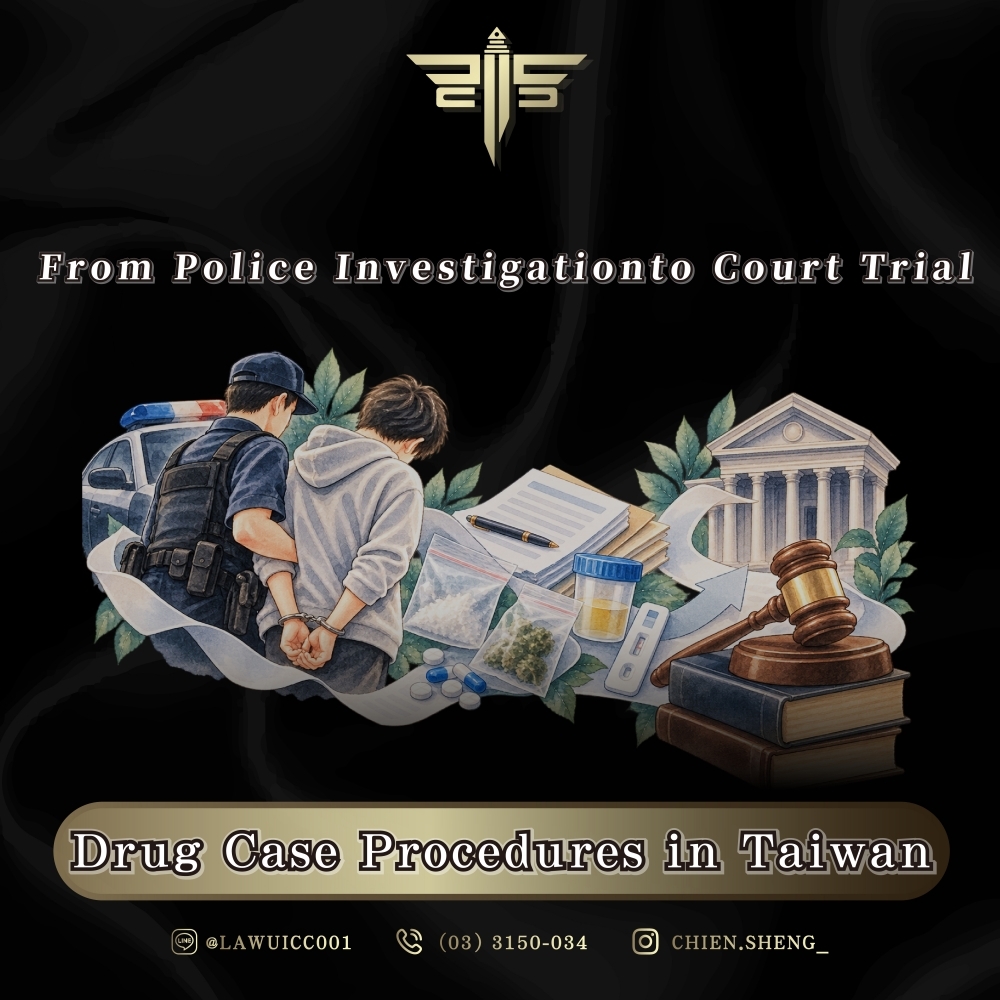
Drug Case Procedures in Taiwan: From Police Investigation to Court Trial
商品圖像
-
商品資訊
目錄
- 1. Identifying the Type of Drug Offense
- 2. Stage One: Police Investigation, Searches, and Arrests
- 3. Your Rights During Police and Prosecutor Questioning
- 4. Stage Two: Prosecutorial Investigation and Pretrial Detention
- 5. Stage Three: Investigation Outcomes
- 6. Special Procedures for Drug Use Cases
- 7. Procedures for Possession, Trafficking, Transportation, and Manufacturing
- 8. Stage Four: Court Trial and Judgment
- 9. How to Prepare a Defense in a Taiwan Drug Case
- 10. Frequently Asked Questions
- 11. How Chien Sheng International Law Firm Can Assist
- 12. Conclusion: Understanding the Drug Case Process Is the First Step Toward an Effective Defense
What happens after you are investigated for a drug offense in Taiwan?
Many people first become concerned about criminal liability after a police search, urine test, arrest, or summons from a District Prosecutors Office. They may wonder whether they will be detained, required to undergo drug rehabilitation, prosecuted, or sentenced to imprisonment.
The legal process depends on the type of offense, drug classification, quantity involved, criminal history, and whether the case concerns drug use, possession, trafficking, transportation, manufacturing, or cultivation.
In general, a drug case may involve four major stages:
■ Police investigation: Searches, seizures, questioning, arrests, urine testing, and evidence collection.
■ Prosecutorial investigation: Questioning by prosecutors, bail decisions, travel restrictions, or applications for detention.
■ Investigation outcome: Non-prosecution, deferred prosecution, indictment, or special drug treatment procedures.
■ Court proceedings: Evidence examination, witness testimony, legal arguments, and judgment.
However, drug use cases may follow special rehabilitation procedures that differ significantly from serious drug trafficking or manufacturing cases.
1. Identifying the Type of Drug Offense
The first step is determining the specific conduct under investigation.
Taiwan's Narcotics Hazard Prevention Act distinguishes between several offenses, including:
■ Drug use and possession
■ Drug trafficking or possession with intent to sell
■ Drug transportation and manufacturing
■ Cannabis cultivation
■ Drug transfer or distribution
■ Aiding or participating in drug-related crimes
Taiwan classifies controlled drugs into four categories. Category 1 includes substances such as heroin, morphine, opium, and cocaine. Category 2 includes cannabis and amphetamine-type substances.
Drug classification affects criminal penalties, but the alleged conduct is equally important.
For example, using a Category 2 drug and selling the same substance involve substantially different legal consequences.
Before preparing a defense, it is essential to identify the alleged offense, relevant statutory provisions, drug quantity, and supporting evidence.
2. Stage One: Police Investigation, Searches, and Arrests
Police may begin investigating a drug offense based on surveillance, witness statements, communications, package inspections, online transactions, urine test results, or information obtained from another criminal investigation.
A person may initially be summoned as a witness or suspect. The legal status stated in the notice should be carefully reviewed before attending questioning.
Under Taiwan's Code of Criminal Procedure, searches generally require a judicial search warrant, subject to statutory exceptions.
Certain urgent circumstances, arrests, or legally authorized emergency situations may permit searches without a warrant.
During a search, important issues include:
■ Whether officers properly identified themselves
■ Whether a warrant was presented or a lawful exception applied
■ Whether the search exceeded its authorized scope
■ What property or electronic records were seized
■ Whether a seizure inventory was provided
If the legality of a search is disputed, the relevant documents should be preserved for legal review. Unlawfully obtained evidence may raise admissibility issues during subsequent proceedings.
A common misunderstanding is that police may automatically detain anyone for 24 hours.
The 24-hour rule primarily concerns the statutory procedures following arrest or compulsory appearance, including the prosecutor's application to a court for pretrial detention.
It does not authorize police to hold every person who voluntarily attends questioning for 24 hours.
The applicable time limits and procedural safeguards depend on the person's legal status and the circumstances of the arrest.
Urine testing is another important issue in drug investigations.
Article 205-2 of the Code of Criminal Procedure regulates certain non-invasive urine collection procedures involving arrested or apprehended suspects, including prosecutorial authorization and urgent evidence-preservation circumstances.
The legality of testing may depend on:
■ The suspect's legal status
■ The grounds for collecting the sample
■ Prosecutorial authorization
■ Compliance with statutory procedures
■ Sample identification and preservation
■ Laboratory testing and confirmation
A positive urine test does not automatically resolve every legal question. The collection procedure, chain of custody, laboratory findings, and substances identified may still require examination.
3. Your Rights During Police and Prosecutor Questioning
Under Article 95 of Taiwan's Code of Criminal Procedure, defendants must be informed of the suspected offense and their procedural rights before questioning.
Important rights include:
■ The right to remain silent: A defendant is not required to make statements against their will.
■ The right to legal counsel: A defendant may retain a defense attorney during criminal proceedings.
■ The right to request favorable evidence: Relevant communications, medical records, surveillance footage, or other materials may be requested for investigation.
These rights are particularly important in cases involving multiple suspects, drug transactions, electronic communications, or disputed possession.
A defendant should not guess about unfamiliar transactions, agree with uncertain allegations, or provide inaccurate details merely because questioning is stressful.
Legal preparation should focus on understanding the allegations and accurately presenting the facts.
4. Stage Two: Prosecutorial Investigation and Pretrial Detention
After police complete their initial investigation, the case may be referred to a District Prosecutors Office.
The prosecutor reviews the evidence and determines whether further investigation or restrictions on the defendant are necessary.
Possible measures include release, bail, placement under a responsible person's supervision, residence restrictions, travel restrictions, or an application for pretrial detention.
Importantly, pretrial detention must be authorized by a court, rather than imposed solely by the prosecutor.
Factors that may increase detention risk include serious trafficking or transportation allegations, evidence of possible flight, witness interference, destruction of evidence, or continued criminal activity.
However, detention is not automatic merely because the charge is serious.
A defense attorney may present evidence of stable residence, employment, family responsibilities, medical needs, and other circumstances supporting alternatives to detention.
If bail or another alternative measure is granted, the defendant must comply with all applicable conditions.
Violating court or prosecutorial orders may result in additional restrictions or other legal consequences.
5. Stage Three: Investigation Outcomes
During the investigation, prosecutors may review seized drugs, laboratory reports, urine tests, electronic devices, communications, financial records, package information, witness statements, and the defendant's own testimony.
Different evidence supports different allegations. A urine test may be relevant to drug use, while transaction records and witness testimony may be examined in a drug trafficking investigation.
➡︎ If the available evidence is insufficient to establish criminal suspicion, or another statutory ground applies, prosecutors may issue a non-prosecution disposition.
In certain drug use cases, successful completion of the applicable observation and rehabilitation procedure may also result in non-prosecution.
Eligible defendants may receive deferred prosecution subject to specific conditions.
These may include addiction treatment, educational programs, payments, community service, or other legal obligations.
Deferred prosecution does not mean that all legal requirements disappear. Failure to comply may result in revocation and further prosecution.
➡︎ If prosecutors determine that sufficient grounds exist to bring the case before a court, they may file an indictment.
An indictment begins the court proceedings but does not establish guilt.
6. Special Procedures for Drug Use Cases
Drug use cases may involve special procedures under the Narcotics Hazard Prevention Act.
Under Article 20, qualifying defendants may be ordered by a court to undergo observation and rehabilitation for a period not exceeding two months.
The purpose is to assess whether the person has a continuing tendency to use drugs.
If no continuing tendency is found, the person may be released and receive a non-prosecution disposition. If a continuing tendency is found, compulsory rehabilitation may follow upon court authorization.
Compulsory rehabilitation generally lasts at least six months and may continue until further treatment is no longer necessary, subject to a statutory maximum of one year.
This procedure differs from outpatient addiction treatment imposed as a condition of deferred prosecution.
The timing of a repeat offense is particularly important.
Under Articles 20 and 23, the legal process may differ depending on whether another drug use offense occurs within three years or more than three years after release following completion of observation or compulsory rehabilitation.
The correct procedure depends on the previous disposition, release date, and timing of the new offense.
Article 24 provides a framework for deferred prosecution involving addiction treatment in qualifying drug use cases.
Defendants must comply with the prescribed treatment and related conditions.
Court orders involving observation or rehabilitation may also be subject to applicable legal remedies. Because procedural deadlines can be short, the relevant order should be reviewed promptly by a lawyer.
7. Procedures for Possession, Trafficking, Transportation, and Manufacturing
Possession cases may involve questions concerning ownership, control, drug classification, quantity, and pure drug weight.
Simple possession must be distinguished from possession with intent to sell, which can carry significantly more serious penalties.
Laboratory findings and the connection between the seized substances and the defendant are often important.
Trafficking investigations commonly focus on communications, payments, delivery locations, packaging, quantities, and statements from alleged buyers.
Possessing drugs does not automatically prove an intent to sell.
The prosecution must establish the elements of the charged offense through the available evidence.
Transportation cases may involve carrying luggage, collecting packages, arranging shipments, or moving substances across borders.
An important defense issue is whether the defendant knew that the items contained controlled drugs and whether the required criminal intent can be established.
Manufacturing cases may involve laboratory equipment, raw materials, production processes, and the defendant's actual role.
Cannabis cultivation cases may require examination of the number of plants, equipment, cultivation purpose, and the relevant statutory provisions.
Article 17 of the Narcotics Hazard Prevention Act provides separate sentence-reduction mechanisms in qualifying cases.
These include disclosing a relevant drug source that consequently leads to the discovery of another principal offender or accomplice, and confession during the required investigation and trial stages for specified offenses.
Simply naming another person does not automatically qualify a defendant for sentence reduction. The statutory requirements and supporting evidence must be examined individually.
8. Stage Four: Court Trial and Judgment
After indictment, the case proceeds to court.
The court may hold preparatory hearings to identify disputed facts, review evidence, determine which witnesses should be examined, and address procedural questions.
During trial, the prosecution and defense may present arguments concerning criminal intent, evidence admissibility, witness credibility, laboratory findings, and the applicable offense.
Common issues in drug trials include:
■ Whether searches and seizures were lawful
■ Whether laboratory testing and pure drug weight were accurate
■ Whether urine samples were legally collected and preserved
■ Whether the defendant's statements were voluntary
■ Whether possession was incorrectly characterized as trafficking
■ Whether accomplice or witness testimony is reliable
■ Whether statutory sentence-reduction provisions apply
Depending on the evidence and law, the court may issue an acquittal, conviction, or another legally authorized judgment.
If the defendant is convicted, sentencing depends on the offense, applicable statutory penalties, criminal history, degree of participation, and other relevant circumstances.
Imprisonment, fines, confiscation, suspended sentences, or alternatives to imprisonment may be considered where legally available. Not every drug conviction qualifies for a fine in lieu of imprisonment or a suspended sentence.
9. How to Prepare a Defense in a Taiwan Drug Case
Early preparation can significantly affect how the evidence and legal issues are presented.
Important steps include:
■ Confirm the alleged offense: Determine whether the case concerns use, possession, trafficking, transportation, manufacturing, cultivation, or another offense.
■ a timeline: Record relevant events, police actions, testing, questioning, and transactions.
■ Preserve original evidence: Keep communications, financial records, package information, medical documents, and other relevant materials.
■ Review procedural legality: Examine searches, seizures, arrests, urine testing, and questioning procedures.
■ Evaluate detention risks: Prepare relevant evidence supporting bail or other alternatives when appropriate.
■ Assess special legal procedures: Determine whether observation, rehabilitation, addiction treatment, non-prosecution, deferred prosecution, or sentence reduction may apply.
Defendants should not delete records, coordinate false statements with other suspects, or assume that every drug case follows the same procedure.
The appropriate defense depends on the evidence, offense date, statutory provisions, and defendant's individual circumstances.
10. Frequently Asked Questions
Q1: Will I be detained after being arrested for a drug offense?
Not necessarily. Detention requires a judicial decision based on the applicable legal requirements. Release, bail, or other restrictions may be possible depending on the case.
Q2: Does a positive urine test automatically mean I will be convicted?
No. The legality of sample collection, laboratory findings, chain of custody, and applicable legal procedures must still be considered.
Q3: Do first-time drug users always have to undergo observation and rehabilitation?
Not necessarily. The applicable procedure depends on the offense, previous records, statutory conditions, and whether another lawful treatment or prosecutorial disposition applies.
Q4: Can a drug use case receive deferred prosecution?
Yes, qualifying cases may be eligible for deferred prosecution with addiction treatment or other conditions.
Q5: Does possessing drugs automatically mean trafficking?
No. Trafficking or intent to sell requires additional evidence beyond mere possession.
Q6: Can providing information about a drug supplier reduce my sentence?
Potentially. Article 17 provides relief in qualifying cases, but specific statutory conditions must be satisfied. Merely providing a name or telephone number is insufficient by itself.
Q7: Does receiving an indictment mean I am guilty?
No. An indictment is a prosecutorial accusation. Guilt must still be established through the judicial process.
11. How Chien Sheng International Law Firm Can Assist
Chien Sheng International Law Firm provides criminal defense assistance for drug-related cases in Taiwan, including drug use, possession, trafficking, transportation, manufacturing, cultivation, and transfer offenses.
Depending on the circumstances, legal assistance may include:
■ Representation during police and prosecutor questioning
■ Review of searches, seizures, arrests, and urine testing
■ Examination of drug identification and laboratory reports
■ Bail applications and pretrial detention defense
■ Observation, rehabilitation, and addiction treatment procedures
■ Applications and arguments supporting non-prosecution or deferred prosecution
■ Analysis of Article 17 sentence-reduction requirements
■ Defense against trafficking, transportation, manufacturing, and cultivation charges
■ Evidence challenges and representation during court proceedings
■ Sentencing arguments and other available legal remedies
If you or a family member has received a police notice, search warrant, seizure inventory, urine testing notice, prosecutor's summons, detention order, rehabilitation order, or indictment, seeking legal advice early may help identify important procedural and evidentiary issues.
12. Conclusion: Understanding the Drug Case Process Is the First Step Toward an Effective Defense
Drug cases in Taiwan may progress from police investigation to prosecutorial questioning, detention proceedings, investigation outcomes, and court trial.
However, the procedure is not identical for every offense. Drug use cases may involve observation, compulsory rehabilitation, or addiction treatment, while trafficking, transportation, manufacturing, and possession cases require different legal and evidentiary analyses.
The most important first step is to identify the alleged offense, understand the procedural stage, preserve relevant evidence, and assess the available legal options before making critical decisions.
※ This article is provided by Chien Sheng International Law Firm for general legal information about drug investigations, criminal procedure, rehabilitation, prosecution, and court trials in Taiwan.
The applicable legal procedures and potential outcomes depend on the offense date, drug classification, quantity, testing results, previous criminal and treatment records, and the complete case evidence.
This article does not guarantee non-prosecution, deferred prosecution, acquittal, release from detention, sentence reduction, or any other specific legal result. Individual cases require professional legal assessment.
This reduces both medical risks and potential legal exposure.
Chien Sheng International Law Firm

LINE Online Legal Consultation: @lawuicc001 (Click to consult)
Welcome to call to schedule a meeting: 03-3150-034
Multiple payment methods available: Cash, Credit Card, Bank Transfer
Facebook: Chien Sheng International Law Firm
Instagram: chien.sheng_
-
商品Q&A