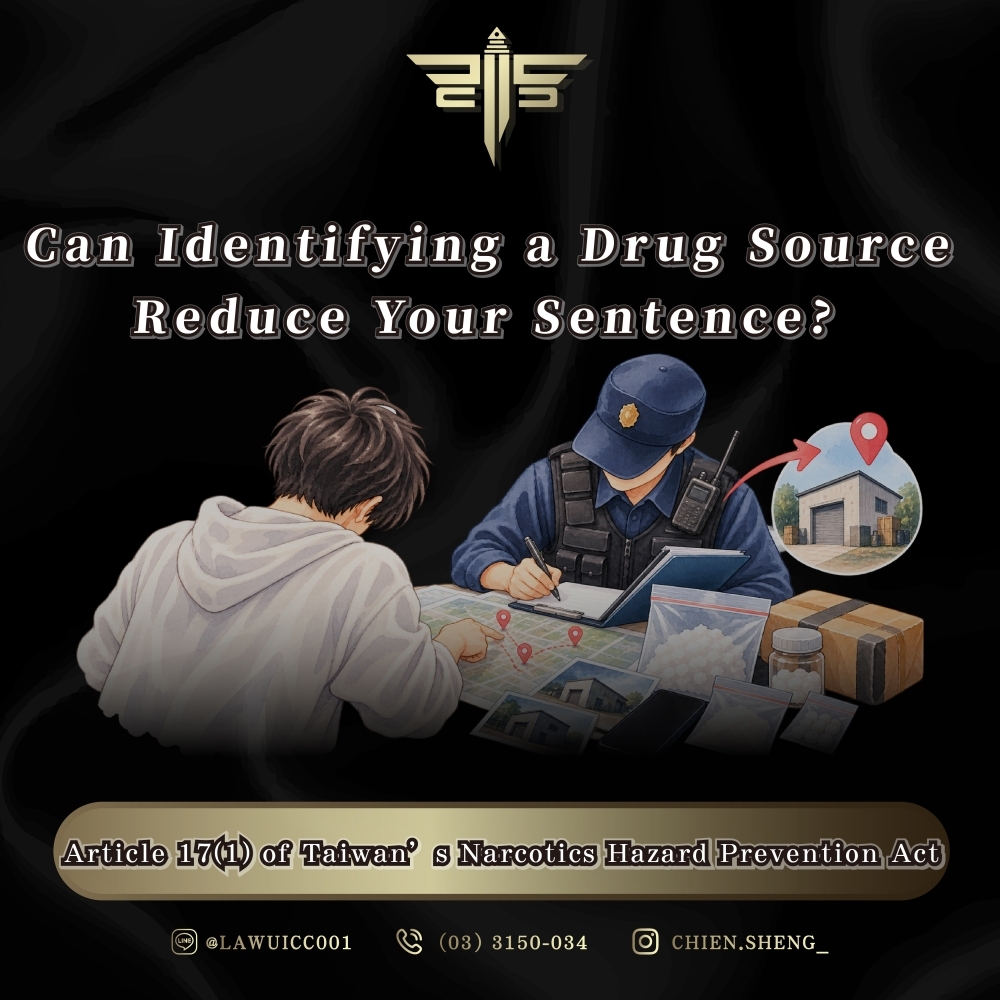
Can Identifying a Drug Source Reduce Your Sentence? Article 17(1) of Taiwan’s Narcotics Hazard Prevention Act
商品圖像
-
商品資訊
目錄
- 1. What Does Article 17(1) Provide?
- 2. Article 17(1) and Confession-Based Reduction Under Article 17(2) Are Different
- 3. What Must Be Proven for Article 17(1) to Apply?
- 4. Does “Drug Source” Mean Only the Direct Supplier?
- 5. Why Does Identifying Another Drug Dealer Sometimes Fail to Reduce the Sentence?
- 6. How Should Information About a Drug Source Be Organized?
- 7. When Should the Drug Source Be Identified?
- 8. How Can a Defense Lawyer Establish That the Information Led to an Apprehension?
- 9. What Should You Avoid When Identifying a Drug Source?
- 10. Frequently Asked Questions
- 11. How Chien Sheng International Law Firm Can Assist
A common question in Taiwan drug cases is: “If I identify my supplier or tell investigators where the drugs came from, will my sentence automatically be reduced?”
➡︎ The answer is no.
Article 17(1) of Taiwan’s Narcotics Hazard Prevention Act provides for a possible sentence reduction or exemption when a defendant identifies the source of the drugs and this information leads to the apprehension of another principal offender or accomplice. However, simply providing a name, phone number, or expressing willingness to cooperate does not automatically satisfy the statutory requirements.
In practice, courts generally examine several key questions: Was the person identified actually connected to the drugs in the defendant’s case? Was the information specific enough to allow investigators to identify and locate that person? Did investigators act because of the defendant’s information? And did those efforts actually lead to the apprehension of another offender connected to the case?
Information about an unrelated drug dealer may still be considered as cooperation or a favorable sentencing factor, but it does not necessarily qualify for Article 17(1).
1. What Does Article 17(1) Provide?
Article 17(1) applies to specified offenses under Articles 4 through 8, 10, and 11 of the Narcotics Hazard Prevention Act. Where an offender identifies the source of the drugs and this leads to the apprehension of another principal offender or accomplice, the sentence may be reduced or punishment may be exempted.
The provision may apply to qualifying cases involving drug manufacture, transportation, sale, transfer, possession, and other specified drug offenses.
The key legal requirements are not satisfied merely because the defendant claims to have “identified the supplier.” Courts must examine the defendant’s statement, the investigative timeline, the person apprehended, and the connection between that person and the drugs involved in the defendant’s case.
The applicable version of Article 17 must also be determined according to the date of the offense because the statute has been amended over time.
2. Article 17(1) and Confession-Based Reduction Under Article 17(2) Are Different
Article 17 contains different sentence-reduction mechanisms that should not be confused.
1. Article 17(1): Identifying the Drug Source
The focus is whether the defendant provides specific information connected to the source of the drugs or another relevant offender and whether that information actually leads investigators to apprehend another principal offender or accomplice.
A complete confession to the defendant’s own offense is not itself the defining requirement of Article 17(1).
2. Article 17(2): Confession During Investigation and Trial
Article 17(2) provides a separate sentence reduction for certain offenses under Articles 4 through 8 when the defendant confesses during the investigation and throughout every stage of trial.
Confessing to drug transportation or sale does not automatically mean that the defendant has identified the drug source. Likewise, identifying a supplier does not automatically satisfy the confession requirements of Article 17(2).
A defense strategy should therefore determine whether Article 17(1), Article 17(2), or potentially both provisions are relevant.
3. What Must Be Proven for Article 17(1) to Apply?
The defendant’s offense must fall within the offenses covered by Article 17(1). The charge, date of the conduct, and applicable version of the law should therefore be confirmed first.
The person identified must have a meaningful connection to the drugs or criminal conduct involved in the defendant’s case.
“Drug source” does not mean every drug dealer the defendant knows. For example, if a defendant is prosecuted for transporting or selling a particular batch of drugs, information about a completely unrelated dealer or separate transaction may not satisfy Article 17(1).
The information must generally be concrete enough for investigators to identify and pursue the person involved.
Useful identifying information may include:
■ real name or nickname;
■ phone number;
■ messaging or social media account;
■ residence or workplace;
■ vehicle information;
■ transaction or delivery location;
■ payment records; or
■ other information linking the person to the relevant drugs.
The defendant should provide only information they actually know. Inventing names, addresses, or transaction details in an attempt to obtain a sentence reduction can seriously damage the defense.
The phrase “thereby apprehended” requires a causal connection.
Investigators must have used the defendant’s information to initiate or materially advance the investigation. If police had already identified, monitored, searched, or arrested the person before the defendant provided the information, it may be difficult to establish the required causal link.
Relevant evidence may include the timing of the defendant’s statement, search warrants, arrest records, investigative reports, surveillance records, and other case materials.
Simply identifying a person is generally not enough. Investigators must actually apprehend another principal offender or accomplice and establish the relevant connection to the drug offense.
➡︎ If the person is merely questioned, cannot be located, or is arrested only for an unrelated case, Article 17(1) may not apply.
4. Does “Drug Source” Mean Only the Direct Supplier?
Not necessarily. The analysis should not always be limited to the person who directly handed the drugs to the defendant.
Depending on the facts, another principal offender or accomplice involved in the circulation, transportation, supply, or coordination of the drugs may potentially fall within Article 17(1), provided that the required connection and causation are established.
➠ For example, in a cross-border transportation case, one person may arrange the overseas supply while another receives the package in Taiwan. If the recipient provides specific information that enables investigators to identify and apprehend the organizer for conduct connected to the same drug shipment, Article 17(1) may potentially be relevant.
The critical questions remain whether the person was connected to the defendant’s case, whether the information was sufficiently specific, and whether the information actually led to the apprehension.
5. Why Does Identifying Another Drug Dealer Sometimes Fail to Reduce the Sentence?
A defendant may provide information about another drug dealer and police may even arrest that person, yet the court may still find that Article 17(1) does not apply.
Common reasons include:
1. The Information Concerns an Unrelated Case
If the identified person was involved with different drugs, transactions, or criminal conduct unrelated to the defendant’s charged offense, the required connection may be missing.
2. The Information Is Too Vague
A nickname without additional identifying information may not be enough to allow investigators to locate the person.
3. Police Already Knew About the Person
If investigators had already identified or begun investigating the person, the defendant’s later statement may not have caused the apprehension.
4. The Person Was Arrested for an Unrelated Offense
An arrest alone does not establish that the identified person was connected to the drugs in the defendant’s case.
5. The Defendant’s Statements Are Inconsistent
Significant inconsistencies regarding identity, dates, drug type, delivery locations, or payment methods may undermine the credibility of the information and make causation difficult to establish.
6. How Should Information About a Drug Source Be Organized?
A useful approach is to reconstruct the flow of the drugs involved in each charged offense.
Relevant information may include:
■ drug type and quantity;
■ date and location of acquisition or delivery;
■ identity of the person supplying or delivering the drugs;
■ communication methods;
■ intermediaries or other participants;
■ payment or transfer records;
■ how the defendant obtained the drugs;
■ how the drugs were transported or transferred afterward; and
■ chats, financial records, location data, photographs, or other supporting evidence.
➡︎ If the defendant is charged with multiple drug transactions, each transaction should generally be analyzed separately.
Identifying the source of one batch of drugs does not necessarily establish the requirements of Article 17(1) for every other charged offense.
The defendant should preserve original records and distinguish between information personally observed, information told directly by another person, and information merely heard from third parties.
7. When Should the Drug Source Be Identified?
Article 17(1) focuses on whether the information actually leads to the apprehension of another offender. Nevertheless, timing can be extremely important in practice.
If the information is provided too late:
■ investigators may already have discovered the same person independently;
■ chats, financial records, or location data may no longer be available;
■ later statements may appear inconsistent with earlier interviews; or
■ there may be insufficient time to investigate before the trial concludes.
➡︎ If a defendant genuinely knows information about the source of the drugs, it is generally important to discuss it with defense counsel early.
“Early” does not mean guessing or accusing someone without a factual basis. The information should be truthful, specific, relevant to the case, and capable of verification.
8. How Can a Defense Lawyer Establish That the Information Led to an Apprehension?
After information has been provided, the defense should not simply state that “the defendant identified the supplier.” The subsequent investigation should be examined carefully.
A lawyer may review:
■ when the defendant first provided the information;
■ what specific information was recorded;
■ whether police already knew the person;
■ when searches, arrests, surveillance, or other investigative measures began;
■ whether the apprehended person was the person identified by the defendant; and
■ whether the discovered offense was actually connected to the defendant’s case.
Where multiple offenses are charged, the defense may also need to connect each drug source and each investigative result to the corresponding offense.
This timeline can be important in establishing the causal relationship required by Article 17(1).
9. What Should You Avoid When Identifying a Drug Source?
A defendant seeking the benefit of Article 17(1) should not:
■ fabricate a supplier, accomplice, address, phone number, or transaction;
■ coordinate statements with other suspects;
■ ask others to delete or evidence;
■ delete or edit communications;
■ present hearsay as personal knowledge; or
■ intentionally provide misleading information merely to obtain a sentence reduction.
False or manipulated information can damage credibility, interfere with the defense, and additional legal risks.
10. Frequently Asked Questions
Q1: I only know the supplier’s nickname. Can Article 17(1) still apply?
Possibly. A nickname alone may be insufficient, but additional information such as a phone number, messaging account, workplace, vehicle, delivery location, or transaction history may allow investigators to identify the person.
Q2: What if police already knew who the supplier was?
The causal connection may become difficult to establish. The defense should determine whether the defendant nevertheless provided new information that materially contributed to the investigation or apprehension.
Q3: Is an arrest alone enough to satisfy Article 17(1)?
Not necessarily. The apprehended person and the discovered criminal conduct must have the required connection to the drugs or offense involved in the defendant’s case.
Q4: What if I identify a drug dealer unrelated to my case?
That information may potentially be considered as cooperation or a favorable sentencing circumstance, but it does not automatically satisfy Article 17(1).
Q5: Can identifying an accomplice in the same drug transportation case qualify?
Potentially. The law does not necessarily limit the provision to a direct upstream supplier. However, the accomplice must be connected to the relevant drug offense, and the defendant’s information must actually lead to the apprehension.
Q6: Do I have to confess before identifying the drug source?
Article 17(1) and Article 17(2) have different requirements. Whether and how a defendant should make statements must be considered together with the overall defense strategy and the existing evidence.
Q7: Can I identify the source after indictment?
It may still be possible, but late disclosure can make it more difficult to prove that the information actually caused the apprehension. Early legal evaluation is therefore important.
11. How Chien Sheng International Law Firm Can Assist
Article 17(1) involves much more than simply telling police the name of a supplier. The defense must connect the defendant’s information to the drugs in the case, the subsequent investigation, and the actual apprehension of another principal offender or accomplice.
 Chien Sheng International Law Firm handles cases involving drug sale, transportation, manufacture, transfer, possession, and organized drug offenses.
Depending on the case, legal assistance may include:
■ reviewing police interviews, prosecutor questioning, indictments, and trial records;
■ determining whether the charged offense falls within Article 17(1);
■ reconstructing the source and movement of each batch of drugs;
■ determining whether the identified person is connected to the defendant’s case;
■ reviewing whether names, phone numbers, accounts, addresses, and transaction records are sufficiently specific;
■ comparing the timing of the defendant’s statements with searches, arrests, surveillance, and other investigative actions;
■ determining whether investigators actually apprehended another offender because of the defendant’s information;
■ asserting Article 17(1) sentence reduction or exemption where the requirements are satisfied; and
■ distinguishing Article 17(1) cooperation from the confession-based reduction under Article 17(2).
Identifying a Drug Source Does Not Automatically Reduce the Sentence
Identifying a supplier or accomplice is not enough by itself to obtain a sentence reduction under Article 17(1).
The central questions are whether the information concerns the drugs or criminal conduct in the defendant’s own case, whether it is specific and verifiable, whether investigators relied on it, and whether it actually led to the apprehension of another principal offender or accomplice.
For this reason, providing a drug source should be treated as part of an overall criminal defense strategy rather than simply “giving police a name.” The timing, content, supporting evidence, investigative response, and relationship to the charged offense should all be reviewed carefully.
※ This article is provided by Chien Sheng International Law Firm for general legal information regarding Article 17(1) of Taiwan’s Narcotics Hazard Prevention Act and the identification of drug sources.
Whether a defendant qualifies for a sentence reduction or exemption depends on the date of the offense, applicable version of the law, charged offense, statements provided, connection to the drug source, investigative results, and complete evidentiary record.
This article does not encourage false accusations, evidence destruction, collusion, or interference with an investigation, and it does not guarantee a sentence reduction, exemption from punishment, non-prosecution, acquittal, or any other specific result.
This reduces both medical risks and potential legal exposure.
Chien Sheng International Law Firm

LINE Online Legal Consultation: @lawuicc001 (Click to consult)
Welcome to call to schedule a meeting: 03-3150-034
Multiple payment methods available: Cash, Credit Card, Bank Transfer
Facebook: Chien Sheng International Law Firm
Instagram: chien.sheng_
-
商品Q&A