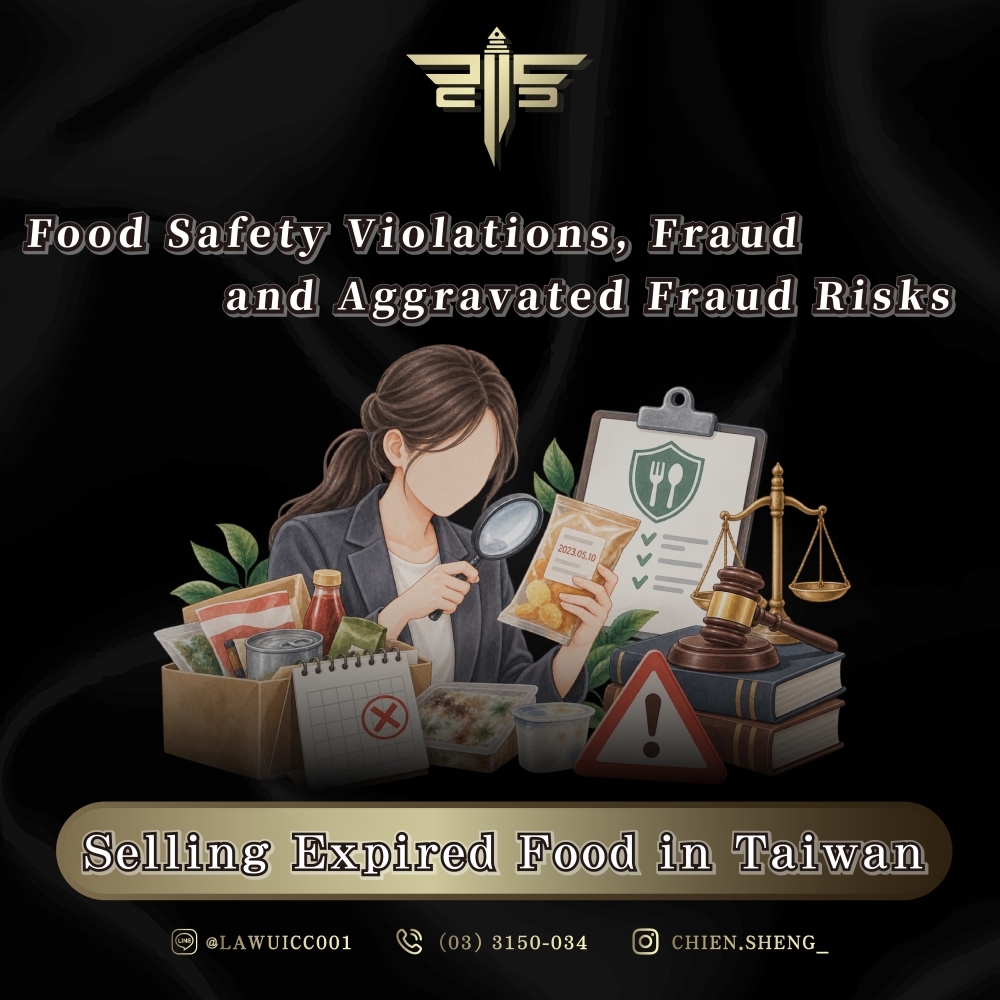
Selling Expired Food in Taiwan: Food Safety Violations, Fraud, and Aggravated Fraud Risks
商品圖像
-
商品資訊
目錄
- 1. Selling Expired Food: Article 15 of the Act Governing Food Safety and Sanitation
- 2. Administrative Fines for Violating Article 15: NT$60,000 to NT$200 Million
- 3. When Selling Expired Food May Lead to Criminal Liability Under Article 49
- 4. When Can Selling Expired Food Constitute Fraud Under Article 339 of the Criminal Code?
- 5. Multiple Participants: When Could Article 339-4 Aggravated Fraud Apply?
- 6. Altering Expiration Dates or Relabeling Products: False Commodity Labeling Under Article 255
- 7. Consumer Claims Under Article 7 of the Consumer Protection Act and Article 184 of the Civil Code
- 8. What Should a Defendant Clarify After Receiving a Summons, Facing a Health Authority Investigation, or Being Searched?
- 9. What Should Consumers Do After Discovering They Purchased Expired Food?
- 10. Defending an Expired Food Case Involves More Than Whether the Product Was Expired
- 11. How Chien Sheng International Law Firm Can Assist in Expired Food Cases
For food businesses, restaurants, e-commerce sellers, group-buying organizers, and food company executives, one of the most serious situations is discovering that expired products remained on store shelves, in warehouses, on shipping records, or were actually delivered to consumers.
Many people initially assume that selling expired food is simply a matter of accepting a return, issuing a refund, or paying an administrative fine imposed by the local health authority. In practice, however, the legal consequences may be considerably more complex.
Selling expired food may involve more than administrative penalties under Taiwan’s Act Governing Food Safety and Sanitation. If the evidence indicates that a person knowingly continued selling expired products, replaced or altered labels, concealed expiration dates, repackaged products, or sold expired products as ordinary merchandise—and particularly where multiple individuals divided responsibilities and sold the products through online marketplaces, social media, group-buying channels, or livestreams—investigators may also examine possible fraud, aggravated fraud involving three or more participants, fraud committed through public dissemination over the internet or other media, and false commodity labeling.
Chien Sheng International Law Firm emphasizes that whether an expired food case constitutes an administrative violation, a criminal food-safety offense, or fraud cannot be determined solely by the fact that the product was expired.
The analysis must consider the specific circumstances, including whether the person knew the product was expired, whether information was concealed, whether consumers were deceived, whether the conduct created a risk to human health, whether multiple individuals participated in a coordinated scheme, and whether the method of sale involved widespread public dissemination.
1. Selling Expired Food: Article 15 of the Act Governing Food Safety and Sanitation
The most directly applicable provision governing the sale of expired food is Article 15, Paragraph 1, Subparagraph 8 of the Act Governing Food Safety and Sanitation.
Article 15, Paragraph 1 prohibits the manufacture, processing, preparation, packaging, transportation, storage, sale, import, export, distribution as gifts, or public display of foods or food additives under specified circumstances.
Subparagraph 8 expressly covers products that are past their expiration date.
Accordingly, once a food product has passed its expiration date, a business generally may not continue selling or shipping it to consumers, nor may it distribute the product as a gift or publicly display it.
When health authorities discover expired food during an inspection, common enforcement measures may include ordering the products removed from sale, sealed, recalled, or otherwise appropriately handled, as well as requiring the business to explain the products’ purchase and distribution history and imposing administrative penalties where applicable.
Some businesses mistakenly believe that labeling a product as “near-expiration,” “clearance,” or “discounted” allows it to remain on sale.
The critical distinction is whether the product has actually passed its expiration date.
A product approaching its expiration date may still be sold in accordance with applicable labeling and food-safety requirements. Once the expiration date has passed, however, selling the product at a discounted price does not, by itself, eliminate potential liability under Article 15, Paragraph 1, Subparagraph 8.
For businesses, administrative liability is often the first legal issue to arise.
The competent authority does not necessarily need to establish fraudulent intent before taking administrative action. If expired food remains stored for prohibited purposes, displayed, shipped, or sold in violation of the Act, administrative liability may arise independently of whether criminal fraud can be proven.
2. Administrative Fines for Violating Article 15: NT$60,000 to NT$200 Million
Where expired food is found being sold or displayed, the first level of liability will often involve administrative penalties.
Under Article 44 of the Act Governing Food Safety and Sanitation, violations of Article 15, Paragraph 1 may result in an administrative fine ranging from NT$60,000 to NT$200 million.
In serious cases, the competent authority may also order the business to suspend or cease operations for a specified period or take other measures authorized by law, including measures affecting relevant business or food-business registrations.
Selling expired food is therefore not merely a matter of receiving a warning.Even if no consumer becomes ill, a violation of Article 15, Paragraph 1, Subparagraph 8 may still result in administrative penalties.
Factors relevant to the severity of the penalty may include the quantity of affected products, duration of the violation, amount of sales, repeated violations, cooperation with recalls or disposal, harm to consumers, and the size and circumstances of the business.
After receiving an administrative disposition from a health authority, a business should review more than just the amount of the fine.
Relevant questions may include:
■ Were the products identified by the authority actually expired?
■ Was the quantity calculated correctly?
■ Were products already removed from sale and awaiting return or disposal mistakenly treated as products still being offered for sale?
■ Does the amount of the penalty comply with the applicable legal standards, including the principle of proportionality?
These issues may affect whether the business should provide additional explanations or pursue an administrative appeal or administrative litigation.
3. When Selling Expired Food May Lead to Criminal Liability Under Article 49
A common question is:
“Can selling food that is merely expired really become a criminal case?”
The answer is that it may, depending on the specific circumstances.
Article 49, Paragraph 1 of the Act Governing Food Safety and Sanitation primarily imposes criminal liability for certain more serious violations specified by the Act, including conduct involving toxic or harmful substances, adulterated or counterfeit food, and other specified food-safety violations.
Simply being past the expiration date falls under Article 15, Paragraph 1, Subparagraph 8 and is not, by itself, one of the provisions directly enumerated in Article 49, Paragraph 1.
However, this does not mean that conduct involving expired food can never result in criminal liability.
Article 49 contains additional criminal provisions addressing serious violations that a sufficient risk of harm to human health, as well as more severe consequences where actual harm, serious injury, or death occurs.
Accordingly, whether an expired food case escalates from an administrative violation into a criminal food-safety case may depend on factors such as:
■ how long the food had been expired;
■ the type of food involved;
■ storage conditions;
■ susceptibility to spoilage;
■ whether consumers became ill;
■ whether the business sold expired products on a large scale or over an extended period;
■ whether expiration labels were deliberately altered or concealed; and
■ whether the conduct created a legally significant risk to human health.
For example, if a convenience store or small retailer inadvertently fails to remove a small number of recently expired products because of an internal management error, and there is no evidence of harm to human health, the matter may primarily involve administrative penalties and corrective measures.
By contrast, if a business purchases large quantities of expired food, repackages or relabels the products, and repeatedly sells them to the public—and particularly if consumers become ill—the matter may attract criminal investigation under food-safety laws in addition to other possible offenses.
4. When Can Selling Expired Food Constitute Fraud Under Article 339 of the Criminal Code?
In addition to food-safety laws, one of the most significant criminal risks associated with knowingly selling expired food is fraud under Article 339 of Taiwan’s Criminal Code.
Article 339 generally applies where a person, with the intent to obtain unlawful property benefits for themselves or another person, uses deception to cause another person to act under a mistaken belief and surrender property.
The key issue in fraud is not simply whether there was something wrong with the product.
The central question is whether the seller used deception that caused the consumer to misunderstand a material fact and, as a result, pay money or otherwise transfer property.
In other words, if consumers believe they are purchasing food with a valid expiration date that is suitable for ordinary sale, while the seller knows the product has expired and intentionally conceals that fact or presents it as a normal product, prosecutors may examine whether the conduct constitutes fraud.
Circumstances that may raise fraud concerns include:
■ knowingly continuing to sell food after its expiration date;
■ repackaging expired food and selling it as ordinary merchandise;
■ removing, covering, or altering the expiration date;
■ advertising the product online as fresh stock or as having a valid expiration date;
■ knowingly selling products that are no longer legally eligible for sale while concealing that fact; or
■ deliberately providing false information when consumers ask about the expiration date.
By contrast, where the incident resulted from an internal management failure—such as an employee failing to conduct required expiration-date inspections, a warehouse system causing an incorrect shipment, or a store failing to follow its removal procedures—food-safety, civil, or administrative liability may still arise.
However, criminal fraud does not automatically follow.
This distinction is often central to the defense.
The question is whether the evidence proves merely negligent management or whether it establishes that the defendant knew the products were expired and intentionally used deceptive means to induce consumers to pay for them.
Article 339 still requires proof of the statutory elements of fraud, including the requisite unlawful intent, deception, mistake, disposition of property, and causal relationship. The mere fact that a product was expired does not automatically establish fraud.
5. Multiple Participants: When Could Article 339-4 Aggravated Fraud Apply?
Food companies, e-commerce businesses, group-buying operations, and retail stores often involve multiple employees or participants.
One person may handle purchasing, another warehousing, another labeling, another online listings, another customer service, another shipping, and another payment processing.
When expired food is allegedly sold through such an operation, investigators may examine whether the conduct involved coordinated participation by multiple individuals.
Article 339-4 of the Criminal Code provides enhanced penalties for fraud committed under specified aggravating circumstances.
Potentially relevant circumstances include fraud committed jointly by three or more persons and certain forms of fraud committed through the public dissemination of information using the internet, electronic communications, or other media.
If, for example, one person handles purchasing, another alters labels or packaging, another lists the products for sale, and another handles customer payments—and prosecutors believe that at least three participants knew the products were expired or falsely labeled and intentionally participated in deceiving consumers—the authorities may investigate the case as aggravated fraud committed jointly by three or more persons.
Likewise, if the products are marketed to members of the public through livestreams, online marketplaces, social media, or digital advertising, investigators may examine whether the statutory requirements concerning fraud committed through public dissemination over the internet or other media are satisfied.
However, using an online platform does not automatically transform an expired-food case into aggravated fraud.
The underlying elements of fraud must first be established.
The fact that a company employs three or more people does not automatically mean that three or more persons jointly committed fraud.
The prosecution must still establish the required criminal intent and participation of the relevant individuals.
It cannot simply infer that every employee or manager was an accomplice because the company was large or because several people participated in ordinary business operations.
Similarly, selling products through an e-commerce website, livestream, or social media does not automatically establish aggravated fraud.
The prosecution must first prove the underlying fraud, including deception, consumer mistake, unlawful intent, and the relevant causal relationship.
This distinction is particularly important for defendants because escalation from an administrative violation or ordinary fraud allegation to aggravated fraud can substantially change the seriousness of the criminal case, potential sentencing exposure, detention considerations, investigative intensity, and settlement pressure.
6. Altering Expiration Dates or Relabeling Products: False Commodity Labeling Under Article 255
In an expired food case, simply failing to remove a product from sale is legally different from deliberately altering the product’s labeling.
If a business owner or employee replaces labels, changes expiration dates, covers the original expiration information, or uses false labels concerning the product’s quality or shelf life, investigators may also consider Article 255 of the Criminal Code, which addresses false commodity labeling.
Article 255 imposes criminal liability, under specified conditions, on a person who intends to deceive others by making false markings or other representations concerning the origin or quality of goods.
Liability may also extend to certain persons who knowingly sell, display for sale, or import goods bearing such false representations.
Expiration dates and shelf-life information are closely connected to product quality, safety, and consumers’ purchasing decisions.
Accordingly, where a business places a new, unexpired date on an expired product or uses new packaging to conceal the original expiration information, investigators may examine whether the conduct falls within the scope of Article 255.
➡︎ False commodity labeling and fraud focus on different aspects of the conduct.
➡︎ Fraud focuses on whether deception caused a victim to act under a mistaken belief and transfer property.
➡︎ False commodity labeling focuses more directly on false representations concerning the goods and the defendant’s intent to deceive.
Evidence such as relabeling equipment, records showing expiration dates were changed, testimony from employees who applied new labels, packaging materials, or large quantities of relabeled products may significantly affect the criminal investigation.
Food businesses that discover labeling errors, packaging irregularities, or inconsistencies in inventory records should therefore stop sales and conduct an internal review rather than attempting to clear the inventory or privately the labels.
Once a criminal investigation begins, such conduct may be interpreted as evidence that the business knew of the problem and nevertheless continued selling the products.
7. Consumer Claims Under Article 7 of the Consumer Protection Act and Article 184 of the Civil Code
In addition to administrative and criminal liability, selling expired food may lead to civil claims.
Consumers may seek refunds, medical expenses, lost income, compensation for non-pecuniary harm, and other remedies available under applicable law.
Under Article 7 of Taiwan’s Consumer Protection Act, businesses engaged in the design, production, or manufacture of goods or the provision of services must ensure that products entering the market meet the level of safety reasonably expected according to the scientific or professional standards existing at the time.
Where goods or services may endanger consumers’ lives, bodies, health, or property, appropriate warnings and emergency-response information may also be required.
Where a violation of these obligations causes damage to a consumer or third party, civil liability may arise in accordance with the Act.
Article 184 of the Civil Code also provides a general basis for tort liability where a person intentionally or negligently unlawfully infringes the rights of another.
Liability may also arise from violations of laws designed to protect others, subject to the requirements and defenses provided by law.
Accordingly, if a consumer experiences gastrointestinal illness, food poisoning, medical expenses, lost wages, or other health-related harm after consuming expired food, the consumer may seek compensation where the legal requirements for causation and damages are established.
Where affected products were sold on a large scale, the business may face claims from multiple consumers, consumer dispute mediation, or potentially collective consumer litigation, depending on the circumstances.
The business may simultaneously face regulatory inspections, criminal investigation, consumer claims, media scrutiny, and reputational harm.
Businesses often respond to an incident by apologizing, issuing refunds, or entering into settlements.
Those measures are not necessarily inappropriate. However, the wording of an apology or settlement document should be carefully considered.
An unnecessarily broad admission could potentially be cited by complainants or investigators as evidence that the business knowingly sold expired products or intentionally deceived consumers.
For this reason, civil settlement strategy and criminal defense strategy should be evaluated together rather than handled solely as a public-relations or customer-service issue.
8. What Should a Defendant Clarify After Receiving a Summons, Facing a Health Authority Investigation, or Being Searched?
If a person or business is already under investigation by a health authority, has received a summons from the police or prosecutors, or has had a company office, warehouse, or store searched, it is important not to assume responsibility for everything before the relevant records and legal risks have been properly reviewed.
1. Determine the Product Source and Expiration-Date Records
Relevant materials may include:
■ purchase dates;
■ batch numbers;
■ supplier information;
■ expiration-date labels;
■ warehouse records;
■ temperature-control records; and
■ shipping records.
These materials can help determine whether the products were actually expired, how long they had been expired, and whether the issue involved a single batch or reflected a broader systemic problem.
2. Clarify Internal Roles and Responsibility
It is important to determine whether:
■ the person in charge instructed employees to continue selling the products;
■ a supervisor knew about the issue but allowed sales to continue;
■ an individual employee made an isolated mistake; or
■ the problem resulted from a warehouse or store-management failure.
These distinctions may significantly affect whether the evidence supports intentional conduct, joint principal liability, or aggravated fraud involving three or more persons.
3. Determine Whether There Was Any Deceptive Conduct
Investigators may pay particular attention to whether anyone:
■ changed expiration dates;
■ replaced labels;
■ concealed expiration information;
■ deleted online product information;
■ altered customer-service communications; or
■ instructed employees not to disclose the product’s condition to consumers.
If such evidence is absent, the defense may have stronger grounds to argue that the case concerns a management failure, administrative violation, or civil consumer dispute rather than intentional criminal fraud.
4. Preserve Evidence of Corrective Measures
Relevant measures may include:
■ voluntarily removing products from sale;
■ conducting a recall;
■ notifying consumers;
■ issuing refunds;
■ arranging product testing;
■ cooperating with the competent authorities;
■ improving inventory-management systems;
■ providing employee training; and
■ establishing more effective expiration-date inspection procedures.
These measures do not necessarily eliminate liability, but they may be relevant to administrative penalties, prosecutorial decisions, sentencing, and settlement negotiations.
9. What Should Consumers Do After Discovering They Purchased Expired Food?
Consumers who discover that they purchased expired food should avoid immediately discarding the product or relying solely on online complaints.
Instead, they should preserve evidence, including:
■ photographs of the product;
■ expiration-date labels;
■ receipts or purchase records;
■ screenshots of the seller’s webpage or livestream; and
■ the product and its original packaging.
If the consumer has already eaten the product and experiences physical symptoms, they should seek medical attention promptly and inform the medical provider about the product consumed, when it was consumed, and the symptoms experienced.
This can help contemporaneous medical records relevant to any subsequent claim.
Depending on the circumstances, consumers may request a refund or compensation from the seller or file a complaint with the local health authority or consumer protection authorities.
If there is evidence suggesting that a business deliberately altered expiration dates, concealed information, repeatedly sold large quantities of expired products, or operated through a coordinated fraudulent scheme, the consumer may also consider reporting the matter to law enforcement.
Whether the conduct ultimately constitutes fraud, false commodity labeling, or a criminal food-safety offense will depend on the available evidence and the statutory requirements of each offense.
Where a consumer has suffered actual health consequences, Chien Sheng International Law Firm recommends prioritizing the preservation of evidence and documentation of the resulting damages rather than focusing solely on obtaining an apology.
The quality and completeness of the evidence may significantly affect the ability to establish causation, damages, and other elements of a subsequent civil claim.
10. Defending an Expired Food Case Involves More Than Whether the Product Was Expired
One of the most common misunderstandings among defendants in expired food cases is the assumption that if the product was in fact expired, there is nothing left to defend.
In reality, whether the product was expired is only the starting point.
The nature and severity of potential liability depend on a series of additional questions:
■ Did the defendant know that the food was expired?
■ Did the defendant intentionally continue selling it?
■ Were labels altered or information concealed?
■ Did consumers purchase the products because of false or misleading information?
■ Did multiple individuals knowingly coordinate and divide responsibilities?
■ Were the products marketed broadly through the internet?
■ Did the food actually cause harm to consumers’ health?
■ Did the business promptly remove and recall the products?
■ Were affected consumers compensated or settlements reached?
The answers to these questions may determine whether the matter remains an administrative enforcement case, develops into an ordinary criminal case, or is investigated as aggravated fraud.
Accordingly, an effective defense should not be limited to admitting an error and requesting leniency.
If investigators are examining possible fraud, aggravated fraud involving three or more persons, or criminal food-safety violations, the defense should review the case records, interview statements, internal procedures, product distribution history, consumer communications, and regulatory records to identify the actual disputed issues as early as possible.
11. How Chien Sheng International Law Firm Can Assist in Expired Food Cases
Expired food cases may simultaneously involve administrative investigations, criminal investigations, consumer claims, media attention, and disputes over responsibility within a company.
For defendants and businesses, identifying the correct strategy at an early stage is particularly important.
Inaccurate statements during questioning, incomplete documentation, poorly drafted settlement language, or an incorrect allocation of internal responsibility may unnecessarily increase the seriousness of the case.
Chien Sheng International Law Firm can assist food businesses, company executives, store managers, e-commerce sellers, group-buying organizers, employees, and consumers with matters including:
■ legal risk assessments involving expired food;
■ legal representation during investigative questioning;
■ preparation for police or prosecutorial interviews;
■ review and analysis of case records and evidence;
■ submissions and explanations to competent administrative authorities;
■ administrative appeals and related proceedings;
■ criminal defense; and
■ civil settlement negotiations.
If you or your company is facing allegations involving the sale of expired food, a health authority inspection, a police or prosecutorial summons, a consumer fraud complaint, or an investigation for aggravated fraud involving three or more participants, obtaining legal advice at an early stage may help clarify the scope of the dispute and preserve relevant evidence.
The earlier the facts, internal procedures, product records, and communications are reviewed, the better positioned the parties will be to distinguish between administrative noncompliance, negligent management, intentional deception, and other potential criminal conduct.
 Chien Sheng International Law Firm can assist in evaluating the evidence and developing an appropriate strategy for the administrative, criminal, and civil aspects of the case while protecting the client’s legal and procedural rights.
Chien Sheng International Law Firm

LINE Online Legal Consultation: @lawuicc001 (Click to consult)
Welcome to call to schedule a meeting: 03-3150-034
Multiple payment methods available: Cash, Credit Card, Bank Transfer
Facebook: Chien Sheng International Law Firm
Instagram: chien.sheng_
-
商品Q&A