Is Undercover Drug Enforcement Entrapment in Taiwan? Police Sting Operations, Attempted Drug Trafficking, and Criminal Defense Strategies | Chien Sheng International Law Firm
商品圖像
-
商品資訊
Table of contents
- 1. Undercover Operations vs. Unlawful Entrapment
- 2. Reconstructing the Investigation Timeline
- 3. Identifying the Actual Participants
- 4. Completed and Attempted Drug Trafficking
- 5. Building an Evidence-Based Entrapment Defense
- 6. Legal Assistance During Investigation Bureau Questioning
- 7. Frequently Asked Questions
- 8. Conclusion: Undercover Drug Investigations Require Careful Legal Analysis
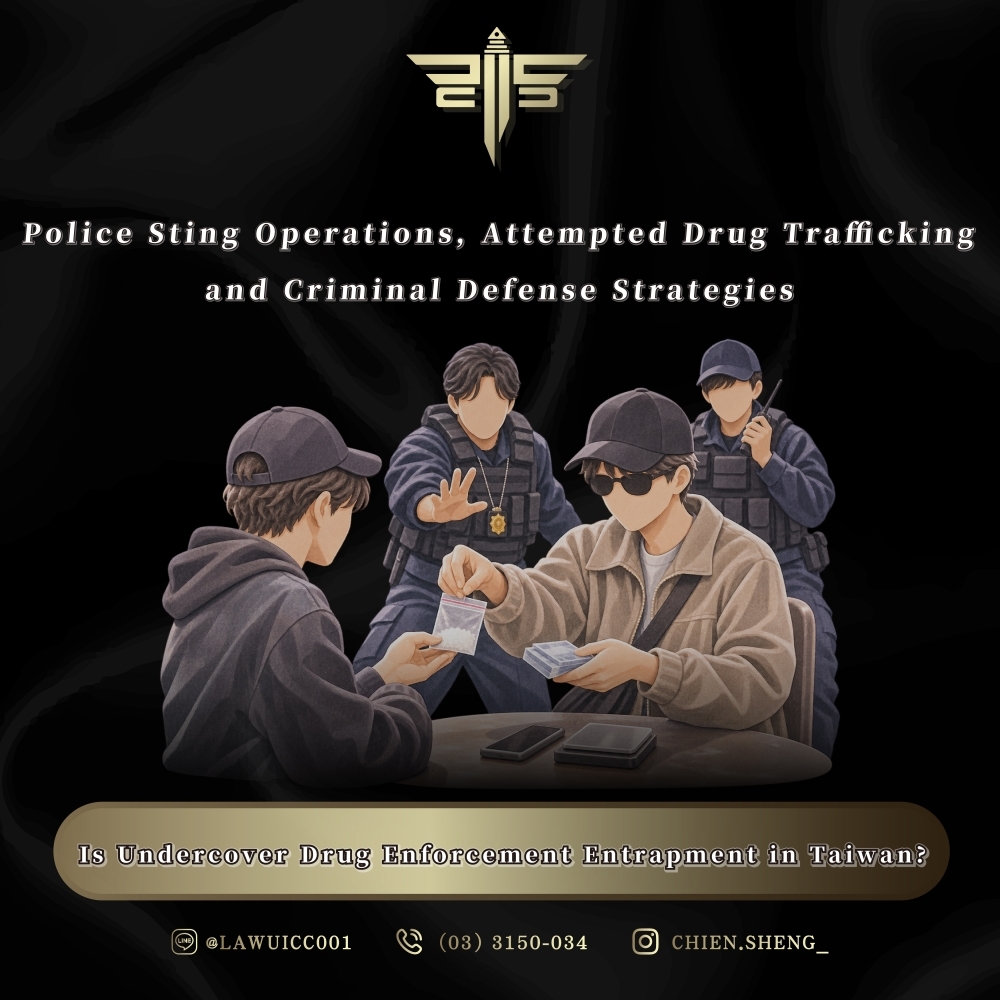
When police officers pose as drug buyers, does the investigation constitute unlawful entrapment?
For criminal defense lawyers handling drug trafficking cases in Taiwan, the answer depends on more than whether an undercover officer initiated contact or repeatedly requested a transaction.
The key questions are whether the defendant already intended to commit the offense, whether law enforcement created that criminal intent, and how far the alleged drug transaction progressed.
Chien Sheng International Law Firm (謙聖國際法律事務所) handles drug-related criminal cases involving undercover investigations, searches and seizures, questioning by the Investigation Bureau, detention proceedings, and criminal trials.
※ This article provides a practical framework for distinguishing lawful undercover operations from improper inducement and analyzing completed versus attempted drug trafficking.
1. Undercover Operations vs. Unlawful Entrapment
1. Two Types of Undercover Investigations
Taiwanese judicial practice distinguishes between two general investigative situations.
The first involves criminal intent induced by law enforcement, commonly referred to as entrapment or improper inducement.
This occurs where a person did not originally intend to commit the crime but developed that intention because of the actions of investigating officers.
The second involves providing an opportunity to commit an offense that the person already intended to commit.
In this situation, undercover officers may pose as buyers to expose an existing criminal plan or activity.
➡︎ Taiwan High Court practice materials discussing Supreme Court Judgment No. 3253 of 2012 (101 Tai-Shang 3253) address this distinction.
2. Does Police Initiation Make the Investigation Illegal?
Not necessarily.
An undercover officer contacting a suspected dealer first does not automatically establish unlawful entrapment.
Likewise, the use of an undercover buyer does not automatically make every investigative method lawful.
➡︎ The analysis must examine the suspect's conduct before police involvement, the nature of the officers' communications, and whether the investigation merely revealed existing criminal intent or improperly created it.
➡︎ The legality of the investigation, admissibility of evidence, and elements of the alleged offense should be evaluated separately.
2. Reconstructing the Investigation Timeline
1. What Happened Before Police Contact?
The first task is to identify when law enforcement or an informant initially contacted the defendant.
Defense counsel should then investigate whether the defendant had previously advertised drugs for sale, contacted potential buyers, negotiated prices, prepared drugs for distribution, or arranged other transactions.
These circumstances may help determine whether an intention to sell already existed.
2. What Did the Undercover Officer Actually Do?
The complete communication history should be examined.
Did the officer simply ask about availability and price? Or did the officer repeatedly pressure the defendant, increase the proposed payment, request larger quantities, or continue encouraging the transaction after a refusal?
The difference between offering an opportunity and creating criminal intent may depend on the complete sequence of communications.
Selected screenshots or isolated messages may not accurately reflect how the alleged offense developed.
3. Preserve the Original Evidence
Relevant materials may include LINE conversations, social media posts, call records, payment information, audio recordings, surveillance footage, and police investigation records.
➡︎ A chronological reconstruction should identify which evidence supports an existing criminal intention and which evidence may suggest inducement.
Missing records should be identified early so that counsel can assess whether further evidence collection is necessary.
3. Identifying the Actual Participants
1, The Person at the Scene May Not Be the Account Holder
Drug investigations frequently involve multiple individuals.
The person who meets an undercover buyer may differ from the owner of the messaging account, the alleged supplier, the person providing transportation, or someone whose name appears in the communications.
Being mentioned in a conversation does not automatically establish participation in drug trafficking.
At the same time, a person who was not physically present may still face criminal liability if other evidence establishes knowing participation.
2. Evaluate Each Defendant Separately
Chien Sheng International Law Firm has publicly discussed a drug-infused coffee packet case involving an undercover buyer and an investigation extending beyond the individual present at the transaction.
Important questions included who controlled the relevant account, how the accused individuals were connected, whether there was evidence of drug delivery, and whether statements by other participants were supported by objective records.
➡︎ For each defendant, counsel should identify the alleged conduct, supporting evidence, and whether that evidence establishes criminal participation or merely ordinary personal contact.
4. Completed and Attempted Drug Trafficking
1. Purchasing Drugs With Intent to Resell Is Not Automatically Completed Trafficking
Judicial Yuan Interpretation No. 792 clarifies that a completed drug-selling offense under Article 4 of Taiwan's Narcotics Hazard Prevention Act requires completion of the act of selling.
Purchasing drugs with an intention to profit does not, by itself, establish completed drug trafficking.
The legal analysis must distinguish between preparing to sell, beginning the sale, and completing the transaction.
2. Possession With Intent to Sell
Article 5 of the Narcotics Hazard Prevention Act addresses possession of controlled drugs with intent to sell.
Where an individual acquires drugs for resale but has not yet begun carrying out a sale, this provision may become relevant.
However, the appropriate charge depends on the defendant's actual conduct and the applicable legal requirements.
3. Attempted Drug Trafficking
Where a defendant has begun executing a drug sale but the transaction has not been completed, the conduct may constitute attempted trafficking.
Article 4 of the Narcotics Hazard Prevention Act expressly provides for punishment of attempted offenses.
The distinction between an attempt and a completed offense cannot be determined solely by whether the defendant received payment or was arrested at the meeting location.
The agreed transaction, delivery of the drugs, payment arrangements, and actual conduct must be examined together.
4. Completed Drug Trafficking
A completed trafficking offense requires proof that the relevant selling conduct was completed.
Defense counsel should examine whether a genuine sale occurred, whether the drugs were delivered, and whether the available evidence establishes the required elements.
➡︎ If the defendant initially possessed drugs for another purpose and only later decided to sell them, the timing of that decision and the commencement of the selling conduct may also affect the legal analysis.
5. Building an Evidence-Based Entrapment Defense
1. Establish the Origin of Criminal Intent
A persuasive entrapment argument should address four stages: the defendant's activities before police contact, the first interaction with investigators, subsequent communications, and the defendant's final conduct.
Each stage should be supported by identifiable evidence.
➡︎ For example, prior advertisements or negotiations with other buyers may support an inference that the defendant already intended to sell drugs.
Conversely, an absence of prior selling activity, repeated refusals, or unusual pressure from investigators may warrant closer examination of whether criminal intent was improperly induced.
Neither conclusion should rest solely on the defendant's description or the investigating officer's characterization.
2. Examine Other Criminal Elements Independently
Even where an entrapment argument is unsuccessful, other defense issues may remain.
These include whether the correct defendant was identified, whether the defendant knew the substance was a controlled drug, whether there was a shared criminal intention with others, and whether the alleged conduct reached the stage of attempted or completed trafficking.
The prosecution must also establish the relevant drug classification and transaction facts through evidence.
An effective defense does not rely exclusively on claiming that the defendant was "set up." It examines every element the prosecution must prove.
6. Legal Assistance During Investigation Bureau Questioning
1. The Right to Legal Representation
Individuals investigated for drug-related offenses may receive questioning notices from Taiwan's Investigation Bureau, police authorities, or prosecutors.
Under Article 245 of Taiwan's Code of Criminal Procedure, defense counsel may generally attend questioning by prosecutors, prosecutorial investigators, judicial police officers, or judicial police, take notes, and express opinions, subject to statutory exceptions.
The applicable procedures and any restrictions must be assessed according to the circumstances.
2. How Can a Criminal Defense Lawyer Help?
A lawyer may assist the defendant in understanding the allegations, organizing the factual timeline, identifying relevant evidence, and preparing for questioning.
Legal assistance may also extend to reviewing search warrants, seizure inventories, interview records, digital evidence, detention applications, and subsequent criminal proceedings.
➡︎ If a search or seizure occurs, the defendant should preserve relevant official documents and original electronic records.
Do not delete or communications, and do not privately coordinate statements with witnesses or other suspects.Such conduct may additional legal risks.
7. Frequently Asked Questions
Q1: Is it illegal for Taiwanese police to pose as drug buyers?
Not automatically. Undercover investigations may be lawful where officers provide an opportunity to expose existing criminal activity. Improperly inducing a person to develop criminal intent raises different legal concerns.
Q2: Is it entrapment if an undercover officer contacts me first?
Not necessarily. The investigation must consider whether criminal intent existed before police involvement and what actions the officer took.
Q3: Can repeated requests from an undercover buyer constitute unlawful inducement?
They may be relevant, particularly where the suspect previously refused or lacked an existing intention to sell. The complete circumstances must be examined.
Q4: Is buying drugs for resale considered completed trafficking?
Not automatically. Judicial Yuan Interpretation No. 792 distinguishes purchasing drugs with intent to profit from completing the act of selling.
Q5: Can attempted drug trafficking be punished in Taiwan?
Yes. Article 4 of the Narcotics Hazard Prevention Act provides for punishment of attempted drug trafficking offenses.
Q6: Does an arrest before payment mean the offense was only attempted?
Not necessarily. Payment alone does not determine whether the offense was completed. The actual selling conduct and applicable legal requirements must be examined.
Q7: Can someone be charged if they did not personally meet the undercover buyer?
Potentially. Criminal liability depends on the person's knowledge, conduct, and participation, not solely on physical presence.
Q8: Can a lawyer accompany someone questioned by Taiwan's Investigation Bureau?
Generally, defense counsel may attend questioning under Article 245 of the Code of Criminal Procedure, subject to statutory exceptions.
8. Conclusion: Undercover Drug Investigations Require Careful Legal Analysis
When police officers pose as drug buyers, the legality of the investigation depends on the origin of criminal intent and the methods used by law enforcement.
At the same time, the distinction between possession with intent to sell, attempted trafficking, and completed trafficking requires a separate examination of the defendant's conduct.
These questions should not be combined into a single argument.
 Chien Sheng International Law Firm handles drug-related criminal cases involving trafficking, transportation, manufacturing, transfer, possession, and use, as well as investigations conducted by police and the Investigation Bureau.
The firm also shares practical criminal defense analysis with lawyers beginning to handle drug-related cases.Individuals facing investigation should preserve original evidence and obtain legal advice based on the complete case record.
※ This article provides general legal information about Taiwan's drug laws and criminal procedure. It does not replace individualized legal advice or guarantee any particular investigation, prosecution, or court outcome.
This reduces both medical risks and potential legal exposure.
Chien Sheng International Law Firm

LINE Online Legal Consultation: @lawuicc001 (Click to consult)
Welcome to call to schedule a meeting: 03-3150-034
Multiple payment methods available: Cash, Credit Card, Bank Transfer
Facebook: Chien Sheng International Law Firm
Instagram: chien.sheng_
-
商品Q&A


