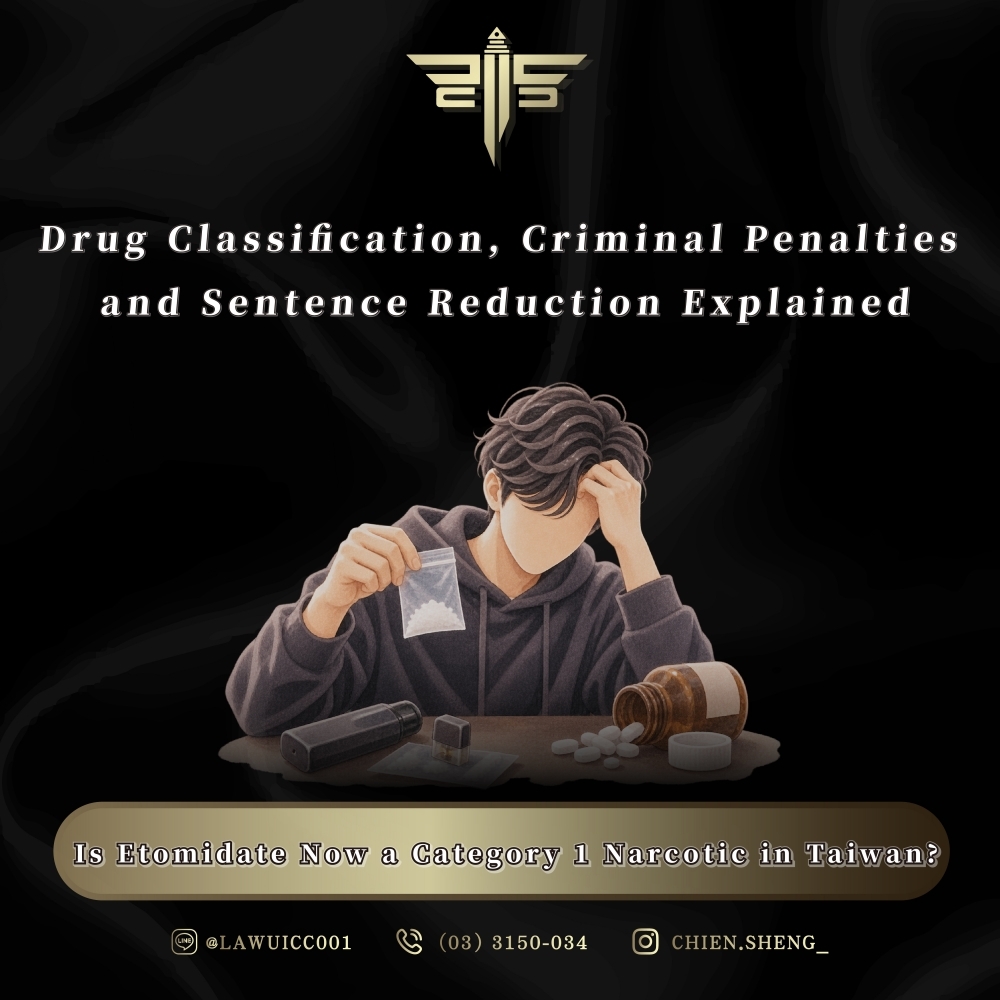
Is Etomidate Now a Category 1 Narcotic in Taiwan? Drug Classification, Criminal Penalties, and Sentence Reduction Explained | Chien Sheng International Law Firm
商品圖像
-
商品資訊
Table of contents
- 1. What Are Category 1 Narcotics in Taiwan?
- 2. Criminal Penalties for Category 1 Drug Offenses
- 3. Sentence Reduction Under Article 17 of the Narcotics Hazard Prevention Act
- 4. Sentence Reduction Under Article 59 of Taiwan's Criminal Code
- 5. Constitutional Court Judgment 112-Hsien-Pan-13
- 6. Defense Strategies for Category 1 Drug Cases
- 7. Frequently Asked Questions About Etomidate and Category 1 Narcotics in Taiwan
- 8. Conclusion: Etomidate Reclassification Makes Drug Identification and Offense Timing Essential
Etomidate, commonly associated with "zombie vape cartridges" or "zombie vapes" in Taiwan, is sometimes mistaken for an ordinary ingredient in electronic cigarettes. However, its legal classification has changed significantly.
According to an Executive Yuan announcement, etomidate and eight related substances were reclassified as Category 1 narcotics effective June 27, 2026.
Individuals involved in possessing, using, transferring, transporting, manufacturing, or selling these substances may face different criminal penalties depending on their conduct.
➡︎ The date of the alleged offense is particularly important because it may determine which drug classification and criminal penalties apply.
This article explains Category 1 narcotics in Taiwan, the legal consequences of etomidate reclassification, and potential sentence reductions under Article 17 of the Narcotics Hazard Prevention Act, Article 59 of the Criminal Code, and Constitutional Court Judgment 112-Hsien-Pan-13.
1. What Are Category 1 Narcotics in Taiwan?
1. Common Category 1 Controlled Substances
Article 2 of Taiwan's Narcotics Hazard Prevention Act identifies Category 1 narcotics, including heroin, morphine, opium, cocaine, and related substances.
Drug classifications may be amended through legally prescribed procedures. Therefore, relying only on traditional drug names may not accurately reflect the current legal classification of a substance.
2. Etomidate and Eight Related Substances Reclassified in 2026
Effective June 27, 2026, Taiwan's Executive Yuan reclassified nine substances as Category 1 narcotics:
■ Etomidate
■ Metomidate
■ Propoxate
■ Butomidate
■ Trifluoroetomidate
■ Fluorometomidate
■ Carboetomidate
■ Methoxycarbonyl-carboetomidate
■ Allyletomidate
The official announcement also covers specified isomers or related chemical forms.
In criminal investigations, the product's appearance or street name is not sufficient to establish its legal classification. The actual chemical composition, laboratory findings, and date of the alleged conduct must be examined.
➡︎ If the conduct occurred before June 27, 2026, or continued across the effective date, the applicable classification may require analysis under Article 2 of Taiwan's Criminal Code concerning changes in criminal law.
The date of police discovery alone does not necessarily determine which drug classification applies.
2. Criminal Penalties for Category 1 Drug Offenses
1. Manufacturing, Transporting, or Selling Category 1 Narcotics
Under Article 4 of the Narcotics Hazard Prevention Act, manufacturing, transporting, or selling Category 1 narcotics carries a statutory penalty of death or life imprisonment.
Where life imprisonment is imposed, an additional fine of up to NT$30 million may apply.These are among the most severe penalties under Taiwan's drug laws.
However, not every offense involving Category 1 narcotics carries the same punishment.
2. Possession, Use, Transfer, and Intent to Sell
The statutory penalties differ according to the conduct involved.
■ Possession with intent to sell: Life imprisonment or imprisonment for at least ten years, with a possible additional fine of up to NT$7 million.
■ Unlawful transfer: Imprisonment for one to seven years, with a possible additional fine of up to NT$1 million.
■ Drug use: Imprisonment for six months to five years.
■ Simple possession: Imprisonment for up to three years, short-term detention, or a fine of up to NT$300,000.
■ Possession of at least ten grams of pure net weight: Imprisonment for one to seven years, with a possible additional fine of up to NT$1 million.
These distinctions demonstrate why the precise criminal charge matters.A person accused of possessing etomidate should not automatically be treated as someone accused of trafficking Category 1 narcotics.
➡︎ The legal assessment must consider the drug identification, quantity, actual conduct, criminal intent, and available evidence.
3. Sentence Reduction Under Article 17 of the Narcotics Hazard Prevention Act
1. Article 17(1): Identifying Drug Sources and Other Offenders
Article 17, Paragraph 1 provides for possible sentence reduction or exemption where a defendant identifies the source of the drugs and the information leads authorities to discover other principal offenders or accomplices, subject to the statutory requirements.
Merely naming another person is not necessarily sufficient.
➡︎ The information must be concrete, relevant to the offense, and causally connected to the authorities' discovery of the other offenders.
Information concerning an unrelated drug case does not automatically satisfy the requirements.
2. Article 17(2): Confession During Investigation and Trial
Article 17, Paragraph 2 provides for sentence reduction for offenses under Articles 4 through 8 where the defendant confesses during the investigation and throughout the relevant trial proceedings.
➡︎ The statutory requirement concerns the substance and timing of the confession.A defendant's statements must be assessed to determine whether they constitute an admission of the relevant criminal facts.
Simply saying "I plead guilty" may not resolve every legal question concerning the confession requirement.
3. Article 17(3): Transporting Drugs for Personal Use
Article 17, Paragraph 3 provides for possible sentence reduction where a defendant commits a drug transportation offense under Article 4 for personal use and the circumstances are minor.
This is a specific provision concerning transportation for personal consumption.It does not automatically apply to individuals transporting drugs for payment or delivering drugs on behalf of others.
4. Sentence Reduction Under Article 59 of Taiwan's Criminal Code
Article 59 of Taiwan's Criminal Code permits a court to reduce a sentence where the circumstances of the offense are clearly deserving of sympathy and even the statutory minimum punishment would be excessively severe.
This provision is discretionary.
Being a first-time offender, possessing a small quantity, or receiving no profit does not automatically guarantee a reduction.Courts may consider the defendant's motivation, degree of participation, drug quantity, number of transactions, financial benefit, actual harm, and other relevant circumstances.
➡︎ The central question is whether the particular offense warrants a punishment below the ordinary statutory minimum.
5. Constitutional Court Judgment 112-Hsien-Pan-13
1. Why the Constitutional Court Addressed Category 1 Drug Trafficking
Taiwan Constitutional Court Judgment 112-Hsien-Pan-13 examined the severe statutory punishment for selling Category 1 narcotics under Article 4, Paragraph 1 of the Narcotics Hazard Prevention Act.
➡︎ The Court addressed circumstances in which the offense is exceptionally minor based on factors such as the method of sale, quantity of drugs, and transaction value, with no other criminal conduct involved.
In such exceptional cases, the punishment may remain disproportionately severe even after a reduction under Article 59 of the Criminal Code.
2. When May an Additional Sentence Reduction Apply?
Before the relevant legislative amendments are completed, the judgment permits courts handling qualifying exceptionally minor Category 1 drug trafficking cases to apply Article 59 and make an additional reduction in accordance with the constitutional judgment, potentially reducing the sentence by a further one-half.
However, this constitutional ruling does not provide an automatic additional reduction for every Category 1 drug offense.
It specifically addresses exceptionally minor cases of selling Category 1 narcotics where the ordinary statutory punishment remains disproportionate even after Article 59 is applied.
➡︎ Manufacturing or transporting Category 1 narcotics does not automatically fall within the ruling's scope.Whether a defendant qualifies must be established through the specific evidence and circumstances of the case.
6. Defense Strategies for Category 1 Drug Cases
1. Confirm the Substance and Applicable Date
When handling an etomidate or other Category 1 narcotics case, the first step is to review laboratory identification results and determine whether the substance falls within the legally controlled category.
➡︎ The date and duration of the alleged conduct must also be established.
Where the offense occurred around a drug reclassification date, the applicable law may require further examination under the Criminal Code's rules governing changes in criminal legislation.
2. Distinguish the Defendant's Actual Conduct
Manufacturing, transporting, selling, possessing with intent to sell, transferring, using, and simply possessing drugs involve different legal elements and penalties.
➡︎ The defense should therefore examine the defendant's actual role, knowledge, conduct, and relationship to the substances.
➡︎ The initial charge should not replace an independent review of the evidence.
3. Evaluate Possible Sentence Reductions
Where Article 17 may apply, legal counsel should examine whether information about drug sources satisfies the statutory requirements and whether any confession meets the relevant procedural conditions.
➡︎ For alleged Category 1 drug trafficking, the defense may also consider the quantity, number of transactions, payment, degree of participation, and overall circumstances when evaluating Article 59 and Constitutional Court Judgment 112-Hsien-Pan-13.
Each reduction mechanism has different legal requirements and should be analyzed separately.
7. Frequently Asked Questions About Etomidate and Category 1 Narcotics in Taiwan
Q1: Is etomidate a Category 1 narcotic in Taiwan?
Yes. According to the Executive Yuan announcement, etomidate and eight related substances were reclassified as Category 1 narcotics effective June 27, 2026.
Q2: What drugs are classified as Category 1 narcotics in Taiwan?
Common examples include heroin, morphine, opium, cocaine, and certain related substances. The category also includes the newly reclassified etomidate-related substances covered by the official announcement.
Q3: Does possessing etomidate automatically result in life imprisonment?
No. Penalties depend on the offense. Simple possession, possession with intent to sell, unlawful transfer, transportation, and trafficking are treated differently.
Q4: What if the alleged etomidate offense occurred before June 27, 2026?
The applicable drug classification and penalties may require examination of the conduct date and Article 2 of Taiwan's Criminal Code concerning changes in criminal law.
Q5: Can a defendant receive a reduced sentence in a Category 1 drug case?
Potentially. Article 17 of the Narcotics Hazard Prevention Act, Article 59 of the Criminal Code, and Constitutional Court Judgment 112-Hsien-Pan-13 may be relevant depending on the offense and statutory conditions.
Q6: Does confessing automatically reduce the sentence?
No. The defendant must satisfy the applicable statutory requirements, including the relevant conditions concerning confession during investigation and trial.
Q7: Does Constitutional Court Judgment 112-Hsien-Pan-13 apply to all Category 1 drug cases?
No. The judgment concerns specific exceptionally minor Category 1 drug trafficking cases where the punishment remains disproportionate even after the ordinary statutory reduction.
8. Conclusion: Etomidate Reclassification Makes Drug Identification and Offense Timing Essential
Etomidate and eight related substances were reclassified as Category 1 narcotics in Taiwan effective June 27, 2026.
This change may significantly affect criminal liability, particularly where the alleged conduct involves transportation, manufacturing, or trafficking.
However, Category 1 classification does not mean that every related offense carries the same sentence.
The applicable punishment depends on the specific conduct, drug quantity, laboratory findings, criminal intent, and date of the offense.
Potential sentence reductions under Article 17, Article 59, and Constitutional Court Judgment 112-Hsien-Pan-13 also require separate legal analysis.
 Chien Sheng International Law Firm focuses on criminal defense and assists clients facing investigations involving etomidate, heroin, morphine, cocaine, and other controlled substances.
Legal counsel may review drug identification reports, offense dates, the defendant's actual role, and possible sentence reduction provisions during investigation and trial.
※ This article provides general legal information about Taiwan's narcotics laws and does not replace individualized legal advice. Criminal liability and sentencing depend on the applicable law, laboratory findings, conduct, timing, and evidence in each case.
This reduces both medical risks and potential legal exposure.
Chien Sheng International Law Firm

LINE Online Legal Consultation: @lawuicc001 (Click to consult)
Welcome to call to schedule a meeting: 03-3150-034
Multiple payment methods available: Cash, Credit Card, Bank Transfer
Facebook: Chien Sheng International Law Firm
Instagram: chien.sheng_
-
商品Q&A


