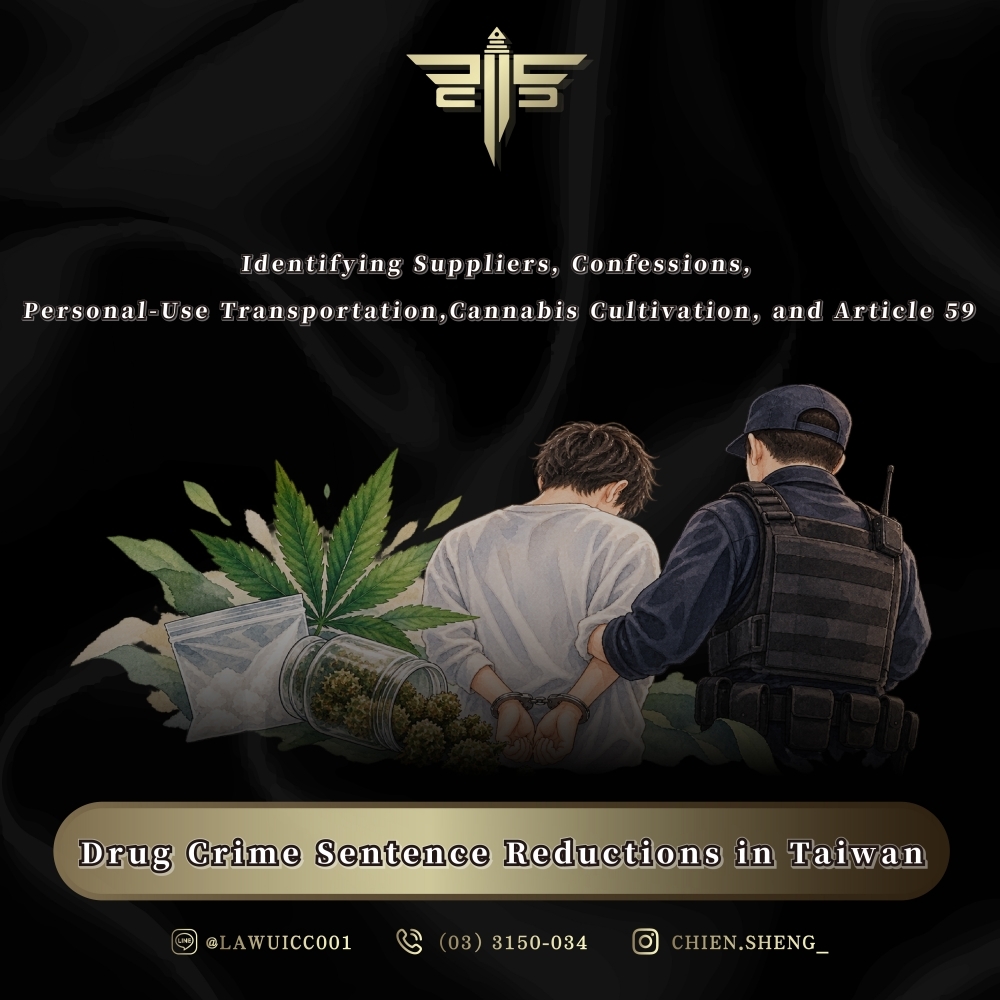
Drug Crime Sentence Reductions in Taiwan: Identifying Suppliers, Confessions, Personal-Use Transportation, Cannabis Cultivation, and Article 59
商品圖像
-
商品資訊
目錄
- 1. Understanding Acquittal, Sentence Reduction, and Treatment Alternatives
- 2. Why Are Sentence Reduction Provisions Important in Taiwan Drug Cases?
- 3. Article 17 of the Narcotics Hazard Prevention Act: Three Major Reduction Provisions
- 4. Cannabis Cultivation for Personal Use: Article 12(3)
- 5. Article 59 of the Criminal Code: Discretionary Reduction for Excessively Harsh Punishment
- 6. Constitutional Court Judgment No. 13 of 2023: Exceptional Reduction for Minor Category 1 Drug Sales
- 7. Other Sentence Reduction Provisions in Drug Cases
- 8. Drug Use Cases: Treatment May Be More Important Than Sentence Reduction
- 9. Common Mistakes When Seeking Drug Crime Sentence Reductions
- 10. Frequently Asked Questions
Drug offenses in Taiwan can carry severe criminal penalties, particularly for manufacturing, transporting, or selling controlled substances. Some offenses involving Category 1 narcotics may result in life imprisonment or even the death penalty.
However, Taiwanese law provides several mechanisms that may reduce criminal sentences, exempt defendants from punishment, or allow certain drug users to enter treatment programs instead of proceeding directly to criminal sentencing.
These mechanisms include Article 17 of the Narcotics Hazard Prevention Act, special provisions for personal-use cannabis cultivation, Article 59 of the Criminal Code, and relevant Constitutional Court judgments.
Sentence reduction does not mean acquittal, and it does not automatically guarantee probation, a suspended sentence, or conversion of imprisonment into a fine.
The appropriate legal strategy depends on the offense, drug classification, quantity, defendant's role, available evidence, and stage of criminal proceedings.
1. Understanding Acquittal, Sentence Reduction, and Treatment Alternatives
Drug cases may lead to three fundamentally different legal outcomes.
1. Acquittal or Non-Establishment of Criminal Liability
An acquittal may be appropriate when prosecutors cannot prove the charged offense.
➡︎ For example, the evidence may fail to establish an intent to sell drugs, the defendant's involvement in manufacturing, or the necessary knowledge for aiding another person's criminal activity.
This is not sentence reduction. It means the charged crime has not been proven.
2. Sentence Reduction or Exemption from Punishment
Where a criminal offense has been established, the court may apply statutory provisions that require or permit a reduced sentence.
Examples include identifying a drug supplier under Article 17, making qualifying confessions, voluntary surrender, aiding rather than directly committing an offense, or seeking discretionary mitigation under Article 59 of the Criminal Code.
Some provisions may even permit exemption from punishment.
3. Treatment and Diversion Programs
For certain Category 1 and Category 2 drug-use offenses, Taiwanese law provides observation and rehabilitation, compulsory treatment, and deferred prosecution subject to addiction treatment.
These measures are not conventional sentence reductions, but they may significantly change the outcome of a case.
2. Why Are Sentence Reduction Provisions Important in Taiwan Drug Cases?
Article 4 of Taiwan's Narcotics Hazard Prevention Act establishes severe penalties for manufacturing, transporting, and selling narcotics.
■ Category 1 narcotics: Death penalty or life imprisonment.
■ Category 2 narcotics: Life imprisonment or at least 10 years' imprisonment.
■ Category 3 narcotics: At least 7 years' imprisonment.
■ Category 4 narcotics: Imprisonment ranging from 5 to 12 years.
Additional fines may also apply.
These statutory penalties cover offenses involving widely different factual circumstances.
A large-scale international trafficking operation and a small, isolated drug transaction may fall under the same basic statutory provision, even though their seriousness differs considerably.
This makes it essential to examine whether the defendant's conduct has been correctly classified and whether statutory or discretionary sentence reductions are available.
3. Article 17 of the Narcotics Hazard Prevention Act: Three Major Reduction Provisions
1. Article 17(1): Identifying Drug Suppliers or Accomplices
Article 17(1) provides for sentence reduction or exemption from punishment when a defendant convicted of an eligible offense identifies the source of the drugs, resulting in the discovery of other principal offenders or accomplices.
This provision applies to offenses specified in Articles 4 through 8, 10, and 11.
However, merely naming an alleged supplier does not automatically qualify a defendant for sentence reduction.
The information must relate to the source of the drugs involved in the defendant's case, and the disclosure must lead to the actual identification or discovery of other offenders through investigation.
There must be a meaningful causal connection between the information provided and the investigative result.
Reporting unrelated drug offenses or providing unverified names generally does not satisfy these requirements.
Because identifying a supplier may affect the defendant's own legal position and additional risks, the decision should be evaluated with defense counsel before statements are made.
2. Article 17(2): Confession During Investigation and Every Trial Stage
Article 17(2) provides a mandatory sentence reduction for defendants convicted of eligible offenses under Articles 4 through 8 who confess during the investigation and throughout the required trial proceedings.
The eligible offenses include manufacturing, transportation, sale, possession with intent to sell, certain offenses involving administering drugs to others, and transfer of narcotics.
Ordinary drug use, simple possession, and cannabis cultivation are generally outside this provision.
A qualifying confession must acknowledge the relevant criminal facts.
➡︎ For example, admitting possession or personal drug use does not necessarily amount to confessing to drug trafficking or manufacturing.
The statutory requirement concerning confessions during investigation and successive trial stages is particularly important.
A defendant who later denies essential criminal facts may lose eligibility for the reduction.
Whether to confess must be considered alongside any available defense disputing the offense itself. A defendant should not admit an offense solely to seek mitigation without understanding the evidence and legal consequences.
3. Article 17(3): Transporting Drugs Solely for Personal Use
Article 17(3) permits discretionary sentence reduction where a defendant transports drugs solely for personal consumption and the circumstances are minor.
Transportation may constitute a separate offense even when the defendant claims the drugs were intended for personal use.
The court may consider the quantity, route, transportation method, communications, and whether the evidence suggests distribution or commercial activity.
Unlike Article 17(2), this provision is discretionary.
Even where personal use is established, the court must separately determine whether the circumstances justify mitigation.
4. Cannabis Cultivation for Personal Use: Article 12(3)
Cannabis cultivation is governed by Article 12 of the Narcotics Hazard Prevention Act rather than the confession-based reduction under Article 17(2).
Under Article 12(3), a person who cultivates cannabis for personal use under minor circumstances may be subject to a lower statutory sentencing range of one to seven years' imprisonment, with a possible additional fine.
This is a special sentencing provision, not simply an additional reduction applied to the ordinary cultivation penalty.
The court must examine whether the cultivation was genuinely intended for personal use and whether the circumstances were sufficiently minor.
Relevant factors may include the number of plants, cultivation equipment, harvested material, communications, and evidence of potential distribution.
Judicial Yuan Interpretation No. 790 addressed the constitutional concerns associated with excessively severe penalties for minor cannabis cultivation cases.
However, personal-use cultivation does not automatically qualify for the lower range.
➡︎ If the conduct also involves processing cannabis into a usable drug product, separate manufacturing allegations may arise depending on the facts.
5. Article 59 of the Criminal Code: Discretionary Reduction for Excessively Harsh Punishment
Article 59 of Taiwan's Criminal Code permits a court to reduce a sentence where the circumstances of the offense are clearly deserving of sympathy and even the statutory minimum penalty would be excessively severe.
This provision is particularly important in serious drug cases with high mandatory minimum sentences.
However, being a first-time offender, expressing remorse, or cooperating with investigators does not automatically justify Article 59 mitigation.
Courts may consider the defendant's subordinate role, limited quantity, low financial benefit, lack of organized criminal involvement, personal circumstances, and genuine remorse.
These factors must be assessed together.
Article 59 may also be considered alongside other applicable sentence reduction provisions, provided its independent requirements are satisfied.
The defense must explain why the minimum punishment would be disproportionate in the particular case rather than merely requesting leniency.
6. Constitutional Court Judgment No. 13 of 2023: Exceptional Reduction for Minor Category 1 Drug Sales
On August 11, 2023, Taiwan's Constitutional Court issued Judgment No. 13 of 2023, addressing the proportionality of punishment for selling Category 1 narcotics.
The Court recognized that certain exceptionally minor drug-sale offenses may be subject to disproportionately severe punishment when the statutory penalty is death or life imprisonment.
The judgment concerns cases involving exceptionally minor circumstances, where the conduct is clearly deserving of sympathy and punishment remains excessively harsh even after applying Article 59 of the Criminal Code.
Under the transitional relief described in the judgment, qualifying courts may apply an additional sentence reduction of up to one-half beyond Article 59, subject to the judgment's conditions and the governing legal framework.
Who May Qualify?
Relevant circumstances may include a very small quantity of drugs, limited financial consideration, a minor role, and the absence of other criminal conduct.
However, this constitutional ruling is not a general sentence reduction for every Category 1 drug offense.
It specifically concerns the sale of Category 1 narcotics under the circumstances addressed by the Constitutional Court.
Manufacturing and transportation offenses cannot automatically be treated as falling within the same ruling.
The applicability of any transitional relief must also be checked against subsequent legislative developments and the law governing the particular case.
7. Other Sentence Reduction Provisions in Drug Cases
1. Voluntary Surrender — Criminal Code Article 62
A defendant who voluntarily reports an offense before it has been discovered and submits to prosecution may qualify for discretionary sentence reduction.
Voluntary surrender is different from confessing after the authorities have already discovered the offense.
2. Aiding an Offense — Criminal Code Article 30
A person who merely assists another offender may be legally classified as an aider rather than a principal offender.
Where the requirements are met, the punishment may be reduced relative to that imposed on the principal offender.
In drug cases, distinguishing aiding from joint commission may significantly affect sentencing.
3. Attempted Offenses and Voluntary Abandonment
Certain attempted drug offenses are punishable, but the Criminal Code may permit a reduction compared with a completed offense.
Where a defendant voluntarily abandons an attempted offense or prevents its completion, additional rules may apply.
The distinction between preparation, attempt, and completion depends on the statutory offense and the actual conduct.
4. Defendants Under 18 or Aged 80 and Above
Under Article 63 of the Criminal Code, defendants under 18 or aged 80 and above cannot receive the death penalty or life imprisonment.
Where those penalties are prescribed, the sentence must be reduced in accordance with the applicable provisions.
5. Multiple Sentence Reductions
More than one reduction provision may apply to the same case.
However, each provision has separate requirements, and the applicable calculation rules must be followed.
The defense should assess all available reductions together rather than assume that one reduction automatically leads to another.
8. Drug Use Cases: Treatment May Be More Important Than Sentence Reduction
For individuals accused of using Category 1 or Category 2 narcotics, the legal strategy may focus on treatment and diversion rather than conventional sentencing mitigation.
Taiwanese law provides several mechanisms, including observation and rehabilitation, compulsory treatment, voluntary medical treatment, and deferred prosecution subject to addiction treatment.
1. Observation and Rehabilitation
For qualifying drug-use offenses, prosecutors may seek a court order for observation and rehabilitation.
Where the assessment finds no continuing tendency to use drugs, release and a non-prosecution disposition may follow.
Where continued drug use is indicated, compulsory treatment may be ordered under the applicable statutory conditions.
The treatment and prosecution framework also depends on the defendant's prior history and the relevant three-year rules.
2. Voluntary Treatment Before Discovery
Under the applicable legal conditions, a person who voluntarily seeks treatment at a designated medical institution before the offense is discovered may receive special procedural protection.
The statutory requirements and limitations, including restrictions on repeated use of this mechanism, must be examined carefully.
3. Deferred Prosecution with Addiction Treatment
Prosecutors may also consider deferred prosecution requiring completion of addiction treatment where the legal requirements are satisfied.
This can provide an alternative to immediate criminal prosecution, although failure to comply may have legal consequences.
These mechanisms are not ordinary sentence reductions, but they may prevent a qualifying drug-use case from proceeding directly to a criminal conviction.
9. Common Mistakes When Seeking Drug Crime Sentence Reductions
Several misunderstandings can undermine a drug defense.
Mistake 1: Naming a supplier always guarantees mitigation.
Article 17(1) requires a qualifying connection between the information provided and the actual discovery of other offenders.
Mistake 2: Admitting drug use qualifies as a confession to trafficking.
A confession must address the criminal facts relevant to the eligible charged offense.
Mistake 3: Transporting drugs for personal use can only be possession.
Transportation may remain a separate offense. Article 17(3) must be considered independently.
Mistake 4: Personal-use cannabis cultivation qualifies for Article 17 confession mitigation.
The relevant special provision is generally Article 12(3), subject to its requirements.
Mistake 5: Every Category 1 drug case qualifies for the Constitutional Court's additional reduction.
Judgment No. 13 of 2023 has a specific scope and demanding factual conditions.
Mistake 6: A reduced sentence guarantees a suspended sentence.
Suspended sentences have separate statutory eligibility requirements, including the sentence imposed and the defendant's criminal history.
How Can a Criminal Defense Lawyer Help?
A defense lawyer should review the charged offense, drug classification, quantity, laboratory findings, communications, financial transactions, and the defendant's actual role.
Counsel may then evaluate whether the evidence supports a lesser offense, whether a statutory reduction applies, and whether Article 59 or relevant constitutional principles provide additional grounds for mitigation.
In cases involving potential supplier identification or confession, legal advice is particularly important because statements made during an investigation may affect both the defense and eligibility for sentence reductions.
 Chien Sheng International Law Firm provides legal representation in drug cases involving manufacturing, transportation, sale, possession, drug use, and cannabis cultivation.
The firm's defense work includes reviewing potential applications of Article 17, personal-use provisions, Article 59, and relevant constitutional rulings.
10. Frequently Asked Questions
Q1: Does identifying a drug supplier automatically reduce my sentence?
No. Article 17(1) requires the statutory conditions to be satisfied, including a qualifying connection between the disclosed source and the discovery of other offenders.
Q2: Can I receive a sentence reduction by confessing after arrest?
Potentially. Article 17(2) applies to specified offenses and requires a qualifying confession during investigation and the required trial proceedings.
Q3: Can transporting drugs for personal use qualify for mitigation?
Yes, where Article 17(3) applies and the court finds that the transportation was solely for personal use and involved minor circumstances.
Q4: Can personal-use cannabis cultivation receive a reduced sentence?
Article 12(3) provides a lower sentencing range for qualifying minor personal-use cultivation cases. It is different from Article 17 confession mitigation.
Q5: Can Article 59 and Article 17 apply together?
Potentially. Each provision must independently satisfy its legal requirements, and the applicable sentence calculation rules must be followed.
Q6: Can minor Category 1 drug sales receive additional constitutional mitigation?
In qualifying cases, Constitutional Court Judgment No. 13 of 2023 may provide a basis for additional mitigation, subject to its scope and the governing legal framework.
Q7: Should someone accused of drug use seek treatment rather than sentence reduction?
For eligible drug-use offenses, observation and rehabilitation or deferred prosecution with addiction treatment may be more relevant than conventional sentence reduction.
Conclusion: Drug Crime Sentence Reduction Requires an Individualized Legal Strategy
Taiwanese drug laws provide multiple mechanisms that may reduce punishment or change the course of criminal proceedings.
■ Article 17 addresses identifying drug sources, qualifying confessions, and minor transportation for personal use.
■ Article 12(3) provides special treatment for minor personal-use cannabis cultivation.
■ Article 59 allows discretionary mitigation where the statutory minimum would be excessively harsh.
Other provisions concerning voluntary surrender, aiding offenses, attempted crimes, and relevant Constitutional Court judgments may also affect sentencing.
For drug-use offenses, treatment and diversion programs may offer a different legal path.
The key is not simply to find a sentence reduction provision, but to determine which provisions actually apply to the defendant's offense, evidence, and procedural circumstances.
Anyone facing a drug investigation, prosecution, or appeal should seek qualified legal assistance to evaluate the available defenses and sentencing options.
※ This article is provided for general legal information and educational purposes. The availability of sentence reductions, exemptions, and treatment alternatives depends on the applicable law, the facts of the offense, the defendant's criminal history, and the relevant judicial decisions. Statutory provisions and constitutional transitional measures should be checked against the latest effective law. This article does not guarantee any particular sentence, suspended sentence, acquittal, or treatment outcome and does not replace individualized advice from a qualified Taiwan criminal defense attorney.
This reduces both medical risks and potential legal exposure.
Chien Sheng International Law Firm

LINE Online Legal Consultation: @lawuicc001 (Click to consult)
Welcome to call to schedule a meeting: 03-3150-034
Multiple payment methods available: Cash, Credit Card, Bank Transfer
Facebook: Chien Sheng International Law Firm
Instagram: chien.sheng_
-
商品Q&A