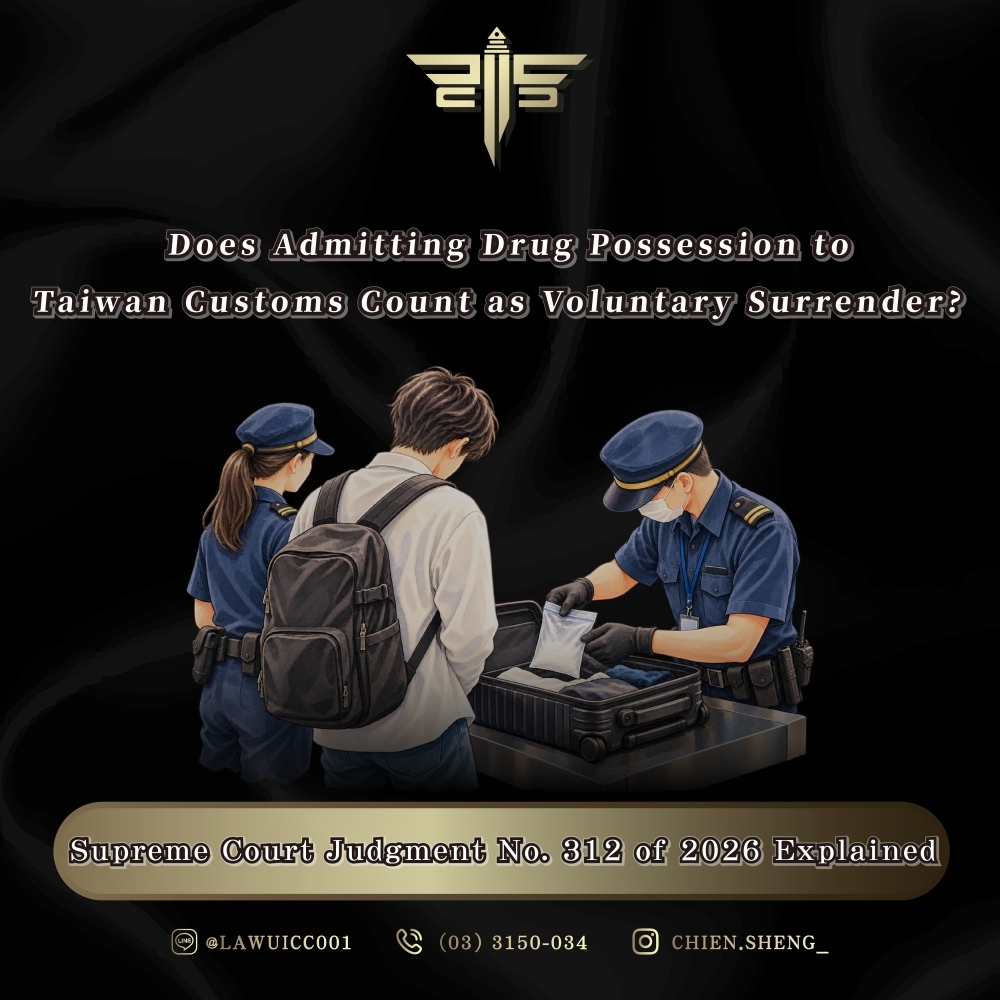
Does Admitting Drug Possession to Taiwan Customs Count as Voluntary Surrender? Supreme Court Judgment No. 312 of 2026 Explained
商品圖像
-
商品資訊
目錄
- 1. What Did the Supreme Court Decide in Judgment No. 312 of 2026?
- 2. What Is Voluntary Surrender Under Article 62 of Taiwan's Criminal Code?
- 3. Why Can an Admission to Customs Officers Potentially Qualify?
- 4. When Does an Admission During a Customs Inspection Count as Voluntary Surrender?
- 5. Does Voluntary Surrender Guarantee a Reduced Sentence?
- 6. Voluntary Surrender vs. Sentence Reductions Under Article 17 of the Narcotics Hazard Prevention Act
- 7. What Evidence Can Prove an Admission Was Made Before the Drugs Were Found?
- 8. Three Important Lessons for Drug Transportation Cases
- 9. How Can Chien Sheng International Law Firm Assist?
If drugs are discovered during a customs inspection at a Taiwanese airport, does voluntarily admitting the offense to customs officers qualify as voluntary surrender under Taiwan's Criminal Code?
This question is particularly important in drug transportation and smuggling cases, where a defendant's statements during the first few minutes of an inspection may affect the possibility of a reduced sentence.
In Supreme Court Criminal Judgment No. 115-Tai-Shang-312 (2026), dated August 24, 2026, Taiwan's Supreme Court clarified an important principle: although ordinary customs officers are not necessarily judicial police officers, admitting a customs-related criminal offense to them may still qualify as voluntary surrender under Article 62 of the Criminal Code.
However, admitting an offense to customs does not automatically establish voluntary surrender or guarantee a sentence reduction. Courts must examine when the admission occurred, what the defendant disclosed, whether the offense had already been discovered, and whether the defendant was willing to submit to judicial proceedings.
※ Important note: This judgment was not a case handled by Chien Sheng International Law Firm. This article provides an independent legal analysis of the Supreme Court's reasoning.
1. What Did the Supreme Court Decide in Judgment No. 312 of 2026?
The case involved a defendant accused of jointly transporting approximately 10 kilograms of ketamine, a Category 3 narcotic, into Taiwan.The defendant claimed that, while being taken aside for a customs inspection, he had voluntarily informed customs officers that he was carrying drugs.
The lower court rejected the voluntary surrender argument, reasoning that customs officers did not possess the legal status of criminal investigators and that the defendant had not expressly requested that they report his surrender to the investigative authorities.
The Supreme Court disagreed with this categorical approach.
Under Article 16-1 of Taiwan's Customs Anti-Smuggling Act, customs authorities must refer suspected criminal offenses discovered during anti-smuggling operations to the competent authorities.
Consequently, a voluntary admission to customs officers performing their statutory duties may have a legal effect comparable to reporting an undiscovered offense to criminal investigators.
Because the lower court had not adequately investigated the timing and circumstances of the alleged admission, the Supreme Court vacated the judgment and remanded the case to the Taiwan High Court for further proceedings.
The Supreme Court did not conclusively determine that the defendant had voluntarily surrendered or was entitled to a reduced sentence.
2. What Is Voluntary Surrender Under Article 62 of Taiwan's Criminal Code?
Article 62 of Taiwan's Criminal Code provides that a person who voluntarily surrenders for an offense before it has been discovered and submits to trial may receive a reduced sentence, unless otherwise provided by law.
Several requirements are particularly important:
■ The offense must not yet have been discovered by the competent investigative authorities.
■ The offender must voluntarily disclose the relevant criminal conduct.
■ The offender must be willing to submit to subsequent judicial proceedings.
■ The disclosure must constitute a genuine voluntary report rather than merely an acknowledgment after the offense has already been established.
Importantly, Article 62 states that the court may reduce the sentence. It does not require a sentence reduction in every qualifying case.
Therefore, establishing voluntary surrender and obtaining an actual sentencing reduction are two separate legal questions.
3. Why Can an Admission to Customs Officers Potentially Qualify?
The central issue in this judgment was not whether customs officers should be classified as judicial police officers.
Instead, the Supreme Court examined their statutory responsibilities.
Customs officers are responsible for inspecting goods, detecting smuggling, and referring suspected criminal offenses to the competent authorities. Article 16-1 of the Customs Anti-Smuggling Act specifically establishes this referral obligation.
When a traveler voluntarily discloses a customs-related criminal offense to an officer performing these duties, the information may enter the criminal justice process through the officer's legally required referral.
Accordingly, the Supreme Court held that the absence of judicial police status does not, by itself, eliminate the possibility of voluntary surrender.
This does not mean that every conversation with a customs officer qualifies. The court must still determine whether the disclosure was sufficiently specific, voluntary, timely, and connected to the officer's official duties.
4. When Does an Admission During a Customs Inspection Count as Voluntary Surrender?
Several factual questions may determine whether Article 62 applies.
1. Was the admission made before the drugs were discovered?
A traveler who voluntarily reveals concealed drugs before officers find them may have a stronger basis for arguing voluntary surrender.
However, being selected for inspection does not automatically mean that the criminal offense has already been discovered.
The court must examine what customs officers and investigative authorities actually knew before the admission.
2. Was the disclosure made during an ongoing inspection?
Even if customs officers have already escorted a traveler to an inspection area, an admission made before the drugs are discovered may still require consideration under Article 62.
This was one of the key factual disputes in Supreme Court Judgment No. 312 of 2026.
3. Was the admission specific and voluntary?
The court may consider whether the traveler clearly identified the concealed items, their location, and the relevant criminal conduct.
Vague statements or admissions made only after confronting conclusive evidence may not have the same legal significance.
4. Had investigators already discovered the offense?
Article 62 concerns offenses that have not yet been discovered by the relevant investigative authorities.
If investigators had already identified the offense through concrete evidence, a subsequent admission may not satisfy this requirement.
The precise sequence of events is therefore essential.
5. Does Voluntary Surrender Guarantee a Reduced Sentence?
➡︎ No.
A finding of voluntary surrender does not guarantee a reduced sentence.
Even if Article 62 applies, the court retains discretion over whether to reduce the punishment.
Relevant considerations may include the timing and motivation of the admission, the defendant's cooperation, the quantity of drugs, the defendant's role, and the seriousness of the offense.
Under Article 4(3) of Taiwan's Narcotics Hazard Prevention Act, manufacturing, transporting, or selling Category 3 narcotics is punishable by imprisonment of at least seven years, with a possible additional fine of up to NT$10 million.
In the present case, the alleged transportation of approximately 10 kilograms of ketamine was a serious criminal matter involving additional legal issues concerning smuggling and organized criminal activity.
Even where voluntary surrender is established, it does not automatically result in probation, a suspended sentence, or a particular prison term.
6. Voluntary Surrender vs. Sentence Reductions Under Article 17 of the Narcotics Hazard Prevention Act
Drug-related criminal cases may involve several distinct sentencing provisions.
1. Criminal Code Article 62: Voluntary Surrender
This provision focuses on whether the offender voluntarily reported an undiscovered offense and submitted to judicial proceedings.
The Supreme Court's customs ruling primarily concerns this provision.
2. Narcotics Hazard Prevention Act Article 17(1): Identifying the Drug Source
For qualifying narcotics offenses, a defendant who identifies the source of the drugs and thereby enables authorities to apprehend another principal offender or accomplice may receive a reduced sentence or exemption from punishment.
Merely admitting possession or stating that another person supplied the drugs is insufficient without satisfying the statutory requirements.
3. Narcotics Hazard Prevention Act Article 17(2): Confession During Investigation and Trial
For qualifying offenses under Articles 4 through 8, a defendant who confesses during the investigation and throughout the relevant trial proceedings may qualify for a statutory sentence reduction.
Unlike voluntary surrender, this provision does not depend on reporting the offense before its discovery. Instead, it focuses on the defendant's qualifying confessions throughout the required proceedings.
These provisions must be assessed separately. A defendant's admission to customs may raise an Article 62 issue, while later statements and cooperation may independently raise questions under Article 17.
7. What Evidence Can Prove an Admission Was Made Before the Drugs Were Found?
The outcome of a voluntary surrender argument may depend on events occurring within minutes of the customs inspection.
Important evidence may include:
■ Customs officers' body-camera footage and airport surveillance recordings.
■ Inspection, search, and seizure records.
■ Customs duty logs and inspection reports.
■ The defendant's earliest recorded statements.
■ Statements from customs officers, accompanying travelers, or other witnesses.
■ Records identifying when the drugs were discovered.
■ Documents showing when police or prosecutors became involved.
■ Official referral records from customs to investigative authorities.
In Judgment No. 312 of 2026, the Supreme Court identified unresolved factual questions concerning whether the defendant had admitted carrying ketamine before being taken into the search room and whether the available recordings covered the relevant period.
The lower court had also failed to adequately address the legal significance of customs officers' statutory duty to refer suspected crimes.These investigative deficiencies contributed to the decision to vacate and remand the judgment.
➡︎ For defendants, preserving the earliest inspection records and accurately documenting the timing of statements may be critical.
8. Three Important Lessons for Drug Transportation Cases
➡︎ First, customs officers do not need to be judicial police officers for an admission to potentially have legal significance under Article 62. Their statutory duties and the circumstances of the disclosure must be considered.
➡︎ Second, voluntary surrender and sentence reduction are separate questions. Even when the statutory requirements are satisfied, the court must still decide whether a reduction is appropriate.
➡︎ Third, early evidence preservation is essential. Body-camera footage, inspection records, seizure documents, and initial statements may establish whether the defendant disclosed the offense before it was discovered.
The Supreme Court's ruling emphasizes a fact-specific analysis rather than an automatic acceptance or rejection of voluntary surrender claims.
9. How Can Chien Sheng International Law Firm Assist?
Drug transportation cases may involve the Narcotics Hazard Prevention Act, the Criminal Code, anti-smuggling legislation, accomplice liability, and organized crime allegations.
 Chien Sheng International Law Firm can assist clients by reviewing the legality of customs inspections and searches, analyzing the timing of alleged voluntary surrender, examining surveillance and seizure records, and evaluating whether Article 62 or Article 17 may apply.
Legal representation may also involve assessing the defendant's actual role, reviewing interrogation procedures, identifying evidentiary weaknesses, and presenting appropriate sentencing arguments during investigation, trial, or appeal.
Where a person is stopped at customs in connection with suspected drugs or other controlled goods, they should not resist inspection, destroy evidence, flee, or coordinate false accounts with others. They should provide truthful information, carefully review recorded statements, and seek qualified criminal defense counsel as soon as possible.
Conclusion: Admitting Drug Possession to Customs May Have Legal Significance, but Timing Is Critical
Taiwan Supreme Court Judgment No. 115-Tai-Shang-312 (2026) establishes an important principle: an admission of a customs-related criminal offense cannot be excluded from voluntary surrender consideration solely because the recipient was a customs officer rather than a judicial police officer.
However, the judgment does not establish automatic voluntary surrender or mandatory sentence reduction.
The decisive questions remain whether the offense had already been discovered, when and how the defendant disclosed it, whether the defendant submitted to judicial proceedings, and how the court evaluates the complete evidence.
In drug transportation cases, the earliest statements and inspection records may significantly affect the available defense strategies.
※ This article is provided by Chien Sheng International Law Firm for general legal information and educational purposes. It analyzes Taiwan Supreme Court Criminal Judgment No. 115-Tai-Shang-312 (2026), a case not handled by the firm. Whether voluntary surrender, identification of a drug source, confession-based sentence reduction, or other legal provisions apply depends on the specific facts, applicable law, and available evidence. This article does not guarantee a reduced sentence or any particular legal outcome and does not replace individualized legal advice.
This reduces both medical risks and potential legal exposure.
Chien Sheng International Law Firm

LINE Online Legal Consultation: @lawuicc001 (Click to consult)
Welcome to call to schedule a meeting: 03-3150-034
Multiple payment methods available: Cash, Credit Card, Bank Transfer
Facebook: Chien Sheng International Law Firm
Instagram: chien.sheng_
-
商品Q&A