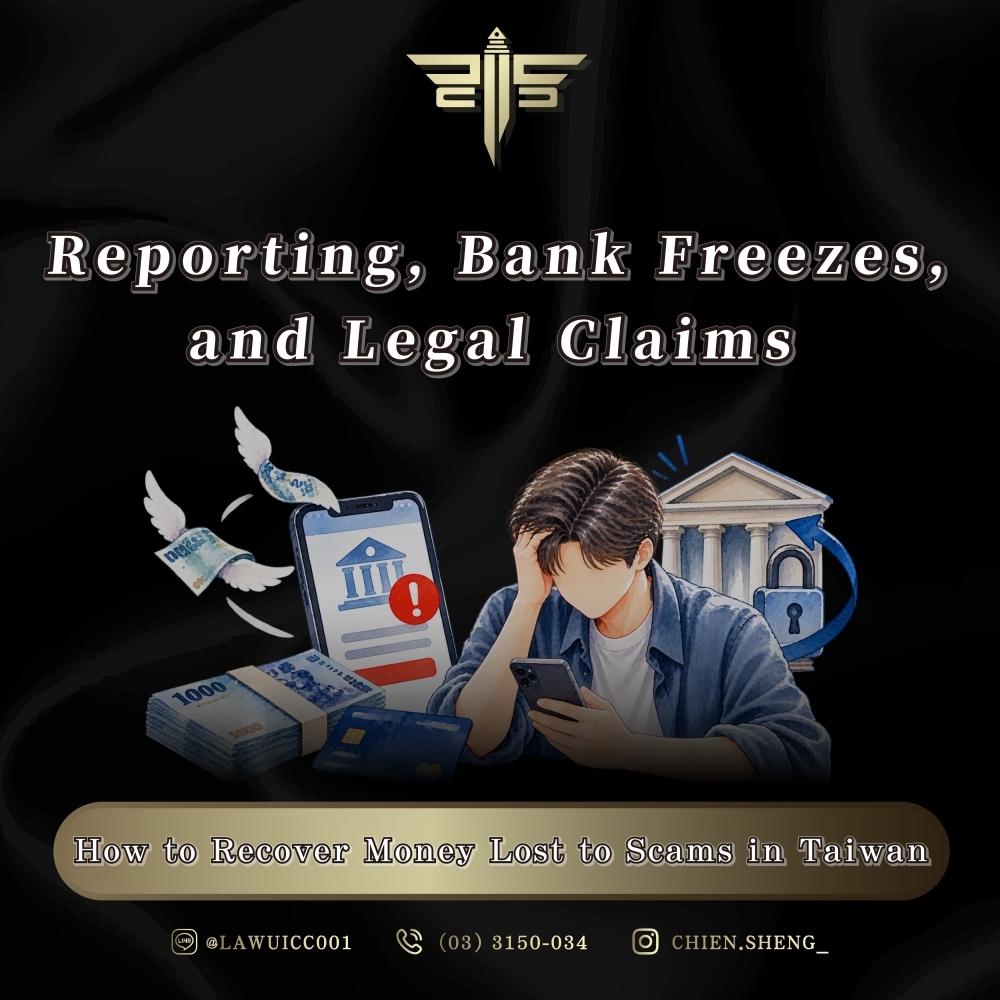
How to Recover Money Lost to Scams in Taiwan: Reporting, Bank Freezes, and Legal Claims
商品圖像
-
商品資訊
目錄
- 1. What Should You Do Immediately After Being Scammed?
- 2. What Should You Do Within the First 24 Hours?
- 3. Bank Freezes, Restricted Funds, and Warning Accounts in Taiwan
- 4. Can Victims Recover Money Remaining in a Warning Account?
- 5. Can Criminal Proceedings Help Recover Scam Money?
- 6. Civil Lawsuits and Compensation Claims After Fraud
- 7. Recovery Options Depend on the Payment Method
- 8. Does an Arrest or Frozen Account Guarantee Repayment?
- 9. Frequently Asked Questions About Recovering Scam Money
- 10. How Chien Sheng International Law Firm Can Assist Fraud Victims
- 11. Conclusion: Acting Quickly May Improve Your Chances of Recovery
Can you get your money back after being scammed in Taiwan?
Recovering stolen funds may be possible, but no police report, bank freeze, criminal investigation, or lawsuit can guarantee a full refund.
The chances of recovery depend on how quickly the fraud is reported, whether the money remains in a bank or payment account, whether authorities can trace and preserve the proceeds, and whether the responsible parties have recoverable assets.
Victims should act immediately by stopping further payments, contacting their bank or payment provider, calling Taiwan's 165 Anti-Fraud Hotline, and filing a formal police report.
Depending on the circumstances, recovery may involve banking procedures, criminal asset recovery, civil compensation claims, and payment-specific dispute mechanisms.
1. What Should You Do Immediately After Being Scammed?
The first priority is to prevent additional losses.
Do not pay so-called withdrawal fees, account-unfreezing charges, taxes, security deposits, or recovery fees requested by suspected scammers.
➡︎ If your banking or payment information may have been compromised, immediately contact the relevant financial institution to secure your accounts, cards, passwords, and payment services.
Notify your bank, credit card issuer, electronic payment provider, or cryptocurrency exchange that the transaction may involve fraud.
Provide the transaction date, amount, reference number, recipient account, wallet address, and other relevant details.
A completed bank transfer cannot necessarily be reversed simply because the victim requests a stop payment. However, early reporting may allow financial institutions and authorities to restrict funds that have not yet been withdrawn or transferred.
Contact Taiwan's 165 Anti-Fraud Hotline and complete a formal police report.
Victims should obtain an official police reporting certificate or other case documentation.
Calling 165 does not automatically complete every criminal reporting or refund procedure. Additional steps may be required.
2. What Should You Do Within the First 24 Hours?
The first 24 hours are particularly important because fraud proceeds may be transferred through multiple accounts or converted into other assets.
Victims should promptly preserve:
■ Messages, emails, phone numbers, and social media accounts
■ Fraudulent websites, investment platforms, and application details
■ Bank transfer receipts and transaction records
■ Recipient accounts and cryptocurrency wallet addresses
■ Contracts, withdrawal instructions, and customer service conversations
■ Records of communications with banks, platforms, police, and the 165 hotline
Original records should be preserved whenever possible rather than relying only on selected screenshots.
Next, notify the relevant payment provider and complete a police report identifying each transaction, the suspected recipient, and the available evidence.
Victims may also provide investigators with information about downstream transfers, cash withdrawals, cryptocurrency transactions, and other possible locations of the proceeds.
An arrest or police investigation does not mean the money has already been recovered.
3. Bank Freezes, Restricted Funds, and Warning Accounts in Taiwan
The term "stop payment" is commonly used by fraud victims, but it does not mean that a completed transaction can always be canceled.
The bank's available response depends on whether the funds remain in the recipient account and whether the applicable anti-fraud procedures can be activated.
Under Taiwan's anti-fraud financial regulations, institutions receiving an authorized fraud-prevention notification may temporarily restrict the reported funds.
➡︎ If the recipient account contains less than the reported amount, the restriction generally cannot exceed the available balance.
This process helps prevent further withdrawals or transfers. However, restricted funds are not the same as refunded funds.
Under the applicable notification procedure, judicial police authorities generally have 48 hours from the time funds are restricted to notify the financial institution whether the reported account should be designated as a warning account or the restriction should be lifted.
This is a procedural deadline, not a guaranteed 48-hour refund period.
A warning account is an account subject to restrictions following notification by authorized judicial authorities.
These restrictions may help prevent further movement of suspected fraud proceeds.
However, a warning account designation does not automatically establish the account holder's criminal guilt or confirm that sufficient funds remain available for repayment.
4. Can Victims Recover Money Remaining in a Warning Account?
➡︎ If fraud proceeds remain in a warning account, victims may be eligible for repayment through the applicable financial anti-fraud procedures.
A written notification from the judicial police authority is generally required before the financial institution can process the return of eligible remaining funds.
Victims may need to provide identification, official police reporting documents, and a declaration concerning the accuracy of their claim.
The recoverable amount depends on the remaining balance, transaction history, and competing claims.
➡︎ If the money has already been withdrawn or transferred, the direct return procedure may not be available.
Cases involving disputed transactions, multiple claimants, judicial seizures, or other legal restrictions may require separate court or prosecutorial procedures.
5. Can Criminal Proceedings Help Recover Scam Money?
Criminal investigations may identify scammers, money mules, recipient accounts, downstream transfers, and assets connected to the offense.
However, criminal prosecution primarily addresses criminal responsibility. It does not guarantee that the government will compensate victims for their losses.
Even after an arrest or conviction, the proceeds may already have been spent, concealed, transferred overseas, or otherwise become unavailable.
Taiwanese criminal law distinguishes between:
■ Seizure: Temporarily securing property or evidence during criminal proceedings.
■ Confiscation: A legal order depriving a person of qualifying criminal proceeds or other property.
■ Value recovery: Recovering an equivalent value when property subject to confiscation cannot be directly confiscated.
■ Return to victims: Delivering eligible property or proceeds to the legally entitled person.
Under Article 38-1 of Taiwan's Criminal Code, criminal proceeds are generally subject to confiscation, subject to applicable exceptions, including where the proceeds have already been lawfully returned to victims.
Article 473 of the Code of Criminal Procedure provides a one-year period after the relevant confiscation or value-recovery judgment becomes final for eligible rights holders to apply for the return or payment of property.
Certain claimants must also have an enforceable legal title.
The period is calculated from the finality of the relevant judgment, not from the date of the scam or police report.
Victims should therefore monitor the criminal proceedings and any confiscation orders rather than waiting indefinitely.
6. Civil Lawsuits and Compensation Claims After Fraud
Fraud victims may pursue civil compensation against the responsible parties under Taiwan's Civil Code.
Depending on the evidence, claims may involve the principal scammers, other legally responsible participants, or persons who received funds without a valid legal basis.
However, merely being the registered holder of a recipient account does not automatically establish civil liability.
Under Article 197 of Taiwan's Civil Code, tort-based compensation claims are generally subject to:
■ A two-year limitation period from the time the claimant becomes aware of the damage and the person liable.
■ A ten-year limitation period from the wrongful act.
Different legal claims may have different limitation rules.
Filing a police report does not necessarily preserve a civil claim against the expiration of its limitation period.
After criminal charges have been filed, qualifying victims may bring a civil compensation claim attached to the criminal proceedings.
Such claims generally must be filed during the legally permitted trial stages, including before the close of oral arguments in the relevant proceedings.
An attached civil claim generally cannot be filed while the case remains only at the prosecutorial investigation stage.
Victims may also consider a separate civil lawsuit and provisional attachment of assets where the statutory requirements are satisfied.
Provisional attachment may help prevent a defendant from disposing of assets before a compensation judgment can be enforced.
Certain qualifying fraud cases may benefit from special procedural protections concerning litigation fees or security requirements under Taiwan's fraud prevention legislation.
7. Recovery Options Depend on the Payment Method
For bank transfers or ATM remittances, immediately contact the sending bank, the 165 hotline, and the police.
Provide transaction records and recipient account information so the relevant institutions can assess whether funds can still be restricted.
➡︎ If a credit card transaction was unauthorized, notify the card issuer immediately and initiate the applicable transaction dispute process.
However, transactions personally authorized by a victim under fraudulent instructions may be treated differently from unauthorized card use.
A refund depends on the transaction circumstances, authentication records, contractual terms, and applicable dispute rules.
Electronic payment institutions and third-party payment providers operate under different regulatory frameworks.
Victims should report suspicious transactions, request preservation of relevant records, and ask whether pending transfers or settlements can be restricted.
A platform cannot necessarily refund money that has already been paid out or withdrawn.
Cryptocurrency fraud victims should preserve:
■ Wallet addresses
■ Transaction hashes
■ Blockchain network details
■ Exchange account information
■ Transaction dates and amounts
■ Bank deposit records and related communications
➡︎ If the assets remain with a regulated virtual asset service provider, restrictions or recovery procedures may be available.
➡︎ If they have been transferred to private wallets, offshore platforms, or other inaccessible destinations, recovery becomes significantly more difficult.
For international wire transfers, immediately request assistance from the sending bank to trace or recall the payment.
Provide the SWIFT information, transaction references, beneficiary details, and police reporting documents.
Successful recovery depends on the recipient bank, intermediary institutions, the status of the funds, and applicable foreign procedures.
8. Does an Arrest or Frozen Account Guarantee Repayment?
➡︎ No.
An arrest means that criminal proceedings have advanced, but it does not establish that the stolen funds remain available.
Similarly, freezing or restricting an account does not guarantee that it contains enough money to repay every victim.
Even when assets have been seized, further procedures may be necessary to determine ownership, resolve competing claims, obtain confiscation orders, and return the available proceeds.
Victims should continue monitoring the investigation and assess whether separate civil proceedings or enforcement measures are needed.
9. Frequently Asked Questions About Recovering Scam Money
Q1: Should I contact my bank or call 165 first?
Both should be contacted immediately. Your bank may help initiate payment-related fraud prevention procedures, while the 165 hotline and police handle reporting and investigative coordination.
Q2: Can a bank reverse a completed scam transfer?
Not necessarily. A completed transfer generally cannot be reversed simply upon request. Recovery depends on whether the funds remain available and whether the relevant legal or banking procedures apply.
Q3: Does the 48-hour rule guarantee a refund?
No. The 48-hour period concerns certain fraud-prevention notifications and restrictions, not a guaranteed refund deadline.
Q4: How long does it take to recover money after filing a police report?
There is no guaranteed timeline. Some remaining account funds may be returned through specific procedures, while other cases require criminal asset recovery, civil litigation, or enforcement.
Q5: Will I get my money back if the scammer is arrested?
Not automatically. The authorities must still identify and secure recoverable property, and the applicable return procedures must be completed.
Q6: Can I sue the holder of the recipient bank account?
Possibly, depending on the account holder's conduct, legal responsibility, and supporting evidence. Account ownership alone does not automatically establish liability.
Q7: Can I file a civil claim attached to a criminal case during the investigation?
Generally, no. Such claims ordinarily become available after indictment and must be filed within the permitted trial stages.
Q8: Must I wait for a criminal conviction before filing a civil lawsuit?
No. Depending on the circumstances, a separate civil claim may be filed without waiting for the criminal case to conclude.
Q9: How long do I have to claim compensation for fraud?
Tort-based claims generally have a two-year period from awareness of the damage and liable person, and a ten-year period from the wrongful act. Other legal bases may involve different rules.
Q10: Can unauthorized credit card charges be refunded?
Potentially. Victims should promptly contact the issuer and follow the applicable dispute procedures. Personally authorized payments made under fraudulent instructions may be treated differently.
Q11: Can stolen cryptocurrency be recovered?
Sometimes. Recovery is more feasible when assets remain with an identifiable regulated provider. Transfers to private wallets or offshore platforms can make recovery substantially harder.
Q12: Should I pay a recovery company that promises to retrieve my money?
Be extremely cautious. Requests for additional taxes, deposits, verification fees, or guaranteed recovery payments may be part of a second scam. Verify professional credentials and contact details independently.
Q13: When does the one-year period under Article 473 begin?
It generally begins when the relevant confiscation or value-recovery judgment becomes final, not when the victim discovers the fraud or files a police report.
10. How Chien Sheng International Law Firm Can Assist Fraud Victims
Recovering money lost to fraud often involves criminal investigations, civil claims, banking procedures, and asset preservation.
 Chien Sheng International Law Firm provides legal assistance for fraud-related matters in Taiwan, including:
■ Reviewing fraud communications, transaction records, and evidence timelines
■ Assessing police reports, bank restrictions, and warning account procedures
■ Identifying potential criminal proceeds and recoverable assets
■ Evaluating seizure, confiscation, value recovery, and victim repayment procedures
■ Pursuing civil compensation and claims attached to criminal proceedings
■ Assessing provisional attachment and other asset preservation measures
■ Reviewing disputes involving credit cards, electronic payments, cryptocurrency, and international transfers
■ Assisting with judgments, settlements, and enforcement proceedings
Legal representation can help victims identify available procedures, preserve evidence, and pursue appropriate claims.
However, no lawyer can guarantee that stolen funds will be recovered in full. The outcome depends on the available assets, evidence, applicable law, and decisions made by financial institutions and judicial authorities.
11. Conclusion: Acting Quickly May Improve Your Chances of Recovery
➡︎ If you have been scammed, do not wait for the fraudster to promise repayment or demand another payment to release your funds.
Immediately stop further transactions, contact the relevant financial institution, call Taiwan's 165 Anti-Fraud Hotline, complete a police report, and preserve all available evidence.
➡︎ If the money remains in a bank account, electronic payment account, or regulated virtual asset platform, applicable restriction and repayment procedures may help preserve it.
➡︎ If the proceeds have already been withdrawn, transferred through multiple accounts, converted into cryptocurrency, or moved overseas, criminal asset recovery and civil compensation may become necessary.
Filing a police report is the beginning of the recovery process, not a guarantee that the money will be returned.
※ This article is provided by Chien Sheng International Law Firm for general legal information concerning fraud reporting, financial restrictions, criminal asset recovery, and civil compensation in Taiwan.
The content is based on the legal framework described as of September 23, 2026. The applicable procedures and outcomes depend on the payment method, transaction history, evidence, asset availability, and laws governing the individual case.
This article does not guarantee reimbursement, recovery of criminal proceeds, a successful lawsuit, or any other specific result. Professional legal advice should be obtained before initiating formal proceedings.
This reduces both medical risks and potential legal exposure.
Chien Sheng International Law Firm

LINE Online Legal Consultation: @lawuicc001 (Click to consult)
Welcome to call to schedule a meeting: 03-3150-034
Multiple payment methods available: Cash, Credit Card, Bank Transfer
Facebook: Chien Sheng International Law Firm
Instagram: chien.sheng_
-
商品Q&A