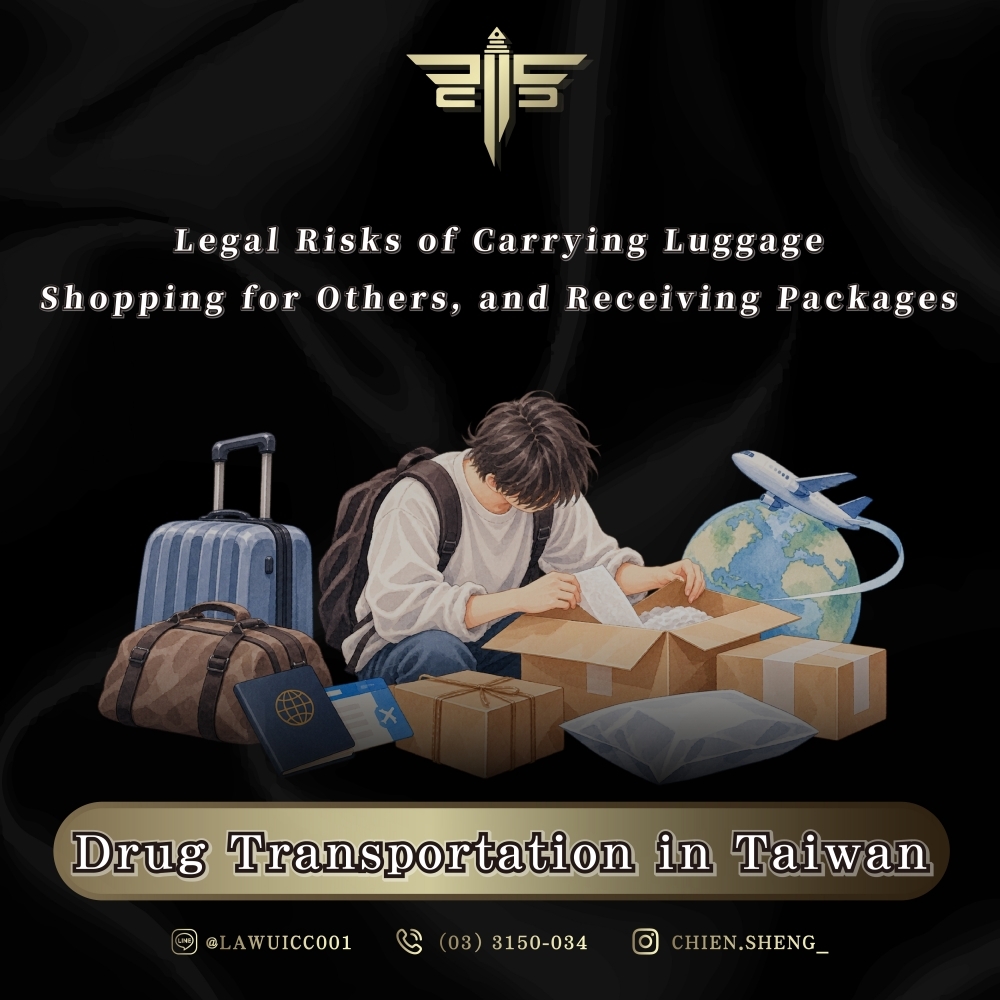
Drug Transportation in Taiwan: Legal Risks of Carrying Luggage, Shopping for Others, and Receiving Packages
商品圖像
-
商品資訊
目錄
- 1. What Constitutes Drug Transportation in Taiwan?
- 2. Common Recruitment Traps Used in Drug Transportation Cases
- 3. Penalties for Drug Transportation in Taiwan
- 4. What If You Did Not Know the Luggage Contained Drugs?
- 5. What Should You Do After Drugs Are Discovered?
- 6. Can a Sentence Be Reduced Under Article 17?
- 7. Key Defense Issues in Drug Transportation Cases
- 8. Frequently Asked Questions
- 9. Criminal Defense for Drug Transportation Cases
“Carry this suitcase and earn a large payment,” “shop overseas and bring some items back,” or “receive a package for someone” may sound like simple jobs or favors. In some cases, however, these offers are used by drug trafficking groups to recruit couriers without openly revealing the true purpose.
Some people do not discover that luggage, parcels, or goods contain illegal drugs until customs or police inspect them. Even if the person is not the organizer of a drug trafficking operation and never personally sold drugs, carrying the items may still lead to allegations of drug transportation, joint participation, or aiding and abetting.
However, the mere presence of drugs does not automatically prove that the carrier committed a crime. Prosecutors and courts must still determine whether the person knew the drugs were present or at least foresaw the possibility and nevertheless agreed to transport them.
If you or a family member has been investigated after overseas shopping, carrying luggage, receiving a package, or accepting an overseas job, early legal advice is important. Drug transportation offenses in Taiwan can carry extremely severe penalties.
1. What Constitutes Drug Transportation in Taiwan?
Drug transportation generally involves moving controlled drugs from one location to another. Common examples include carrying drugs across borders, transporting luggage containing drugs, mailing or receiving drug parcels, or delivering drugs to a designated person.
A person does not need to be the leader of a trafficking organization to face criminal liability. A courier, recipient, transporter, or person responsible for delivery may also become a defendant.
The key questions usually include:
■ Did the defendant know the luggage or package contained drugs?
■ Did the defendant suspect illegal contents but accept the risk because of unusually high compensation?
■ Did the defendant actually possess, receive, transport, or deliver the drugs?
■ Was there an agreement or coordinated plan with other participants?
■ What role did the defendant actually play?
■ Did the defendant receive payment or participate in other drug-related activities?
Therefore, a defense should not focus only on the statement that “the drugs were not mine.” Ownership and criminal responsibility are separate issues.
2. Common Recruitment Traps Used in Drug Transportation Cases
Drug trafficking groups rarely approach strangers by openly asking them to transport illegal drugs. Instead, they may disguise the arrangement as legitimate work, travel, shopping, parcel delivery, or a personal favor.
1. Overseas Shopping or Courier Jobs
Offers promising unusually high compensation for simple overseas shopping or delivery work should be treated cautiously, especially when the person is asked to carry luggage or goods they cannot inspect.
2. Free Overseas Trips
A person may be offered free flights, accommodation, and travel expenses in exchange for bringing luggage back to Taiwan. If the luggage was packed by someone else or cannot be inspected, significant criminal risk may arise.
3. Carrying Luggage for Someone Else
Requests to carry another person's luggage through an airport because of excess baggage, customs concerns, or other excuses can serious legal problems if drugs are later discovered.
4. Receiving or Forwarding Packages
Criminal groups may use another person's name, address, phone number, or identity to receive or forward packages. Even without directly handling the drugs, a person who knowingly assists the transportation process may face criminal investigation.
5. Concealed Cross-Border Transportation
Some cases involve concealed transportation methods designed to avoid detection. These cases can carry serious criminal consequences. This article addresses only the legal risks and does not provide instructions for concealing or transporting controlled substances.
3. Penalties for Drug Transportation in Taiwan
Under Taiwan’s Narcotics Hazard Prevention Act, manufacturing, transporting, or selling controlled drugs is treated as a serious criminal offense. Penalties depend heavily on the drug classification.
■ Category 1 drugs: death or life imprisonment; where life imprisonment is imposed, an additional fine of up to NT$30 million may apply.
■ Category 2 drugs: life imprisonment or imprisonment for at least 10 years, with a possible fine of up to NT$15 million.
■ Category 3 drugs: imprisonment for at least 7 years, with a possible fine of up to NT$10 million.
■ Category 4 drugs: imprisonment for 5 to 12 years, with a possible fine of up to NT$5 million.
Attempted offenses are also punishable. Therefore, being intercepted before the drugs reach their final destination does not necessarily eliminate criminal liability.
In cross-border cases involving airports, international parcels, or drugs brought into Taiwan, additional legal issues may also arise. The proper charge depends on the substance, transportation process, defendant’s role, and evidence.
4. What If You Did Not Know the Luggage Contained Drugs?
Lack of knowledge is one of the most important issues in many drug transportation cases. However, simply stating “I did not know” is usually not enough. The defense should be supported by objective evidence such as messages, job advertisements, travel arrangements, payment records, luggage handover details, and communications with the person who arranged the trip.
Prosecutors may examine whether:
■ the promised payment was unusually high;
■ the job description was vague or suspicious;
■ the defendant was prohibited from inspecting the luggage;
■ the organizer told the defendant not to ask questions;
■ the defendant had a reasonable opportunity to inspect the items; or
■ messages or other evidence were deleted after the incident.
1. Conditional Intent May Also Be an Issue
A defendant does not necessarily need to expressly admit, “I knew there were drugs.” If the circumstances were highly suspicious and the defendant foresaw the possibility of drug transportation but nevertheless accepted the risk, prosecutors may argue that the defendant acted with conditional intent.
For this reason, the defense should explain what information the defendant actually had at the time and why the defendant reasonably believed the goods were lawful.
2. No Payment Does Not Automatically Mean No Liability
Receiving compensation is relevant to motive and sentencing, but payment is not the sole element of drug transportation. A person may still face prosecution even if the promised payment was never received.
Conversely, lack of profit, limited involvement, deception by others, and absence of participation in other drug offenses may all be relevant to the defense.
5. What Should You Do After Drugs Are Discovered?
The first statements and evidence preserved after arrest or investigation can significantly affect the case.
1. Do Not Delete Messages or Evidence
Preserve complete conversations, call records, payment information, airline tickets, hotel bookings, job advertisements, travel arrangements, and luggage handover records. Deleting unfavorable messages can additional evidentiary problems.
2. Do Not Coordinate Stories With Other Suspects
Do not ask organizers, travel companions, or other suspects to delete messages, change their statements, or provide a fabricated explanation. This may additional risks involving evidence destruction or collusion.
3. Do Not Guess During Questioning
If you genuinely do not remember a date, amount, conversation, or other detail, do not invent an answer merely to complete the interview. Inconsistent statements may later be used to challenge credibility.
4. Seek Criminal Defense Counsel Early
Drug transportation cases often involve forensic reports, customs records, phone data, financial transactions, seized items, and statements from multiple suspects. A lawyer can review these materials before determining the appropriate defense strategy.
6. Can a Sentence Be Reduced Under Article 17?
Article 17 of the Narcotics Hazard Prevention Act provides sentence reductions or exemptions in certain circumstances. These rules do not apply merely because a defendant says they are willing to cooperate.
1. Identifying the Drug Source and Leading to Another Arrest
A defendant who identifies the source of the drugs and thereby enables authorities to apprehend another principal offender or accomplice may qualify for a sentence reduction or exemption.
Providing only a nickname, phone number, or unverified identity is not necessarily sufficient. The information generally must be specific, relevant to the case, and actually contribute to the authorities’ investigation and apprehension of another offender.
2. Confession During Investigation and Every Stage of Trial
For certain offenses under Articles 4 through 8, a defendant who confesses during the investigation and throughout all stages of trial may qualify for a statutory sentence reduction.
Whether this requirement is satisfied depends on the defendant’s statements at each procedural stage. A confession does not necessarily prevent the defense from disputing other issues, such as drug classification, quantity, role, attempt versus completion, confiscation, or sentencing factors.
3. Transportation for Personal Use in Minor Circumstances
The law also provides a possible reduction where transportation was for the defendant’s own use and the circumstances were minor. Whether this applies depends on the drug type, quantity, purpose, method of transportation, and other evidence.
7. Key Defense Issues in Drug Transportation Cases
A criminal defense lawyer may focus on several major issues:
■ Knowledge and intent: Did the defendant actually know or foresee that drugs were being transported?
■ Role in the offense: Was the defendant an organizer, joint principal, aider, recipient, or merely a low-level courier?
■ Communications and financial evidence: Do messages and payment records actually support the prosecution’s theory?
■ Search and seizure: Were the luggage, phone, parcel, or other items lawfully searched and seized?
■ Drug identification and quantity: Does the forensic report correctly establish the controlled substance, amount, and classification?
■ Stage of the offense: Was the alleged transportation completed or merely attempted?
■ Article 17 reductions: Did the defendant confess as required or provide information that actually led to the apprehension of another offender?
■ Sentencing factors: Was the defendant deceived or exploited, did the defendant profit, and what was the defendant’s actual level of participation?
A strong defense should connect these issues to the complete evidence rather than rely on a single statement such as “the drugs were not mine.”
8. Frequently Asked Questions
Q1: If drugs are found in luggage I carried, will I automatically be convicted of drug transportation?
No. The court must still determine whether you knew the drugs were present or foresaw the possibility and nevertheless agreed to transport them. However, these cases carry serious risks and require careful review of the evidence.
Q2: What if I genuinely did not know the package contained drugs?
Lack of knowledge may be a critical defense, but it should be supported by objective evidence such as messages, job advertisements, travel arrangements, payment records, and the circumstances under which the package was received.
Q3: What is the difference between transporting and selling drugs?
Transportation primarily concerns moving drugs from one place to another, while selling generally involves a transaction for consideration. Depending on the facts, a case may involve transportation, sale, joint participation, or aiding and abetting.
Q4: Does carrying only one suitcase mean the sentence will be lighter?
Not necessarily. Courts may consider the number of items, but drug classification, quantity, cross-border transportation, criminal role, prior record, and other circumstances may be more significant.
Q5: Does confessing automatically reduce the sentence?
No. Article 17 contains specific requirements, including confession during the investigation and throughout every stage of trial for certain offenses. The complete procedural record must be reviewed.
Q6: Does identifying the supplier automatically result in a reduced sentence?
No. The information must generally be sufficiently specific and must actually contribute to authorities apprehending another principal offender or accomplice connected to the drug source.
Q7: Should I contact the person who asked me to carry the luggage after I am caught?
Generally, you should not contact other suspects to coordinate explanations, delete messages, or evidence. Speak with a criminal defense lawyer before taking steps that could affect the investigation.
9. Criminal Defense for Drug Transportation Cases
Chien Sheng International Law Firm handles criminal cases involving drug transportation, cross-border drug offenses, luggage concealment, international parcels, overseas shopping arrangements, couriers, aiding and abetting, and organized drug operations.
Depending on the case, our lawyers can assist with reviewing police interviews, prosecutor questioning, search and seizure records, forensic reports, indictments, communications, financial records, drug classification, quantity, criminal intent, and the defendant’s actual role.
We can also evaluate the potential application of Article 17, including confession-based sentence reductions and cooperation that leads to the apprehension of drug sources or accomplices, as well as detention, bail, trial, appeal, acquittal arguments, alternative charges, and sentencing mitigation.
 If you or a family member is investigated after carrying luggage, receiving a parcel, working overseas, or transporting goods for another person, do not delete messages, evidence, or coordinate statements with other suspects.
Preserve police notices, search and seizure records, indictments, phone conversations, job or travel information, payment records, and luggage handover evidence. Early review by an experienced criminal defense lawyer can help determine whether the evidence actually proves knowledge, intent, participation, and the offense alleged by prosecutors.
※ This article is provided by Chien Sheng International Law Firm for general legal information only. Criminal liability and sentencing in drug transportation cases depend on the type and quantity of drugs, transportation method, date of the offense, criminal intent, defendant’s role, statements, and the complete evidentiary record.
This article does not guarantee non-prosecution, acquittal, sentence reduction, exemption from punishment, or any other specific result, and it does not replace individualized legal advice from a qualified attorney. Applicable laws should always be confirmed based on the latest legislation and the law in effect at the time of the alleged offense.
This reduces both medical risks and potential legal exposure.
Chien Sheng International Law Firm

LINE Online Legal Consultation: @lawuicc001 (Click to consult)
Welcome to call to schedule a meeting: 03-3150-034
Multiple payment methods available: Cash, Credit Card, Bank Transfer
Facebook: Chien Sheng International Law Firm
Instagram: chien.sheng_
-
商品Q&A