Emerging Drugs Are Evolving Faster Than Regulation: Does a Legal Gap Really Exist? Taiwan’s NPS Control Challenges and the Principle of Legality
商品圖像
-
商品資訊
目錄
- 1. Why Cold Medicine Matters During Addiction Treatment
- 2. What Is Codeine and Why Can It Produce Morphine?
- 3. Screening Tests vs. Confirmatory Urine Tests
- 4. Can a Positive Test Revoke Deferred Prosecution?
- 5. Can Morphine and Codeine Levels Prove Heroin Use?
- 6. What Does 6-MAM Testing Show?
- 7. What Should You Do Before and After a Urine Test?
- 8. What Evidence Should You Preserve?
- 9. How Can a Criminal Defense Lawyer Help?
1. Why Cold Medicine Matters During Addiction Treatment
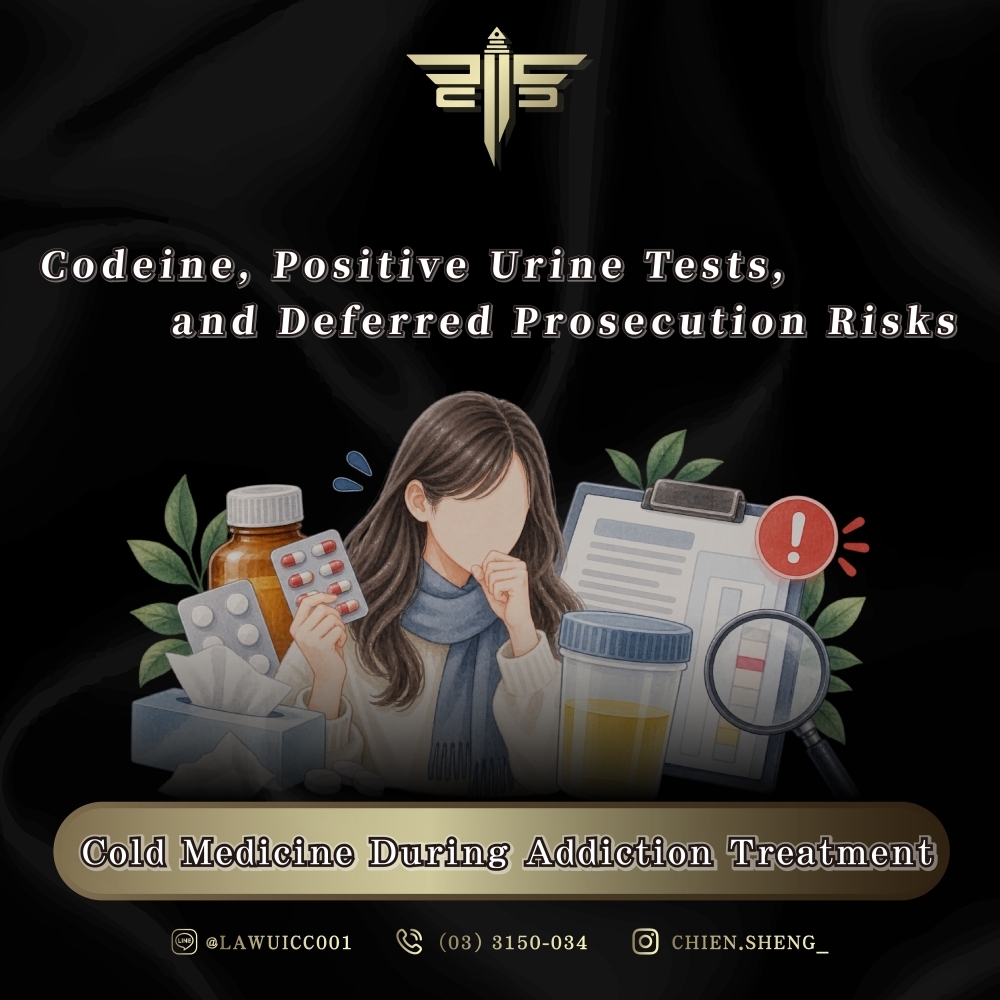
If you are undergoing addiction treatment, treatment-based deferred prosecution, probation supervision, or regular judicial urine testing in Taiwan, having a cold does not mean you cannot take medication. The key is to avoid taking medicine without checking its ingredients or keeping records.
Some cough medicines and combination cold medications may contain codeine. After codeine enters the body, part of it may be metabolized into morphine. As a result, a urine test may detect both codeine and morphine.
A positive morphine or codeine result does not automatically prove heroin use. The result may be affected by legitimate medication, dosage, timing, individual metabolism, urine collection time, and the testing method.
During addiction treatment, the safer approach is to seek medical care, tell the doctor that you are subject to judicial drug testing, keep your prescription and medication records, and disclose recent medication use when providing a urine sample.
2. What Is Codeine and Why Can It Produce Morphine?
Codeine is a pharmaceutical ingredient used in certain cough medicines and other medications. A legally prescribed medicine containing codeine is not treated in the same way as unlawful narcotic use merely because codeine is present.
However, codeine is relevant to urine drug testing because part of it can be metabolized into morphine.
The amount and ratio of codeine and morphine detected in urine may vary according to dosage, frequency of use, time since ingestion, metabolism, physical condition, and urine concentration.
Heroin use may also produce morphine-related metabolites. Therefore, a report stating only “morphine positive” or “codeine positive” may not by itself establish the precise source of the detected substance.
The correct legal question is whether the laboratory findings, medication history, and other evidence together support the conclusion that an illegal drug was used.
3. Screening Tests vs. Confirmatory Urine Tests
Under Taiwan’s urine-testing rules for drugs of abuse, an initial screening test and a confirmatory test serve different purposes.
Screening tests are designed to identify potentially positive samples. When the screening threshold is reached or the result requires further clarification, confirmatory testing may be performed using more specific analytical methods, such as gas or liquid chromatography combined with mass spectrometry.
If you receive notice of a positive urine test, first determine:
■ Was the result only an initial screening result or a confirmed laboratory result?
■ Which substances were detected—morphine, codeine, 6-acetylmorphine (6-MAM), or other metabolites?
■ What were the measured concentrations and applicable thresholds?
■ When was the urine collected and tested?
■ Are the sample number and chain-of-custody records consistent?
■ Is the sample still available for retesting or further analysis?
A verbal statement that a test was “positive” is not the same as reviewing the complete laboratory report.
4. Can a Positive Test Revoke Deferred Prosecution?
Under Taiwan’s Narcotics Hazard Prevention Act, a person receiving deferred prosecution subject to completion of addiction treatment must comply with the required treatment and testing conditions.
A positive drug test during the treatment period may a risk that the person will be considered not to have successfully completed treatment and that deferred prosecution may be revoked.
➡︎ However, a positive result should still be examined in context. If the person had a legitimate prescription or medical reason for taking codeine, the medication records, detected metabolites, concentrations, timing, and testing procedures may all be relevant.
If prosecutors request an explanation or a revocation notice has already been received, the person should promptly obtain the laboratory report, medical records, prescriptions, and relevant procedural documents rather than relying only on a verbal explanation that cold medicine was taken.
5. Can Morphine and Codeine Levels Prove Heroin Use?
Taiwan Supreme Court Criminal Judgment No. 705 of 2019 addressed an evidentiary dispute involving codeine-containing medication and urine results showing morphine and codeine.
The Court recognized that the relative levels of codeine and morphine may vary depending on factors such as frequency of use, individual metabolism, physical characteristics, and the timing of urine collection.
Accordingly, courts should not automatically treat a fixed morphine-to-codeine ratio as conclusive proof of heroin use without considering the circumstances of the individual case and appropriate expert evidence.
Ratios may be relevant scientific evidence, but they are not an absolute legal formula.
Claims found online such as “two-to-one” or “three times higher” should not be treated as universal rules. Proper interpretation may require the complete laboratory report, medication dosage, timing, testing method, and expert analysis.
Likewise, claiming “I took cold medicine” is not enough by itself. The claim should be supported by identifiable medication, dosage, prescription records, and a timeline consistent with the urine test.
6. What Does 6-MAM Testing Show?
6-acetylmorphine, commonly known as 6-MAM, is a metabolite associated with heroin and may provide additional evidence when distinguishing heroin exposure from the use of codeine-containing medication.
Its presence can therefore be significant when the central dispute is whether morphine detected in urine came from legitimate codeine use or heroin.
However, the absence of 6-MAM does not automatically prove that heroin was never used. Its detection may depend on factors such as collection timing, metabolism, sample preservation, and analytical sensitivity.
Where appropriate, defense counsel may evaluate whether additional analysis of 6-MAM, codeine, morphine, and other relevant substances or expert interpretation should be requested.
Hair testing may sometimes provide supplementary information, but it is not automatically “more accurate” than urine testing. Sampling location, hair growth, external contamination, cosmetic treatment, and the relevant detection period must also be considered.
7. What Should You Do Before and After a Urine Test?
If you become sick during addiction treatment:
1. Seek medical treatment rather than taking unidentified leftover medication.
2. Tell the doctor or pharmacist that you are undergoing judicial drug testing.
3. Ask about ingredients that may affect urine drug tests.
4. Keep prescriptions, medication bags, receipts, packaging, and medical records.
5. Record when the medication was actually taken.
6. Disclose recent medication honestly on the urine collection form.
If the form asks whether medication was taken within the previous several days, answer according to the facts. If you do not know the medication name, provide the prescription, medication bag, or a photograph instead of guessing.
If the urine test is positive:
■ Obtain the complete laboratory report.
■ Confirm whether the result is a screening or confirmatory test.
■ Collect medical and prescription records immediately.
■ a timeline of illness, medical treatment, medication use, urine collection, and notification of the result.
■ Preserve all original documents and communications.
■ Ask counsel whether retesting or expert analysis is appropriate.
Do not discard medication packaging, records, delete messages, or documents after the fact.
8. What Evidence Should You Preserve?
National Health Insurance records may help establish that a person received medical treatment or was prescribed a particular medication on a certain date. However, they do not automatically prove when the medication was actually taken, how much was taken, or whether the detected substance necessarily came from that medication.
When the medical date, prescription, medication ingredients, reported dosage, and laboratory findings are consistent, these records may provide important supporting evidence.
Medication obtained from a self-paid clinic or pharmacy may also be relevant. Preserve or request prescriptions, receipts, dispensing records, medication bags, and other verifiable records.
The key is not whether the treatment was covered by National Health Insurance. The key is whether the medication history is genuine, complete, and capable of independent verification.
Legitimate medication is not a universal defense to every positive drug test.
If the detected metabolites, concentrations, collection timing, and other evidence cannot reasonably be explained by the claimed medication, prosecutors or courts may still find evidence of illegal drug use.
Conversely, genuine medical use should not be ignored merely because morphine or codeine was detected. The conclusion should be based on medical records, laboratory data, testing procedures, and appropriate expert evidence.
9. How Can a Criminal Defense Lawyer Help?
Disputes involving positive morphine or codeine urine tests during addiction treatment may involve medical evidence, toxicology, deferred prosecution requirements, and criminal procedure at the same time.
Chien Sheng International Law Firm can assist in reviewing urine collection records, laboratory reports, chain-of-custody documents, medication history, prescriptions, medical records, and National Health Insurance information.
Depending on the case, counsel may also evaluate whether to submit a written explanation to prosecutors, request additional evidence, seek retesting or expert analysis, challenge testing or sample-handling procedures, or respond to the revocation of deferred prosecution.
Any explanation based on legitimate medication should be supported by genuine and verifiable evidence. Medical records should never be fabricated or altered to avoid legal responsibility.
A Positive Morphine or Codeine Test Does Not Tell the Whole Story
Having a cold during addiction treatment does not mean medication must be avoided entirely. The safer approach is to confirm the ingredients, use medication under medical or pharmaceutical guidance, and preserve complete records.
Codeine-containing medication may result in the detection of both codeine and morphine in urine. Whether a positive result indicates legitimate medication use or illegal drug use cannot be determined from the word “positive” alone.
The testing method, detected metabolites, concentrations, timing, medical records, and expert interpretation should be considered together.
 If you are undergoing addiction treatment and receive a positive morphine or codeine urine test, obtain the complete laboratory report and medical records promptly. If deferred prosecution may be revoked, early review of the evidence and applicable procedures can be particularly important.
※ This article provides general legal information and does not guarantee any particular outcome or replace individualized legal advice.
If you are concerned that cold medicine, cough medicine, or another legally obtained medication may have affected a urine drug test—or if you have already received a positive test result, notice concerning revocation of deferred prosecution, or a prosecutor’s summons—consider obtaining legal advice promptly so that testing records, medication evidence, and available procedural remedies can be reviewed in time.
This reduces both medical risks and potential legal exposure.
Chien Sheng International Law Firm

LINE Online Legal Consultation: @lawuicc001 (Click to consult)
Welcome to call to schedule a meeting: 03-3150-034
Multiple payment methods available: Cash, Credit Card, Bank Transfer
Facebook: Chien Sheng International Law Firm
Instagram: chien.sheng_
-
商品Q&A


