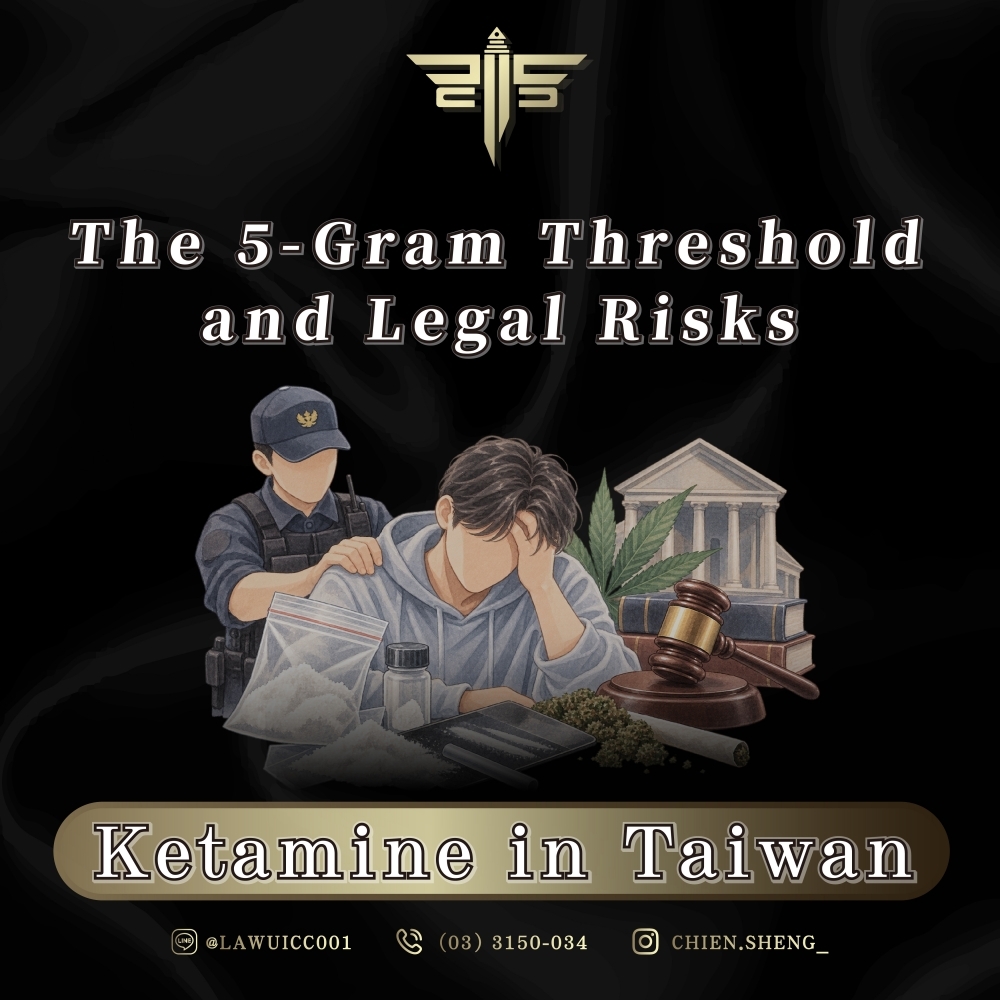
Ketamine in Taiwan: The 5-Gram Threshold and Legal Risks
商品圖像
-
商品資訊
目錄
- 1. What Category of Narcotic Is Ketamine in Taiwan? Are Ketamine Powder and K-Cigarettes Treated the Same Way?
- 2. Is Using Ketamine a Criminal Offense? Understanding Administrative Penalties and Criminal Liability
- 3. Is Possessing 5 Grams of Ketamine a Criminal Offense? The Key Is “Pure Net Weight”
- 4. Why Can “It Was Only for Personal Use” Still Lead to Suspected Intent to Sell?
- 5. Getting, Giving, or Sharing Ketamine for a Friend: Does Payment Make a Difference?
- 6. Why Are the Penalties for Selling, Transporting, or Manufacturing Ketamine So Severe?
- 7. Providing Ketamine at Parties, Schools, or to Minors May Also Involve Inducing Drug Use
- 8. Can Seized Ketamine and Drug Paraphernalia Be Returned?
- 9. What Should You Do If You Are Caught Using Ketamine? Do Not Ignore an Administrative Case
- 10. How Can a Ketamine Drug Crime Lawyer Help?
“What category of narcotic is ketamine in Taiwan?”
“Will using ketamine leave me with a criminal record?”
“What happens if I possess more than 5 grams of ketamine?”
“If K-cigarettes are found, is it only a fine?”
“If I buy ketamine for a friend or share it with someone else, could that be considered drug trafficking?”
These are some of the most common questions in ketamine-related cases.
Ketamine is classified as a Category 3 narcotic in Taiwan, and its legal treatment differs from Category 2 narcotics such as methamphetamine.
For adults, unauthorized use or possession of a Category 3 narcotic below the statutory criminal threshold is generally subject to administrative fines and mandatory drug-harm prevention education rather than criminal prosecution.
However, this does not mean that ketamine is legal or that every ketamine case results only in a fine.
Once the amount possessed reaches the statutory pure-net-weight threshold, or the conduct involves transfer, inducing another person to use drugs, possession with intent to sell, sale, transportation, or manufacture, the matter may become a criminal case and the potential penalties increase significantly.
※ This article by Chien Sheng International Law Firm explains Taiwan’s classification of ketamine, the legal consequences of ketamine use, criminal liability for possessing 5 grams or more by pure net weight, legal risks involving K-cigarettes, and the serious penalties for selling Category 3 narcotics. This article provides general legal information only. The actual charge and outcome of any case depend on the circumstances of the seizure, laboratory test results, available evidence, and the specific facts of the case.
1. What Category of Narcotic Is Ketamine in Taiwan? Are Ketamine Powder and K-Cigarettes Treated the Same Way?
The terms “K,” “ketamine,” and “K powder” generally refer to ketamine.
Under Taiwan’s narcotics control framework, ketamine is generally classified as a Category 3 narcotic.
What matters legally is not the street name given to the substance, but whether the seized material contains a controlled narcotic and how the substance is classified after laboratory testing.
A “K-cigarette” is not a separate criminal offense or legal classification.
If a cigarette, tobacco material, residue, powder, or other sample tests positive for ketamine, it may still be handled under the laws governing Category 3 narcotics.
If the item also contains narcotics from other categories, the legal consequences must be determined according to the actual laboratory findings.
The fact that a substance appears in a cigarette, e-cigarette liquid, candy, beverage, or another type of packaging does not prevent it from becoming the subject of a narcotics case.
Article 2 of the Narcotics Hazard Prevention Act provides that narcotics are addictive and abusable narcotic drugs, their preparations, psychotropic substances, and their preparations that are harmful to society.
Narcotics are divided into four categories according to their addictiveness, potential for abuse, and harmful effects on society:
■ 1. Category 1: Heroin, morphine, opium, cocaine, and similar substances.
■ 2. Category 2: Opium poppy, coca, cannabis, amphetamine, pethidine, pentazocine, and similar substances.
■ 3. Category 3: Secobarbital, amobarbital, nalorphine, and similar substances.
■ 4. Category 4: Allobarbital, alprazolam, and similar substances.
The categories and listed narcotics are periodically reviewed by a review committee jointly organized by the Ministry of Justice and the Ministry of Health and Welfare. Substances that pose risks of addiction, abuse, or social harm, including substances with similar chemical structures, may be reviewed and added, removed, or reclassified through the statutory process.
Narcotic drugs and psychotropic substances required for medical and scientific purposes are separately regulated by law.
2. Is Using Ketamine a Criminal Offense? Understanding Administrative Penalties and Criminal Liability
Many people have heard that “using ketamine will not send you to prison” and mistakenly interpret this to mean that ketamine use has no legal consequences.
That is incorrect.
Although unauthorized use or possession of a Category 3 narcotic by an adult may, under certain circumstances, be handled through administrative penalties rather than criminal prosecution, the person may still face a fine, mandatory drug-harm prevention education, and confiscation and destruction of the seized drugs and related paraphernalia.
Article 11-1 provides that Category 3 and Category 4 narcotics, as well as equipment used to manufacture or consume narcotics, may not be possessed without legitimate reason.
A person who possesses or uses a Category 3 or Category 4 narcotic without legitimate reason is subject to a fine of NT$10,000 to NT$50,000 and must complete four to eight hours of drug-harm prevention education within the prescribed period.
Where a juvenile uses a Category 3 or Category 4 narcotic, the case is handled under the Juvenile Justice Act rather than under the administrative penalty provision above.
The standards for administrative penalties and the method, content, timing, duration, and responsible agencies for drug-harm prevention education are prescribed by the competent authorities.
Under this provision, an adult who uses ketamine without legitimate reason, or possesses ketamine below the criminal threshold, will generally face an administrative fine of NT$10,000 to NT$50,000 and mandatory drug-harm prevention education lasting between four and eight hours.
This is an administrative sanction rather than a criminal sentence imposed by a court, but it does not mean that the conduct is legally permitted.
For juveniles who use Category 3 narcotics, the matter is handled through the protective and educational procedures of the Juvenile Justice Act.
Juvenile proceedings, administrative sanctions against adults, and ordinary criminal proceedings have different purposes, procedures, and potential outcomes and should not be treated as interchangeable.
3. Is Possessing 5 Grams of Ketamine a Criminal Offense? The Key Is “Pure Net Weight”
The 5-gram threshold is one of the most frequently misunderstood aspects of ketamine cases.
Whether possession of a Category 3 narcotic constitutes a criminal offense is not determined by the weight of the outer packaging, plastic bag, or container, nor simply by the total weight of the powder.
The relevant statutory standard is the narcotic’s pure net weight.
The actual amount must be determined through laboratory testing and calculation by the competent forensic authority.
Article 11 provides:
■ A person who possesses a Category 1 narcotic may be punished by imprisonment for up to three years, short-term imprisonment, or a fine of up to NT$300,000.
■ A person who possesses a Category 2 narcotic may be punished by imprisonment for up to two years, short-term imprisonment, or a fine of up to NT$200,000.
■ A person who possesses a Category 1 narcotic with a pure net weight of 10 grams or more may be punished by imprisonment for one to seven years and may also be fined up to NT$1 million.
■ A person who possesses a Category 2 narcotic with a pure net weight of 20 grams or more may be punished by imprisonment for six months to five years and may also be fined up to NT$700,000.
■ A person who possesses a Category 3 narcotic with a pure net weight of 5 grams or more may be punished by imprisonment for up to two years and may also be fined up to NT$200,000.
■ A person who possesses a Category 4 narcotic with a pure net weight of 5 grams or more may be punished by imprisonment for up to one year and may also be fined up to NT$100,000.
■ A person who possesses equipment specifically intended for manufacturing or using Category 1 or Category 2 narcotics may be punished by imprisonment for up to one year, short-term imprisonment, or a fine of up to NT$100,000.
Possessing ketamine with a pure net weight of 5 grams or more may therefore constitute the criminal offense of possessing a Category 3 narcotic.
The statutory penalty is imprisonment for up to two years and a possible fine of up to NT$200,000.
If the pure net weight is below 5 grams, this does not mean that there are no legal consequences. Administrative penalties and mandatory education under Article 11-1 may still apply.
➡︎ For example, if police seize a packet of powder that weighs 6 grams including the packaging, this alone does not establish that the substance has reached 5 grams in pure net weight.
Conversely, a substance that appears relatively small in total weight should not automatically be assumed to fall below the statutory threshold before laboratory testing is completed.
The narcotic ingredients, purity, net weight, and pure net weight may all affect whether the case proceeds as an administrative matter or a criminal prosecution.
4. Why Can “It Was Only for Personal Use” Still Lead to Suspected Intent to Sell?
A person found possessing ketamine may state that it was intended solely for personal use and was never meant to be sold.
Whether that explanation is accepted must be evaluated together with the objective evidence.
Police and prosecutors may examine factors such as:
■ the quantity possessed;
■ whether the drugs were divided into separate packages;
■ whether scales or sealing equipment were found;
■ communications and messages;
■ bank transfers or cash transactions;
■ the existence of potential buyers;
■ discussions concerning prices or delivery; and
■ other conduct surrounding the possession of the drugs.
No single factor necessarily proves an intent to sell.
However, where several pieces of evidence are mutually consistent, a case initially viewed as simple possession may instead be investigated as possession of a Category 3 narcotic with intent to sell, which carries a substantially heavier penalty.
Article 5 provides:
■ Possession of a Category 1 narcotic with intent to sell is punishable by life imprisonment or imprisonment for at least ten years, with a possible fine of up to NT$7 million.
■ Possession of a Category 2 narcotic with intent to sell is punishable by imprisonment for at least five years, with a possible fine of up to NT$5 million.
■ Possession of a Category 3 narcotic with intent to sell is punishable by imprisonment for three to ten years, with a possible fine of up to NT$3 million.
■ Possession of a Category 4 narcotic, or equipment specifically intended for manufacturing or consuming narcotics, with intent to sell is punishable by imprisonment for one to seven years, with a possible fine of up to NT$1 million.
Accordingly, possession of ketamine with intent to sell carries a statutory penalty of three to ten years’ imprisonment, with a possible fine of up to NT$3 million.
This is significantly more serious than simple possession of 5 grams or more of a Category 3 narcotic.
Whether the prosecution can actually prove an intent to sell must be determined from the specific facts and evidence. It should not be inferred merely from speculation, labels, or moral judgments.
5. Getting, Giving, or Sharing Ketamine for a Friend: Does Payment Make a Difference?
Handing ketamine to another person cannot necessarily be dismissed simply by saying that it was “for a friend.”
A gratuitous transfer may constitute the transfer of a Category 3 narcotic.
If money, fees, benefits, an exchange of value, or other consideration is involved, the conduct may instead be characterized as a sale.
Where a person merely acts under another person’s direction to transport or deliver the drugs, further analysis is required to determine whether that person may be liable as a principal offender, an aider, or in another participatory role.
Article 8 provides:
■ Transfer of a Category 1 narcotic is punishable by imprisonment for one to seven years and a possible fine of up to NT$1 million.
■ Transfer of a Category 2 narcotic is punishable by imprisonment for six months to five years and a possible fine of up to NT$700,000.
■ Transfer of a Category 3 narcotic is punishable by imprisonment for up to three years and a possible fine of up to NT$300,000.
■ Transfer of a Category 4 narcotic is punishable by imprisonment for up to one year and a possible fine of up to NT$100,000.
Attempts to commit the offenses above are also punishable.
Where the quantity transferred reaches a threshold prescribed by the Executive Yuan, the sentence may be increased by up to one-half.
The absence of a cash payment does not necessarily mean that handing ketamine to another person carries no criminal risk.
The purpose of the transfer, source of the substance, existence of consideration, communications between the parties, whether similar conduct occurred repeatedly, and the evidence establishing each person’s actual role should all be examined.
6. Why Are the Penalties for Selling, Transporting, or Manufacturing Ketamine So Severe?
Once a case involves the manufacture, transportation, or sale of a Category 3 narcotic, the statutory penalties increase substantially.
Article 4 provides:
■ Manufacturing, transporting, or selling a Category 1 narcotic is punishable by death or life imprisonment. Where life imprisonment is imposed, a fine of up to NT$30 million may also be imposed.
■ Manufacturing, transporting, or selling a Category 2 narcotic is punishable by life imprisonment or imprisonment for at least ten years, with a possible fine of up to NT$15 million.
■ Manufacturing, transporting, or selling a Category 3 narcotic is punishable by imprisonment for at least seven years, with a possible fine of up to NT$10 million.
■ Manufacturing, transporting, or selling a Category 4 narcotic is punishable by imprisonment for five to twelve years, with a possible fine of up to NT$5 million.
■ Manufacturing, transporting, or selling equipment specifically intended for manufacturing or consuming narcotics is punishable by imprisonment for one to seven years, with a possible fine of up to NT$1.5 million.
Attempts to commit these offenses are also punishable.
Selling Category 3 ketamine therefore carries a statutory penalty of at least seven years’ imprisonment, with a possible fine of up to NT$10 million.
Attempts may also be punishable.
For this reason, determining whether the conduct constituted a gratuitous transfer, purchasing on behalf of another person, a joint purchase, possession with intent to sell, or a completed sale is often a central issue in the defense and evaluation of the evidence.
7. Providing Ketamine at Parties, Schools, or to Minors May Also Involve Inducing Drug Use
Where ketamine is provided, encouraged, or introduced to another person at a party, KTV room, nightclub, residence, school, or similar setting, the legal issues may extend beyond possession or transfer.
Authorities may also examine whether the conduct constitutes inducing another person to use a Category 3 narcotic.
Whether this offense is established depends on factors such as what was said, what occurred at the scene, whether there was active encouragement, whether the drugs were actually supplied, and other supporting evidence.
Article 7 provides:
■ Inducing another person to use a Category 1 narcotic is punishable by imprisonment for three to ten years and a possible fine of up to NT$3 million.
■ Inducing another person to use a Category 2 narcotic is punishable by imprisonment for one to seven years and a possible fine of up to NT$1 million.
■ Inducing another person to use a Category 3 narcotic is punishable by imprisonment for six months to five years, with a possible fine of up to NT$700,000.
■ Inducing another person to use a Category 4 narcotic is punishable by imprisonment for up to three years and a possible fine of up to NT$500,000.
Attempts to commit these offenses are also punishable.
Cases involving adults and minors using drugs together, providing drugs to minors, or encouraging minors to use drugs are generally more factually complicated.
They may also involve juvenile proceedings, school safety issues, or other legal consequences.
A person should not assume that describing the incident as “everyone using together” resolves the legal issues. Each person’s conduct and legal responsibility must be evaluated separately.
8. Can Seized Ketamine and Drug Paraphernalia Be Returned?
Whether a ketamine case ultimately results in an administrative penalty or criminal proceedings, seized ketamine and unlawfully possessed drug-related equipment may still be subject to confiscation and destruction.
Article 18 provides that seized Category 1 and Category 2 narcotics, as well as equipment specifically intended for manufacturing or using Category 1 or Category 2 narcotics, shall be confiscated and destroyed regardless of whether they belong to the offender.
Seized Category 3 and Category 4 narcotics, and equipment used to manufacture or consume Category 3 or Category 4 narcotics, shall be administratively confiscated and destroyed when possessed without legitimate reason.
An exception may apply where the substances or equipment are legitimately required for medical, research, or training purposes.
Where seized narcotics are dangerous, at risk of loss or deterioration, difficult to store, or excessively costly to preserve, they may be destroyed after sampling even before the judgment becomes final, subject to applicable procedures.
Where a testing institution identifies a new psychoactive substance or ingredient and requires a reference standard, part of the sample may be provided to the Ministry of Health and Welfare or another legally established government testing institution for the preparation and use of such standards.
The requirements and procedures governing legitimate medical, research, or training uses and the use of samples by testing institutions are prescribed by the competent authorities.
This means that even where the conduct involves only possession or use of a Category 3 narcotic and does not ultimately result in a criminal sentence, a person should not expect the seized ketamine or related paraphernalia to be automatically returned.
The nature of the seized items, whether they constitute drug paraphernalia, whether there was a legitimate reason for possession, and whether the seizure and subsequent procedures were lawful must be evaluated from the evidence in each case.
9. What Should You Do If You Are Caught Using Ketamine? Do Not Ignore an Administrative Case
The first step is to determine exactly what has happened in the case.
Important questions include:
■ What substance was seized?
■ Was it submitted for laboratory testing?
■ What were the test results?
■ What were the net weight and pure net weight?
■ Did you receive an administrative notice or a summons from the prosecutors office?
■ Are authorities also alleging transfer, sale, inducement, or another criminal offense?
Preserve legitimate evidence that may explain the circumstances, including:
■ the background of transactions or fund flows;
■ communications;
■ information concerning the source or ownership of the seized substance;
■ the persons present; and
■ the sequence and timing of events.
Do not delete messages, destroy items, move suspicious funds, or ask other people to coordinate their statements.
These actions do not make the underlying facts disappear and may instead make the case more complicated.
A person should truthfully explain facts that they actually know.
However, legal conclusions such as whether the substance reached 5 grams in pure net weight, whether there was an intent to sell, whether a transaction involved consideration, or whether someone acted as a principal offender or aider must be determined from laboratory testing, communications, fund flows, and other evidence.
If the case has progressed to police questioning, a prosecutorial investigation, search and seizure, or criminal court proceedings, having a lawyer review the evidence and procedure at an early stage may help protect the person’s procedural rights.
10. How Can a Ketamine Drug Crime Lawyer Help?
Although Category 3 narcotic cases may begin with an administrative penalty, the potential legal consequences can escalate quickly when the case involves weight thresholds, transfer, sale, or multiple participants.
The lawyer’s role is not simply to make an abstract statement that the person is “guilty” or “not guilty.”
The relevant issues may include:
■ laboratory identification of ketamine;
■ pure net weight;
■ how the substance was obtained and possessed;
■ communications;
■ financial transactions;
■ delivery or transfer;
■ search and seizure procedures; and
■ the actual role played by each person involved.
In an administrative case, the contents of the penalty notice and mandatory education order, applicable deadlines, factual basis, and available remedies should be reviewed.
In a criminal case, the evidence supporting the prosecutor’s alleged offense should be carefully examined, including statements, laboratory reports, communications, financial records, and other evidence.
Where unlawful conduct is in fact involved, the subsequent procedure, sentencing factors, and available legal options should also be assessed early rather than responding hastily without understanding the legal consequences.
Chien Sheng International Law Firm handles a wide range of narcotics cases, including ketamine and other Category 3 narcotics, drug use and possession, drug trafficking and transportation, drug-impaired driving, and related money laundering or organized crime allegations.
If you, a family member, or a friend receives a police notice, administrative penalty, or summons from a prosecutors office involving ketamine, K-cigarettes, or another Category 3 narcotic—or faces a search, seizure, or questioning—the appropriate legal response should be evaluated based on the actual facts and evidence of the case.
Ketamine Is a Category 3 Narcotic, but That Does Not Mean There Are No Legal Consequences
Ketamine is generally classified as a Category 3 narcotic in Taiwan.
For an adult who uses ketamine without legitimate reason or possesses an amount below the criminal threshold, the matter will generally involve administrative penalties and mandatory drug-harm prevention education.
However, possession of 5 grams or more by pure net weight, or conduct involving transfer, inducement, possession with intent to sell, sale, transportation, or manufacture, may constitute a criminal offense.
The statutory penalties vary significantly depending on the offense.
The fact that ketamine is classified as a Category 3 narcotic should therefore not be interpreted as meaning that its legal risks are minor.
 Chien Sheng International Law Firm recommends seeking legal advice from a lawyer familiar with narcotics cases at an early stage. Doing so is not about avoiding responsibility; it is about ensuring that every piece of evidence, every alleged offense, and every procedural issue is properly and thoroughly examined under the law.
This reduces both medical risks and potential legal exposure.
Chien Sheng International Law Firm

LINE Online Legal Consultation: @lawuicc001 (Click to consult)
Welcome to call to schedule a meeting: 03-3150-034
Multiple payment methods available: Cash, Credit Card, Bank Transfer
Facebook: Chien Sheng International Law Firm
Instagram: chien.sheng_
-
商品Q&A