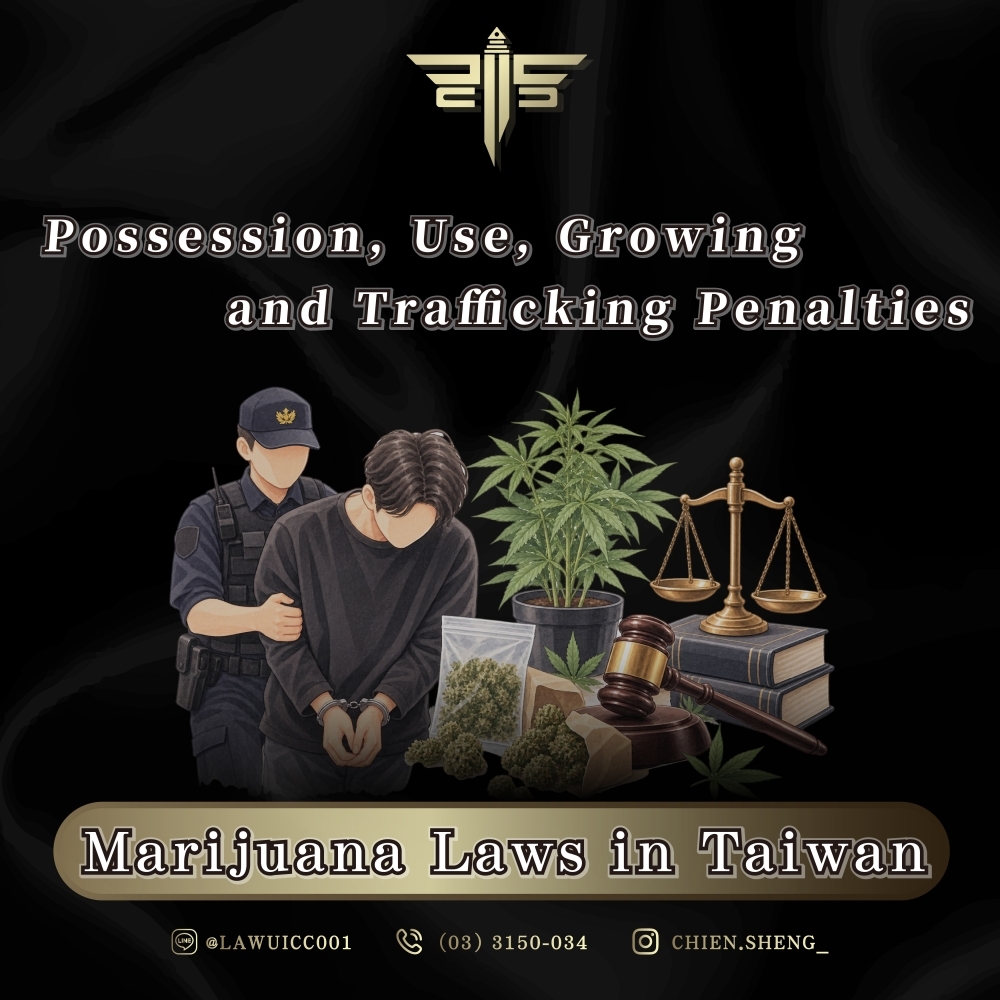
Marijuana Laws in Taiwan: Possession, Use, Growing, and Trafficking Penalties
商品圖像
-
商品資訊
目錄
- 1. What Category of Narcotic Is Marijuana in Taiwan? Legal Overseas Does Not Mean Legal in Taiwan
- 2. What Are the Penalties for Marijuana Possession? 20 Grams Is Not a Legal Threshold
- 3. What Happens If You Are Caught Using Marijuana? Category 2 Drug Use Is Not Just a Fine
- 4. Sharing Marijuana for Free May Constitute Transfer; Receiving Payment May Constitute Sale
- 5. Why Are the Penalties for Selling Marijuana and Possession with Intent to Sell So Severe?
- 6. Is Growing Marijuana at Home or on a Balcony a Serious Offense?
- 7. Can You Buy, Possess, or Give Away Marijuana Seeds?
- 8. Does Identifying Your Drug Source or Confessing Automatically Reduce Your Sentence?
- 9. What Happens to Marijuana Seized by the Authorities?
- 10. What Should You Do If You Are Caught with Marijuana? First Identify the Evidence and Procedure
- 11. How Can a Drug Defense Lawyer Help in a Marijuana Case?
- 12. Conclusion: Marijuana Is a Category 2 Narcotic, and 20 Grams Is Not a Safe Limit
“Is marijuana legal in Taiwan?”
“What happens if I buy marijuana edibles or cannabis vape products overseas and bring them back to Taiwan?”
“Is possessing less than 20 grams of marijuana legal?”
“If I am caught using marijuana for the first time, will I be sent to observation and rehabilitation?”
“If I grow marijuana at home only for my own use, can I still face serious criminal liability?”
As overseas travel, social media, vaping products, and cross-border online shopping become increasingly common, these questions frequently arise in drug-related cases.
In Taiwan, marijuana is classified as a Category 2 narcotic.
The fact that certain foreign jurisdictions have adopted different policies toward marijuana use, possession, or commercial activity does not change how marijuana is regulated under Taiwanese law.
Conduct occurring in Taiwan—or bringing, mailing, or transporting controlled marijuana-related products into Taiwan—may trigger liability under Taiwan’s Narcotics Hazard Prevention Act.
The legal risks are not limited to selling marijuana.
Possession, use, transfer, possession with intent to sell, cultivation, possession of marijuana seeds, transportation, and manufacture may each carry different forms of criminal liability.
※ This article by Chien Sheng International Law Firm provides a general overview of Taiwan’s current legal framework governing marijuana, including its classification as a narcotic, the legal significance of the 20-gram possession threshold, observation and rehabilitation and deferred prosecution with addiction treatment for marijuana use, cultivation and marijuana seeds, the distinction between transfer and sale, and key issues to consider when facing a marijuana-related investigation.
This article provides general legal information only and does not replace legal advice for an individual case. Each case must be evaluated based on laboratory testing, financial records, communications, prior case history, and other specific evidence.
1. What Category of Narcotic Is Marijuana in Taiwan? Legal Overseas Does Not Mean Legal in Taiwan
The Narcotics Hazard Prevention Act expressly classifies marijuana as a Category 2 narcotic.
Whether marijuana, cannabis, marijuana-containing smoking products, food products, oils, vape products, or other cannabis-related products are subject to Taiwan’s narcotics laws must still be determined according to the actual ingredients, concentration, source, and laboratory analysis of the specific product.
A product should not be assumed to be lawful in Taiwan merely because its packaging states that it is “legal,” “natural,” “available overseas,” or “not a drug.”
Article 2 of the Narcotics Hazard Prevention Act
For purposes of the Act, “narcotics” refers to addictive and abusable narcotic drugs and their preparations, as well as psychotropic substances and their preparations, that pose a risk of harm to society.
Narcotics are divided into four categories according to their addictiveness, potential for abuse, and risk of harm to society:
■ Category 1: Heroin, morphine, opium, cocaine, and similar substances or preparations listed in Schedule 1.
■ Category 2: Opium poppy, coca, marijuana, amphetamine, pethidine, pentazocine, and similar substances or preparations listed in Schedule 2.
■ Category 3: Secobarbital, amobarbital, nalorphine, and similar substances or preparations listed in Schedule 3.
■ Category 4: Allobarbital, alprazolam, and similar substances or preparations listed in Schedule 4.
The categories and listed narcotics are periodically reviewed by a review committee jointly formed by the Ministry of Justice and the Ministry of Health and Welfare. Following review and approval, additions, removals, or adjustments may be announced by the Executive Yuan and submitted to the Legislative Yuan for reference.
Narcotics and psychotropic substances required for medical and scientific purposes are separately regulated by law.
For the general public, the most important point is that Taiwan does not allow individuals to freely possess, use, cultivate, or sell marijuana merely because another country or jurisdiction permits such conduct.
Particular caution is required when carrying marijuana-related products across borders or ordering them by mail or online.
The legality of a product overseas does not determine whether its importation or possession is lawful in Taiwan.
2. What Are the Penalties for Marijuana Possession? 20 Grams Is Not a Legal Threshold
People searching for information about “possessing 20 grams of marijuana” may mistakenly assume that possession is lawful as long as the amount is below 20 grams.
That is incorrect.
Because marijuana is a Category 2 narcotic, simple possession itself may constitute the offense of possessing a Category 2 narcotic.
The 20-gram threshold concerns a heavier statutory penalty where the pure net weight of a Category 2 narcotic reaches the specified amount. It does not mean that possession below 20 grams is legal.
Article 11 of the Narcotics Hazard Prevention Act
■ Possession of a Category 1 narcotic is punishable by imprisonment for up to three years, short-term imprisonment, or a fine of up to NT$300,000.
■ Possession of a Category 2 narcotic is punishable by imprisonment for up to two years, short-term imprisonment, or a fine of up to NT$200,000.
■ Possession of a Category 1 narcotic with a pure net weight of 10 grams or more is punishable by imprisonment for one to seven yers and may additionally result in a fine of up to NT$1 million.
■ Possession of a Category 2 narcotic with a pure net weight of 20 grams or more is punishable by imprisonment for six months to five years and may additionally result in a fine of up to NT$700,000.
■ Possession of a Category 3 narcotic with a pure net weight of 5 grams or more is punishable by imprisonment for up to two years and may additionally result in a fine of up to NT$200,000.
■ Possession of a Category 4 narcotic with a pure net weight of 5 grams or more is punishable by imprisonment for up to one year and may additionally result in a fine of up to NT$100,000.
■ Possession of equipment intended exclusively for the manufacture or use of Category 1 or Category 2 narcotics is punishable by imprisonment for up to one year, short-term imprisonment, or a fine of up to NT$100,000.
Possessing marijuana with a pure net weight of less than 20 grams may still result in criminal liability under Article 11, Paragraph 2, including imprisonment for up to two years, short-term imprisonment, or a fine of up to NT$200,000.
Where the pure net weight reaches 20 grams or more, Article 11, Paragraph 4 provides a heavier penalty of imprisonment for six months to five years, with a possible additional fine of up to NT$700,000.
The key phrase is “pure net weight.”
Whether the statutory 20-gram threshold has been reached is not determined simply by placing a bag, container, or packaged product on a scale.
Marijuana plants, dried leaves, flowers, extracts, mixed products, and other seized materials must be evaluated according to the nature of the seized evidence and laboratory results.
Whether individual samples contain a Category 2 narcotic, their concentration, and how the pure net weight should be calculated may become important issues in the case.
Do not rely solely on online conversion formulas, product labels, or visual appearance.
3. What Happens If You Are Caught Using Marijuana? Category 2 Drug Use Is Not Just a Fine
Because marijuana is a Category 2 narcotic, using it may result in criminal liability.
This differs from the administrative penalty framework that may apply to the simple use of certain Category 3 narcotics, such as ketamine.
Article 10 of the Narcotics Hazard Prevention Act
■ Use of a Category 1 narcotic is punishable by imprisonment for six months to five years.
■ Use of a Category 2 narcotic is punishable by imprisonment for up to three years.
However, not every case involving the use of a Category 1 or Category 2 narcotic immediately proceeds to a criminal trial and sentencing.
Taiwan’s legal framework includes treatment-oriented procedures such as observation and rehabilitation, compulsory treatment, and deferred prosecution with addiction treatment.
These mechanisms are intended to address addiction and the risk of repeated drug use alongside criminal responsibility.
This does not mean that:
■ first-time marijuana use always results in observation and rehabilitation;
■ a willingness to receive treatment automatically guarantees deferred prosecution; or
■ every repeated drug-use case within three years necessarily leads to prosecution.
The applicable procedure depends on factors such as the person’s most recent observation and rehabilitation or compulsory treatment record, the statutory procedural requirements, medical assessment, circumstances of the case, and other individual facts.
Article 24 of the Narcotics Hazard Prevention Act
The procedures under Article 20, Paragraph 1 and Article 23, Paragraph 2 do not apply where a prosecutor first issues a conditional deferred prosecution disposition under Article 253-1, Paragraph 1 and Article 253-2, Paragraph 1, Subparagraphs 4 through 6 or Subparagraph 8 of the Code of Criminal Procedure, or where a juvenile court considers it appropriate to proceed under the Juvenile Justice Act.
If the deferred prosecution disposition is revoked, the prosecutor shall continue the investigation or initiate prosecution.
Before issuing deferred prosecution under Article 253-2, Paragraph 1, Subparagraph 6 of the Code of Criminal Procedure, the prosecutor shall seek the opinion of a medical institution and, where necessary, may also seek the opinion of other relevant authorities or institutions.
The applicable forms of addiction treatment, eligible persons, treatment content and methods, implementing medical or other institutions, and standards for determining completion of addiction treatment are prescribed by the Executive Yuan.
Where a prosecutor grants conditional deferred prosecution requiring addiction treatment, the person must comply with the required treatment, testing, reporting, urine testing, and other conditions.
Deferred prosecution is not an acquittal, nor is it an unconditional promise of immunity.
If the conditions are violated or statutory grounds for revocation arise, the prosecutor may continue the investigation or initiate prosecution.
4. Sharing Marijuana for Free May Constitute Transfer; Receiving Payment May Constitute Sale
“I didn’t sell it—I just shared some with a friend” is a common explanation in marijuana cases.
Under Taiwanese law, however, giving marijuana to another person without payment may still constitute the transfer of a Category 2 narcotic.
If the transfer involves money, purchasing fees, bank transfers, an exchange of property, or other benefits, the conduct may potentially be investigated as the sale of narcotics.
Article 8 of the Narcotics Hazard Prevention Act
■ Transfer of a Category 1 narcotic is punishable by imprisonment for one to seven years and may additionally result in a fine of up to NT$1 million.
■ Transfer of a Category 2 narcotic is punishable by imprisonment for six months to five years and may additionally result in a fine of up to NT$700,000.
■ Transfer of a Category 3 narcotic is punishable by imprisonment for up to three years and may additionally result in a fine of up to NT$300,000.
■ Transfer of a Category 4 narcotic is punishable by imprisonment for up to one year and may additionally result in a fine of up to NT$100,000.
■ Attempts to commit the foregoing offenses are punishable.
■ Where the amount transferred reaches the threshold prescribed by the Executive Yuan, the sentence may be increased by up to one-half.
Whether the conduct constitutes transfer, joint use, purchasing on behalf of another person, temporary storage, safekeeping, or a sale involving consideration must be evaluated from the entire course of conduct.
Relevant evidence may include communications between the parties, financial transactions, movement of the marijuana, the circumstances of delivery, and other objective evidence.
The absence of a cash payment does not automatically eliminate criminal liability.
5. Why Are the Penalties for Selling Marijuana and Possession with Intent to Sell So Severe?
If prosecutors believe that the marijuana was not possessed for personal use but was instead being held for future sale, the person may face the offense of possessing a Category 2 narcotic with intent to sell.
Article 5 of the Narcotics Hazard Prevention Act
■ Possession of a Category 1 narcotic with intent to sell is punishable by life imprisonment or imprisonment for at least ten years and may additionally result in a fine of up to NT$7 million.
■ Possession of a Category 2 narcotic with intent to sell is punishable by imprisonment for at least five years and may additionally result in a fine of up to NT$5 million.
■ Possession of a Category 3 narcotic with intent to sell is punishable by imprisonment for three to ten years and may additionally result in a fine of up to NT$3 million.
■ Possession of a Category 4 narcotic, or equipment intended exclusively for manufacturing or using narcotics, with intent to sell is punishable by imprisonment for one to seven years and may additionally result in a fine of up to NT$1 million.
Possessing marijuana with intent to sell therefore carries a statutory penalty of at least five years’ imprisonment, with a possible additional fine of up to NT$5 million.
Investigators and prosecutors may examine the amount possessed, packaging, scales, packaging materials, communications, potential customers, bank transfers, cash transactions, delivery arrangements, and other objective evidence when determining whether there was an intent to sell.
Each factor may carry different weight depending on the circumstances.
No single factor should automatically determine the result, but simply stating that the marijuana was “for personal use” does not eliminate other evidence suggesting a pattern of distribution or sale.
The statutory penalties become even more severe where the allegations involve manufacturing, transporting, or selling a Category 2 narcotic.
Article 4 of the Narcotics Hazard Prevention Act
■ Manufacturing, transporting, or selling a Category 1 narcotic is punishable by death or life imprisonment. Where life imprisonment is imposed, an additional fine of up to NT$30 million may be imposed.
■ Manufacturing, transporting, or selling a Category 2 narcotic is punishable by life imprisonment or imprisonment for at least ten years and may additionally result in a fine of up to NT$15 million.
■ Manufacturing, transporting, or selling a Category 3 narcotic is punishable by imprisonment for at least seven years and may additionally result in a fine of up to NT$10 million.
■ Manufacturing, transporting, or selling a Category 4 narcotic is punishable by imprisonment for five to twelve years and may additionally result in a fine of up to NT$5 million.
■ Manufacturing, transporting, or selling equipment intended exclusively for manufacturing or using narcotics is punishable by imprisonment for one to seven years and may additionally result in a fine of up to NT$1.5 million.
■ Attempts to commit the foregoing offenses are punishable.
Selling, transporting, or manufacturing marijuana may therefore expose a defendant to life imprisonment or imprisonment for at least ten years, with a possible additional fine of up to NT$15 million.
Attempted offenses may also be punishable.
Where a case involves any of these allegations, the evidence should be carefully examined to determine whether there was consideration, transportation, manufacturing conduct, intent to sell, and sufficient corroborating evidence.
6. Is Growing Marijuana at Home or on a Balcony a Serious Offense?
Cultivating marijuana is one of the activities that people may underestimate.
Some assume that growing marijuana is less serious if it is not sold and is intended only for personal use.
However, the Narcotics Hazard Prevention Act separately criminalizes cultivating marijuana with the intent that it be used to manufacture narcotics.
Such cases are not treated merely as ordinary possession or drug-use cases.
Article 12 of the Narcotics Hazard Prevention Act
■ Cultivating opium poppy or coca with the intent that it be used to manufacture narcotics is punishable by life imprisonment or imprisonment for at least seven years and may additionally result in a fine of up to NT$7 million.
■ Cultivating marijuana with the intent that it be used to manufacture narcotics is punishable by imprisonment for at least five years and may additionally result in a fine of up to NT$5 million.
■ Where the preceding marijuana-cultivation offense is committed for the offender’s own use and the circumstances are minor, the offense is punishable by imprisonment for one to seven years and may additionally result in a fine of up to NT$1 million.
■ Attempts to commit the foregoing offenses are punishable.
Cultivating marijuana with the intent that it be used to manufacture narcotics therefore carries a statutory penalty of at least five years’ imprisonment and a possible additional fine of up to NT$5 million.
Even where the defendant claims that the marijuana was intended solely for personal use, the conduct remains a criminal offense if the requirements of Article 12 are satisfied.
Where the cultivation was for the defendant’s own use and the circumstances are minor, the statutory penalty may be imprisonment for one to seven years, with a possible additional fine of up to NT$1 million.
Whether the conduct legally constitutes cultivation, what the intended purpose was, and whether the circumstances qualify as minor must be determined from the evidence.
A statement that the person was simply “growing it for personal use” does not automatically eliminate serious criminal liability.
7. Can You Buy, Possess, or Give Away Marijuana Seeds?
Marijuana seeds are separately regulated under Taiwanese law.
The fact that a seed has not yet germinated, resembles an ordinary gardening seed, or can legally be purchased from an overseas website does not mean that possessing, mailing, or transporting it is necessarily lawful in Taiwan.
Article 13 of the Narcotics Hazard Prevention Act
■ Transporting or selling opium poppy or coca seeds with the intent that they be used for cultivation is punishable by imprisonment for up to five years and may additionally result in a fine of up to NT$500,000.
■ Transporting or selling marijuana seeds with the intent that they be used for cultivation is punishable by imprisonment for up to two years and may additionally result in a fine of up to NT$200,000.
Article 14 of the Narcotics Hazard Prevention Act
■ Possessing with intent to sell, or transferring, opium poppy or coca seeds is punishable by imprisonment for up to three years.
■ Possessing with intent to sell, or transferring, marijuana seeds is punishable by imprisonment for up to two years.
■ Possession of opium poppy or coca seeds is punishable by imprisonment for up to two years, short-term imprisonment, or a fine of up to NT$30,000.
■ Possession of marijuana seeds is punishable by imprisonment for up to one year, short-term imprisonment, or a fine of up to NT$10,000.
Under the current statutory framework, transporting or selling marijuana seeds with the intent that they be used for cultivation may result in imprisonment for up to two years and an additional fine of up to NT$200,000.
Possessing marijuana seeds with intent to sell, or transferring them, may result in imprisonment for up to two years.
Simple possession of marijuana seeds may result in imprisonment for up to one year, short-term imprisonment, or a fine of up to NT$10,000.
Cross-border online purchases, purchasing on behalf of others, mailing, forwarding parcels, or receiving packages for another person should therefore be approached carefully after confirming the actual contents and applicable legal restrictions.
8. Does Identifying Your Drug Source or Confessing Automatically Reduce Your Sentence?
People involved in drug cases frequently ask:
“If I identify my supplier, will my sentence be reduced?”
“If I confess, do I automatically receive a reduced sentence?”
Taiwan’s Narcotics Hazard Prevention Act contains specific sentence-reduction provisions, but merely naming a source or admitting an offense does not automatically satisfy them.
Article 17 of the Narcotics Hazard Prevention Act
A person who commits an offense under Articles 4 through 8, Article 10, or Article 11 and provides information identifying the source of the narcotics, thereby leading to the apprehension of another principal offender or accomplice, shall receive a reduced sentence or may be exempted from punishment.
A person who commits an offense under Articles 4 through 8 and confesses during the investigation and throughout each stage of trial shall receive a reduced sentence.
Where a defendant commits the offense of transporting narcotics under Article 4 for personal use and the circumstances are minor, the sentence may be reduced.
Under Paragraph 1, simply identifying the source of the drugs is not enough.
The information must lead to the apprehension of another principal offender or accomplice before the statutory reduction or exemption may apply.
If the information is too vague to verify, or if there is no sufficient causal connection between the defendant’s information and the resulting apprehension, the statutory requirements may not be satisfied.
The confession-based sentence reduction under Paragraph 2 is limited to offenses under Articles 4 through 8, including manufacturing, transporting, selling, possession with intent to sell, and transferring narcotics.
It also requires a confession during the investigation and throughout each stage of trial.
Simple drug use or possession does not automatically qualify for the Article 17, Paragraph 2 reduction merely because the defendant confesses.
Accordingly, whether to admit particular conduct, the scope of any admission, and whether factual or procedural disputes remain should be carefully considered after reviewing the evidence and understanding the legal consequences.
9. What Happens to Marijuana Seized by the Authorities?
Because marijuana is a Category 2 narcotic, seized marijuana is generally subject to confiscation and destruction.
Article 18 of the Narcotics Hazard Prevention Act
Seized Category 1 and Category 2 narcotics, as well as equipment intended exclusively for manufacturing or using Category 1 or Category 2 narcotics, shall be confiscated and destroyed regardless of whether they belong to the offender.
Seized Category 3 and Category 4 narcotics, and equipment used to manufacture or consume them, shall be confiscated and destroyed where possessed without legitimate reason.
An exception may apply where the narcotics or equipment are used for medical, research, or training purposes.
Where seized narcotics are dangerous, at risk of loss or deterioration, difficult to store, or excessively costly to preserve, they may be destroyed after samples are taken even before the judgment becomes final.
Where a testing institution identifies a new narcotic or ingredient and needs to a reference standard, part of the sample may be provided to the Ministry of Health and Welfare or another government-established testing institution for preparation and use as a reference standard.
The requirements, procedures, and management rules applicable to narcotics, equipment, and samples used for medical, research, training, or testing purposes are separately prescribed by the competent authorities.
Category 2 marijuana and equipment intended exclusively for its manufacture or use are therefore generally subject to confiscation and destruction.
In an individual case, however, it remains necessary to determine the actual nature of the seized items, whether an item legally qualifies as dedicated equipment, whether the sampling and laboratory procedures were lawful, and whether other seized property is subject to confiscation.
10. What Should You Do If You Are Caught with Marijuana? First Identify the Evidence and Procedure
Marijuana cases may begin with a police stop, airport or customs inspection, parcel interception, residential search, analysis of mobile-phone communications, urine testing, or statements made by another person.
After receiving a police notice or prosecutors office summons, or following a search, seizure, or urine-testing procedure, the first task is to establish the basic facts of the case.
Key questions include:
■ What exactly was seized?
■ What does the laboratory report show?
■ What are the gross weight and pure net weight?
■ Is the person accused of possession, use, transfer, sale, transportation, cultivation, or another offense?
■ Are there communications or financial records allegedly supporting the accusation?
■ What procedural stage has the case reached?
A person should truthfully explain facts that they actually know.
However, uncertain matters should not be presented as facts based on speculation, and a person should not prematurely accept an imprecise legal conclusion before understanding the evidence.
➡︎ For example, questions such as whether the pure net weight reaches 20 grams, whether there was an intent to sell, whether consideration was exchanged, or whether the conduct legally constitutes transportation or joint principal liability must be evaluated based on laboratory analysis, communications, financial records, the circumstances of delivery, and other objective evidence.
Do not delete messages, destroy or conceal items, transfer suspicious funds, or ask other people to coordinate their stories.
Such conduct does not make the case disappear and may make it more difficult to determine the facts.
Instead, preserve lawful evidence that may explain the transaction background, source of the items, source of funds, communications, and the extent of your actual involvement, and seek legal advice as early as possible.
11. How Can a Drug Defense Lawyer Help in a Marijuana Case?
The issues in a marijuana case often extend far beyond whether marijuana was found.
Important questions may include:
■ What exactly was identified in the laboratory analysis?
■ What are the relevant ingredients and pure net weight?
■ Can possession legally be attributed to the defendant?
■ Is there sufficient evidence of actual drug use?
■ Do the communications establish an intent to sell?
■ Are the financial transactions actually connected to drug sales?
■ Were the search and seizure procedures lawful?
■ What role did the defendant actually play in a case involving multiple people?
➡︎ In a drug-use case, a lawyer can help distinguish among observation and rehabilitation, compulsory treatment, and deferred prosecution with addiction treatment, while reviewing prior treatment records and confirming the current procedural stage.
➡︎ In a possession case, the laboratory report, pure net weight, circumstances of seizure, and evidence establishing possession should be carefully examined.
➡︎ In cases involving alleged sale, transportation, or cultivation, communications, financial records, cultivation equipment, delivery circumstances, witness or accomplice statements, and the relationship among the different pieces of evidence should be reviewed closely.
Chien Sheng International Law Firm handles a broad range of narcotics-related criminal matters, including cases involving marijuana, methamphetamine, ketamine, and other controlled substances.
These cases may involve drug use, possession, sale, transportation, manufacture, cultivation, drugged driving, and related allegations involving money laundering or organized crime.
When facing police questioning, a prosecutorial investigation, search and seizure, an observation and rehabilitation notice, an addiction-treatment assessment, or court proceedings, identifying the facts, preserving evidence, and evaluating the applicable procedures as early as possible may help prevent misunderstandings of the law or rushed responses from adversely affecting the person’s rights.
12. Conclusion: Marijuana Is a Category 2 Narcotic, and 20 Grams Is Not a Safe Limit
Marijuana is classified as a Category 2 narcotic in Taiwan, and the laws of other countries or jurisdictions do not change its legal status under Taiwanese law.
Possessing marijuana itself may constitute a criminal offense.
A pure net weight of 20 grams or more is a threshold for a more serious possession penalty—it is not a rule making possession below 20 grams lawful.
Marijuana use may trigger both criminal procedures and treatment-oriented measures.
Giving marijuana to another person without payment may still constitute unlawful transfer.
Where a case involves sale, transportation, cultivation, or marijuana seeds, the potential criminal penalties may increase substantially.
 Whether you, a family member, or a friend has received a notice, been subjected to a search and seizure, undergone urine testing, received an observation and rehabilitation notice, or been prosecuted in connection with marijuana, cannabis-containing products, marijuana seeds, cultivation equipment, or related financial transactions, the case should be evaluated individually based on the complete evidence and the law applicable at the relevant time.
※ Chien Sheng International Law Firm emphasizes that seeking assistance from a lawyer experienced in drug cases at an early stage is not about avoiding responsibility. It is about ensuring that every allegation, every criminal charge, and every piece of evidence is properly examined through the legal process.
This reduces both medical risks and potential legal exposure.
Chien Sheng International Law Firm

LINE Online Legal Consultation: @lawuicc001 (Click to consult)
Welcome to call to schedule a meeting: 03-3150-034
Multiple payment methods available: Cash, Credit Card, Bank Transfer
Facebook: Chien Sheng International Law Firm
Instagram: chien.sheng_
-
商品Q&A