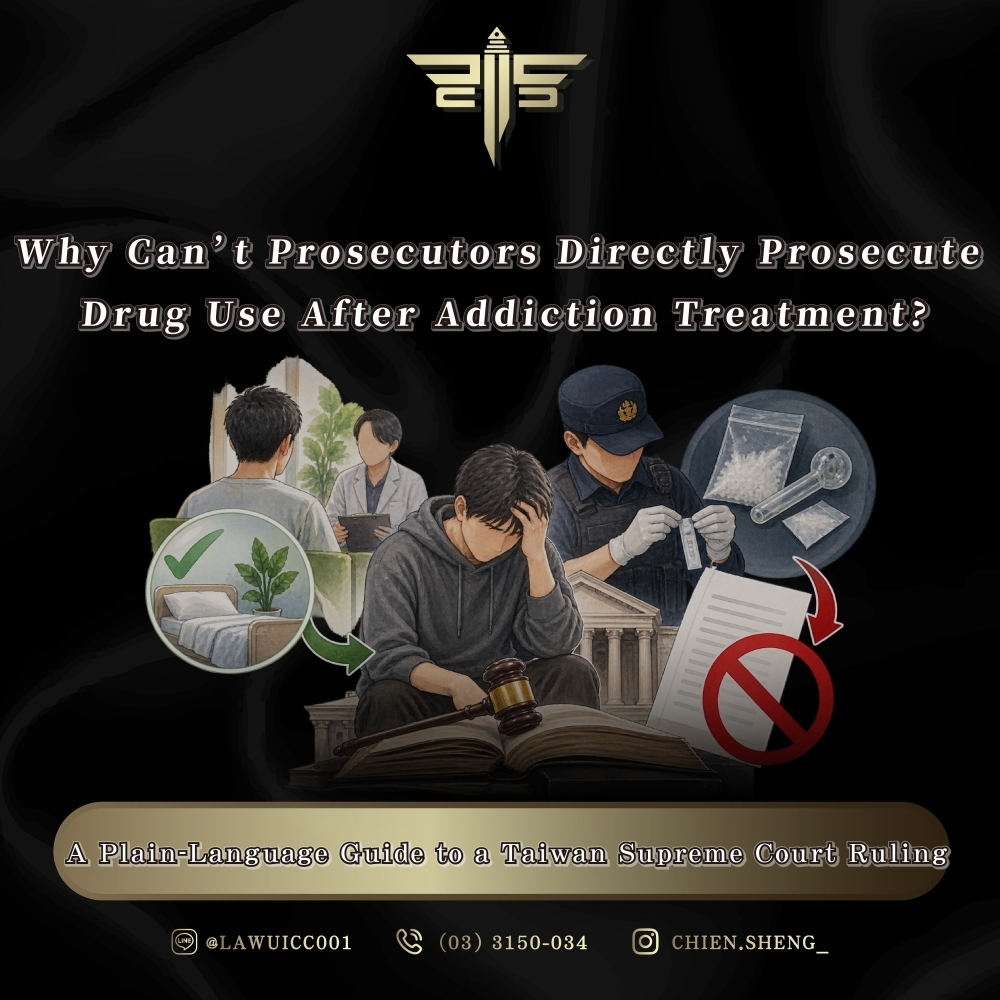
Why Can’t Prosecutors Directly Prosecute Drug Use After Addiction Treatment? A Plain-Language Guide to a Taiwan Supreme Court Ruling
商品圖像
-
商品資訊
目錄
- 1. The Ruling in One Sentence
- 2. What Happened in This Case?
- 3. Two Procedures That Are Often Confused
- 4. When Does the Three-Year Period Begin?
- 5. Two Examples That Make the Rule Easy to Understand
- 6. What Does Article 20 of the Narcotics Hazard Prevention Act Provide?
- 7. What Does Article 24 of the Narcotics Hazard Prevention Act Provide?
- 8. Why Did the Court Dismiss the Case Instead of Acquitting the Defendant?
- 9. What Is an Extraordinary Appeal, and How Can a Final Judgment Still Be Changed?
- 10. After Receiving a Drug-Case Summons, Rehabilitation Petition, or Indictment, Start by Building a Timeline
This article discusses the legal principles set out in Taiwan Supreme Court Criminal Judgment No. 100 of 2026, a publicly available decision. This was not a case handled by Chien Sheng International Law Firm. To protect privacy, this article does not disclose the defendant’s name, address, or other identifying information.
When people encounter a drug-use case, they often assume:
“The person already completed addiction treatment before. If they are caught using drugs again, shouldn’t the prosecutor simply prosecute them and have the court impose a sentence?”
The Supreme Court’s ruling shows that the answer is not that simple.
Taiwan law provides two procedures that may appear similar but are legally distinct: observation and rehabilitation and deferred prosecution with addiction treatment.
Both are intended to address drug dependence and reduce repeated drug use, but they operate through different legal procedures.
Completing addiction treatment under deferred prosecution does not mean that the person has legally completed observation and rehabilitation. Therefore, when a person is later found to have used drugs again, a prosecutor cannot simply conclude that the new offense occurred “within three years after addiction treatment” and proceed directly with prosecution on that basis.
1. The Ruling in One Sentence
➡︎ The Supreme Court ultimately set aside the defendant’s final conviction and entered a procedural dismissal.
➡︎ The reason was not that the Court found that the defendant had not used drugs. Nor did the Court find that the drug test was invalid.
➡︎ The problem was that the prosecutor had followed the wrong procedure.
The prosecutor should first have determined, in accordance with the applicable law, whether to petition for observation and rehabilitation or whether deferred prosecution with addiction treatment was appropriate.
Instead, the prosecutor directly applied to the district court for a summary judgment.
Because the prosecution procedure did not comply with the statutory requirements, the Supreme Court set aside the original judgment.
2. What Happened in This Case?
The defendant had previously been involved in a case concerning the use of a Category 2 narcotic.
In that earlier case, the prosecutor granted conditional deferred prosecution requiring addiction treatment. The defendant completed the required treatment, and the deferred prosecution period expired without being revoked.
Later, the defendant was again found to have used a Category 2 narcotic.
The prosecutor concluded that the new offense occurred within three years after the defendant completed addiction treatment and therefore directly applied to the district court for a summary judgment.
The district court convicted the defendant, and that judgment became final.
However, the Prosecutor General of the Supreme Prosecutors Office concluded that the final judgment may have violated the law and filed an extraordinary appeal.
After reviewing the applicable procedure, the Supreme Court held that the prosecutor was not entitled to proceed directly with prosecution in this manner.
The Court therefore set aside the original conviction and entered a procedural dismissal.
3. Two Procedures That Are Often Confused
1. Observation and Rehabilitation
Observation and rehabilitation can be understood as a procedure in which the person is placed in a rehabilitation facility so that professionals can evaluate whether there is a continuing tendency to use narcotics.
Unlike community-based treatment, this is an institutional procedure in which the person enters a designated facility for observation and rehabilitation.
Under Article 20 of the Narcotics Hazard Prevention Act, the period of observation and rehabilitation may not exceed two months.
After the procedure is completed, if the assessment concludes that the person does not have a continuing tendency to use narcotics, the person is to be released and the prosecutor is to issue a non-prosecution disposition.
If the person is assessed as having a continuing tendency to use narcotics, the prosecutor may petition the court for compulsory treatment in a rehabilitation facility.
In simple terms, the process can be understood as:
Enter a facility for observation and assessment → determine whether there is a continuing tendency to use drugs → either release with non-prosecution or proceed to compulsory treatment.
2. Deferred Prosecution with Addiction Treatment
Deferred prosecution with addiction treatment follows a different path.
It can be understood as allowing the person to remain in the community and receive treatment while complying with conditions imposed by the prosecutor.
The person generally does not enter an observation and rehabilitation facility solely because of this form of treatment.
Instead, the person may be required to attend treatment at a medical institution, receive psychological counseling, report regularly, perform community service, make specified payments, or comply with other conditions designed to reduce the risk of repeated drug use.
If the person completes the required conditions during the deferred prosecution period and the disposition is not revoked, the case ordinarily does not proceed directly to a criminal conviction in court.
For individuals who are willing to receive treatment and have relatively stable living circumstances, this procedure may offer an alternative form of intervention.
The key point, however, is that deferred prosecution with addiction treatment is not the same legal procedure as observation and rehabilitation.
The Key Point in Plain Language: Two Different Paths Cannot Be Treated as the Same Path
Think of the law as providing two separate treatment routes.
➡︎ Route One — Observation and Rehabilitation: The person enters a rehabilitation facility for institutional observation and assessment.
➡︎ Route Two — Deferred Prosecution with Addiction Treatment: The person remains in the community, receives treatment, and completes the conditions imposed by the prosecutor.
Both routes may serve the broader purpose of addressing drug dependence, but they are legally distinct.
A person who completes Route Two cannot automatically be treated as though they had completed Route One.
That distinction was central to this case.
The prosecutor treated the defendant’s completion of addiction treatment under deferred prosecution as though it were equivalent to completing observation and rehabilitation, and then calculated the three-year period from the date the addiction treatment was completed.
The Supreme Court held that this was incorrect.
4. When Does the Three-Year Period Begin?
This is the most important issue in the case.
Taiwan’s legal framework for the use of Category 1 and Category 2 narcotics does contain an important three-year period.
However, that period does not restart after every form of treatment, every deferred prosecution disposition, every criminal sentence, or every release from custody.
Under the Supreme Court’s reasoning, the critical reference point is the most recent date on which observation and rehabilitation or compulsory treatment was completed and the person was released.
If a person previously underwent observation and rehabilitation and is found using narcotics again more than three years after being released, the prosecutor must apply the statutory framework governing the appropriate treatment procedure rather than simply bypassing that process and proceeding directly to prosecution.
Likewise, where the person later completed addiction treatment under deferred prosecution but their most recent observation and rehabilitation occurred much earlier, the relevant analysis still looks to the legally applicable observation-and-rehabilitation or compulsory-treatment history.
The completion date of addiction treatment under deferred prosecution cannot simply be substituted as a new starting point for the three-year period.
5. Two Examples That Make the Rule Easy to Understand
Example 1: The Type of Situation Addressed in This Case
Suppose An underwent observation and rehabilitation in 2018 and was subsequently released.
➡︎ In 2023, An was involved in another drug-use case and received deferred prosecution with a requirement to complete addiction treatment. An successfully completed the treatment.
➡︎ In 2025, An was again found to have used narcotics.
Someone might argue:
“An completed addiction treatment in 2023. The new drug use occurred in 2025, less than three years later, so the prosecutor should be able to prosecute directly.”
That is precisely the type of reasoning this Supreme Court decision rejects.
An’s most recent actual observation and rehabilitation occurred in 2018.
More than three years passed between An’s release in 2018 and the new incident in 2025.
The addiction treatment completed under deferred prosecution in 2023 does not replace the observation and rehabilitation completed in 2018, nor does it automatically become a new starting point for calculating the three-year period.
Accordingly, the prosecutor cannot rely solely on the fact that fewer than three years have passed since the completion of addiction treatment to justify direct prosecution. The prosecutor must instead follow the applicable statutory procedure and evaluate the legally available treatment options.
Example 2: Drug Use Actually Occurring Within Three Years After Observation and Rehabilitation
Suppose Ming completed observation and rehabilitation and was released in 2024.
In 2025, Ming is again found to have used narcotics.
Here, fewer than three years have passed since Ming actually completed observation and rehabilitation and was released.
The legal analysis therefore differs from Example 1.
Even in this situation, however, the phrase “used drugs again within three years” does not by itself answer every procedural question.
The prosecutor must still examine the person’s prior case history, the evidence, treatment circumstances, and the requirements of any potentially applicable disposition.
Different procedures have different statutory requirements, and the outcome should not be determined solely by media headlines or simplified information found online.
6. What Does Article 20 of the Narcotics Hazard Prevention Act Provide?
Article 20 of the Narcotics Hazard Prevention Act establishes the statutory framework for observation and rehabilitation in cases involving the offense prescribed in Article 10.
In general, the prosecutor must petition the court for an order placing the defendant in an observation and rehabilitation facility, and the period of observation and rehabilitation may not exceed two months.
After observation and rehabilitation:
■ if the person is assessed as having no continuing tendency to use narcotics, the person is to be released and the prosecutor is to issue a non-prosecution disposition; or
■ if the person is assessed as having a continuing tendency to use narcotics, the prosecutor may petition the court for compulsory treatment.
Compulsory treatment is subject to the duration and other requirements prescribed by law.
Article 20 also addresses subsequent drug use after a person has completed observation and rehabilitation or compulsory treatment and has been released.
The three-year period discussed in this case is connected to that statutory treatment history.
In plain language, the provision reflects a system in which drug use is addressed first through legally prescribed treatment and assessment procedures in the circumstances specified by law.
For purposes of the three-year rule discussed by the Supreme Court, the key reference point is the completion of observation and rehabilitation or compulsory treatment followed by release—not simply the completion of any form of addiction treatment.
7. What Does Article 24 of the Narcotics Hazard Prevention Act Provide?
Article 24 provides another procedural route.
Under specified circumstances, the prosecutor may first issue a conditional deferred prosecution disposition under the Code of Criminal Procedure, including conditions involving addiction treatment, instead of immediately following the observation-and-rehabilitation procedure.
If the deferred prosecution disposition is later revoked, the prosecutor must continue the investigation or proceed with prosecution in accordance with the applicable law.
The statute also contains provisions concerning consultation with medical institutions and the implementation of addiction treatment.
In plain language, Article 24 allows prosecutors, in appropriate cases, to use conditional deferred prosecution combined with addiction treatment instead of first sending the person into an observation and rehabilitation facility.
This is a separate legal route.
That is precisely why the Supreme Court emphasized that:
Completing addiction treatment under deferred prosecution is not the same as completing observation and rehabilitation.
8. Why Did the Court Dismiss the Case Instead of Acquitting the Defendant?
A procedural dismissal can easily be misunderstood as meaning that the defendant has been proven innocent or that the case has permanently disappeared.
That is not what happened here.
The Supreme Court’s ruling means that the prosecutor used an improper procedure to bring this particular case before the court.
Because the case reached the court through a legally defective prosecution procedure, the court could not simply proceed on that basis and impose a criminal conviction.
Under Article 451, Paragraph 3 of the Code of Criminal Procedure, a prosecutor’s application for a summary judgment has the same effect as an indictment.
Meanwhile, Article 303, Paragraph 1, Subparagraph 1 provides for a judgment dismissing the prosecution where the prosecution procedure violates statutory requirements.
Accordingly, the issue in this Supreme Court decision was not whether the defendant had in fact used narcotics.
The issue was whether the prosecutor was legally entitled to bypass the required procedure and proceed directly with prosecution.
The Supreme Court concluded that the prosecutor could not do so.
A procedural dismissal also does not necessarily mean that the matter can never be addressed again.
The prosecutor must instead return to the proper statutory framework and determine what legally authorized procedure should follow, including whether observation and rehabilitation, conditional deferred prosecution, or another legally available disposition is appropriate.
9. What Is an Extraordinary Appeal, and How Can a Final Judgment Still Be Changed?
Once an ordinary criminal judgment becomes final, it generally cannot be changed through the ordinary appellate process.
However, Taiwan’s Code of Criminal Procedure provides a special remedy for certain final judgments that violate the law: the extraordinary appeal.
Under Article 441 of the Code of Criminal Procedure, when it is discovered after a judgment has become final that the adjudication violated the law, the Prosecutor General of the Supreme Prosecutors Office may file an extraordinary appeal with the Supreme Court.
In plain language, an extraordinary appeal is not an ordinary appeal that every defendant may file directly.
It is a special procedure initiated by the Prosecutor General before the Supreme Court to address legal errors in final criminal judgments under the circumstances prescribed by law.
In this case, the procedural error in directly prosecuting the defendant operated to the defendant’s disadvantage.
The Supreme Court therefore set aside the original conviction and entered a procedural dismissal.
10. After Receiving a Drug-Case Summons, Rehabilitation Petition, or Indictment, Start by Building a Timeline
In drug-use cases, one of the most important issues is often not simply whether the person used narcotics.
The person’s previous treatment history—and the precise dates of those procedures—may determine which legal procedure applies to the new case.
If you or a family member receives a police notice, prosecutorial summons, petition for observation and rehabilitation, indictment, or summary judgment documents, consider gathering records such as:
■ previous court orders for observation and rehabilitation;
■ documentation showing the date of release from the rehabilitation facility;
■ records concerning compulsory treatment;
■ previous deferred prosecution dispositions;
■ certificates showing completion of addiction treatment; and
■ records of prior criminal or treatment-related proceedings.
Next, arrange the dates chronologically:
■ When did observation and rehabilitation begin?
■ When was the person released?
■ Was compulsory treatment ever imposed, and when was it completed?
■ When did addiction treatment under deferred prosecution begin?
■ When was that treatment completed?
■ When did the deferred prosecution period expire?
■ When was the person allegedly found using narcotics in the present case?
Once this timeline is established, it becomes much easier to determine whether the prosecutor is following the correct statutory procedure.
Drug cases are not limited to a choice between “confessing” and “denying everything.”
Important issues may include whether evidence was lawfully obtained, whether the evidence sufficiently proves drug use, whether the person previously underwent observation and rehabilitation or instead completed addiction treatment under deferred prosecution, when the relevant three-year period begins, whether deferred prosecution with addiction treatment may be available, and whether prosecutors have complied with all required procedures.
 When handling narcotics cases, Chien Sheng International Law Firm first reviews the chronology of the prior and current cases, the type of treatment or disposition previously imposed, and the available evidence before determining which procedural arguments may be available.
For cases involving drug use, observation and rehabilitation, deferred prosecution with addiction treatment, drugged driving, possession, transportation, or sale of narcotics, identifying the correct procedural stage and obtaining complete records of prior proceedings as early as possible can be critical to protecting the person’s legal rights.
A mistake concerning a date or the legal nature of a prior treatment procedure may significantly affect how the current case should proceed. For that reason, the timeline and procedural history should be carefully reviewed before conclusions are drawn about whether direct prosecution is legally permitted.
This reduces both medical risks and potential legal exposure.
Chien Sheng International Law Firm

LINE Online Legal Consultation: @lawuicc001 (Click to consult)
Welcome to call to schedule a meeting: 03-3150-034
Multiple payment methods available: Cash, Credit Card, Bank Transfer
Facebook: Chien Sheng International Law Firm
Instagram: chien.sheng_
-
商品Q&A