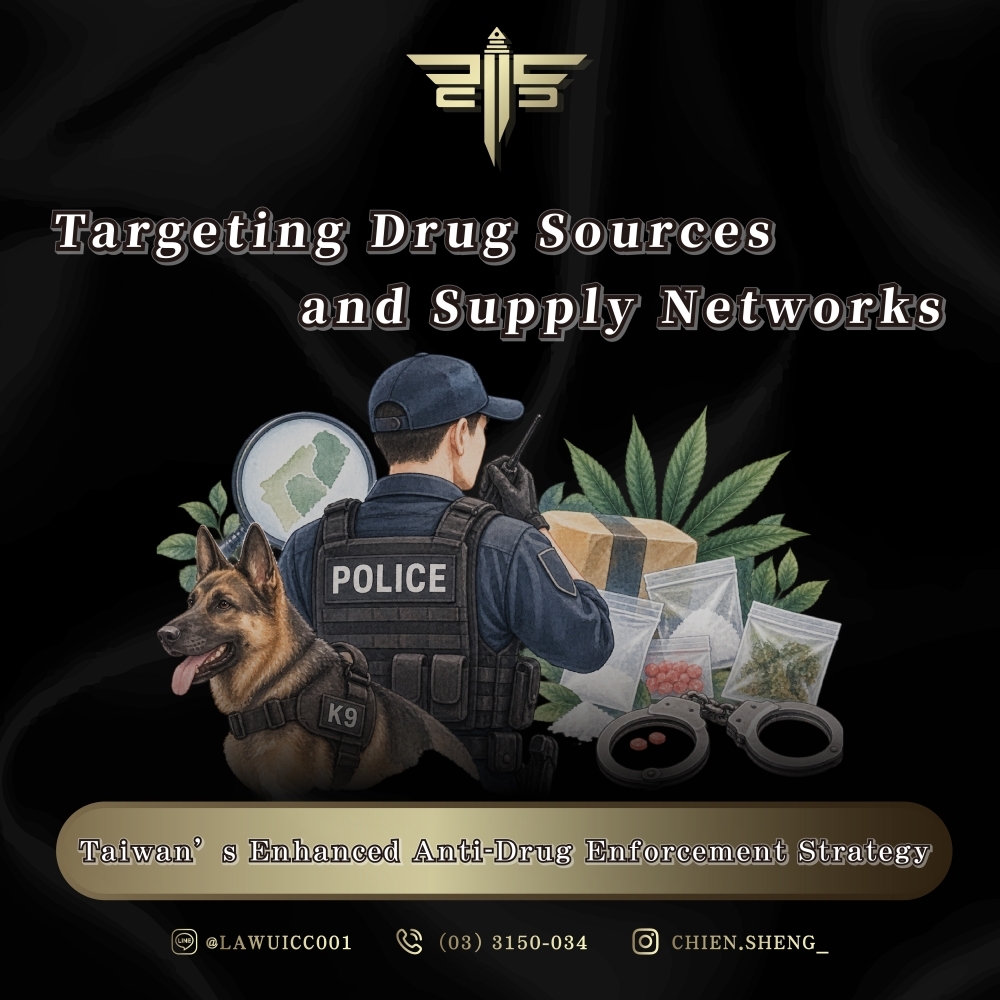
Taiwan’s Enhanced Anti-Drug Enforcement Strategy: Targeting Drug Sources and Supply Networks
商品圖像
-
商品資訊
目錄
- 1. Core Strategy: Four Key Enforcement Priorities
- 2. Targeting Drug Distribution Involving Minors: Enhanced Penalties Under Article 9 of the Narcotics Hazard Prevention Act
- 3. Tracing Drug Supply Networks: Severe Penalties Under Article 4
- 4. Combating Cross-Border Drug Trafficking and Drug Manufacturing Operations
- 5. Enforcement at Drug-Related Hotspots: Criminal Liability for Providing Premises
- 6. Your Legal Rights During Quest
- 7. Chien Sheng International Law Firm: Legal Representation in Drug Cases
Drug-related crime has continued to evolve in recent years, ranging from the spread of emerging narcotics to increasingly sophisticated cross-border trafficking operations. These developments pose significant challenges to public safety and public health.
In response, Taiwan’s National Police Agency (NPA), Ministry of the Interior, has continued to strengthen its anti-drug enforcement strategy. Its enforcement approach has increasingly emphasized tracing narcotics upstream and disrupting the underlying supply networks rather than focusing solely on lower-level offenders.
This enforcement strategy directly affects how drug cases are investigated in practice.
For individuals who may become involved in a narcotics investigation, understanding current police enforcement priorities and the relevant legal framework can help them better understand the direction of an investigation and seek legal assistance at an early stage when necessary.
1. Core Strategy: Four Key Enforcement Priorities
The central principle of the National Police Agency’s enhanced anti-drug enforcement strategy is to trace drug sources upstream and dismantle supply networks, rather than merely arresting individual drug users.
The strategy focuses on four major enforcement priorities:
■ tracing and identifying upstream drug suppliers;
■ seizing large quantities of narcotics and uncovering drug manufacturing operations;
■ preventing organized crime groups and gangs from becoming involved in narcotics offenses; and
■ enforcing required urine testing for individuals subject to such testing under applicable law.
Enhanced enforcement targeting particular groups, locations, and distribution networks also forms an important part of the strategy.
The following sections examine several of these enforcement measures together with the relevant provisions of Taiwan’s Narcotics Hazard Prevention Act and Code of Criminal Procedure.
2. Targeting Drug Distribution Involving Minors: Enhanced Penalties Under Article 9 of the Narcotics Hazard Prevention Act
Juvenile involvement in drug-related offenses remains an important concern for law enforcement.
To reduce the risk of minors and students being recruited into drug distribution networks, police enforcement places particular emphasis on identifying individuals who supply narcotics to young people or recruit minors into drug-related activities.
Under Article 9 of the Narcotics Hazard Prevention Act, where an adult commits certain narcotics offenses specified in Articles 4 through 8 against a minor, the punishment prescribed for the relevant offense may be increased by up to one-half.
Accordingly, an adult who manufactures, transports, sells, or transfers narcotics in circumstances covered by this provision may face enhanced criminal penalties when the offense is committed against a minor.
For example, offenses involving the manufacture, transportation, or sale of a Category 2 narcotic—such as methamphetamine or marijuana—are already subject to severe penalties under Article 4, Paragraph 2 of the Narcotics Hazard Prevention Act.
Where the statutory requirements of Article 9 are also satisfied because the offense was committed by an adult against a minor, the applicable punishment may be further increased.
This reflects the legislature’s heightened protection of minors from narcotics-related harm.
Police enforcement is not limited to patrols and inspections around schools.
Law enforcement authorities may also cooperate with educational institutions to prevent students from being recruited through peer relationships into narcotics offenses.
Emerging substances—including marijuana and etomidate, which has been associated with so-called “zombie vapes”—have likewise become significant enforcement concerns, with authorities using targeted anti-drug operations to prevent narcotics from entering schools and younger communities.
3. Tracing Drug Supply Networks: Severe Penalties Under Article 4
Police enforcement increasingly focuses on tracing drug cases upstream rather than stopping after discovering isolated possession or use.
Investigators may attempt to identify the source of the narcotics, intermediate distributors, and higher-level suppliers by examining communications, transaction records, financial flows, and relationships among suspected participants.
Police may also conduct enforcement operations in communities and commercial establishments where drug transactions are believed to occur.
Authorities have also promoted community-based reporting networks designed to identify narcotics activity concealed in residential buildings, rental properties, and other locations.
These measures reflect the broader objective of disrupting the supply chain rather than addressing only individual instances of possession or use.
From a legal perspective, the manufacture, transportation, and sale of narcotics are among the most serious offenses under Taiwan’s Narcotics Hazard Prevention Act.
Under Article 4, the severity of the punishment depends on the category of narcotic involved.
Offenses involving Category 1 narcotics, such as heroin, carry the most severe statutory penalties. Serious penalties also apply to Category 2 narcotics such as methamphetamine and marijuana, Category 3 narcotics such as ketamine, and Category 4 narcotics.
In addition, Article 5 separately imposes criminal liability for possessing narcotics with the intent to sell them.
The distinction between simple possession, possession with intent to sell, transportation, and sale can significantly affect the potential criminal exposure.
Accordingly, the prosecution’s evidence concerning intent, quantity, packaging, communications, financial transactions, delivery arrangements, and the defendant’s role in the alleged distribution chain may become central issues in a drug case.
4. Combating Cross-Border Drug Trafficking and Drug Manufacturing Operations
Large-scale cross-border narcotics shipments and clandestine drug manufacturing operations present different investigative challenges from ordinary possession cases.
To address these offenses, law enforcement authorities have adopted more proactive measures aimed at intercepting drug precursors, identifying high-risk businesses and shipments, reviewing customs declarations and import records, and tracing the ultimate destination of suspicious materials.
International law enforcement cooperation is also increasingly important.
Taiwanese authorities may exchange intelligence and coordinate investigations with foreign law enforcement agencies when cases involve cross-border shipments, overseas suppliers, international logistics networks, or other transnational elements.
Such investigations may involve evidence located in multiple jurisdictions and therefore raise additional issues concerning evidence collection, jurisdiction, and the roles of individual participants.
Under Article 4 of the Narcotics Hazard Prevention Act, manufacturing and transporting narcotics are serious criminal offenses and are subject to severe penalties comparable to those imposed for selling narcotics.
The applicable punishment depends on the category of narcotic involved.
The Act also separately regulates conduct associated with narcotics production.
For example, Article 12 imposes criminal liability for cultivating marijuana with the intent that it be used to manufacture narcotics.
Depending on the facts, persons who provide premises, funding, raw materials, equipment, or other assistance connected to a drug manufacturing operation may also face investigation under applicable narcotics or accomplice-liability provisions.
Another important provision is Article 17 of the Narcotics Hazard Prevention Act, which provides statutory grounds for sentence reduction in specified circumstances.
For certain offenses under Articles 4 through 8, a defendant who confesses during the investigation and throughout the relevant stages of trial may qualify for a reduction in punishment when the statutory requirements are satisfied.
Whether to confess, when to make a statement, and precisely what conduct to admit can have major consequences in a narcotics case.
A statement may affect not only eligibility for a statutory sentence reduction but also the scope of the alleged offense, the identification of accomplices, and the prosecution’s characterization of the defendant’s role.
For that reason, decisions concerning a confession should be made only after carefully evaluating the evidence and legal consequences.
5. Enforcement at Drug-Related Hotspots: Criminal Liability for Providing Premises
Police may also focus enforcement efforts on commercial establishments and other locations suspected of facilitating drug transactions or drug use.
Under a “third-party policing” approach, law enforcement authorities may coordinate with building administration, fire safety, commercial regulation, and other administrative agencies when addressing establishments associated with suspected narcotics activity.
Online drug distribution has also become an important enforcement target.
Police may conduct online investigations and, where legally permitted, use undercover investigative techniques to identify individuals suspected of advertising or selling narcotics online.
Authorities may also take measures against websites or online services used to disseminate information facilitating illegal drug transactions.
The Narcotics Hazard Prevention Act also imposes liability in certain circumstances where a third party provides real property for narcotics-related activities.
Depending on the statutory requirements and the facts of the case, knowingly providing premises for the manufacture, sale, transportation, storage, transfer, or use of narcotics may result in criminal liability.
Businesses may also face separate administrative consequences when narcotics-related activity occurs on their premises and the requirements for administrative sanctions are satisfied.
However, the mere fact that drugs are discovered at a business does not automatically establish the criminal liability of the owner or operator.
The investigation must still address the elements required by the applicable offense, including the person’s knowledge, conduct, control over the premises, and other relevant circumstances.
6. Your Legal Rights During Questioning: Access to Defense Counsel
Anyone involved in a narcotics investigation—whether concerning manufacture, transportation, sale, possession, or use—may face significant legal consequences.
When investigators are focused on tracing the supply chain upstream, an investigation may also expand to include alleged accomplices, suppliers, purchasers, financial transactions, and other participants.
As a result, drug investigations can quickly become substantially more complex than the initial allegation suggests.
Taiwan’s Code of Criminal Procedure protects a suspect’s or defendant’s right to legal representation.
Under Article 34, defense counsel has the right to meet and communicate with a detained suspect or defendant, subject to limitations permitted by law in specified circumstances.
In addition, Article 95 requires authorities, before questioning a defendant, to inform the defendant of important procedural rights, including the right to retain defense counsel.
Statements made during police, prosecutorial, or investigative questioning may later affect the scope of the prosecution, the characterization of the alleged offense, the determination of the defendant’s role, and sentencing issues.
Legal assistance at an early stage can therefore help the person understand the allegations, preserve relevant rights, and evaluate how to respond to questioning based on the evidence actually available.
7. Chien Sheng International Law Firm: Legal Representation in Drug Cases
Chien Sheng International Law Firm has experience handling a wide range of narcotics-related criminal matters.
Individuals facing investigations by police, prosecutors, or investigative authorities may experience substantial pressure, particularly when required to make immediate decisions about whether to exercise the right to remain silent, whether to provide a statement, whether to confess, and the scope and timing of any admission.
Each of these decisions may have significant consequences for the subsequent proceedings.
Drug cases may also involve highly specialized legal and evidentiary issues.
Cross-border narcotics transportation cases may involve questions concerning international evidence collection, logistics records, jurisdiction, and the defendant’s knowledge of the contents of a shipment.
Drug manufacturing cases may involve chemical testing, precursor substances, manufacturing processes, laboratory evidence, and disputes over the defendant’s actual role.
Cases involving organized crime groups may require a careful distinction between individual conduct and the broader activities of other alleged participants.
Chien Sheng International Law Firm can assist clients with:
■ legal representation during questioning by the Investigation Bureau, police, and prosecutors;
■ defense and appeals in narcotics cases;
■ evaluating whether the sentence-reduction provisions under Article 17 of the Narcotics Hazard Prevention Act may apply;
■ proceedings involving observation and rehabilitation or compulsory treatment; and
■ defense issues involving alleged money laundering or financial flows connected to narcotics offenses.
 Chien Sheng International Law Firm can review the allegations and available evidence, provide legal representation during investigative questioning, and develop a defense strategy based on the specific circumstances of the case while protecting the client’s procedural rights throughout the criminal proceedings.
This reduces both medical risks and potential legal exposure.
Chien Sheng International Law Firm

LINE Online Legal Consultation: @lawuicc001 (Click to consult)
Welcome to call to schedule a meeting: 03-3150-034
Multiple payment methods available: Cash, Credit Card, Bank Transfer
Facebook: Chien Sheng International Law Firm
Instagram: chien.sheng_
-
商品Q&A