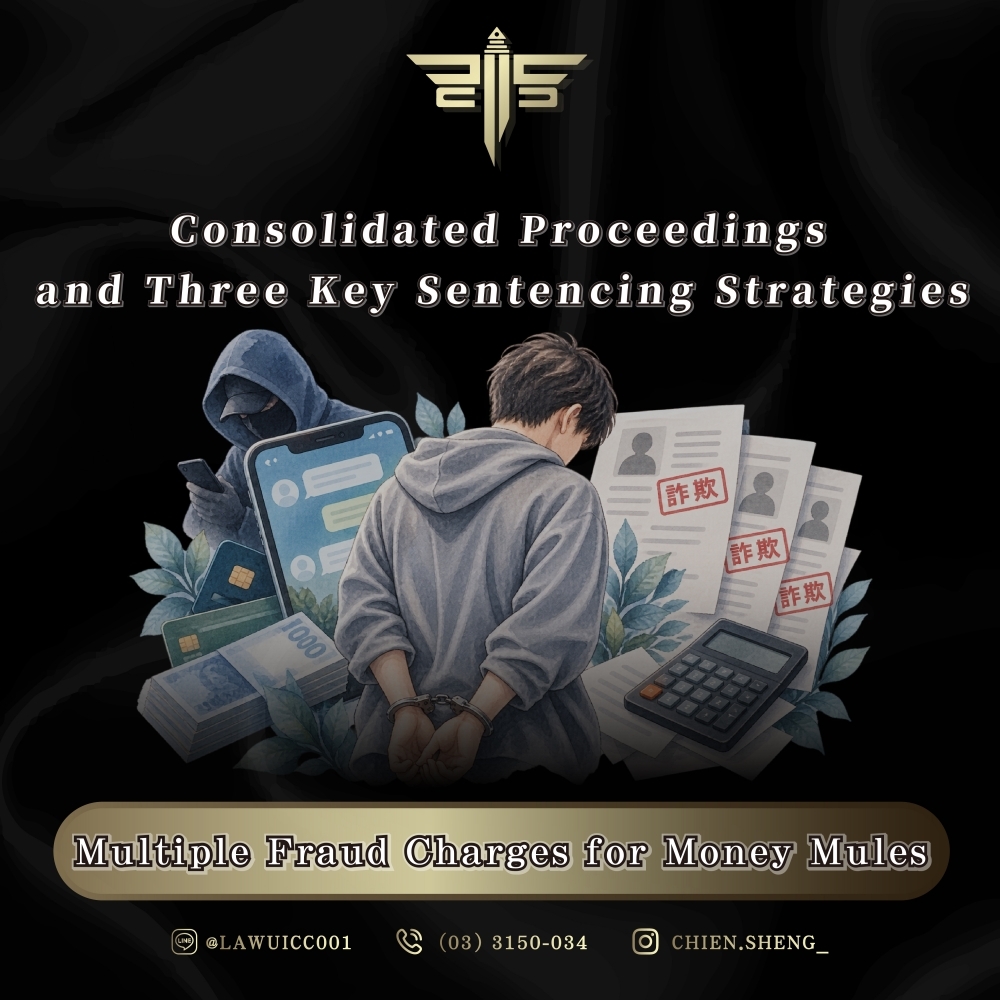
Multiple Fraud Charges for Money Mules: Consolidated Proceedings and Three Key Sentencing Strategies
商品圖像
-
商品資訊
目錄
- 1. Introduction: Why Can Several Withdrawals Lead to Multiple Fraud Charges?
- 2. Understanding Separate Offenses and Consolidated Proceedings
- 3. Chien Sheng’s Defense Strategy: Consolidating Cases and Seeking Sentence Reduction
- 4. Successful Cases Handled by Chien Sheng International Law Firm
- 5. Frequently Asked Questions About Multiple Money Mule Charges and Consolidated Proceedings
- 6. Conclusion: Early Case Coordination Can Significantly Affect the Final Outcome
1. Introduction: Why Can Several Withdrawals Lead to Multiple Fraud Charges?
“Attorney, I know I made a mistake, but I only made five ATM withdrawals. Why does the indictment say I committed five counts of aggravated fraud? If each offense carries a substantial sentence, does that mean I could end up serving several years in prison?”
Chien Sheng International Law Firm frequently receives questions like this from defendants accused of acting as money mules.
From the defendant’s perspective, the conduct may have seemed like one continuous “job”: following instructions from the same fraud organization, using the same bank card, and visiting several convenience stores or ATMs during the same afternoon.
➡︎ However, Taiwan’s criminal courts may evaluate each act separately depending on the number of victims, the nature of each transaction, and the independence of the individual acts.
This issue has become even more important following the enactment and amendment of the Fraud Crime Hazard Prevention Act, which introduced stricter rules concerning fraud offenses, sentencing, restitution, and sentence reductions.
Multiple charges do not necessarily mean that the final sentence is simply calculated by mechanically adding every sentence together. However, defendants facing cases in different jurisdictions must understand how separate offenses, consolidated proceedings, combined sentencing, restitution, confession, and suspended sentences interact.
Early coordination of multiple cases may have a significant impact on the final sentencing outcome.
2. Understanding Separate Offenses and Consolidated Proceedings
1. Why Can Multiple Withdrawals Lead to Multiple Offenses?
In criminal practice, the number of offenses in a money mule case often depends on factors such as the number of victims, the property interests infringed, and whether individual transactions are legally independent.
➡︎ For example, if five separate withdrawals involve funds belonging to five different fraud victims, prosecutors and courts may treat the conduct as multiple fraud offenses because each transaction involves a separate victim and separate property interest.
Where several withdrawals involve only one victim, the legal analysis may differ. Courts may examine the time, place, method, continuity of conduct, and whether the acts form part of a single criminal course of conduct.
Accordingly, the number of ATM withdrawals does not by itself determine the number of offenses.
Under Article 339-4, Paragraph 1, Subparagraph 2 of the Criminal Code, fraud committed jointly by three or more persons constitutes aggravated fraud and is punishable by imprisonment for one to seven years, together with a possible fine of up to NT$1 million.
Where multiple offenses are established, the court must determine the sentence for each offense and then determine the sentence to be executed in accordance with the rules governing multiple offenses under Article 51 of the Criminal Code.
The final sentence is therefore not simply determined by adding every individual sentence together. The court must determine the combined sentence within the statutory framework after considering the overall criminal conduct.
2. What Are Consolidated Proceedings?
If victims report the same defendant in different cities—for example, Taipei, Taichung, and Kaohsiung—the defendant may receive summonses from several police departments, prosecutors offices, and courts.
This can result in related criminal cases proceeding separately in different jurisdictions.
Under Article 7 of the Code of Criminal Procedure, cases involving one person accused of multiple offenses may constitute connected cases.
Where the statutory requirements are satisfied, the Code of Criminal Procedure provides mechanisms that may allow connected cases to be handled by the same competent court.The practical benefit is not merely convenience.
Where related offenses are heard together, the same court can evaluate the defendant’s overall participation, role, criminal intent, restitution efforts, post-offense conduct, and sentencing circumstances in a more complete manner.
This may also reduce the risk of inconsistent judgments and fragmented sentencing across different courts.
3. Sentencing Under the Fraud Crime Hazard Prevention Act
The Fraud Crime Hazard Prevention Act has made confession, restitution, settlement, criminal proceeds, and post-offense conduct increasingly important in fraud cases.
In addition to the sentencing factors under Article 57 of the Criminal Code, courts may consider whether a defendant maintained a lifestyle exceeding ordinary standards before fully compensating the victims.
The Act also provides sentence-reduction mechanisms in specified circumstances where defendants confess during the legally required stages and satisfy applicable restitution or settlement requirements within the statutory period.
➡︎ Because these rules are highly dependent on the exact procedural history and timing of each case, defendants should not assume that a late confession or settlement will automatically qualify for a statutory reduction.
3. Chien Sheng’s Defense Strategy: Consolidating Cases and Seeking Sentence Reduction
1. Early Coordination of Related Cases
When a defendant begins receiving notices from police or prosecutors in different jurisdictions, one of the first tasks is to identify whether the cases arise from the same period, the same alleged fraud organization, or closely connected conduct.
Where permitted by law, counsel may request that related investigations or pending cases be transferred or coordinated so they can be handled more efficiently.
The earlier this issue is identified, the greater the opportunity to prevent multiple related cases from proceeding independently until separate judgments become final.
Key Sentencing Factor 1: Emphasizing the Close Connection Between the Offenses
Even where the law treats several acts as separate offenses, counsel may still present evidence showing that they arose from a closely connected course of conduct.
Relevant circumstances may include:
■ participation during the same short period;
■ instructions from the same alleged fraud organization;
■ use of the same method or account;
■ closely connected withdrawal locations;
■ limited decision-making authority; and
■ the defendant’s subordinate role.
Where legally appropriate, counsel may also examine whether doctrines concerning concurrence of offenses apply.
Even where each offense remains separately punishable, the close relationship among the acts may still be relevant when the court determines the combined sentence under Article 51 of the Criminal Code.
Key Sentencing Factor 2: Acting Quickly on Restitution and Settlement
Restitution is often one of the most important factors in fraud sentencing.
Where the applicable provisions of the Fraud Crime Hazard Prevention Act require confession and payment pursuant to a settlement or mediation within a specified statutory period, timing can be critical.
Once related cases have been identified, counsel may assist the defendant in contacting victims, arranging mediation, documenting settlement efforts, and completing payments where financially possible.
Successful compensation does not guarantee a particular sentence, but it can materially affect statutory sentence reductions, general sentencing considerations, and the court’s assessment of whether a suspended sentence is appropriate.
If the final sentence satisfies the requirements of Article 74 of the Criminal Code, the defendant may also seek a suspended sentence where the other statutory conditions are met.
Key Sentencing Factor 3: Demonstrating Stable and Law-Abiding Conduct
Under the Fraud Crime Hazard Prevention Act and Article 57 of the Criminal Code, the defendant’s lifestyle, conduct, motives, personal circumstances, and behavior after the offense may all be relevant to sentencing.
During the proceedings, defendants should avoid conduct that could undermine claims of rehabilitation or remorse.
Useful supporting materials may include:
■ proof of stable employment;
■ labor insurance records;
■ employment certificates;
■ evidence of regular income;
■ treatment or counseling records where relevant;
■ records of restitution; and
■ other materials showing a stable and law-abiding lifestyle.
These materials may help the court evaluate the defendant’s risk of reoffending and the appropriate sentence.
4. Successful Cases Handled by Chien Sheng International Law Firm
Misled into Becoming an In-Person Cash-Collection and Withdrawal Money Mule — Suspended Sentence Successfully Obtained
The client was misled by a fraud organization and became involved as both an in-person cash-collection mule and a withdrawal mule.The trial court originally convicted the client of attempted aggravated fraud committed jointly by three or more persons.
After Chien Sheng’s defense team took over the case, counsel focused on the client’s post-offense conduct, successfully completed mediation during the appeal, and presented arguments concerning sentence reduction for an attempted offense and the applicable confession-based reduction.
The Taiwan High Court ultimately set aside the original judgment, imposed a sentence of ten months’ imprisonment, and granted a two-year suspended sentence.
Deceived into Acting as an In-Person Money Mule — Ten-Month Sentence and Suspended Sentence Obtained
The client was deceived into acting as an in-person cash-collection money mule in a case involving approximately NT$2.4 million.The client was accused of attempted aggravated fraud committed jointly by three or more persons and use of forged private documents. The prosecutor sought a sentence of two years and six months.
Chien Sheng’s attorneys identified the important fact that the purported victim had not actually been deceived from the outset, allowing the defense to argue that the offense remained attempted.
After presenting applicable mitigation arguments, the court ultimately imposed a sentence of ten months, granted a suspended sentence, and ordered 120 hours of community service together with legal education.
Online Romance Scam Led to Money Mule Charges — Suspended Sentence Obtained Without Settlement
The client became involved as an in-person money mule after being deceived through an online relationship.
Although a settlement with the victim could not be reached, Chien Sheng’s defense team emphasized several favorable circumstances, including the client’s lack of prior criminal convictions, positive post-offense conduct, cooperation with the investigation, and the absence of actual financial loss.
The Taichung District Court ultimately imposed a sentence of six months’ imprisonment and granted a two-year suspended sentence.
Multiple Fraud Cases Pending in Different Cities — Consolidated Proceedings Successfully Preserved the Opportunity for a Suspended Sentence
The client faced several fraud prosecutions in both Taipei and Tainan.Some cases had already reached the Taiwan High Court, while others remained pending before district courts.
If one case had become final before the others were resolved, the resulting criminal record could have affected the client’s eligibility for a suspended sentence in the remaining cases.
Chien Sheng’s attorneys therefore applied to consolidate the related pending cases under the connected-case provisions of the Code of Criminal Procedure.The High Court ultimately approved consolidation, allowing the related offenses to be handled together for sentencing purposes.
This reduced the risk of fragmented sentencing and inconsistent legal treatment while preserving the opportunity for the court to evaluate the defendant’s circumstances as a whole.
5. Frequently Asked Questions About Multiple Money Mule Charges and Consolidated Proceedings
1. Can I Apply for Consolidated Proceedings Immediately After Receiving a Notice from Police in Another City?
At the police-investigation stage, officers may record that other related cases exist or report the connection between cases.
Formal requests for coordinated investigation, transfer of jurisdiction, or consolidated court proceedings generally become more relevant once cases reach the prosecutors office or are filed with a court.
The appropriate procedure depends on the procedural stage and the jurisdictions involved.
2. Can Cases Still Be Consolidated After Some of Them Have Already Been Indicted?
Potentially, yes, if the relevant cases remain pending and the statutory requirements for connected cases and jurisdiction are satisfied.
However, once individual judgments have become final, those cases ordinarily can no longer simply be consolidated for a new joint trial.
Instead, after multiple judgments become final, a separate issue may arise concerning determination of the sentence to be executed for multiple offenses.
For this reason, identifying related cases early is particularly important.
3. After the New Anti-Fraud Law, Can a First-Time Money Mule Who Made Many Withdrawals Still Receive a Suspended Sentence?
A suspended sentence may still be legally possible, but it is not automatic.
Under Article 74 of the Criminal Code, the defendant must satisfy the applicable statutory requirements, including requirements concerning the sentence imposed and prior criminal history.
The court may also consider restitution, settlement, confession, the defendant’s role, post-offense conduct, employment, family circumstances, and risk of reoffending.
Where multiple charges exist, coordinated proceedings and early restitution efforts may be particularly important in seeking a final sentence that remains within the legal range for a suspended sentence.
4. What If Some Victims Refuse to Settle?
A victim’s refusal to settle may affect the court’s sentencing assessment, but failure to obtain a settlement does not necessarily eliminate every possibility of a favorable sentence.
Counsel may preserve records showing genuine efforts to contact the victim, propose reasonable compensation, participate in mediation, and make restitution where possible.Courts may consider these efforts as part of the defendant’s overall post-offense conduct.
As demonstrated by prior cases handled by our firm, a suspended sentence may still be possible in an appropriate case even where a settlement cannot ultimately be reached.
6. Conclusion: Early Case Coordination Can Significantly Affect the Final Outcome
Multiple offenses can make a money mule case appear overwhelming, particularly where indictments are filed in several jurisdictions.
However, criminal sentencing is not simply a mechanical process of adding every charge together.
The number of victims, relationship among the offenses, defendant’s role, timing of the conduct, confession, restitution, settlement, prior record, and post-offense behavior can all affect the final outcome.
For defendants facing several related fraud cases, early identification of connected cases, timely consideration of consolidation, preservation of favorable evidence, and prompt handling of restitution may significantly affect sentencing.
 Chien Sheng International Law Firm handles criminal fraud and money mule cases involving multiple victims, multiple jurisdictions, aggravated fraud, money laundering, connected cases, consolidated proceedings, restitution, sentence reductions, and suspended sentences.
When a defendant is facing summonses or prosecutions in different cities, the cases should be reviewed together as early as possible.The goal is to determine which matters are legally connected, whether consolidation or transfer is available, what sentence-reduction provisions may apply, and how restitution and sentencing materials should be coordinated.
【Related Successful Chien Sheng Cases】
【Acquittals】
► Romance Scam Victim Became a Money Mule — Acquitted of Fraud
► Home-Based Work Scam Led to Money Mule Charges — Acquitted of Fraud
► Cryptocurrency Investment Scam Led to Money Mule Charges — Both Co-Defendants Acquitted
► Online Dating Scam Led to Fraud Money Mule Charges — Attorney Successfully Obtained an Acquittal
【Non-Prosecution Cases】
► Romance Scam Victim Was Used as a Money Mule — Non-Prosecution Successfully Obtained
► Deceived by a Part-Time Job and Drawn into Fraudulent Fund Transfers — Non-Prosecution Obtained
【Video】
► Watch the Full Video: “Two Cases in One Trial? Consolidated Proceedings Explained”
Chien Sheng International Law Firm

LINE Online Legal Consultation: @lawuicc001 (Click to consult)
Welcome to call to schedule a meeting: 03-3150-034
Multiple payment methods available: Cash, Credit Card, Bank Transfer
Facebook: Chien Sheng International Law Firm
Instagram: chien.sheng_
-
商品Q&A


