First-Time Money Laundering Charges in Taiwan: Penalties and Defense Strategies
商品圖像

-
商品資訊
目錄
- 1. Introduction: What Should You Do If You Are Unexpectedly Involved in a Money Laundering Case?
- 2. Elements of Money Laundering: What Conduct Can Constitute the Offense?
- 3. What Are the Penalties for Money Laundering? Will You Go to Prison?
- 4. What Can a First-Time Offender Do? Strategies for Seeking Non-Prosecution, Acquittal, or a Suspended Sentence
- 5. Chien Sheng International Law Firm: Professional Defense for Money Laundering and Fraud Cases
- 6. Conclusion: Seek Professional Legal Assistance as Early as Possible
1. Introduction: What Should You Do If You Are Unexpectedly Involved in a Money Laundering Case?
“Attorney, I only lent my bank account to a friend or helped receive a payment. How did I suddenly become a defendant in a money laundering case? Will a first-time offender go to prison? I really did not know the money came from a fraud ring.”
These are questions we frequently hear from clients at Chien Sheng International Law Firm.
Fraud schemes in Taiwan have become increasingly sophisticated in recent years.
People may unknowingly become involved as holders of dummy accounts, money mules, cash collectors, or account-book collectors while:
■ applying for jobs;
■ making friends or dating online;
■ investing in cryptocurrency;
■ applying for loans; or
■ simply lending a bank account to a family member or friend.
When they later receive a police notice or a summons from the District Prosecutors Office and discover that they are being investigated under Taiwan’s Money Laundering Control Act, many are shocked and frightened.
Following several legislative amendments, the penalties for money laundering have become significantly more serious.
Many people assume that being a first-time offender or claiming that they were unaware of the illegal activity will automatically protect them from criminal liability.
In practice, however, prosecutors and courts closely examine the defendant’s knowledge, conduct, transaction history, communications, and surrounding circumstances.
If the case is not handled properly from the beginning, the defendant may face substantial criminal consequences, including imprisonment.
This article explains the legal elements of money laundering, the current penalty structure, and the strategies that may be available to first-time defendants seeking non-prosecution, deferred prosecution, acquittal, or a suspended sentence.
If you are searching for information about money laundering defense attorneys or what to do as a first-time defendant, understanding these issues early can be critical to protecting your rights.
2. Elements of Money Laundering: What Conduct Can Constitute the Offense?
Many people still associate money laundering with scenes from movies in which criminal organizations move large amounts of cash overseas.
Under Taiwanese law, however, the legal definition of money laundering is much broader.
Under Article 2 of the Money Laundering Control Act, money laundering generally includes several forms of conduct involving proceeds derived from specified criminal activity.
1. Transferring or Converting Criminal Proceeds
This includes transferring or altering specified criminal proceeds with the intent to:
■ conceal or disguise their source; or
■ help another person avoid criminal investigation or prosecution.
For example, the organizer of a fraud ring may transfer fraud proceeds into overseas accounts to make the funds more difficult to trace.
2. Concealing or Disguising Criminal Proceeds
Money laundering may also involve concealing or disguising the:
■ nature;
■ source;
■ destination;
■ location;
■ ownership;
■ right of disposition; or
■ other rights connected with specified criminal proceeds.
For example, a money mule who withdraws fraud proceeds and delivers the cash to an upstream member may a break in the financial trail.
3. Receiving, Possessing, or Using Another Person’s Criminal Proceeds
This is one of the situations most frequently encountered in practice.
For example, a person may provide a bank account into which fraud proceeds are deposited, or may receive a package containing illicit funds or account materials.
Depending on the person’s knowledge, intent, and actual conduct, such activity may become part of a money laundering investigation.
The key concept in these offenses is “proceeds of specified criminal activity.”
Money laundering must be connected to an underlying predicate offense, such as:
■ fraud;
■ corruption;
■ drug trafficking; or
■ another offense designated by law.
In practice, many money laundering cases are connected to aggravated fraud under Article 339-4 of the Criminal Code.
Where fraud proceeds are deposited into a person’s account, prosecutors may investigate both the underlying fraud-related conduct and possible money laundering liability.
3. What Are the Penalties for Money Laundering? Will You Go to Prison?
One of the most common questions defendants ask is: How serious are the penalties for money laundering?
Under the current Article 19 of the Money Laundering Control Act, the applicable sentence depends in part on the value of the property or financial benefit involved in the laundering activity.
1. Amount Below NT$100 Million
Where the value of the laundered property or financial benefit is less than NT$100 million, the offense is punishable by imprisonment for six months to five years, together with a fine of up to NT$50 million.
2. Amount of NT$100 Million or More
Where the amount reaches NT$100 million or more, the offense is punishable by imprisonment for three to ten years, together with a fine of up to NT$100 million.
Attempted money laundering may also be punishable.
Can a Money Laundering Sentence Be Converted into a Fine?
Under Article 41 of the Criminal Code, conversion of imprisonment into a fine may be available where the statutory conditions are satisfied, including where the offense carries a maximum term of imprisonment of no more than five years and the sentence actually imposed is no more than six months.
Under the current penalty structure, money laundering involving less than NT$100 million carries a statutory maximum of five years.
This means that if a defendant is ultimately sentenced to six months of imprisonment, there may be an opportunity to seek conversion of the sentence into a fine, provided the other statutory requirements are satisfied.
➡︎ However, this does not mean that every defendant will avoid imprisonment.
If the court imposes a sentence of more than six months, conversion into a fine may no longer be available under the ordinary rules.
Sentencing will depend on factors such as:
■ the defendant’s role;
■ the amount involved;
■ criminal intent;
■ prior criminal record;
■ attitude after the offense;
■ whether the defendant confessed;
■ whether compensation was paid; and
■ whether a settlement was reached with the victims.
4. What Can a First-Time Offender Do? Strategies for Seeking Non-Prosecution, Acquittal, or a Suspended Sentence
Does a first-time defendant still have a realistic opportunity to avoid imprisonment?
In many cases, yes.
➡︎ However, the appropriate strategy depends heavily on the evidence and the defendant’s actual role in the case.
1. Key Strategies for Seeking Non-Prosecution or Acquittal
During the investigation stage, obtaining a non-prosecution decision may be one of the best possible outcomes.
Chien Sheng’s attorneys carefully review objective evidence such as:
■ chat records;
■ account transactions;
■ employment advertisements;
■ loan communications;
■ cryptocurrency records;
■ payment records; and
■ the defendant’s relationship with the person who requested use of the account.
If a client was deceived through a job offer, an online romance scam, a loan application, or another apparently legitimate arrangement, the defense may focus on whether the client actually possessed the required criminal intent to assist fraud or money laundering.
The central issue is often not merely whether the defendant provided an account or handled funds, but whether the prosecution can prove that the defendant knew of or intentionally accepted the risk of participating in criminal activity.
Where the person was genuinely deceived and lacked the necessary criminal intent, there may be grounds to seek non-prosecution or an acquittal.
Relevant defense evidence may include proof that:
■ the defendant had a legitimate reason for providing the account;
■ the defendant did not receive any commission or illegal benefit;
■ the defendant was also deceived by the fraud ring;
■ communications presented the arrangement as legitimate; and
■ the defendant’s conduct after discovering the fraud was consistent with that of a victim rather than an accomplice.
2. Seeking a Suspended Sentence
If the objective evidence is unfavorable or the case has already proceeded to trial, seeking a suspended sentence may become an important strategy.
Under Article 74 of the Criminal Code, a suspended sentence may be available where the statutory requirements are satisfied.
One basic requirement is that the court impose a sentence of no more than two years of imprisonment, short-term imprisonment, or a fine.
The defendant must also satisfy the criminal-record conditions set out in Article 74.
Being a first-time offender is therefore an important favorable factor, although eligibility must still be assessed under the specific statutory requirements.
In fraud-related money laundering cases, reaching a settlement with victims and compensating their losses can be highly significant.
Depending on the applicable statutes and facts, a defendant’s:
■ confession;
■ compensation;
■ settlement efforts; and
■ demonstrated willingness to repair the harm
may affect both statutory sentence reduction and the court’s overall sentencing decision.
Chien Sheng’s attorneys have extensive experience assisting clients with settlement negotiations and compensation arrangements.Even where there are multiple victims or substantial losses, counsel may work to develop a realistic compensation plan and present the defendant’s efforts to repair the harm to the court.
Other favorable circumstances, including post-offense conduct, compliance with court requirements, family responsibilities, employment, and the risk of reoffending, may also be presented in support of a suspended sentence.
5. Chien Sheng International Law Firm: Professional Defense for Money Laundering and Fraud Cases
When facing a money laundering accusation, choosing an attorney with substantial experience in criminal defense can have a major impact on the direction of the case.
Chien Sheng International Law Firm has extensive experience handling fraud and money laundering cases throughout Taiwan.
Our offices in Taipei, Taoyuan, and Kaohsiung provide legal services to clients facing criminal investigations and prosecutions in different jurisdictions.Our defense team combines legal analysis with substantial courtroom and investigative experience.
 Case 1: Debit Card Sent to Another Person — Acquittal Successfully Obtained
The client unknowingly fell into a fraud scheme and handed over a debit card.
The client was later accused of aiding fraud and money laundering.
Chien Sheng’s defense team carefully reconstructed the circumstances and demonstrated that the client lacked the necessary criminal intent.
The court ultimately entered a judgment of acquittal.
Case 2: Fraud Proceeds Deposited into Client’s Account — Non-Prosecution Successfully ObtainedFraud proceeds were transferred into the client’s account, leading to an investigation for aiding money laundering.
After becoming involved, Chien Sheng’s attorneys presented evidence explaining the legitimate background of the transactions.
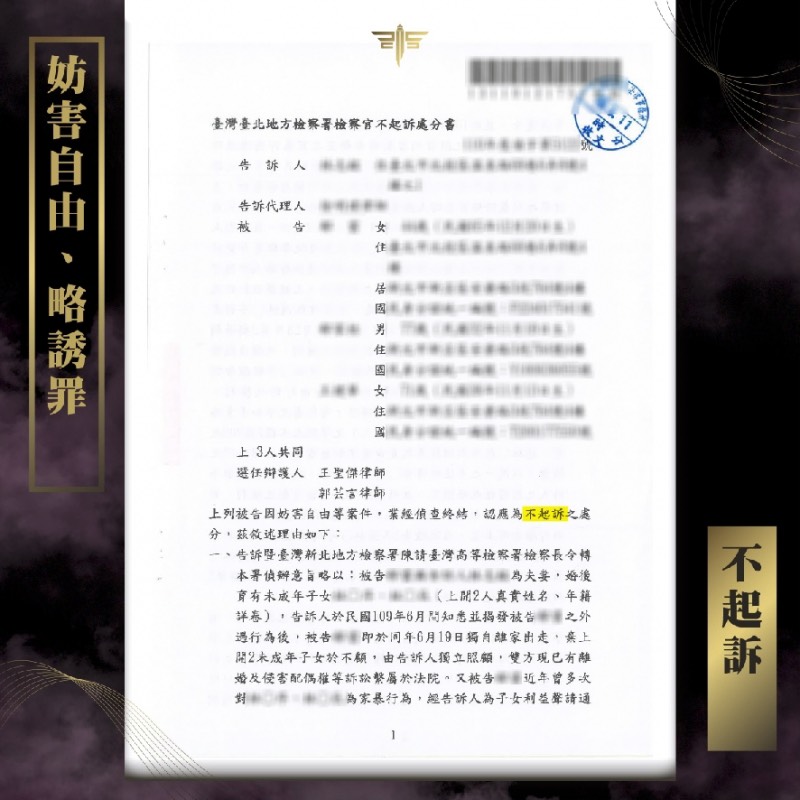
The defense successfully obtained a non-prosecution decision during the investigation stage, avoiding further criminal proceedings.
Case 3: Romance Scam Victim Helped Receive Funds — Acquittal in Fraud and Money Laundering CaseThe client became a victim of an online romance scam and, following the other person’s instructions, allowed funds to be transferred into the client’s account and later withdrew cash.
The client was subsequently accused of aggravated fraud involving three or more participants and money laundering.
Chien Sheng’s attorneys carefully reconstructed how the client had been deceived and successfully obtained an acquittal.
Case 4: Australian National Involved in a Taiwan Money Laundering Case — Suspended Sentence Successfully ObtainedAn Australian client became involved in a money laundering case while in Taiwan.
Chien Sheng’s legal team provided full legal assistance in English, identified the key issues in the case, and successfully obtained a suspended sentence, helping protect the client’s legal interests in Taiwan.
6. Conclusion: Seek Professional Legal Assistance as Early as Possible
Money laundering offenses can carry serious criminal penalties, and the standards applied by prosecutors and courts can be strict.
If you or a family member becomes involved in a money laundering investigation, do not assume that being a first-time offender will automatically resolve the case.
Early statements, especially the first police interview, can have a significant impact on how the facts are later understood and characterized.
Before giving detailed statements, it is important to understand the allegations, the evidence, and your procedural rights.
If you are looking for experienced legal representation in a money laundering case, Chien Sheng International Law Firm provides criminal defense services tailored to the facts and evidence of each case.
Our attorneys can assist with:
■ police questioning;
■ prosecutorial investigation;
■ analysis of criminal intent;
■ account and transaction evidence;
■ settlement negotiations;
■ applications for non-prosecution or deferred prosecution;
■ acquittal defenses; and
■ suspended-sentence strategies.
Our goal is not to promise a particular outcome, but to develop the strongest legally supportable defense strategy based on the evidence and circumstances of your case.
Chien Sheng International Law Firm

LINE Online Legal Consultation: @lawuicc001 (Click to consult)
Welcome to call to schedule a meeting: 03-3150-034
Multiple payment methods available: Cash, Credit Card, Bank Transfer
Facebook: Chien Sheng International Law Firm
Instagram: chien.sheng_
-
商品Q&A