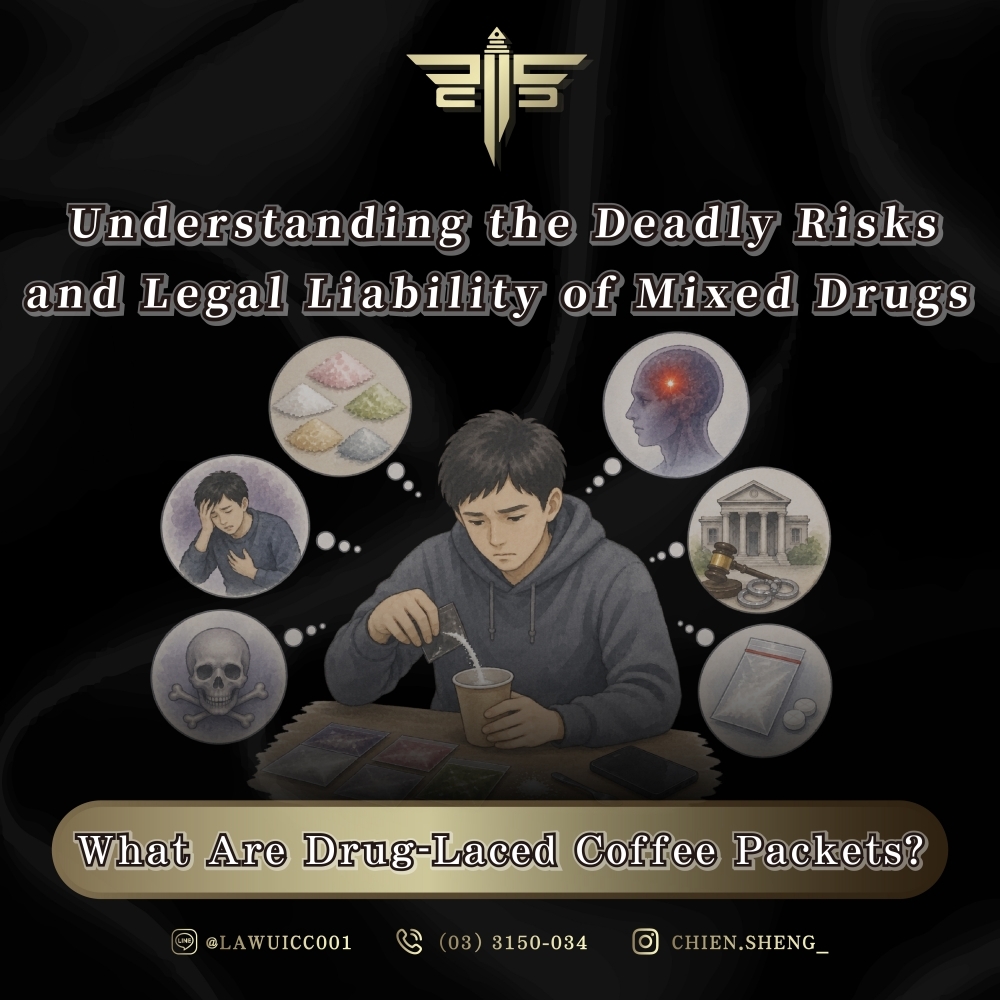
What Are Drug-Laced Coffee Packets? Understanding the Deadly Risks and Legal Liability of Mixed Drugs
商品圖像
-
商品資訊
目錄
- 1. The Truth About Drug-Laced Coffee Packets: A Deadly Substance in Disguise
- 2. Drug Classification and Criminal Liability: From Category 1 to Category 4
- 3. Legal Liability for Drug-Laced Coffee Packets: The Contents Determine the Consequences
- 4. Liability for Possessing and Using Drug-Laced Coffee Packets
- 5. Possession with Intent to Sell: A Serious Offense Separated by a Fine Line
- 6. Opposing Parties and Corroborating Evidence in Drug Cases
- 7. Police-Induced Questioning and Confession Strategies
- 8. Why Do Drug Cases Require an Experienced Criminal Defense Lawyer?
- 9.Conclusion: Stay Away from Drugs and Seek Professional Legal Assistance
In recent years, the term “drug-laced coffee packets” has frequently appeared in news reports in Taiwan. Many people have heard the term but do not fully understand what these packets actually contain, what substances may be mixed inside them, or the serious criminal liability they may carry.
Based on Chien Sheng International Law Firm’s practical experience, we have seen many individuals become involved with drug-laced coffee packets out of curiosity or peer pressure, only to later face severe criminal consequences.
This article explains what drug-laced coffee packets really are and examines the legal risks associated with mixed drugs under Taiwan law.
1. The Truth About Drug-Laced Coffee Packets: A Deadly Substance in Disguise
Drug-laced coffee packets are illegal drug products disguised as ordinary instant coffee, milk tea, juice powder, or other powdered beverages.
To avoid police detection and reduce users’ suspicion, drug distributors may grind narcotics into powder, mix them into commercially available beverage packets, reseal the packaging, and then sell them.
Some criminal groups even produce their own packaging featuring well-known trademarks, cartoon characters, or popular slogans in order to attract younger users.
The greatest danger of drug-laced coffee packets, however, is not their packaging but their contents.
Unlike traditional drugs containing a single substance, such as pure heroin or amphetamine, drug-laced coffee packets are often a form of mixed synthetic drug.
This means that a single packet may contain several controlled substances belonging to different drug categories and producing different effects.
According to testing data from Taiwan’s National Police Agency and Ministry of Health and Welfare, commonly detected substances include:
■ 1. Category 2 narcotics: such as MDMA (commonly known as ecstasy), amphetamine, and synthetic cathinones. These substances generally stimulate the central nervous system and may cause hallucinations, rapid heartbeat, and elevated blood pressure.
■ 2. Category 3 narcotics: such as ketamine and FM2. These substances may have depressant or anesthetic effects on the central nervous system and can cause dissociation, memory impairment, unconsciousness, or coma.
➠ When stimulants and depressants are mixed together and consumed at the same time, dangerous interactions may occur.
The body may effectively receive conflicting signals to “speed up” and “slow down” simultaneously, causing severe disruption to the central nervous system.
This can result in arrhythmia, respiratory failure, acute kidney failure, and even sudden death. This is one of the reasons mixed drug packets are particularly dangerous.
2. Drug Classification and Criminal Liability: From Category 1 to Category 4
To understand the criminal liability associated with drug-laced coffee packets, it is first necessary to understand Taiwan’s drug classification system under the Narcotics Hazard Prevention Act.
Under Article 2 of the Narcotics Hazard Prevention Act, controlled drugs are divided into four categories based on their potential for addiction, abuse, and harm to society.
Different categories carry significantly different criminal penalties.
■ Category 1 Narcotics: The Most Severe Penalties
Category 1 narcotics include heroin, morphine, opium, cocaine, and similar substances.
Because these substances are considered highly addictive and harmful, they are subject to the most severe penalties.
Under Article 4, Paragraph 1 of the Narcotics Hazard Prevention Act, manufacturing, transporting, or selling Category 1 narcotics is punishable by death or life imprisonment. Where life imprisonment is imposed, a fine of up to NT$30 million may also be imposed.
Even simple possession carries criminal liability.
Under Article 11 of the Narcotics Hazard Prevention Act, possession of Category 1 narcotics may be punishable by imprisonment of up to three years, detention, or a fine of up to NT$300,000.
If the net pure weight reaches ten grams or more, the penalties become substantially more severe.
■ Category 2 Narcotics: Strict Criminal Control
Category 2 narcotics include marijuana, amphetamine, MDMA, and similar substances.
Under Article 4, Paragraph 2 of the Narcotics Hazard Prevention Act, manufacturing, transporting, or selling Category 2 narcotics is punishable by life imprisonment or imprisonment for not less than ten years, and a fine of up to NT$15 million may also be imposed.
Under Article 11, possession of Category 2 narcotics may also result in imprisonment, detention, or a fine.
Where the pure net weight reaches the statutory threshold, enhanced possession penalties may apply.
■ Category 3 and Category 4 Narcotics: Criminal Liability Should Not Be Underestimated
Category 3 narcotics include substances such as ketamine and FM2, while Category 4 narcotics include certain controlled pharmaceutical substances and related compounds.
Under Article 4, Paragraphs 3 and 4 of the Narcotics Hazard Prevention Act, manufacturing, transporting, or selling Category 3 narcotics is punishable by imprisonment for not less than seven years, while the corresponding offense involving Category 4 narcotics is punishable by imprisonment for not less than five years but not more than twelve years.
Possession of Category 3 or Category 4 narcotics above the statutory pure-weight thresholds may also result in criminal penalties.
Where a person possesses or uses Category 3 or Category 4 narcotics without legitimate reason, administrative fines and mandatory drug-harm prevention education may also apply under the Narcotics Hazard Prevention Act.
3. Legal Liability for Drug-Laced Coffee Packets: The Contents Determine the Consequences
Because drug-laced coffee packets are mixed drugs, legal liability may be more complicated than in cases involving a single controlled substance.
When police seize suspected drug packets, the evidence is generally sent to a professional laboratory for chemical testing.
The laboratory report identifies the controlled substances contained in the packets, as well as their concentrations and purity.
Courts then rely heavily on these test results when determining the applicable criminal liability.
Applying the Penalty for the Highest-Level Drug
A particularly important rule appears in Article 9, Paragraph 3 of the Narcotics Hazard Prevention Act.
Where a person manufactures, transports, sells, possesses with intent to sell, unlawfully administers, induces another person to use, or transfers drugs containing a mixture of two or more controlled substances, the statutory penalty applicable to the highest-category drug applies, and the punishment may be increased by up to one-half.
➡︎ For example, suppose a person sells drug-laced coffee packets containing both a Category 2 narcotic, such as MDMA, and a Category 3 narcotic, such as ketamine.
The case will not simply be treated as two unrelated drug offenses. Instead, the statutory penalty applicable to the higher-level substance—Category 2 narcotics—will apply.
In Chien Sheng International Law Firm’s experience, some defendants initially believe that selling only a small number of drug-laced coffee packets will result in relatively minor criminal liability.
However, once laboratory testing reveals multiple controlled substances, they may face significantly enhanced penalties under the mixed-drug provisions.
4. Liability for Possessing and Using Drug-Laced Coffee Packets
If a drug-laced coffee packet contains Category 1 or Category 2 narcotics, use of the packet may trigger criminal liability under Article 10 of the Narcotics Hazard Prevention Act.
Use of Category 1 narcotics is punishable by imprisonment for six months to five years, while use of Category 2 narcotics is punishable by imprisonment for up to three years.
In appropriate cases, prosecutors may also petition the court to order observation and rehabilitation.
➡︎ However, observation and rehabilitation is not necessarily the only possible outcome.
Under Taiwan’s drug-control framework and the Code of Criminal Procedure, prosecutors may in certain circumstances grant a deferred prosecution disposition subject to drug addiction treatment conditions.
This allows the prosecution to be suspended while the defendant completes a prescribed treatment program.
If the treatment requirements are successfully completed, the criminal case may ultimately be concluded without prosecution.
➡︎ To seek deferred prosecution with addiction treatment, the defendant generally needs to cooperate with the treatment process, complete the required consent procedures, receive treatment at an approved medical institution, and comply with the prosecutor’s treatment requirements.
In practice, treatment programs may last approximately one year and require regular medical evaluation and follow-up.
★ Whether deferred prosecution is available depends on the circumstances of each case.
Prosecutors may consider factors such as the seriousness of the conduct, prior criminal history, willingness to undergo treatment, rehabilitation prospects, and family support.
For this reason, early legal representation may be particularly important before the prosecutor makes a final decision.
If the court has already issued an order for observation and rehabilitation, legal remedies may still be available.
A defendant may file an appeal against the court’s order and request that a higher court revoke or the decision.
Relevant new facts or evidence, such as voluntary participation in addiction treatment or stronger family support, may be submitted as part of the appeal.
For possession offenses, the pure net weight of the controlled substance is important.
The pure net weight refers to the actual amount of the prohibited drug after substances such as coffee powder, creamer, flavoring, or other non-drug ingredients have been excluded.
Although drug-laced coffee packets often contain substantial filler material, criminal liability may still increase if the pure narcotic content reaches the statutory threshold.
5. Possession with Intent to Sell: A Serious Offense Separated by a Fine Line
Another serious offense frequently encountered in drug cases is possession of narcotics with intent to sell.
A defendant found with a large number of drug-laced coffee packets may claim that the drugs were only intended for personal use.
However, if the quantity greatly exceeds a reasonable amount for personal consumption, or police also seize packaging materials, electronic scales, transaction records, or other sales-related items, prosecutors may argue that the defendant intended to sell the drugs.
Under Article 5 of the Narcotics Hazard Prevention Act, possession of Category 1 narcotics with intent to sell carries extremely severe penalties, while possession of Category 2 narcotics with intent to sell is also punishable by substantial imprisonment.
These penalties are dramatically more serious than those for simple possession.
In cases involving allegations of possession with intent to sell, courts may consider multiple factors, including the quantity of drugs, packaging methods, the defendant’s financial circumstances, drug-use history, communication records, and surrounding evidence.
Chien Sheng International Law Firm analyzes these factors carefully to determine whether the prosecution can actually prove an intent to sell.
Transferring Drug-Laced Coffee Packets: Giving Them Away for Free Can Still Be a Crime
A common misconception is that giving drug-laced coffee packets to a friend without receiving payment is not a criminal offense.
Under Taiwan law, providing narcotics to another person without compensation may constitute transfer of narcotics.
Under Article 8 of the Narcotics Hazard Prevention Act, transferring Category 1 or Category 2 narcotics carries criminal penalties.
Therefore, even “sharing” a packet with a friend at a party or gathering may result in serious criminal liability.
6. Opposing Parties and Corroborating Evidence in Drug Cases
Drug transactions often involve two opposing parties: the seller and the buyer.
In many cases, police first arrest the purchaser orand then rely on that person’s statements to investigate an alleged supplier.
This raises an important evidentiary question:
Can the buyer’s statement alone be sufficient to convict the alleged seller?
Generally, courts require additional corroborating evidence.
This requirement exists partly because a buyer may have an incentive to identify another person as the drug source in order to seek a sentence reduction.
Corroborating evidence may include independent evidence such as:
■ LINE messages or other communications;
■ bank transfer records;
■ surveillance footage;
■ narcotics seized from the alleged seller;
■ packaging equipment, scales, or transaction records.
Only when the buyer’s statements are sufficiently supported by other evidence can the court more reliably conclude that the alleged transaction occurred.
In certain circumstances, statements from multiple buyers may also be considered together.
Where their statements were made independently and are mutually consistent, courts may consider whether those statements can provide corroborative support for one another.
The evidentiary analysis remains highly fact-specific.
In drug-sale cases, Chien Sheng International Law Firm pays particular attention to the quality and legality of corroborating evidence.
We carefully examine whether witness statements contain inconsistencies, whether communications actually establish a drug transaction, and whether the prosecution’s evidence is sufficient to prove guilt beyond a reasonable doubt.
7. Police-Induced Questioning and Confession Strategies
During the investigation stage, defendants may face intensive police questioning.
In practice, some defendants report being told statements such as:
“If you confess to selling drugs, we will help you ask the prosecutor to release you on bail.”
or:
“Your friends have already identified you. If you still refuse to confess, the judge will give you a heavier sentence.”
Such statements may place enormous psychological pressure on individuals who are unfamiliar with criminal procedure.
Whether to confess is a highly consequential strategic decision.
If the defendant actually committed the offense and the evidence is strong, a carefully considered confession—after consultation with counsel—may potentially provide grounds for sentence reduction.
Under Article 17 of the Narcotics Hazard Prevention Act, defendants in certain drug-sale cases may qualify for sentence reduction if they confess during the investigation and at each stage of trial.
A defendant who identifies the source of the narcotics and thereby enables authorities to apprehend another principal offender or accomplice may also qualify for a reduction or exemption from punishment.
However, if the defendant is innocent or has been falsely accused, they should not confess merely because of police pressure.
Once incriminating statements are recorded in a police interview record, reversing those statements later in court may become much more difficult.
Seeking legal counsel before or during questioning can therefore be critical to protecting the defendant’s rights and ensuring that statements are accurate and voluntary.
8. Why Do Drug Cases Require an Experienced Criminal Defense Lawyer?
■ 1. Precise Legal Analysis: We carefully review laboratory reports to determine the substances, purity, and weight of the drugs involved and analyze the potential criminal liability under the Narcotics Hazard Prevention Act.
■ 2. Thorough Evidence Review: We examine communications, witness statements, search and seizure procedures, laboratory reports, and other prosecution evidence, with particular attention to the sufficiency and legality of corroborating evidence.
■ 3. Developing the Appropriate Defense Strategy: Depending on the facts and evidence, we may evaluate strategies including seeking an acquittal, deferred prosecution, sentence reduction based on confession, or mitigation based on cooperation with the investigation.
■ 4. Protecting Fundamental Rights: We assist clients throughout the investigation and trial process, including police questioning and prosecutorial hearings, to help prevent involuntary, misleading, or improperly induced statements.
9.Conclusion: Stay Away from Drugs and Seek Professional Legal Assistance
Drug-laced coffee packets are particularly dangerous because their attractive packaging and concealed ingredients can make them appear less harmful than they actually are.
In reality, mixed drugs can cause devastating physical harm and may expose those involved to severe criminal penalties.
Manufacturing, transporting, selling, possessing, transferring, or using drug-laced coffee packets may all result in significant legal consequences.
 If you or a family member becomes involved in a drug-laced coffee packet case, remain cautious about making statements before fully understanding the allegations and evidence.
Early assistance from an experienced criminal defense lawyer can be critical.
Chien Sheng International Law Firm has extensive experience handling drug-related criminal cases and can assist with evidence analysis, investigation strategy, defense preparation, and protection of defendants’ procedural rights.
※ If you are facing a drug-related criminal investigation, please contact Chien Sheng International Law Firm for professional legal assistance and criminal defense representation.
Chien Sheng International Law Firm

LINE Online Legal Consultation: @lawuicc001 (Click to consult)
Welcome to call to schedule a meeting: 03-3150-034
Multiple payment methods available: Cash, Credit Card, Bank Transfer
Facebook: Chien Sheng International Law Firm
Instagram: chien.sheng_
-
商品Q&A