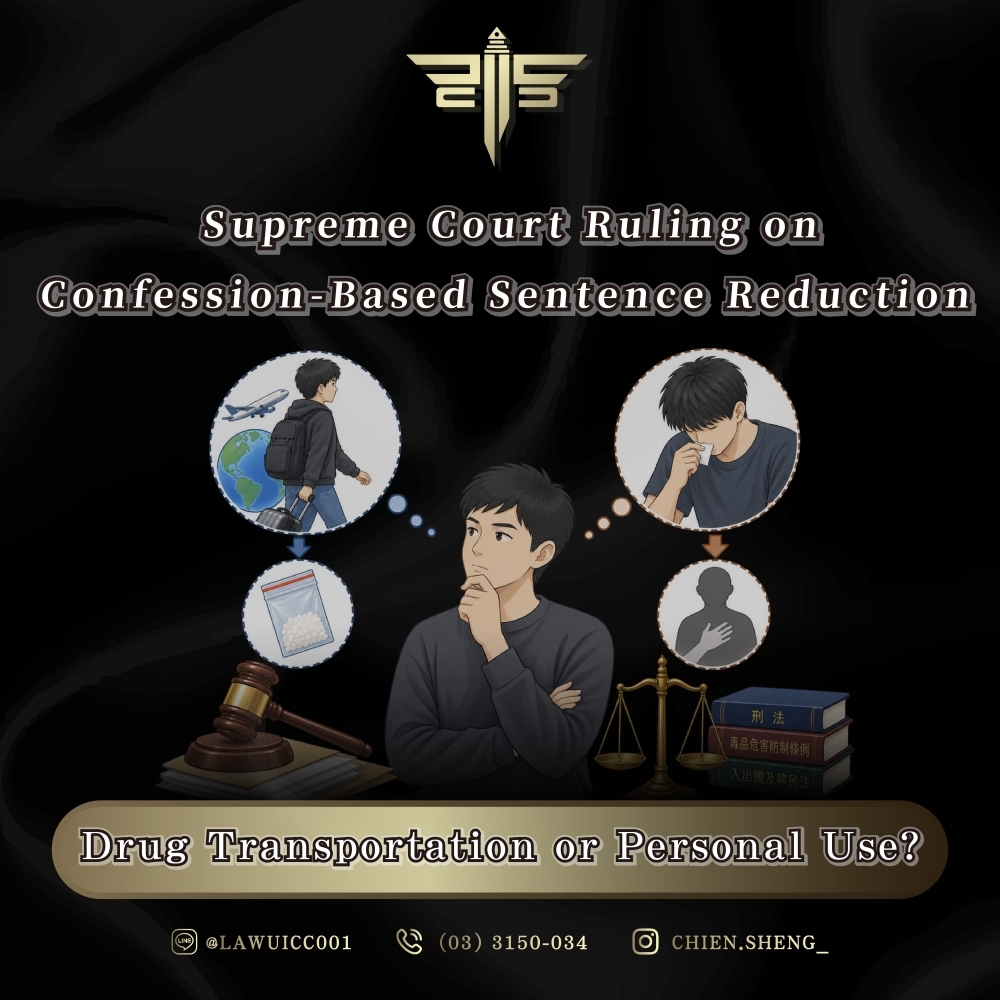
Drug Transportation or Personal Use? Supreme Court Ruling on Confession-Based Sentence Reduction
商品圖像
-
商品資訊
目錄
- 1. Does Personal Use Exclude Drug Transportation? Courts Focus on Objective Conduct
- 2. What Counts as a “Confession”? Does Disputing the Legal Characterization Affect Sentence Reduction?
- 3. Why Did the Supreme Court Vacate the Lower Court’s Judgment?
- 4. How Should You Respond to Serious Drug Charges?
Disclaimer: The Supreme Court Judgment No. 2358 of 2026 discussed in this article was not handled by Chien Sheng International Law Firm. This article is intended solely for legal education and analyzes the standards applied by Taiwan courts under the Narcotics Hazard Prevention Act based on a publicly available judicial decision.
One of the most common misunderstandings in drug-related criminal cases is:
“These drugs were for my own personal use. I wasn’t selling them or delivering them for anyone else. How could I be charged with the serious offense of drug transportation?”
➙ Transporting a Category 1 narcotic, such as heroin, is an extremely serious offense carrying a statutory penalty of life imprisonment or death, while simple possession of a Category 1 narcotic carries substantially lighter penalties.
Therefore, distinguishing between “transportation” and “possession” can be a decisive issue in drug-related criminal cases.
In Supreme Court Judgment No. 2358 of 2026, the Supreme Court of Taiwan provided important guidance on both the legal standard for the offense of transporting narcotics and the requirements for obtaining a sentence reduction based on confession. These principles are particularly important for defendants and families facing similar charges.
1. Does Personal Use Exclude Drug Transportation? Courts Focus on Objective Conduct
Many defendants assume that if they can prove the drugs were intended for their own personal use, they cannot be convicted of transporting narcotics.
However, the Supreme Court made clear in this judgment that “transportation” under the Narcotics Hazard Prevention Act refers to the act of moving or conveying narcotics from one location to another.
This may include bringing narcotics into Taiwan from abroad, transporting them from Taiwan to another jurisdiction, or moving them between different locations within Taiwan.
The Supreme Court emphasized several key factors:
■ First, the motive or purpose of transportation is not decisive. Whether the drugs are transported for sale, delivered on behalf of another person, or carried for the defendant’s own personal use, the offense may still be established if the objective conduct constitutes transportation.
■ Second, the method of transportation is not decisive. Transportation by sea, air, land, or even personally driving a vehicle carrying the drugs may satisfy the relevant legal requirements.
■ Third, important factors distinguishing “transportation” from “simple possession” include the distance involved and the quantity of drugs.
➙ The Supreme Court explained that merely possessing drugs and carrying a small quantity over a short distance—for example, purchasing a small amount near one’s residence and bringing it home—may remain within the scope of simple possession.
In this case, however, the defendant transported more than 216 grams of heroin by car from Kaohsiung to Taoyuan. This involved both a substantial quantity and long-distance transportation between different locations.
Under such circumstances, the court may find that the defendant acted with the intent to transport and physically convey the narcotics, thereby satisfying the elements of the offense of transporting narcotics.
2. What Counts as a “Confession”? Does Disputing the Legal Characterization Affect Sentence Reduction?
Under Article 17, Paragraph 2 of the Narcotics Hazard Prevention Act, a defendant charged with certain serious drug offenses, including manufacturing, transportation, or sale of narcotics, may qualify for a reduced sentence if the defendant confesses during the investigation and at each stage of trial.
In serious drug cases, this provision can be crucial to obtaining a substantial reduction in the sentence.
➙ In practice, however, defendants often face a difficult question:
What if I admit the objective facts—for example, that I actually transported the drugs by car from Kaohsiung to Taoyuan—but dispute the legal characterization of those facts by arguing that I merely possessed the drugs for personal use rather than “transported” them?
Does this still qualify as a “confession”? Or does disputing the offense mean losing eligibility for a sentence reduction?
The Supreme Court provided a clear answer in Judgment No. 2358 of 2026: Yes, it may still constitute a confession.
The Supreme Court explained that a “confession” means an affirmative admission of all or the essential parts of the facts constituting the defendant’s criminal conduct. It does not require the defendant to agree with the legal characterization of those facts.
In other words, as long as the defendant truthfully admits what they actually did—for example:
“I placed the drugs in my car and drove them from Kaohsiung to Taoyuan.”
the defendant may still satisfy the confession requirement even if they argue that the conduct should legally be characterized as possession rather than transportation.
3. Why Did the Supreme Court Vacate the Lower Court’s Judgment?
In this case, the lower court—the Taichung Branch of the Taiwan High Court—found that because the defendant claimed the drugs were intended for personal use, the defendant had effectively denied having the subjective intent to transport narcotics.
The lower court therefore concluded that the defendant did not satisfy the confession requirement and denied the corresponding sentence reduction.
The Supreme Court found fault with this reasoning.
The defendant had admitted during police questioning, the prosecutorial investigation, and the first-instance trial that a substantial quantity of narcotics had been placed in the vehicle and transported by car from Kaohsiung to Taoyuan.
Although the defendant claimed that the drugs were “for my own use” and that they were being kept readily available for personal consumption, the Supreme Court viewed these statements as arguments concerning the legal characterization of the conduct, rather than a denial of the underlying objective facts.
➙ The Supreme Court therefore concluded that the lower court had failed to adequately consider evidence favorable to the defendant and had not sufficiently explained why such evidence was rejected.
The judgment was consequently found to contain inadequate reasoning, and the Supreme Court vacated the original judgment and remanded the case to the High Court for further proceedings.
This reasoning also reflects the evidentiary principle under Article 154 of the Code of Criminal Procedure that criminal facts must be established on the basis of evidence.
4. How Should You Respond to Serious Drug Charges?
■ First, do not assume that claiming “the drugs were for my own use” will automatically prevent a transportation charge.
If the objective circumstances involve transporting a substantial quantity of narcotics over a significant distance, prosecutors and courts may still characterize the conduct as the serious offense of transporting narcotics.
■ Second, when seeking a confession-based sentence reduction under Article 17, Paragraph 2 of the Narcotics Hazard Prevention Act, it is critical to distinguish between “admitting the facts” and “disputing their legal characterization.”
The distinction can be highly technical. Statements made during police questioning, prosecutorial investigation, and trial may directly affect whether the defendant qualifies for a statutory sentence reduction.
Professional criminal defense counsel can therefore play an important role in analyzing the evidence and ensuring that the defendant’s legal position is accurately presented.
If you or a family member is facing a drug-related criminal investigation, the potential legal consequences should not be underestimated. Chien Sheng International Law Firm has extensive experience in drug-related criminal defense. Our legal team can analyze complex evidence, identify the key factual and legal issues, and develop an appropriate defense strategy based on the latest Supreme Court decisions.
 If you have questions regarding drug transportation, possession, confession-based sentence reductions, or other drug-related criminal matters, please contact Chien Sheng International Law Firm for professional legal assistance.
※ This article discusses Supreme Court Judgment No. 2358 of 2026 for legal educational purposes. The case was not handled by Chien Sheng International Law Firm.
Chien Sheng International Law Firm

LINE Online Legal Consultation: @lawuicc001 (Click to consult)
Welcome to call to schedule a meeting: 03-3150-034
Multiple payment methods available: Cash, Credit Card, Bank Transfer
Facebook: Chien Sheng International Law Firm
Instagram: chien.sheng_
-
商品Q&A