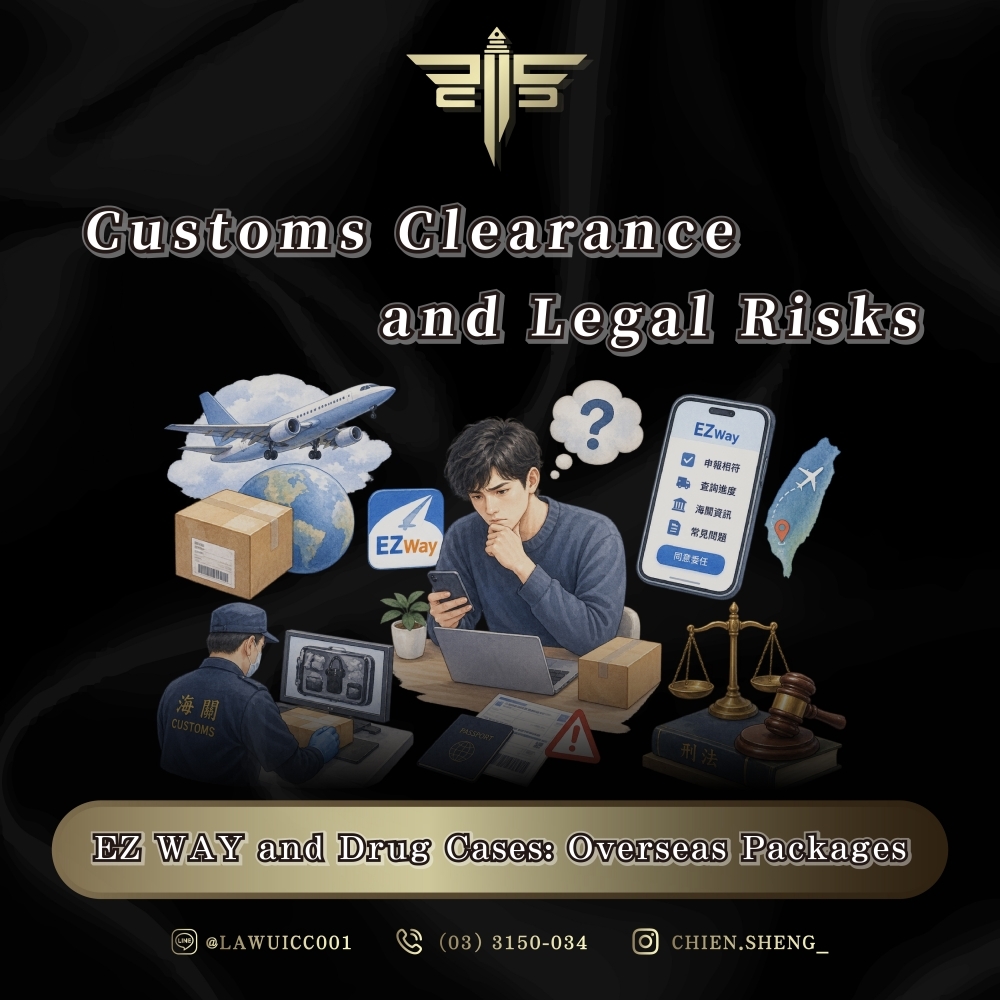
EZ WAY and Drug Cases: Overseas Packages, Customs Clearance, and Legal Risks
商品圖像
-
商品資訊
目錄
Shopping on Taobao, Amazon, CASETiFY, or overseas sneaker websites has become part of everyday life. But whenever an international package arrives in Taiwan, you may receive a notification from EZ WAY asking you to confirm a customs declaration or authorize a customs broker.
What exactly does this mean? What happens if you do not confirm it?
This article explains the entire customs clearance process in plain English and, more importantly, examines why EZ WAY records can become an important investigative lead in drug smuggling cases involving international parcels.
1. Why Do You Need to Confirm an Overseas Package Through EZ WAY?
When you purchase goods from an overseas seller and have them shipped to Taiwan, the package must go through customs clearance before it can enter the country.
Because you are not physically present at customs, Taiwan’s EZ WAY customs clearance system allows you to electronically authorize a customs broker—usually arranged through the logistics company—to handle the import declaration on your behalf.
Beginning March 1, 2026, Taiwan Customs fully implemented the advance authorization system for applicable express import shipments.
Under the previous practice, certain confirmation procedures could be completed after customs processing had already begun. Under the advance authorization system, however, the consignee must first complete the required authorization or confirmation through EZ WAY before the customs declaration can proceed.
In practical terms, when you receive the notification, you must check whether the shipment information is correct and complete the required confirmation in the app. Without the necessary authorization, the customs clearance process may be suspended and the package may not be released.
2. The Five Main Steps of Customs Clearance for Overseas Packages
An overseas package generally goes through the following five stages before it reaches you in Taiwan.
■ Step 1. Placing an Order on an Overseas Website
You purchase goods from an overseas e-commerce platform. After payment, the seller packs the goods and hands the package over to an international logistics provider for shipment to Taiwan by air or sea.
■ Step 2. Arrival at Taiwan Customs
After arriving in Taiwan, the package enters an import warehouse or customs-controlled facility.
At this stage, Customs needs to verify the import declaration and determine whether the person identified as the consignee is associated with the shipment.
■ Step 3. Notification from the Customs Broker
The customs broker submits the package information to the customs system. After the consignee’s identity information is matched, an EZ WAY notification may be sent to the consignee’s mobile device.
■ Step 4. Confirming the Declaration in EZ WAY
You open the app, review information such as the shipment or house airway bill number and declared value, and confirm that the declaration matches your shipment.
This electronic confirmation creates an important digital record associated with the customs declaration and authorization process.
■ Step 5. Customs Release and Domestic Delivery
Once Customs completes its review and releases the shipment, the package enters Taiwan’s domestic delivery network and is delivered by the relevant logistics company or convenience-store delivery service.
3.Three Common EZ WAY Customs Statuses Explained
When checking the status of an import shipment through EZ WAY, you may encounter several customs-processing terms.
■ 1. Declaration Received / Processing
This generally means that the customs broker has successfully transmitted the relevant declaration information to the customs system and that the shipment is waiting for automated review or possible manual inspection.
In most cases, the consignee simply needs to wait for further processing.
■ 2. Declaration Error / Rejected Declaration
This may occur when the information submitted by the customs broker is incorrect or inconsistent—for example, when the consignee’s name, identification information, or telephone number does not match.
Customs clearance may be suspended until the information is corrected and resubmitted.
If this happens, you should contact the customs broker or logistics provider to determine what information needs to be corrected.
■ 3. Released by Customs
This means that Customs has completed the relevant clearance procedures and released the shipment.
The package will then be transferred to the domestic logistics provider for final delivery.
4.Why Do Prosecutors and Investigators Examine EZ WAY Records in Drug Smuggling Cases?
In recent years, drug trafficking organizations have repeatedly attempted to smuggle heroin, cannabis, methamphetamine, and other controlled substances into Taiwan through international parcels.
This raises an important question: when drugs are discovered inside an overseas package, why might investigators immediately examine the consignee and the person associated with the EZ WAY customs authorization instead of focusing only on the overseas sender?
There are three important investigative and legal reasons.
■ 1. EZ WAY Is Linked to Identity Information and Can Help Identify the Consignee in Taiwan
The sender of an international parcel may be located overseas and may use false, incomplete, or third-party identity information. This can make it difficult for Taiwanese investigators to immediately identify or locate the sender.
By contrast, customs clearance in Taiwan involves information identifying the consignee or declarant.
EZ WAY’s real-name authentication mechanism links theto identifying information, including a mobile phone number verified through the telecommunications system and personal identification information.
Therefore, when Customs discovers drugs concealed inside a package, investigators may review customs and EZ WAY-related records to determine who was identified as the consignee, declarant, or person who completed the relevant customs authorization.
However, being listed as the consignee or EZ WAYdoes not, by itself, automatically prove criminal liability. Investigators must still determine whether the person knowingly participated in the transportation or importation of the drugs.
■ 2. EZ WAY Confirmation Records May Become Important Evidence of Knowledge and Intent
In a drug transportation case, one of the central issues is often whether the defendant knew that the package contained controlled substances and intentionally participated in receiving or transporting them.
A common defense in international parcel cases is:
“I did not know there were drugs inside the package. Someone else sent it to me without my knowledge.”
Under the advance authorization system, however, investigators may examine whether the consignee personally received an EZ WAY notification, reviewed the shipment information, and confirmed the relevant declaration or authorization.
Such records may constitute an important digital footprint showing that the person expected or was aware of the incoming shipment.
Nevertheless, clicking a confirmation button in EZ WAY does not automatically prove that the person knew the package contained drugs.
The prosecution must still establish the required criminal intent based on the totality of the evidence, which may include communications with the sender, payment records, package tracking records, prior shipments, delivery arrangements, the defendant’s conduct, and other surrounding circumstances.
■ 3. EZ WAY Can Also Help Protect Victims of Identity Misuse
EZ WAY records are not only useful to investigators—they can also help protect innocent individuals whose identities have been misused.
Suppose a package containing drugs is addressed to you, but you never purchased the goods, never authorized the shipment through EZ WAY, or actively selected an option indicating that the declaration did not match your transaction or that your identity had been used without authorization.
These records may become important evidence supporting the argument that your personal information was misused by someone else.
Accordingly, investigators can use customs and EZ WAY records to distinguish between a person who knowingly arranged to receive an illegal shipment and an innocent individual whose identity was fraudulently used as the consignee.
★ Practical Tips for Online Shoppers: Three Ways to Protect Yourself
When receiving overseas packages, keep the following principles in mind:
➙ Do not casually receive overseas packages on behalf of other people, and never lend your EZ WAY account or personal identification information to someone else for customs clearance.
➙ Always verify the shipment information before confirming an EZ WAY notification. Check the shipment number, declared value, seller, and other available information. If you never purchased the goods, do not simply confirm the declaration.
➙ Protect your personal information. Avoid providing your identification number, mobile phone number, or other sensitive information to unknown websites or individuals. If you discover a suspicious declaration or believe that your identity has been misused, use the appropriate reporting or mismatch function and preserve relevant records.
In international drug parcel cases, the name written on a package is only the beginning of the investigation. Whether the consignee actually knew about the shipment, personally completed the customs authorization, communicated with the sender, paid for the goods, or arranged to receive the package may all become important factors in determining criminal liability.
Chien Sheng International Law Firm

LINE Online Legal Consultation: @lawuicc001 (Click to consult)
Welcome to call to schedule a meeting: 03-3150-034
Multiple payment methods available: Cash, Credit Card, Bank Transfer
Facebook: Chien Sheng International Law Firm
Instagram: chien.sheng_
-
商品Q&A