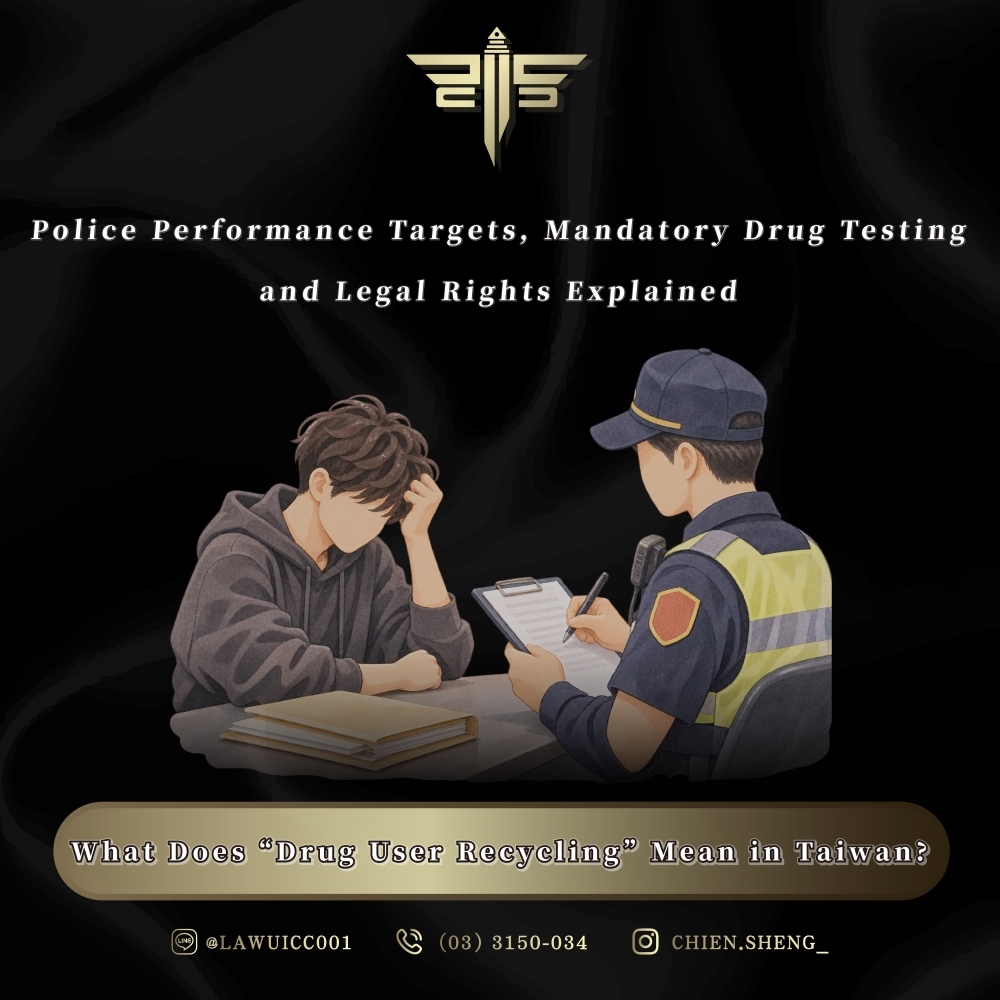
What Does “DrugRecycling” Mean in Taiwan? Police Performance Targets, Mandatory Drug Testing, and Legal Rights Explained
商品圖像
-
商品資訊
Table of contents
- 1. What Is Taiwan's Drug Monitoring System?
- 2. Police Performance Targets and Enforcement Concerns
- 3. Legal Rights During Mandatory Urine Testing
- 4. What Happens After a Positive Drug Test?
- 5. Remedies for Unlawful Police Testing
- 6. Practical Advice for Individuals Under Drug Monitoring
- 7. Frequently Asked Questions
- 8. Conclusion: Drug Monitoring Must Comply With Legal Safeguards
In Taiwan's drug enforcement community, the informal expression "drugrecycling" refers to an alleged practice in which previously identified drug users are repeatedly investigated or tested, potentially generating additional criminal cases and contributing to police performance statistics.
The expression is not an official legal term. Rather, it reflects concerns about how police performance targets may influence enforcement practices involving individuals already subject to drug monitoring.
➠ For people released from prison or compulsory drug treatment, these practices raise important questions about police authority, mandatory urine testing, procedural safeguards, and the right to challenge unlawful evidence collection.
1. What Is Taiwan's Drug Monitoring System?
1. Legal Basis for Mandatory Urine Testing
Article 25 of Taiwan's Narcotics Hazard Prevention Act establishes a framework for urine testing of certain individuals with previous drug-related offenses.
➠ The system may apply to individuals subject to protective supervision for drug use offenses or those released after court-ordered observation, rehabilitation, or compulsory treatment for Category 1 or Category 2 drug use.
➠ The law also addresses monitoring following the completion of relevant sentences or other legally specified circumstances.
➠ The applicable monitoring period is generally two years, calculated according to the statutory starting point.
2. How Frequently Can Police Require Testing?
Under the regulations governing urine sample collection, police may conduct periodic testing of individuals legally subject to monitoring.
The source material identifies a general requirement for testing at least once every three months, with written notification.Additional testing may be requested where there are factual grounds to suspect renewed drug use.
However, being previously convicted of a drug offense does not give police unlimited authority to demand urine samples at any time or under any circumstances.The legal basis and procedure for each request remain important.
2. Police Performance Targets and Enforcement Concerns
1. How Police Performance Scoring Works
Taiwan's National Police Agency has implemented anti-drug enforcement programs that use performance indicators to evaluate investigative results.
➠ The source article describes a scoring system in which different drug offenses receive different performance points.
➠ For example, it cites approximately two points for certain Category 3 or Category 4 drug cases, five points for certain Category 1 drug use or possession cases, and 20 or more points for serious Category 1 trafficking or manufacturing cases.
These figures are presented as examples from the enforcement framework discussed in the original article, rather than verified current scoring standards.
2. Why Are Previously Identified Drug Users a Concern?
Investigating large drug trafficking organizations may require extensive surveillance, resources, and time.
By comparison, individuals already included in police drug monitoring records may be easier to identify and contact.
Critics argue that performance pressure can incentives to concentrate enforcement efforts on previously identified drug users rather than more complex trafficking networks.This concern is sometimes described informally as "drugrecycling."
However, the existence of performance indicators does not, by itself, establish that any particular officer acted unlawfully or improperly.
3. Potentially Improper Enforcement Practices
The original article raises concerns about situations in which police repeatedly stop monitored individuals, request urine testing without an adequate procedural basis, or seek signatures on voluntary testing consent forms.
Such allegations require examination of the specific facts.
A person's inclusion in a drug monitoring database does not eliminate statutory safeguards governing police questioning, sample collection, or the use of force.
3. Legal Rights During Mandatory Urine Testing
1. The Right to Proper Notification
Article 9 of the regulations governing urine sample collection provides for written notification in the context of periodic testing.
➠ The notice should identify the required time and location and explain the legal consequences of failing to appear without a legitimate reason.A telephone call or verbal request should not automatically be treated as equivalent to a legally required written notice.
➠ The precise procedure must be assessed according to the legal basis for the testing request.
2. Protection Against Unlawful Compulsory Testing
Under Article 25 of the Narcotics Hazard Prevention Act, compulsory urine collection requires compliance with statutory conditions and authorization procedures.
Where an individual fails to appear without justification or refuses testing, the authorities may seek the required authorization for compulsory collection.
Article 205-2 of Taiwan's Code of Criminal Procedure also addresses certain evidence-collection powers during criminal investigations.
Police cannot rely solely on a person's previous drug history as unlimited authority to conduct compulsory urine testing.
The legality of a particular collection depends on the applicable statutory procedure and circumstances.
3. Protection After the Monitoring Period Expires
The statutory monitoring period is generally two years from the relevant legally prescribed starting date.
Once the applicable period expires, police cannot continue relying solely on that expired monitoring status to require routine testing under the same provision.
However, a separate lawful basis for investigation or evidence collection may still exist.
4. Can Illegally Collected Urine Evidence Be Excluded?
➠ Potentially.
Article 158-4 of Taiwan's Code of Criminal Procedure provides a framework for assessing the admissibility of evidence obtained through violations of legal procedure.
Courts consider relevant circumstances, including the protection of individual rights and public interests.
An unlawful collection procedure may support an argument for excluding urine test results, but exclusion is not automatic in every case.
Defense counsel should examine the notification, authorization, collection process, and evidence preservation records.
4. What Happens After a Positive Drug Test?
1. Criminal Penalties for Drug Use
Under Article 10 of the Narcotics Hazard Prevention Act, using Category 1 narcotics, such as heroin, may result in imprisonment of six months to five years.
Using Category 2 narcotics, such as methamphetamine, may result in imprisonment of up to three years.
However, a positive urine test does not automatically determine the final criminal outcome.The prosecution must still address the applicable legal requirements and evidence.
2. Observation and Rehabilitation
Article 20 of the Narcotics Hazard Prevention Act establishes procedures involving observation and rehabilitation for qualifying drug use cases.
Depending on the person's previous treatment and criminal history, the prosecutor may need to seek a court order for observation and rehabilitation rather than immediately proceeding with ordinary prosecution.The observation and rehabilitation period generally may not exceed two months.
Where the statutory conditions are satisfied and continued drug use tendencies are not found, release and a non-prosecution disposition may follow.
Taiwan's drug laws recognize treatment-oriented procedures for certain drug use cases rather than treating every positive test as requiring immediate imprisonment.
3. Repeat Drug Use and Prosecution
Repeat drug use cases require careful examination of previous observation, rehabilitation, compulsory treatment, and prosecution records.The original article discusses the legal consequences of repeat offenses and refers to Judicial Yuan Interpretation No. 799.
However, the applicable repeat-offense rules should be determined from the relevant statutory provisions and current judicial interpretations rather than relying on a general assumption that every positive test leads directly to imprisonment.
The timing and legal nature of previous proceedings can materially affect whether treatment-oriented procedures or criminal prosecution apply.
5. Remedies for Unlawful Police Testing
1. Administrative Complaints
Individuals who believe that police officers conducted unlawful or improper urine testing may submit complaints to the relevant police supervisory or internal affairs unit.
The complaint should identify the officers involved, the testing date, the circumstances, and any supporting records.
2. Challenging Evidence in Criminal Proceedings
Where urine samples were allegedly obtained through unlawful procedures, defense counsel may raise evidentiary objections during the investigation or trial.The court must assess admissibility according to the applicable provisions of the Code of Criminal Procedure.
3. State Compensation and Other Remedies
Article 2 of Taiwan's State Compensation Law may provide a basis for compensation where the statutory requirements concerning unlawful official conduct are satisfied.
Individuals may also petition the Control Yuan regarding alleged improper enforcement practices.The availability of each remedy depends on the specific conduct, supporting evidence, and applicable legal requirements.
6. Practical Advice for Individuals Under Drug Monitoring
1. Verify the Monitoring Period
Keep records of the relevant release date, completion of observation and rehabilitation, compulsory treatment, or sentence execution.These documents may be necessary to determine whether the statutory monitoring period remains in effect.
2. Check the Testing Notice
Review whether the police request is supported by the applicable legal authority and whether the required notification procedures have been followed.
If the basis for the request is unclear, seek clarification before making assumptions about your obligations.
3. Review Consent Forms Carefully
Individuals should read voluntary urine testing consent forms carefully and understand their legal significance before signing.
A signature may become important evidence concerning consent, but it does not automatically resolve every question about whether the consent was legally valid.
4. Seek Legal Assistance When Necessary
If a person is subjected to disputed compulsory testing or receives a positive drug test result, a criminal defense lawyer can review the monitoring status, collection procedure, laboratory evidence, and available legal remedies.Early legal assistance may help identify procedural issues before the investigation advances.
7. Frequently Asked Questions
Q1: What does "drugrecycling" mean in Taiwan?
It is an informal expression describing concerns that previously identified drug users may be repeatedly investigated or tested to generate additional enforcement results.
Q2: Is "drugrecycling" an official legal term?
No. It is not a statutory term or an officially recognized criminal offense.
Q3: How long can police monitor someone after drug treatment or imprisonment?
The monitoring period under Article 25 is generally two years, subject to the applicable statutory conditions and starting date.
Q4: Can police require periodic urine testing?
Yes, for individuals legally subject to the relevant monitoring system, provided that statutory procedures are followed.
Q5: Can police demand a urine sample during a roadside stop?
A roadside stop does not automatically authorize compulsory urine collection. Police must have an applicable legal basis and comply with the required procedures.
Q6: Can I refuse an unlawful urine test?
Individuals may challenge testing that lacks a lawful basis. However, refusal of a legally authorized test can have consequences, so the circumstances should be assessed carefully.
Q7: Can an illegally collected urine sample be used in court?
The admissibility of unlawfully obtained evidence may be challenged under Article 158-4 of the Code of Criminal Procedure. Exclusion depends on the court's assessment.
Q8: Does a positive urine test always mean imprisonment?
No. The outcome depends on the evidence, previous proceedings, and whether the case qualifies for observation, rehabilitation, or other statutory procedures.
Q9: Can I file a complaint about improper police testing?
Yes. Depending on the circumstances, complaints, evidentiary challenges, state compensation claims, or petitions to the Control Yuan may be considered.
Q10: Can a lawyer help challenge a compulsory urine test?
Yes. A lawyer can examine the legal basis for testing, authorization documents, collection procedures, and the admissibility of laboratory results.
8. Conclusion: Drug Monitoring Must Comply With Legal Safeguards
Taiwan's drug monitoring system allows police to conduct urine testing of certain individuals with previous drug-related offenses.
However, a person's previous drug use or criminal record does not remove their procedural rights.
Police testing must comply with the applicable legal requirements, and potentially unlawful evidence collection may be challenged through the appropriate procedures.
Concerns about police performance targets also highlight the importance of distinguishing legitimate drug enforcement from improper or excessive investigative practices.
 Chien Sheng International Law Firm (謙聖國際法律事務所) handles drug-related criminal cases, including police and Investigation Bureau questioning, compulsory testing disputes, evidence admissibility, drug trafficking, transportation, manufacturing, possession, and drug use offenses.
The firm assists clients in reviewing investigative procedures, protecting their legal rights, and evaluating available defense strategies.
※ This article provides general information about Taiwan's drug monitoring system and criminal procedure. The legality of any police action and the availability of legal remedies depend on the applicable laws and individual circumstances. No particular case outcome is guaranteed.
This reduces both medical risks and potential legal exposure.
Chien Sheng International Law Firm

LINE Online Legal Consultation: @lawuicc001 (Click to consult)
Welcome to call to schedule a meeting: 03-3150-034
Multiple payment methods available: Cash, Credit Card, Bank Transfer
Facebook: Chien Sheng International Law Firm
Instagram: chien.sheng_
-
商品Q&A


