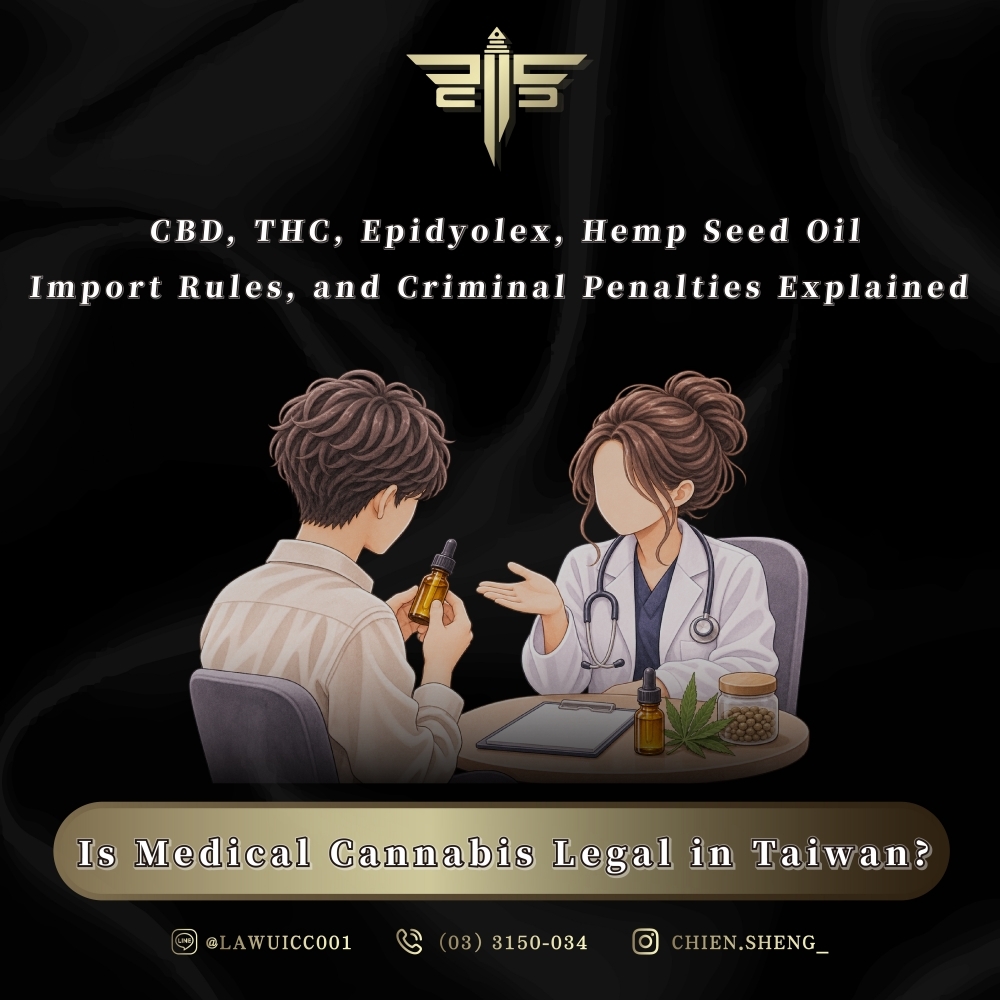
Is Medical Cannabis Legal in Taiwan? CBD, THC, Epidyolex, Hemp Seed Oil, Import Rules, and Criminal Penalties Explained
商品圖像
-
商品資訊
Table of contents
- 1. Cannabis, THC, and CBD: Understanding the Legal Differences
- 2. Is Medical Cannabis Legal in Taiwan?
- 3. Can You Import CBD Oil or Cannabis Medication Into Taiwan?
- 4. CBD Gummies, Hemp Seed Oil, and Cosmetics
- 5. Criminal Penalties for Cannabis Offenses in Taiwan
- 6. What to Do If Customs or Police Seize Your CBD Product
- 7. Frequently Asked Questions
- 8. Conclusion: CBD and Medical Cannabis Are Not Automatically Legal in Taiwan
Is CBD legal in Taiwan? Can travelers bring CBD oil from overseas? Has Taiwan legalized medical cannabis?
These questions frequently arise among patients, families, travelers, and online shoppers. However, a product being labeled "CBD," "hemp," or "medical cannabis" does not automatically make it legal to purchase, import, possess, or use in Taiwan.
As of November 1, 2026, Taiwan has not broadly legalized cannabis for recreational or general medical use. Nevertheless, certain cannabidiol-based medications have received regulatory approval for specific medical conditions.
The legal status of a cannabis-related product depends on its ingredients, THC concentration, intended use, pharmaceutical approval, and method of acquisition.
※ This article explains Taiwan's cannabis laws, medical CBD regulations, import requirements, and potential criminal penalties.
1. Cannabis, THC, and CBD: Understanding the Legal Differences
1. Cannabis Is a Category 2 Narcotic in Taiwan
Under Taiwan's Narcotics Hazard Prevention Act, cannabis is classified as a Category 2 narcotic.
Controlled substances include cannabis plants and certain cannabis-derived products, such as cannabis resin, extracts, tinctures, and tetrahydrocannabinol (THC), subject to their respective regulatory classifications.Limited statutory exceptions exist for certain products derived from mature cannabis stems or non-germinating seeds.
➡︎ However, these exceptions do not mean that cannabis flowers, leaves, extracts, or all hemp-labeled products are legal.
2. Is THC Illegal in Taiwan?
THC is the primary psychoactive compound associated with cannabis and is subject to Taiwan's controlled substance regulations.
Products containing THC may fall under narcotics or controlled pharmaceutical regulations, depending on their composition and applicable legal classification.
➡︎ A low THC concentration does not automatically establish that a product is lawful.
3. Is CBD Considered a Narcotic?
Cannabidiol (CBD) is a cannabis-derived compound that differs from THC.
Taiwan's Ministry of Health and Welfare has previously explained that CBD itself is not inherently classified as a narcotic or controlled pharmaceutical substance.
➡︎ However, CBD products intended to treat diseases or affect physiological functions may be regulated as pharmaceuticals under the Pharmaceutical Affairs Act.
If a product also contains THC, additional controlled substance restrictions may apply.CBD itself not being classified as a narcotic does not mean that every CBD product can be freely sold or imported into Taiwan.
2. Is Medical Cannabis Legal in Taiwan?
1. Taiwan Has Approved Certain CBD-Based Medications
Although Taiwan has not broadly legalized medical cannabis, specific cannabidiol-based medications have received regulatory approval.One example is Epidyolex Oral Solution, a medication containing cannabidiol.
According to the regulatory information described in the source material, Epidyolex holds Taiwan rare-disease drug import authorization No. 000094 and is listed as a Category 2 controlled drug.
➡︎ Its approved medical uses include adjunctive treatment for certain difficult-to-control epilepsy conditions associated with Dravet syndrome or tuberous sclerosis complex, subject to the applicable age and treatment requirements.Patients must satisfy the approved indications and prescription conditions.
2. Why Is Epidyolex Controlled If Its Main Ingredient Is CBD?
Although cannabidiol is the principal active ingredient, the medication may still be regulated because of other components.
The source material cites Taichung Veterans General Hospital's pharmaceutical information indicating that Epidyolex is classified as a Category 2 controlled drug because its THC content exceeds 10 parts per million (ppm).
A medication's legal classification depends on its complete composition and regulatory approval, not merely the name of its primary ingredient.
3. Does Approval Mean Anyone Can Purchase Medical Cannabis?
➡︎ No.
Approved medications remain subject to their authorized indications, physician prescriptions, and controlled drug requirements.
Taiwan's National Health Insurance Administration has also announced reimbursement arrangements for certain cannabidiol-containing medications under specified conditions.
➡︎ However, this does not authorize unrestricted purchases of overseas CBD oils, cannabis gummies, or other cannabis products.
3. Can You Import CBD Oil or Cannabis Medication Into Taiwan?
1. Pharmaceutical Import Requirements
Under Taiwan's Pharmaceutical Affairs Act, pharmaceuticals generally require regulatory registration and approval before importation.Unauthorized imports may be classified as prohibited drugs under the applicable legal provisions.
Article 82 of the Pharmaceutical Affairs Act provides criminal penalties for manufacturing or importing counterfeit or prohibited drugs, including imprisonment of up to 10 years and a possible fine of up to NT$100 million.
However, criminal liability depends on the product's legal classification, the import circumstances, applicable approvals, and the evidence in the individual case.
A product containing CBD does not automatically establish a violation of Article 82.
2. Can Travelers Bring CBD Oil Into Taiwan?
Travelers should not assume that CBD products purchased legally overseas may be brought into Taiwan.
Limited exceptions may apply to personal medications carried by travelers, subject to the applicable requirements and quantity restrictions.
These exceptions do not automatically extend to online purchases or international parcels.
Before purchasing or shipping CBD products, travelers should verify the product's ingredients, pharmaceutical classification, and import requirements with the relevant Taiwanese authorities.
3. Special Import Applications for Medical Purposes
Patients requiring medications that have not received domestic approval may, under certain conditions, apply through Taiwan's special pharmaceutical import procedures.
Depending on the medication, supporting documents may include a medical diagnosis, physician prescription, and regulatory authorization.
➡︎ Products containing controlled THC may require applications through qualified medical institutions under the relevant special approval regulations.These procedures must generally be addressed before the medication is purchased or shipped.
The source material also notes that Taiwan's Food and Drug Administration announced proposed amendments concerning certain special pharmaceutical import and sample medication procedures on October 5, 2026.
A proposed regulatory amendment does not have the same legal effect as an amendment that has entered into force.
4. CBD Gummies, Hemp Seed Oil, and Cosmetics
1. Can CBD Gummies or Cannabis Foods Be Imported?
Products marketed as supplements or natural foods are not automatically lawful in Taiwan.
➡︎ The source material states that cannabis and cannabis-derived products are not permitted as food ingredients under the relevant Taiwanese regulatory guidance.
CBD-containing cookies, gummies, jams, and similar food products therefore may face import restrictions.A product being sold as food overseas does not mean it can legally enter Taiwan as food.
2. Is Hemp Seed Oil Legal?
➡︎ The legal treatment of hemp seed oil depends on its intended use and applicable product regulations.
➡︎ The source material states that Taiwan's Food and Drug Administration has not approved hemp seed oil as a food ingredient.
Products intended for cosmetic use are subject to different requirements.Consumers and businesses should not assume that a label reading "hemp seed oil" automatically establishes compliance.
3. Can CBD Be Used in Cosmetics?
According to the regulatory guidance cited in the source material, CBD may not be added to cosmetics in Taiwan, while THC is classified as a prohibited cosmetic ingredient.
➡︎ For cosmetics containing hemp seed oil, the finished product's residual THC concentration must not exceed 10 ppm.This threshold does not constitute general permission to add CBD or cannabis extracts to cosmetic products.
Violations may result in product withdrawal, recalls, administrative penalties, or other regulatory consequences.Depending on the violation, fines may range from NT$20,000 to NT$5 million, with additional measures possible in serious cases.
5. Criminal Penalties for Cannabis Offenses in Taiwan
If the substance involved is legally classified as a Category 2 narcotic, criminal penalties depend on the specific conduct.
1. Cannabis Use
Under Article 10 of the Narcotics Hazard Prevention Act, using a Category 2 narcotic may result in imprisonment of up to three years.
➡︎ However, drug use cases may involve statutory observation, rehabilitation, or compulsory treatment procedures.
A positive drug test or an allegation of cannabis use does not automatically mean that the individual will immediately be imprisoned.
2. Cannabis Possession
Possession of a Category 2 narcotic may be punishable by imprisonment of up to two years, detention, or a fine of up to NT$200,000.
Where the pure net weight of the Category 2 narcotic reaches 20 grams or more, the statutory penalty increases to imprisonment of six months to five years, with a possible fine of up to NT$700,000.
➡︎ The relevant measurement is the pure net weight of the controlled substance, which may differ from the total weight of the product or liquid.
3. Cannabis Transfer
Transferring a Category 2 narcotic may result in imprisonment of six months to five years and a possible fine of up to NT$700,000.
Giving cannabis to another person without payment may still criminal liability.
The legal classification depends on the circumstances and evidence.
4. Cannabis Manufacturing, Transportation, or Trafficking
Manufacturing, transporting, or selling Category 2 narcotics carries substantially more severe penalties.
Under Article 4 of the Narcotics Hazard Prevention Act, the statutory punishment may be life imprisonment or imprisonment of at least 10 years, with a possible fine of up to NT$15 million.
Descriptions such as "sharing," "buying for a friend," or "helping someone purchase" do not automatically determine the applicable offense.The actual conduct, payment arrangements, communications, and evidence must be examined.
5. Cannabis Cultivation
Article 12 of the Narcotics Hazard Prevention Act regulates cannabis cultivation intended for drug manufacturing.Such conduct may result in imprisonment of at least five years.
➡︎ The law also provides a different sentencing framework for certain minor circumstances involving cultivation for personal use.
➡︎ The defendant's purpose, number of plants, cultivation equipment, scale of activity, and other evidence may affect the legal analysis.
6. What to Do If Customs or Police Seize Your CBD Product
1. Preserve the Original Product and Purchase Records
If customs authorities inspect a CBD shipment or police seize a cannabis-related product, preserve the original packaging, ingredient labels, purchase receipts, order confirmations, shipping records, and communications with the seller.
Any available THC concentration reports or laboratory certificates should also be retained.Do not alter, mix, discard, or replace the original product or packaging.
2. Identify Which Law Is Being Investigated
Cannabis-related products may raise issues under several different laws, including the Narcotics Hazard Prevention Act, Pharmaceutical Affairs Act, Act Governing Food Safety and Sanitation, Cosmetic Hygiene and Safety Act, and customs import regulations.
The appropriate defense or administrative response depends on whether the authorities are investigating controlled substances, unauthorized pharmaceutical imports, prohibited food ingredients, cosmetic restrictions, or product labeling.
Different regulatory violations have different legal elements and do not automatically carry the same criminal consequences.
3. Examine Laboratory Results and Import Documentation
Where the product contains THC or its classification is disputed, relevant questions include whether laboratory testing distinguished CBD from THC, how concentrations were calculated, and whether the sample collection and preservation procedures were properly documented.
Patients should also preserve medical diagnoses, prescriptions, special import approvals, and pharmaceutical authorization documents.Businesses should retain supplier information, batch testing records, import declarations, ingredient documentation, and product distribution records.
7. Frequently Asked Questions
Q1: Is medical cannabis legal in Taiwan?
Taiwan has not broadly legalized medical cannabis. However, certain approved cannabidiol-based medications may be used under specific medical and regulatory conditions.
Q2: Is CBD illegal in Taiwan?
CBD itself is not necessarily classified as a narcotic, but products containing CBD may be subject to pharmaceutical, food, cosmetic, or controlled substance regulations.
Q3: Can I bring CBD oil from the United States or Canada into Taiwan?
Not automatically. Overseas legality does not establish permission to import the product into Taiwan. Its ingredients and import classification must be verified.
Q4: Is Epidyolex legal in Taiwan?
Yes, the source material identifies Epidyolex as an approved medication for specified medical indications, subject to prescription and controlled drug requirements.
Q5: Can I buy CBD gummies online and ship them to Taiwan?
CBD-containing food products may be prohibited from importation under Taiwan's food ingredient regulations.
Q6: Is hemp seed oil legal in Taiwan?
Its legal status depends on the product category. Food and cosmetic uses are governed by different regulations.
Q7: Does a THC concentration below 10 ppm make a product legal?
Not necessarily. The 10 ppm threshold applies in specific regulatory contexts and is not a universal exemption for all cannabis products.
Q8: Can cannabis possession lead to imprisonment in Taiwan?
Yes. Possession of a substance classified as a Category 2 narcotic may carry criminal penalties, depending on the quantity and circumstances.
Q9: Is sharing cannabis with a friend illegal?
It may constitute unlawful transfer of a Category 2 narcotic, even where no payment is involved.
Q10: What should I do if customs seizes CBD oil or cannabis products?
Preserve the purchase records, packaging, ingredient information, and official notices. Legal counsel can help determine which laws apply and whether additional testing or documentation is necessary.
8. Conclusion: CBD and Medical Cannabis Are Not Automatically Legal in Taiwan
Taiwan's legal framework distinguishes between cannabis, THC, CBD, approved pharmaceutical products, food ingredients, and cosmetic materials.
Although certain CBD-based medications have received approval for specific medical purposes, Taiwan has not generally legalized cannabis for recreational use or unrestricted medical consumption.
Before purchasing, importing, possessing, or using cannabis-related products, individuals should verify the product's composition, THC concentration, intended use, and regulatory approval.
 Chien Sheng International Law Firm (謙聖國際法律事務所) handles criminal cases involving controlled substances, cannabis-related investigations, customs seizures, pharmaceutical import issues, and related regulatory disputes.
Legal assistance may include reviewing laboratory findings, examining import documentation, evaluating criminal allegations, and representing clients during investigations or court proceedings.
※ This article is based on the legal and regulatory information provided as of November 1, 2026. Pharmaceutical approvals, controlled substance classifications, and import procedures may change. The article provides general legal information and does not replace individualized legal advice or guarantee a particular case outcome.
This reduces both medical risks and potential legal exposure.
Chien Sheng International Law Firm

LINE Online Legal Consultation: @lawuicc001 (Click to consult)
Welcome to call to schedule a meeting: 03-3150-034
Multiple payment methods available: Cash, Credit Card, Bank Transfer
Facebook: Chien Sheng International Law Firm
Instagram: chien.sheng_
-
商品Q&A