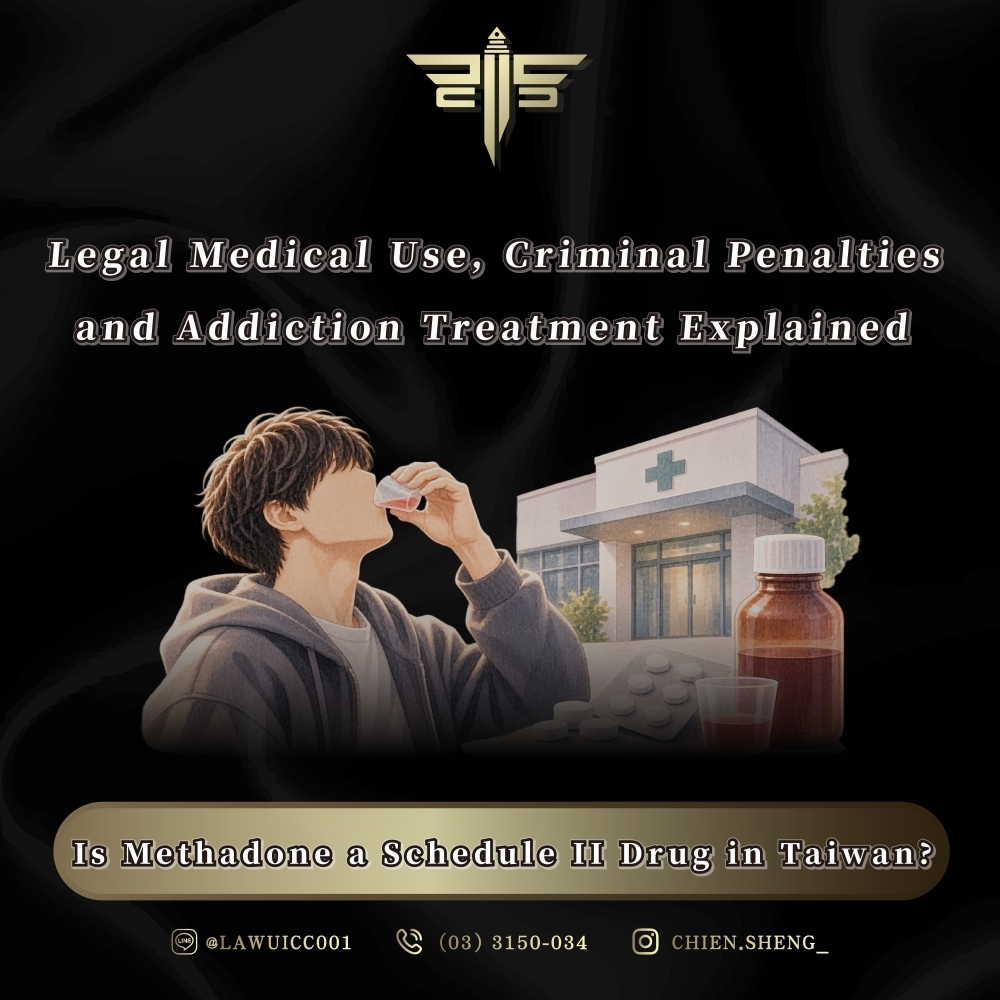
Is Methadone a Schedule II Drug in Taiwan? Legal Medical Use, Criminal Penalties, and Addiction Treatment Explained
商品圖像
-
商品資訊
Table of contents
- 1. Methadone's Dual Legal Classification in Taiwan
- 2. Why Can a Schedule II Narcotic Be Used for Addiction Treatment?
- 3. Criminal Penalties for Illegal Methadone Use and Possession
- 4. Methadone Trafficking, Distribution, and Transfer
- 5. Taiwan's Controlled Medication Regulations
- 6. Does Methadone Treatment Protect Patients from Criminal Liability?
- 7. Addiction Treatment, Rehabilitation, and Deferred Prosecution
- 8. Can Methadone-Related Offenses Result in a Fine or Suspended Sentence?
- 9. What Should You Do If Police Investigate Your Methadone Use?
- 10. Frequently Asked Questions About Methadone in Taiwan
Is methadone an illegal drug or a legitimate medication in Taiwan?The answer is both, depending on the legal framework and how the substance is obtained and used.
Methadone is classified as a Schedule II narcotic under Taiwan's Narcotics Hazard Prevention Act. It is also classified as a Schedule II controlled medication under the Controlled Drugs Act.
These classifications are not contradictory. Methadone remains a regulated narcotic even when used for medical treatment, while its narcotic classification does not automatically make properly authorized treatment illegal.
The key legal distinction is whether methadone is obtained, possessed, administered, or transferred through lawful medical procedures.
1. Methadone's Dual Legal Classification in Taiwan
1. Methadone as a Schedule II Narcotic
Under Article 2 of Taiwan's Narcotics Hazard Prevention Act, narcotics are classified into four schedules based on their addictive potential, abuse potential, and social harm.Methadone, a synthetic opioid, is classified as a Schedule II narcotic.
This classification is relevant to criminal offenses involving unlawful use, possession, transfer, manufacturing, transportation, and sale.
2. Methadone as a Schedule II Controlled Medication
Methadone is also listed as a Schedule II controlled medication under Taiwan's controlled-drug classification system.
This separate classification regulates its medical and scientific use, including prescribing, dispensing, administration, storage, and distribution.The two systems serve different purposes.
The Narcotics Hazard Prevention Act primarily addresses illegal drug-related conduct, while the Controlled Drugs Act regulates lawful medical and scientific activities.
➠ Therefore, methadone is not an ordinary unrestricted medication. Its legitimate medical use depends on compliance with specific legal requirements.
2. Why Can a Schedule II Narcotic Be Used for Addiction Treatment?
1. How Methadone Maintenance Treatment Works
Methadone is a synthetic opioid used in medically supervised treatment for opioid use disorder.When administered appropriately, it can help reduce withdrawal symptoms, cravings, and the risks associated with illicit heroin use.
Methadone maintenance treatment is intended to replace uncontrolled drug use with a structured medical program involving professional assessment, appropriate dosing, and ongoing monitoring.Its medical purpose does not remove its controlled legal status.
2. Requirements for Lawful Methadone Treatment
In Taiwan, methadone treatment is subject to medical and regulatory requirements.
Authorized treatment generally involves physician assessment, qualified medical personnel, approved medical institutions or designated dispensing sites, appropriate prescriptions or medical orders, and documented administration.Patients must follow the prescribed treatment arrangements.
➠ Methadone supplied for treatment must not be independently sold, shared, exchanged, or transferred to another person.The distinction is straightforward: lawful medical administration may be permitted, but unauthorized possession or distribution may criminal liability.
3. Criminal Penalties for Illegal Methadone Use and Possession
1. Illegal Methadone Use
Under Article 10, Paragraph 2 of the Narcotics Hazard Prevention Act, illegal use of a Schedule II narcotic is punishable by imprisonment of up to three years.A person who obtains and uses methadone outside lawful medical procedures may therefore face a criminal investigation.
However, a positive methadone test does not automatically establish illegal drug use.
➠ If the individual is receiving authorized methadone maintenance treatment, medical records, prescriptions, and administration records may help explain the presence of methadone in the body.Investigators must distinguish lawful medical administration from unlawful consumption.
2. Illegal Possession of Methadone
Under Article 11, unlawful possession of a Schedule II narcotic may result in imprisonment of up to two years, short-term imprisonment, or a fine of up to NT$200,000.
Where the net pure weight reaches 20 grams or more, the statutory penalty increases to imprisonment of six months to five years, with a possible additional fine of up to NT$700,000.
Possession is not determined solely by ownership. Actual knowledge and control over the substance may also be relevant.
➠ For liquid methadone preparations, laboratory analysis of the substance, concentration, and net pure weight may be important.The total weight of a container or liquid preparation should not automatically be treated as the net pure weight of methadone.
4. Methadone Trafficking, Distribution, and Transfer
1. Manufacturing, Transporting, or Selling Methadone
Under Article 4, Paragraph 2 of the Narcotics Hazard Prevention Act, unlawfully manufacturing, transporting, or selling a Schedule II narcotic may result in life imprisonment or imprisonment of at least ten years, with a possible additional fine of up to NT$15 million.
These penalties are substantially more severe than those for ordinary unlawful use or possession.
2. Possession with Intent to Sell
Article 5, Paragraph 2 provides a penalty of imprisonment of at least five years, with a possible additional fine of up to NT$5 million, for possession of a Schedule II narcotic with intent to sell.
Investigators may examine the quantity, packaging, communications, financial transactions, delivery arrangements, and other evidence of intended distribution.
Possession alone does not automatically establish intent to sell.The prosecution must prove the additional elements required for the more serious offense.
3. Giving Methadone to Another Person
Under Article 8, Paragraph 2, unlawfully transferring a Schedule II narcotic may result in imprisonment of six months to five years, with a possible additional fine of up to NT$700,000.
Payment is not necessarily required for an unlawful transfer offense.Giving methadone to a friend or family member may criminal liability even when no money changes hands.Encouraging another person to use methadone unlawfully may also raise separate issues under Article 7.
Patients should never redistribute methadone supplied for their own treatment. Unauthorized sharing also creates serious medical risks, including overdose and respiratory depression.
5. Taiwan's Controlled Medication Regulations
1. Medical Use and Prescription Requirements
Taiwan's Controlled Drugs Act regulates controlled medications used for medical and scientific purposes.As a Schedule II controlled medication, methadone is subject to restrictions involving authorized practitioners, prescriptions, dispensing, administration, and recordkeeping.
Medical institutions providing addiction treatment with controlled medications must comply with the applicable authorization and management requirements.
2. Restrictions for Patients Receiving Methadone
Patients should follow medical instructions and the procedures established by their treatment provider.They should not independently change their dosage, obtain methadone from unauthorized sources, or provide prescribed medication to others.
➠ Questions about missed doses, travel, or alternative dispensing arrangements should be discussed with the treating institution.Medical records should also be preserved in case the legality of treatment later becomes relevant to a criminal investigation.
6. Does Methadone Treatment Protect Patients from Criminal Liability?
1. Lawful Treatment Is Not Automatically a Crime
Receiving methadone through a legally authorized treatment program generally provides a lawful medical basis for its administration.
A positive methadone test, by itself, should not be treated as conclusive proof of unlawful drug use when the person has valid treatment records.The source of the medication and the circumstances of administration remain essential.
2. Treatment Does Not Provide General Criminal Immunity
Methadone treatment does not authorize patients to obtain additional methadone illegally, share medication, or use other prohibited substances.
➠ For example, a patient receiving lawful methadone treatment may still face separate criminal liability for unlawful heroin or amphetamine use.The legal assessment must distinguish authorized treatment from any alleged conduct outside that treatment.
7. Addiction Treatment, Rehabilitation, and Deferred Prosecution
1. Voluntary Treatment Before an Offense Is Discovered
Article 21 of the Narcotics Hazard Prevention Act provides a special mechanism for qualifying individuals who voluntarily seek treatment at a designated medical institution before their drug-use offense is discovered.
Under the statutory conditions, a person discovered during qualifying treatment may receive a non-prosecution disposition.
This mechanism is subject to specific requirements and a one-time limitation.Seeking treatment after an offense has already been discovered does not automatically satisfy Article 21.
2. Observation, Rehabilitation, and Compulsory Treatment
Under Article 20, certain drug-use cases may involve court-ordered observation and rehabilitation for a period not exceeding two months.
Where continued drug-use tendencies are identified under the applicable procedure, compulsory treatment may follow, subject to statutory duration limits.The treatment pathway depends on the circumstances of the case, including previous treatment and relevant dates.
3. Deferred Prosecution with Addiction Treatment Conditions
Article 24 provides a framework for deferred prosecution involving addiction treatment and other legally authorized conditions.
➠ Depending on the case, a prosecutor may consider treatment participation, medical monitoring, drug testing, and other rehabilitation requirements.
➠ Deferred prosecution is not an acquittal or a declaration that the underlying conduct was lawful.Failure to comply with the conditions may result in revocation and further criminal proceedings.
Methadone maintenance treatment may be relevant to a treatment plan, but participation alone does not guarantee non-prosecution or deferred prosecution.
8. Can Methadone-Related Offenses Result in a Fine or Suspended Sentence?
1. Conversion of Imprisonment into a Fine
Under Article 41 of Taiwan's Criminal Code, eligibility for converting a custodial sentence into a fine depends on statutory conditions, including the applicable maximum penalty and the sentence imposed.
Certain offenses involving unlawful methadone use or ordinary possession may qualify if the legal requirements are met.
➠ However, eligibility is not automatic.The final sentence, applicable offense, and statutory restrictions must all be considered.
2. Serious Trafficking Offenses
Unlawfully manufacturing, transporting, or selling a Schedule II narcotic carries a statutory penalty of life imprisonment or at least ten years of imprisonment.
These offenses do not ordinarily qualify for conversion into a fine under the standard Article 41 requirements.A reduction in the sentence does not automatically change that conclusion.
3. Suspended Sentences
Article 74 of the Criminal Code provides for suspended sentences under specified conditions, including restrictions relating to the sentence imposed and prior convictions.Courts may also impose appropriate conditions.
Receiving methadone treatment does not guarantee a suspended sentence, although documented rehabilitation efforts may be relevant to the overall assessment.
9. What Should You Do If Police Investigate Your Methadone Use?
1. Preserve Medical and Treatment Records
➠ If you receive a police notice, prosecutor's summons, or Investigation Bureau notification, first confirm your procedural status and the alleged offense.
Preserve relevant documents, including medical records, prescriptions, treatment attendance records, dispensing information, and laboratory reports.Do not delete communications or attempt to coordinate statements with other individuals involved in the investigation.
2. Identify the Actual Criminal Allegation
A methadone investigation may concern illegal use, possession, transfer, sale, or transportation.Each offense has different legal requirements and penalties.
The defense should examine the medication's source, the treatment records, the substance analysis, the alleged conduct, and the legality of evidence collection.
3. Legal Assistance from Chien Sheng International Law Firm
Chien Sheng International Law Firm handles criminal defense matters involving drug use, possession, transfer, trafficking, and addiction treatment.
➠ For methadone-related cases, the firm may help evaluate whether the substance was obtained through lawful medical treatment, whether the prosecution can establish the alleged offense, and whether relevant evidence was lawfully collected.
Where appropriate, legal assistance may also involve assessing eligibility for non-prosecution, deferred prosecution with treatment conditions, sentencing mitigation, or other legally available outcomes.The appropriate defense strategy depends on the facts, evidence, and procedural stage of each case.
10. Frequently Asked Questions About Methadone in Taiwan
Q1: Is methadone a Schedule II narcotic in Taiwan?
Yes. Methadone is classified as a Schedule II narcotic under the Narcotics Hazard Prevention Act and as a Schedule II controlled medication under the Controlled Drugs Act.
Q2: Is methadone treatment at a hospital illegal?
No. Methadone may be used for authorized medical treatment when the relevant legal and medical requirements are satisfied.
Q3: Can I give prescribed methadone to a family member?
No. Methadone prescribed or administered for one patient should not be transferred to another person without lawful authorization. Unauthorized transfer may criminal liability.
Q4: Will a positive methadone urine test automatically result in a conviction?
No. Investigators must consider whether methadone was administered through lawful medical treatment and evaluate the relevant records and other evidence.
Q5: Is possession of a small amount of methadone legal?
Not necessarily. Unlawful possession of a Schedule II narcotic may be punishable even below the enhanced-penalty threshold. Lawful medical authorization and the circumstances of possession remain important.
Q6: Does methadone treatment mean addiction treatment has been completed?
Not necessarily. Methadone maintenance treatment is a medical treatment method. Completion of a medical or court-related treatment program depends on the applicable requirements and professional assessment.
Q7: Can I avoid prosecution by starting methadone treatment after being caught?
Not automatically. Voluntary treatment before an offense is discovered and treatment after an investigation begins are legally different situations. Eligibility for non-prosecution or deferred prosecution must be assessed individually.
Conclusion: Methadone's Legal Status Depends on More Than Its Drug Classification
Methadone has two legal classifications in Taiwan: it is both a Schedule II narcotic and a Schedule II controlled medication.Its medical use is legally permitted under specified conditions, but unauthorized use, possession, transfer, manufacturing, transportation, or sale may result in criminal liability.
➠ For individuals receiving methadone maintenance treatment, preserving prescriptions and treatment records is particularly important when responding to police or prosecutorial inquiries.
➠ If a case involves alleged illegal methadone use, possession, or trafficking, the distinction between lawful treatment and criminal conduct must be established through the applicable law and evidence.
 Chien Sheng International Law Firm provides legal assistance in drug-related criminal investigations, including cases involving methadone treatment, drug testing, and allegations of unlawful possession or distribution.
※ Legal Disclaimer: This article provides general legal information and does not replace individualized legal advice. Applicable laws, controlled-substance classifications, and judicial practice may change. Actual liability depends on the law applicable to the conduct and the evidence in the case.
This reduces both medical risks and potential legal exposure.
Chien Sheng International Law Firm

LINE Online Legal Consultation: @lawuicc001 (Click to consult)
Welcome to call to schedule a meeting: 03-3150-034
Multiple payment methods available: Cash, Credit Card, Bank Transfer
Facebook: Chien Sheng International Law Firm
Instagram: chien.sheng_
-
商品Q&A