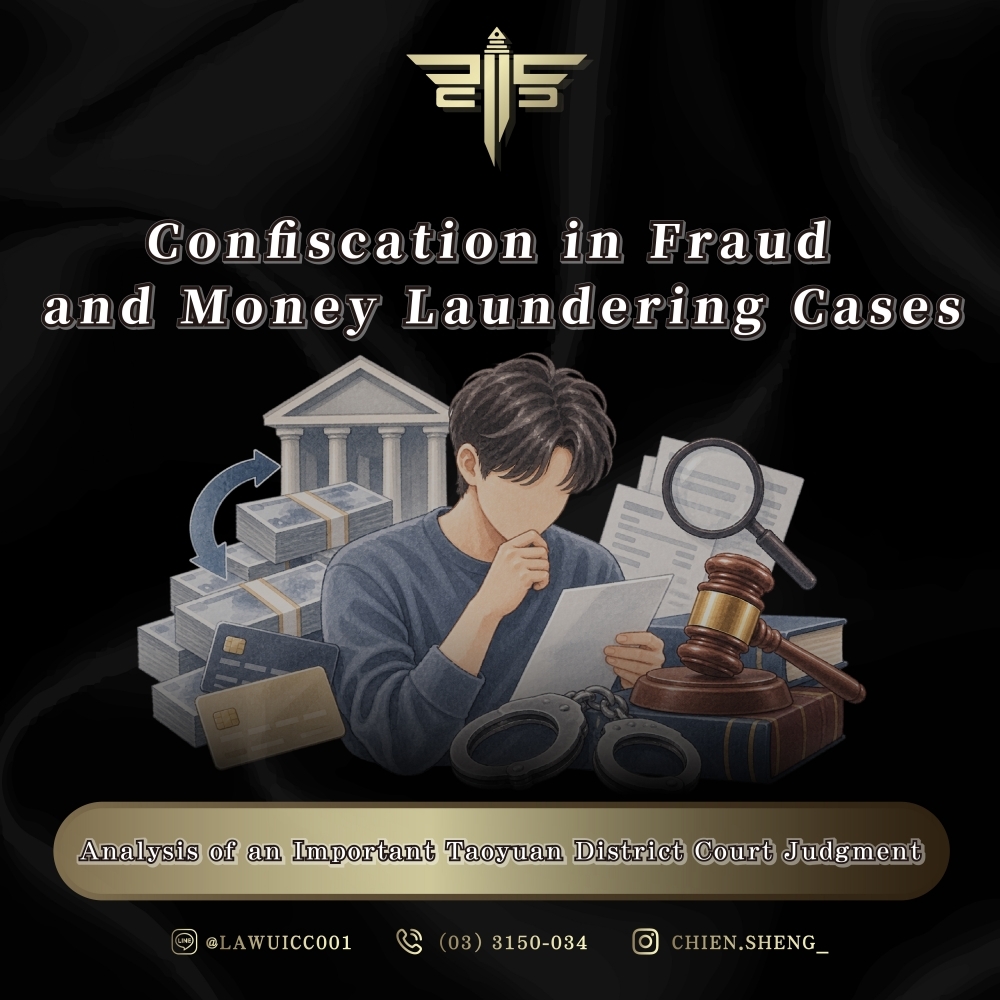
Received a Fraud Case Summons in Taiwan? Bank Account Liability, Money Mule Charges, and Criminal Defense Explained
商品圖像

-
商品資訊
Table of contents
- 1. What Kind of Fraud Case Summons Have You Received?
- 2. Six Things to Do Before Police Questioning in a Fraud Case
- 3. Where Will You Be Questioned in a Fraud Case?
- 4. What Criminal Charges May Apply in Taiwan Fraud Cases?
- 5. Can You Be Convicted for Providing Your Bank Account?
- 6. What If You Are Accused of Being a Fraud Money Mule?
- 7. What Are Your Rights During Police or Prosecutorial Questioning?
- 8. What Happens If You Ignore a Fraud Case Summons?
- 9. How Can Chien Sheng International Law Firm Help with Fraud Defense?
- 10. Frequently Asked Questions About Fraud Case Summons in Taiwan
Received a police notice, prosecutor's summons, court summons, or Investigation Bureau notification in Taiwan involving an alleged fraud case?
Many people are surprised to discover that providing a bank account, withdrawing money, or accepting a part-time job may lead to a criminal investigation.
A summons does not mean you have been convicted. However, ignoring the notice or attending questioning without understanding the allegations can additional legal risks.
Fraud investigations in Taiwan may involve ordinary fraud, aggravated fraud, aiding fraud, money laundering, or participation in a criminal organization.The most important first step is to identify your legal status, the alleged offense, and your actual role in the case.
1. What Kind of Fraud Case Summons Have You Received?
1. Police Station Notice
Police may issue a notice requesting that a criminal suspect appear for questioning.
Under Article 71-1 of Taiwan's Code of Criminal Procedure, a suspect who fails to appear after lawful notification without a legitimate reason may be subject to further compulsory procedures.
A police notice is not necessarily the same as a formal court summons, but it should not be ignored.Check the issuing authority, case number, alleged offense, scheduled appearance, and your status in the investigation.
2. District Prosecutors Office Summons
A summons from a District Prosecutors Office generally indicates that the case is under prosecutorial investigation.
➡︎ If you are identified as a defendant or criminal suspect, you have procedural rights, including the right to remain silent and the right to retain defense counsel.
➡︎ If you are summoned as a witness, different rules may apply, including protections against compelled self-incrimination in qualifying circumstances.
3. Court Summons
A court summons may indicate that the case has entered judicial proceedings.Review the indictment, application for summary judgment, or other relevant court documents to identify the charges and alleged criminal conduct.
Under Article 154 of the Code of Criminal Procedure, a defendant is presumed innocent until proven guilty by a final judgment.Being prosecuted does not automatically mean that the court will convict you.
4. Investigation Bureau Notice
Taiwan's Investigation Bureau may investigate fraud cases involving money laundering, illegal fundraising, virtual assets, Banking Act violations, or cross-border financial transactions.
➡︎ If you receive an Investigation Bureau notice, clarify whether you are being questioned as a witness, suspect, or defendant.
Legal assistance may be especially important when the investigation involves complicated financial records or multiple alleged participants.
2. Six Things to Do Before Police Questioning in a Fraud Case
1. Verify the Notice
Confirm the issuing authority, case reference, alleged offense, date, location, and official contact information.
➡︎ If you receive a suspicious phone call or message claiming to be from police or prosecutors, verify it independently through official channels.
Legitimate judicial authorities do not require transfers to private accounts to cancel criminal charges or remove banking restrictions.
2. Preserve Relevant Evidence
Keep LINE conversations, emails, employment advertisements, loan applications, payment instructions, bank statements, withdrawal records, and relevant transaction histories.
Preserve the original context whenever possible.Do not delete or communications, even if some information appears unfavorable.
3. Avoid Contacting Other Suspects to Coordinate Statements
Do not ask other suspects or witnesses to change their accounts, delete messages, or conceal evidence.
Such actions may raise concerns about collusion or evidence destruction and additional procedural risks.
4. Identify Your Alleged Role
Fraud investigations may involve account providers, cash withdrawal agents, in-person money collectors, fund-transfer intermediaries, cryptocurrency exchangers, and other alleged participants.
Determine which role investigators attribute to you and identify the relevant transactions, dates, amounts, and victims.
5. Prepare a Chronological Timeline
Organize when you first contacted the relevant person, why you provided account information, when money was received or withdrawn, whether compensation was offered, and when you discovered suspicious activity.
A factual timeline can help prevent confusion between different transactions or individuals.
6. Consult a Criminal Defense Lawyer
Fraud investigations may involve multiple victim statements, surveillance footage, electronic communications, bank records, and testimony from other suspects.Early legal advice can help identify the allegations and prepare relevant evidence before questioning.
3. Where Will You Be Questioned in a Fraud Case?
1. Bank Account Provider Cases
In practice, cases involving individuals who provided bank accounts may sometimes be handled or coordinated through the police precinct associated with the suspect's registered residence.
However, this is not an absolute jurisdictional rule.Investigative responsibility may depend on the location of the offense, the relevant victims, related cases, and prosecutorial directions.
➡︎ If you receive a notice from another city, contact the investigating authority before requesting an alternative questioning location.
2. Money Mule and Cash Withdrawal Cases
Cases involving ATM withdrawals or in-person cash collection are often investigated by police authorities connected to the location of the alleged criminal conduct.
➠ For example, an ATM withdrawal in Taichung or an in-person collection in New Taipei City may involve investigators from those locations.
Cases involving multiple transactions or victims may result in notices from different police departments or prosecutors.Do not assume that you can ignore an out-of-town notice merely because you live elsewhere.
4. What Criminal Charges May Apply in Taiwan Fraud Cases?
1. Ordinary Fraud Under Article 339
Article 339 of Taiwan's Criminal Code addresses obtaining another person's property or unlawful financial benefits through deception.
The statutory penalty may include imprisonment of up to five years, short-term imprisonment, or a fine of up to NT$500,000.
An ordinary fraud offense requires proof of the relevant criminal intent, deceptive conduct, victim's mistaken belief, and resulting transfer of property or financial benefit.
2. Aggravated Fraud Under Article 339-4
Article 339-4 provides enhanced penalties for fraud committed under specified circumstances.
➠ Examples include fraud committed jointly by three or more people, impersonation of government authorities, and certain forms of public dissemination through electronic communications or online media.
The statutory penalty is imprisonment of one to seven years, with a possible additional fine of up to NT$1 million.
However, involvement in a transaction connected to a fraud group does not automatically establish aggravated fraud.The prosecution must prove the statutory elements and the defendant's relevant participation and intent.
3. Additional Penalties Under Taiwan's Fraud Crime Hazard Prevention Act
Taiwan's Fraud Crime Hazard Prevention Act provides additional rules and penalties for specified fraud offenses.Articles 43 and 44 address certain serious or aggravated circumstances.
Because fraud-related legislation has undergone amendments, the applicable version of the law and the date of the alleged conduct may affect the legal assessment.The relevant statutory provisions should be reviewed based on the individual case.
4. Principal Offenders and Accomplices
Article 28 of the Criminal Code concerns joint principal offenders, while Article 30 addresses aiding another person's criminal conduct.A person who provides a bank account or assists with a transfer may be investigated for aiding fraud.
However, criminal liability requires more than a mere connection to the transaction.The individual's knowledge, intention, actions, and relationship to the alleged offense must be examined.
5. Can You Be Convicted for Providing Your Bank Account?
1. Common Situations Involving Bank Account Providers
Some individuals provide bank accounts after responding to employment advertisements, loan offers, investment opportunities, or requests from acquaintances.
They may later discover that the accounts were used to receive fraud proceeds.The resulting investigation may involve aiding fraud, money laundering, or other applicable account-related offenses.
2. What Evidence Matters in a Bank Account Case?
Investigators may examine why the account was provided, what information was shared, whether the individual received compensation, and whether they participated in subsequent withdrawals or transfers.
Relevant evidence may include communications, employment advertisements, loan applications, banking records, and reports made after suspicious activity was discovered.
3. Does a Warning Account Mean You Are Guilty?
➡︎ No.
A warning account, known in Taiwan as a 警示帳戶, is a banking restriction associated with a reported or suspected criminal matter.
It is not a criminal conviction.The defense should examine whether the account holder knowingly assisted unlawful conduct or was deceived into providing the account.
Simply stating that you were tricked may not be sufficient without supporting evidence, but an account's involvement in fraud does not automatically establish criminal intent.
6. What If You Are Accused of Being a Fraud Money Mule?
1. What Is a Money Mule?
A money mule may be involved in withdrawing, collecting, transferring, or delivering funds connected to fraudulent activity.
In Taiwan, investigations may involve ATM withdrawal agents, in-person cash collectors, or intermediaries who pass funds to other individuals.These roles may raise allegations of fraud, aggravated fraud, or money laundering.
2. What Evidence Do Investigators Examine?
Police and prosecutors may review ATM footage, surveillance recordings, mobile phone data, location records, financial transactions, payment instructions, and statements from alleged accomplices.
Important questions include whether the defendant actually performed the alleged act, understood the source of the funds, or knowingly participated in the fraudulent operation.
3. Can a Money Mule Be Charged with Money Laundering?
➡︎ Potentially, yes.
Handling funds derived from criminal activity may raise issues under Taiwan's Money Laundering Control Act when the relevant statutory requirements are met.
However, a person is not automatically guilty of money laundering merely because they withdrew or transferred money.
The prosecution must establish the applicable conduct and mental elements.A defense strategy should examine both the alleged fraud and the separate money laundering allegations.
7. What Are Your Rights During Police or Prosecutorial Questioning?
1. The Right to Remain Silent
Under Article 95 of Taiwan's Code of Criminal Procedure, a defendant must be informed of important procedural rights before questioning.
These include the alleged offense, the right to remain silent, the right to defense counsel, and the right to request investigation of favorable evidence.Exercising the right to remain silent is not an admission of guilt.
2. The Right to Legal Representation
A criminal suspect or defendant may seek legal representation during the applicable stages of the proceedings.
This can be especially important when investigators ask questions about complex financial transactions, multiple victims, or alleged criminal organizations.
3. Audio and Video Recording of Questioning
Articles 100-1 and 100-2 of the Code of Criminal Procedure establish rules concerning the recording of defendant questioning and relevant police questioning procedures.
Available recordings may become important when there is a dispute about what was said.
4. How to Review an Interview Record
Before signing an interview record, carefully check the dates, amounts, individuals, transactions, and statements attributed to you.Do not guess about matters you cannot remember.
➡︎ If a question contains an incorrect assumption, clarify it before answering.
➡︎ If the written record does not accurately reflect your statement, request correction.
Even after questioning has been completed, a lawyer may help submit additional explanations or request further investigation of relevant evidence.
8. What Happens If You Ignore a Fraud Case Summons?
1. Failure to Appear Without a Legitimate Reason
Under Articles 71 and 75 of Taiwan's Code of Criminal Procedure, a defendant who fails to appear after lawful summons without a legitimate reason may face compulsory appearance procedures.
The precise consequences depend on the type of notice and procedural circumstances.Ignoring a summons does not make the criminal investigation disappear.
2. Can You Request a Different Date?
➡︎ If hospitalization, a serious emergency, or another legitimate reason prevents attendance, contact the issuing authority promptly.
Provide supporting documentation and request rescheduling through the appropriate procedure.Do not assume that an informal message automatically excuses nonattendance.
9. How Can Chien Sheng International Law Firm Help with Fraud Defense?
1. Bank Account and Warning Account Cases
Chien Sheng International Law Firm assists individuals involved in bank account fraud investigations, including cases arising from employment scams, loan scams, and the alleged provision of financial accounts to criminal groups.
The defense may focus on the account holder's knowledge, intention, communications, and actual participation.
2. Money Mule and Aggravated Fraud Cases
For cases involving ATM withdrawals, in-person collections, or fund transfers, the firm may examine surveillance evidence, financial records, communications, and witness statements.
The objective is to identify the actual conduct and determine whether the prosecution's allegations are supported by sufficient evidence.
3. Investigation Bureau and Prosecutorial Questioning
The firm provides legal assistance with questioning by police, prosecutors, and Taiwan's Investigation Bureau.
Depending on the case, services may include pre-interview preparation, evidence review, accompaniment during questioning, written submissions, and criminal trial defense.
4. Criminal Defense Services Across Taiwan
With offices in Taipei, Taoyuan, and Kaohsiung, Chien Sheng International Law Firm assists clients facing fraud, money laundering, virtual asset, and financial crime investigations.
Possible legal strategies may involve seeking non-prosecution, deferred prosecution, acquittal, a different charge, or sentencing mitigation where legally appropriate.
No specific result can be guaranteed before the facts and evidence have been evaluated.
10. Frequently Asked Questions About Fraud Case Summons in Taiwan
Q1: Why did I receive a fraud summons if I only provided my bank account?
Fraud groups frequently use accounts belonging to other individuals to receive stolen funds.
Investigators may examine whether the account holder knowingly assisted fraud or money laundering.Providing an account does not automatically establish criminal guilt.
Q2: Can I ignore a police notice because it is not a court summons?
No. A lawful police notification may still carry procedural consequences if you fail to appear without a legitimate reason.
Contact the investigating authority if you cannot attend.
Q3: Can I request questioning at a police station near my registered residence?
You may ask the investigating authority whether alternative arrangements are possible.
However, approval depends on the case, investigative responsibility, and relevant procedural considerations.
Q4: Can I still defend myself if I already admitted something during police questioning?
Yes.Under Article 156 of the Code of Criminal Procedure, a confession cannot be the sole basis for a guilty judgment without other necessary supporting evidence.
The content and circumstances of the statement should be reviewed alongside the available evidence.
Q5: Does being identified as a money mule automatically mean aggravated fraud?
No.The prosecution must establish the underlying offense and any applicable aggravating circumstances.
The defendant's actual role, knowledge, and conduct are central to the legal assessment.
Q6: Can I remain silent during questioning?
Yes. A defendant or criminal suspect has the right to remain silent under the applicable procedural protections.
You may seek legal advice before deciding how to respond to substantive allegations.
Conclusion: A Fraud Summons Is Not a Conviction, but Preparation Matters
Receiving a fraud case summons in Taiwan does not automatically mean that you will be convicted.
However, cases involving bank accounts, money mules, aggravated fraud, and money laundering may involve complex financial evidence and serious criminal allegations.
The most important steps are to verify the notice, identify your legal status, preserve relevant records, avoid interfering with evidence or witnesses, and understand your rights before questioning.
➡︎ If the investigation involves multiple victims, virtual assets, cross-border transactions, or questioning by Taiwan's Investigation Bureau, early legal advice may help clarify your role and prepare an appropriate defense.
 Chien Sheng International Law Firm provides legal assistance for individuals facing fraud and money laundering investigations in Taiwan, including bank account providers, alleged money mules, and defendants in aggravated fraud cases.
※ Legal Disclaimer: This article provides general information about Taiwan's criminal laws and procedures. Fraud-related legislation and judicial interpretations may change. Actual liability and legal outcomes depend on the applicable law, facts, and evidence. This article does not replace individualized legal advice.
This reduces both medical risks and potential legal exposure.
Chien Sheng International Law Firm

LINE Online Legal Consultation: @lawuicc001 (Click to consult)
Welcome to call to schedule a meeting: 03-3150-034
Multiple payment methods available: Cash, Credit Card, Bank Transfer
Facebook: Chien Sheng International Law Firm
Instagram: chien.sheng_
-
商品Q&A