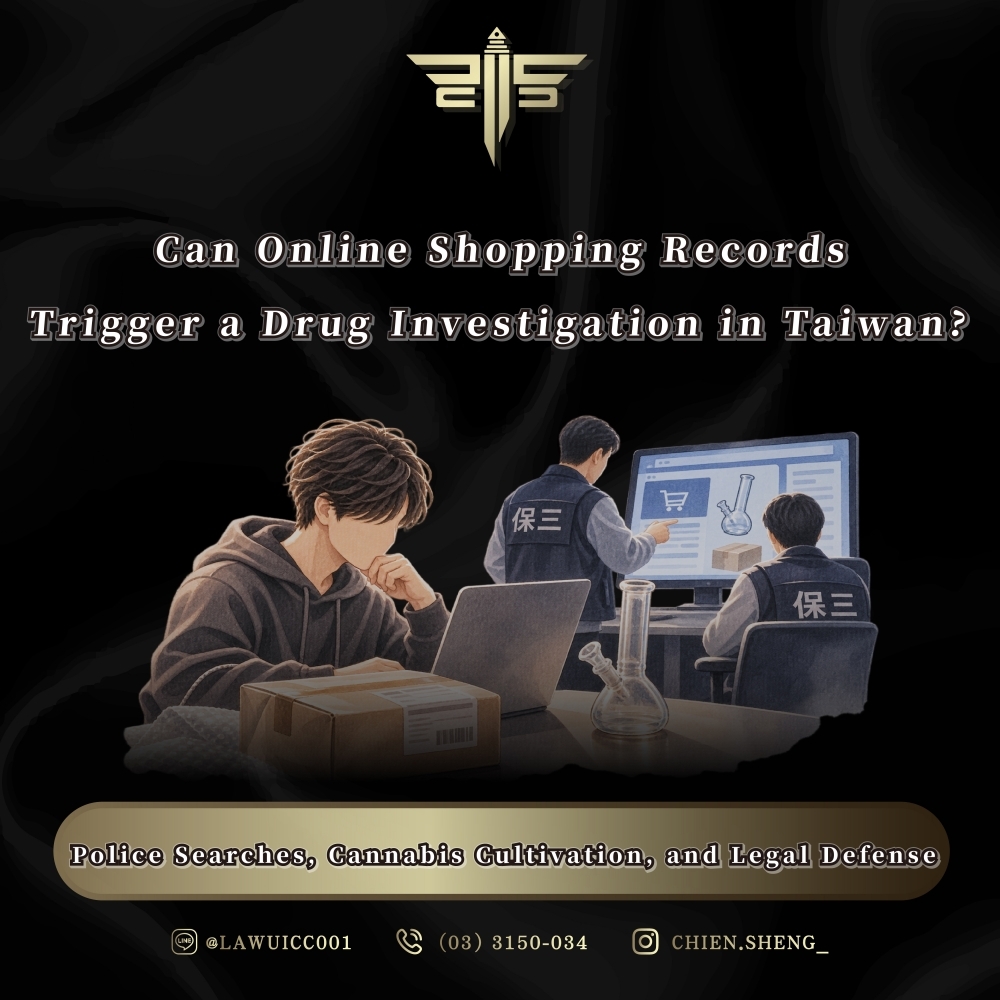
Can Online Shopping Records Trigger a Drug Investigation in Taiwan? Police Searches, Cannabis Cultivation, and Legal Defense
商品圖像
-
商品資訊
目錄
- 1. What Is Taiwan's Third Special Police Corps?
- 2. How Can Online Shopping Records Become Evidence in Drug Cases?
- 3. Can Police Obtain a Search Warrant Based on Shopping Records?
- 4. What Are the Penalties for Drug Crimes in Taiwan?
- 5. Is Growing Cannabis at Home a Criminal Offense?
- 6. Can Drug Offenders Receive Reduced Sentences or Avoid Prosecution?
- 7. What Should You Do If Police Search Your Home?
- 8. How Can a Criminal Defense Lawyer Help in Online Shopping-Related Drug Cases?
- 9. Frequently Asked Questions About Online Shopping and Drug Investigations in Taiwan
- 10. Conclusion: Online Purchases Are Investigative Leads, Not Automatic Proof of Drug Crimes
Can buying smoking accessories or gardening equipment online lead to a police investigation in Taiwan?
Purchasing ordinary products such as grinders, glass pipes, grow lights, fertilizers, or pH testing equipment is not automatically a criminal offense. However, online shopping records may become relevant when investigators suspect drug cultivation, manufacturing, possession, or trafficking.
Taiwan's Third Special Police Corps, commonly known as Bao San, is involved in criminal investigations, including drug-related cases. Its Criminal Investigation Brigade may examine commercial records and other legally obtained evidence when investigating suspected offenses.
A purchase history alone does not establish guilt. Investigators must still connect the available evidence to a specific criminal offense, and searches must comply with Taiwan's Code of Criminal Procedure.
※ This article explains how online shopping records may be used in drug investigations, when police can obtain a search warrant, and what legal defenses may be available.
1. What Is Taiwan's Third Special Police Corps?
1. The Role of the Third Special Police Corps
Taiwan's Third Special Police Corps has traditionally performed duties involving cargo inspections, customs-related security, and the prevention of smuggling.
Its criminal investigation operations also address suspected narcotics offenses, including drug trafficking and cultivation.
These investigations may involve cooperation among police investigators, prosecutors, and other law enforcement authorities.
2. How Digital Evidence Supports Drug Investigations
Drug investigations are not limited to physical surveillance or arrests during transactions.
Investigators may also examine legally obtained digital evidence, such as transaction records, communications, shipping information, and other relevant materials.
➡︎ However, the existence of a digital record does not automatically prove criminal conduct.The evidence must be evaluated in context, and the methods used to obtain it must comply with applicable law.
2. How Can Online Shopping Records Become Evidence in Drug Cases?
1. Are Smoking Accessories and Gardening Supplies Illegal?
Many products available on platforms such as Shopee have ordinary, lawful uses.
➡︎ Examples include smoking accessories, plant-growing lights, fertilizers, soil-testing equipment, and gardening containers.Buying these products does not, by itself, establish drug possession, cultivation, or trafficking.
Nevertheless, certain purchases may become investigative leads when combined with other evidence suggesting unlawful activity.
2. How Investigators May Connect Different Records
The original article describes a publicly reported court case in which online purchases of gardening equipment were examined alongside other investigative evidence.
Police reportedly discovered an indoor cannabis cultivation setup during a subsequent search, including lighting equipment, environmental controls, cannabis plants, and harvested plant material.
➡︎ The significance of such a case lies in the relationship between the evidence.
A grow light alone is not proof of cannabis cultivation. However, an actual cultivation site, controlled plants, relevant communications, and corroborating records may support a criminal investigation.
➡︎ The precise evidentiary value depends on the individual case and the lawfulness of the investigative methods.
3. Can Police Obtain a Search Warrant Based on Shopping Records?
1. Search Warrants Under Articles 128 and 128-1
Under Taiwan's Code of Criminal Procedure, searches generally require a judicial search warrant unless a recognized statutory exception applies.
Article 128 specifies the required contents of a search warrant, including the case, search targets, locations or electronic records, and validity period.
The warrant must be signed by a judge.Under Article 128-1, prosecutors may apply to the competent court for a search warrant during an investigation.
Judicial police officers may also apply after obtaining the prosecutor's authorization.The court evaluates the legal grounds and necessity for the requested search.
2. Can Police Search a Home Without a Warrant?
Certain narrowly defined circumstances permit warrantless searches, including specified situations involving arrests, urgent circumstances, or other statutory exceptions.
Therefore, it would be inaccurate to say that police must always obtain a warrant before every search.Whether an exception applies must be assessed under the relevant provisions of the Code of Criminal Procedure.
3. What Should You Check on a Search Warrant?
➡︎ If officers present a search warrant, review the issuing court, case information, authorized search location, search targets, validity period, and judicial signature.
You may ask officers to clarify the legal basis and scope of the search.
Do not physically obstruct lawful police action. If there are concerns about the warrant or how the search is conducted, those issues should be documented and reviewed with legal counsel.
4. What Are the Penalties for Drug Crimes in Taiwan?
1. Taiwan's Four Categories of Narcotics
Article 2 of the Narcotics Hazard Prevention Act divides narcotics into four categories based on addictive potential, abuse risk, and social harm.
■ Category 1 includes substances such as heroin, morphine, opium, and cocaine.
■ Category 2 includes cannabis and amphetamine-related substances.
■ Categories 3 and 4 contain other controlled substances identified in the applicable official schedules.
The legal consequences depend on both the classification and the alleged conduct.
2. Manufacturing, Transporting, or Selling Narcotics
Under Article 4, manufacturing, transporting, or selling narcotics carries severe criminal penalties.
■ For Category 1 narcotics, the statutory penalty may be death or life imprisonment.
■ For Category 2 narcotics, including cannabis and methamphetamine, the penalty is life imprisonment or imprisonment of at least ten years, with a possible additional fine of up to NT$15 million.
➡︎ The statutory penalties for Categories 3 and 4 are generally lower but may still involve substantial prison terms.
➡︎ The law also separately regulates certain equipment specifically intended for manufacturing or using narcotics.
3. Possession with Intent to Sell
Article 5 criminalizes possession of narcotics with intent to sell.
Possession of Category 2 narcotics with intent to sell carries imprisonment of at least five years, with a possible additional fine of up to NT$5 million.
Investigators must establish the relevant intention through evidence rather than automatically treating every possession case as trafficking.
4. Ordinary Drug Possession
Under Article 11, ordinary unauthorized possession of Category 1 narcotics may result in imprisonment of up to three years, short-term imprisonment, or a fine.
Ordinary possession of Category 2 narcotics may result in imprisonment of up to two years, short-term imprisonment, or a fine of up to NT$200,000.Higher penalties apply when specified pure net weight thresholds are reached.
For Category 2 narcotics, possession of at least 20 grams in pure net weight carries imprisonment of six months to five years, with a possible additional fine.Certain possession offenses involving Categories 3 and 4 may also become criminal offenses when statutory quantity thresholds are met.
5. Drug Use and Addiction Treatment
Under Article 10, using Category 1 narcotics carries imprisonment of six months to five years.Using Category 2 narcotics carries imprisonment of up to three years.
➡︎ However, qualifying drug-use cases may involve observation and rehabilitation, compulsory treatment, or deferred prosecution with addiction treatment.These procedures depend on the defendant's previous treatment history and the applicable statutory requirements.
6. Transferring or Inducing Another Person to Use Drugs
Articles 7 and 8 separately regulate inducing another person to use narcotics and transferring narcotics.
➡︎ For example, transferring Category 2 narcotics may result in imprisonment of six months to five years, with a possible additional fine of up to NT$700,000.
Payment is not always required for a transfer offense.The actual conduct, intention, and available evidence determine which provision may apply.
5. Is Growing Cannabis at Home a Criminal Offense?
1. Cannabis Cultivation Under Article 12
Under Article 12 of the Narcotics Hazard Prevention Act, cultivating cannabis with intent to manufacture narcotics carries imprisonment of at least five years, with a possible additional fine of up to NT$5 million.
➡︎ The prosecution must establish the statutory elements, including the cultivation conduct and relevant intention.
➡︎ The offense does not necessarily require the authorities to prove that a finished narcotic product has already been manufactured.
2. Is There a Reduced Penalty for Minor Personal-Use Cultivation?
➡︎ Yes, in qualifying circumstances.
Article 12, paragraph 3 provides a separate penalty of imprisonment of one to seven years, with a possible additional fine of up to NT$1 million, where the cultiva tion offense was committed for personal use and the circumstances were minor.
This provision was introduced to address proportionality concerns involving less serious cultivation cases.
It does not legalize growing cannabis at home.The number of plants, cultivation purpose, equipment, and other facts remain relevant to the legal assessment.
6. Can Drug Offenders Receive Reduced Sentences or Avoid Prosecution?
1. Circumstances That May Increase Criminal Penalties
Article 9 provides enhanced penalties for specified drug offenses, including certain offenses committed by adults against minors or knowingly involving pregnant individuals.
It also addresses specified offenses involving mixtures of multiple narcotics.The precise aggravating provisions depend on the offense charged.
2. Sentence Reduction Under Article 17
Article 17 provides potential sentence reductions or exemptions for specified offenses where the defendant identifies a drug source and that information leads to the apprehension of another principal offender or accomplice.
Other provisions address qualifying confessions during investigation and trial proceedings.These benefits are subject to statutory conditions and do not apply to every narcotics offense.
In particular, Article 12 cannabis cultivation is not included within the offenses covered by Article 17's principal reduction provisions.
3. Voluntary Addiction Treatment Before Discovery
Article 21 provides a mechanism for individuals who voluntarily seek treatment at designated medical institutions before their Category 1 or Category 2 drug-use offense is discovered.
When the statutory requirements are satisfied, the provision may protect the individual from prosecution for the qualifying offense.
The mechanism is subject to specific conditions and a one-time limitation.
4. Deferred Prosecution with Addiction Treatment
Article 24 allows prosecutors to consider deferred prosecution subject to addiction treatment or other legally authorized conditions.
This may involve medical treatment, periodic reporting, drug testing, or other appropriate requirements.Deferred prosecution is not an acquittal. Failure to comply with its conditions may result in revocation and further proceedings.
7. What Should You Do If Police Search Your Home?
1. Verify the Search Authority
Ask to review the search warrant or clarify the statutory basis for any warrantless search.
Check the authorized location, relevant case information, and scope of the search.Remain calm and avoid physically interfering with lawful police procedures.
2. Preserve Your Legal Rights
A criminal suspect may seek assistance from defense counsel under Taiwan's Code of Criminal Procedure.Do not guess about the purpose of purchases, invent explanations, or sign an inaccurate interview record.
You may request legal advice before making substantive statements.Avoid deleting purchase histories, communications, or other potentially relevant evidence.
3. Review the Search and Seizure Records
Where applicable, request or retain the relevant search and seizure documentation.Record any concerns about the execution of the search and discuss them with your lawyer.
Potential issues may include the scope of the warrant, seizure procedures, electronic evidence, and whether statutory exceptions were properly invoked.
8. How Can a Criminal Defense Lawyer Help in Online Shopping-Related Drug Cases?
1. Challenge Unsupported Inferences from Purchase Records
A lawful purchase should not automatically be treated as proof of criminal intent.
Defense counsel may examine whether investigators have evidence connecting the purchased items to actual cultivation, manufacturing, possession, or trafficking.
2. Examine the Legality of Searches and Digital Evidence
A lawyer may review the search warrant, applicable exceptions, seizure records, and the procedures used to obtain electronic evidence.
Where evidence was obtained unlawfully, the defense may consider whether the relevant exclusionary rules apply.
3. Distinguish Cultivation, Possession, Use, and Trafficking
Different drug offenses have substantially different elements and penalties.
A defense strategy should address the specific conduct alleged rather than assuming that all drug-related evidence proves the most serious offense.
4. Assess Treatment Options and Sentencing Issues
In eligible drug-use cases, counsel may evaluate observation and rehabilitation, voluntary treatment, or deferred prosecution.
Where a criminal charge proceeds to trial, the defense may also examine applicable sentence reductions, mitigating circumstances, and the proportionality of the proposed penalty.
5. Legal Assistance from Chien Sheng International Law Firm
Chien Sheng International Law Firm provides criminal defense services in Taiwan for drug-related investigations, searches, and prosecutions.
Depending on the case, assistance may include reviewing search procedures, analyzing electronic records, accompanying clients during questioning, examining narcotics evidence, and developing a defense strategy based on the actual allegations.
The appropriate approach depends on the law, the evidence, and the defendant's circumstances. No specific outcome can be guaranteed.
9. Frequently Asked Questions About Online Shopping and Drug Investigations in Taiwan
Q1: Can buying a grinder or glass pipe online lead to a drug investigation?
Possibly, if investigators have additional evidence suggesting a narcotics offense. However, buying an ordinary lawful item does not automatically establish criminal liability.
Q2: Can police search my home simply because I purchased grow lights?
A purchase alone does not automatically authorize a home search. Investigators must satisfy the applicable legal requirements for a warrant or a recognized warrantless-search exception.
Q3: Can Shopee purchase records be used as evidence in Taiwan?
Potentially, yes. Relevant transaction records may be used as evidence if obtained through lawful procedures and properly connected to the alleged offense.
Q4: Is growing cannabis for personal use legal in Taiwan?
No. Unauthorized cannabis cultivation remains a criminal offense. A separate statutory penalty may apply to qualifying minor personal-use cultivation cases.
Q5: What if police find gardening equipment but no cannabis plants?
The legal assessment depends on the complete evidence. Ordinary gardening equipment does not, by itself, prove cannabis cultivation or another narcotics offense.
Q6: Can a defendant challenge evidence obtained during a police search?
Yes. Defense counsel may review whether the search and seizure complied with applicable law and whether the evidence is admissible.
Q7: Can a first-time drugreceive treatment instead of immediate prosecution?
In qualifying cases, observation and rehabilitation or deferred prosecution with addiction treatment may be available. Eligibility depends on the relevant statutory requirements and previous proceedings.
10. Conclusion: Online Purchases Are Investigative Leads, Not Automatic Proof of Drug Crimes
Online shopping records can become part of a criminal investigation in Taiwan, particularly when police suspect cannabis cultivation or other drug-related activities.
However, purchasing ordinary smoking accessories or gardening supplies does not automatically constitute a crime.Investigators must establish the elements of the alleged offense through sufficient evidence, and searches must comply with the Code of Criminal Procedure.
The consequences of a drug investigation depend on whether the evidence supports possession, use, cultivation, manufacturing, transfer, or trafficking.
➡︎ If police have contacted you about online purchases or conducted a search of your home, preserve relevant records, understand your procedural rights, and seek legal advice before making important statements.
 Chien Sheng International Law Firm assists individuals facing narcotics investigations and criminal proceedings in Taiwan, including cases involving digital evidence, search warrants, cannabis cultivation, and drug trafficking allegations.
※ Legal Disclaimer: This article provides general information about Taiwan's narcotics laws and criminal procedures. Criminal liability, search legality, treatment eligibility, and sentencing depend on the applicable law and specific facts of each case. No particular legal outcome is guaranteed.
This reduces both medical risks and potential legal exposure.
Chien Sheng International Law Firm

LINE Online Legal Consultation: @lawuicc001 (Click to consult)
Welcome to call to schedule a meeting: 03-3150-034
Multiple payment methods available: Cash, Credit Card, Bank Transfer
Facebook: Chien Sheng International Law Firm
Instagram: chien.sheng_
-
商品Q&A