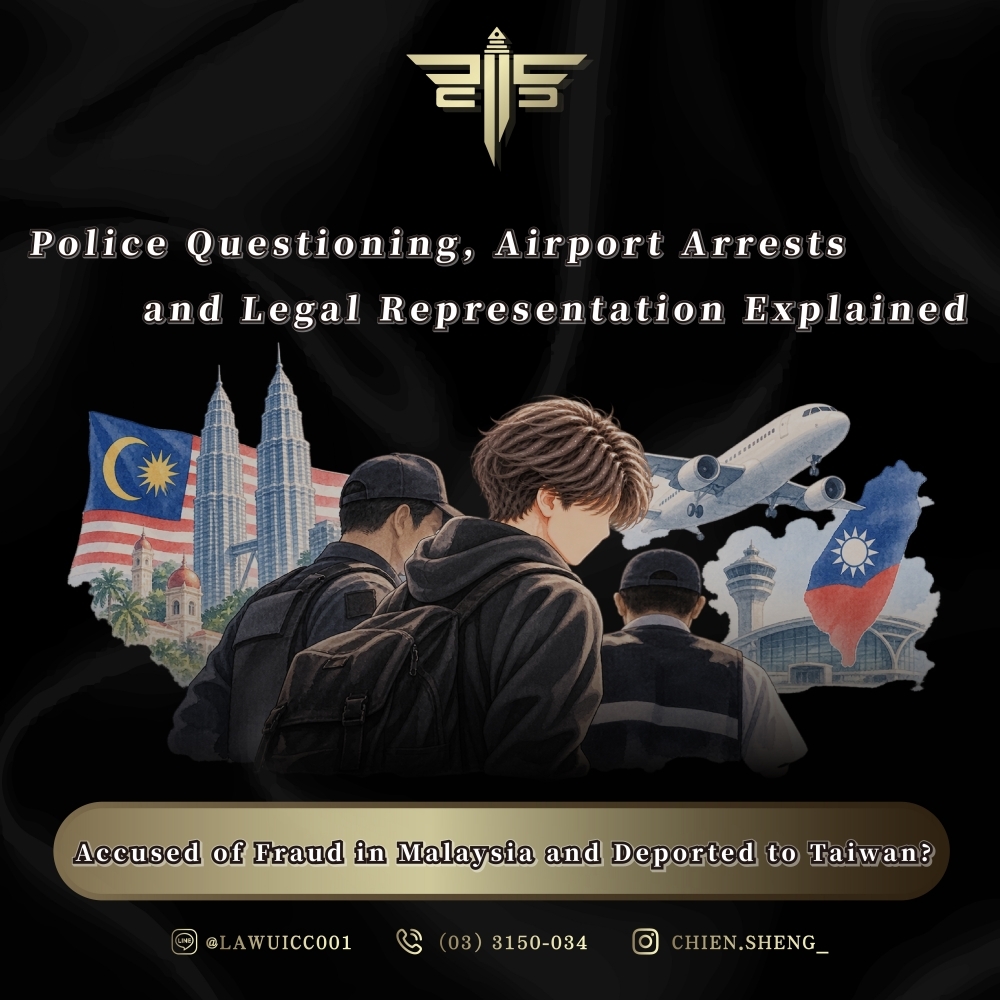
Accused of Fraud in Malaysia and Deported to Taiwan? Police Questioning, Airport Arrests, and Legal Representation Explained
商品圖像
-
商品資訊
目錄
- 1. Will You Be Arrested Immediately After Being Deported from Malaysia to Taiwan?
- 2. What Can a Taiwanese Criminal Defense Lawyer Do Before Deportation?
- 3. What Happens After Arrival at a Taiwanese Airport?
- 4. Why Is Having a Lawyer During Police Questioning Important?
- 5. What If the Person Deported from Malaysia Is a Minor?
- 6. What Should Families Prepare Before Deportation to Taiwan?
- 7. How Chien Sheng International Law Firm Can Assist
- 8. Frequently Asked Questions
What happens if a Taiwanese national is accused of fraud in Malaysia and subsequently deported to Taiwan?
Can a lawyer meet the person at the airport? Will the individual be arrested immediately upon arrival? What happens if the person is exhausted or too nervous to answer police questions accurately?
Chien Sheng International Law Firm recently received a case involving an individual accused of fraud in Malaysia who was facing deportation to Taiwan.
For individuals and their families, the primary concerns often extend beyond potential criminal liability. They also involve airport procedures, police questioning, prosecutorial investigations, possible detention, and court hearings.
Deportation does not automatically mean that a person has been convicted of a crime or will be detained in Taiwan.
➡︎ However, when Taiwanese authorities are already investigating a related fraud case, important criminal procedures may begin shortly after the person's arrival.
Early legal assistance can help the individual understand their rights, preserve relevant evidence, and provide accurate statements during questioning.
1. Will You Be Arrested Immediately After Being Deported from Malaysia to Taiwan?
Being deported by a foreign country, being accused of a crime overseas, and being wanted by Taiwanese authorities are legally distinct circumstances.
A person returning to Taiwan is not automatically subject to arrest simply because they have been deported from Malaysia.
Whether Taiwanese authorities may arrest or take the person into custody depends on the applicable legal grounds, such as an outstanding warrant, a lawful arrest or compulsory appearance order, or other statutory circumstances.
In cross-border fraud investigations, Taiwanese police and prosecutors may already be coordinating with foreign authorities.
Where an investigation is underway and lawful grounds exist, the individual may be arrested or taken into custody upon arrival at Taiwan Taoyuan International Airport or another entry point.
What Should Families Confirm Before the Return Flight?
Family members should try to establish the following information:
■ Whether a criminal investigation or outstanding warrant exists in Taiwan.
■ Which police agency, prosecutor's office, or court is handling the case.
■ The expected arrival airport, flight number, and arrival time.
■ The allegations made overseas and the individual's actual work or activities.
■ Whether arrangements for legal representation can be made before arrival.
These details can help defense counsel coordinate with the relevant authorities and prepare for the procedures that may follow.
2. What Can a Taiwanese Criminal Defense Lawyer Do Before Deportation?
Legal preparation does not have to wait until the individual arrives in Taiwan.
Where communication and access to information are possible, a lawyer can begin reviewing the circumstances surrounding the person's travel, employment, detention, and alleged involvement in fraud.
1. Investigating the Background of the Alleged Fraud
Important questions may include:
■ How was the individual recruited to work in Malaysia?
■ Did the actual work differ from the job originally advertised?
■ Did the individual communicate with alleged fraud victims?
■ Were they instructed to operate bank accounts, transfer money, or withdraw funds?
■ Did they receive payment, and how was it calculated?
■ Were their passport, identification documents, or freedom of movement restricted?
■ Did they know, or could they reasonably foresee, that the activities involved fraud?
Recruitment advertisements, employment messages, payment records, travel documents, and communications with supervisors may become important evidence.
2. Preparing for Taiwanese Criminal Procedures
Before the return flight, counsel may explain the possible procedures following arrival, including police questioning, transfer to a prosecutor's office, and potential court proceedings.
This preparation can help the individual understand what may happen and avoid confusion during a stressful situation.
Legal representation in Taiwan and legal assistance during detention or deportation in Malaysia are separate matters.
Proceedings conducted by Malaysian authorities are governed by Malaysian law and may require assistance from a qualified local lawyer.
3. What Happens After Arrival at a Taiwanese Airport?
The following procedures may apply when an adult returning to Taiwan is subject to an outstanding warrant or another lawful basis for arrest or compulsory appearance.
The actual sequence depends on the case and the responsible authorities.
1. Airport Arrival and Identity Verification
After arrival, airport police, the original investigating police agency, or other authorized officers may verify the person's identity and carry out legally authorized procedures.
Not every case is handled by the same airport unit, and questioning does not necessarily take place inside the airport.
A lawyer should confirm the responsible agency and the location where questioning is expected to occur.
Access to restricted airport areas and transportation vehicles may be limited.
2. Police Questioning and Statement Records
Police may ask about the individual's activities in Malaysia, employment arrangements, communications with other suspects, financial transactions, and possible involvement in fraud.
Under Taiwan's Code of Criminal Procedure, suspects and defendants have important procedural rights, including the right to remain silent, the right to retain defense counsel, and the right to request investigation of favorable evidence.
Defense counsel may generally attend questioning, take notes, and express opinions in accordance with the applicable procedural rules.
During questioning, a lawyer can help ensure that the individual understands the questions and that the written record accurately reflects the answers provided.
➡︎ Where a question is unclear, clarification may be requested.
➡︎ Where a statement has been inaccurately recorded, corrections or supplementary explanations may be necessary.
A person should answer according to their actual knowledge and memory rather than guessing or accepting facts they do not know.
If the return flight arrives late at night, the authorities must still comply with the applicable restrictions on nighttime questioning.
3. Transfer to a Prosecutor's Office or Court
After the initial procedures, the individual may be transferred to the competent prosecutor's office or court, depending on the case.
➡︎ If the matter remains under investigation, a prosecutor may conduct questioning and decide whether further compulsory measures are necessary.
➡︎ If the case has already reached trial or concerns enforcement of an existing criminal judgment, different procedures may apply.
Therefore, returning to Taiwan does not necessarily mean that every individual will follow the same sequence of police questioning and prosecutorial proceedings.
4. Prosecutorial Questioning and Possible Detention
During an investigation, the prosecutor may determine whether the individual should be released, released on bail, placed under another legally authorized restriction, or subjected to an application for pretrial detention.
A prosecutor's request for detention does not mean that detention will automatically be ordered.
A court must examine the statutory grounds and necessity for detention before making its decision.
Restrictions on visits or communications also require a lawful basis and are not automatically imposed in every fraud case.
A criminal defense lawyer can assist during prosecutorial questioning and represent the individual in detention proceedings, including presenting arguments concerning release or appropriate alternatives to detention.
4. Why Is Having a Lawyer During Police Questioning Important?
Individuals returning from overseas detention may be physically exhausted and emotionally distressed.
After a long flight and an unfamiliar legal process, they may struggle to explain events clearly.
Some people provide answers before fully understanding the question. Others confuse the sequence of events or repeat information they heard from someone else as though they had witnessed it personally.
These differences can significantly affect how statements are interpreted.
1. Understanding the Procedure and Legal Rights
A lawyer can explain the current procedural stage, the responsible authorities, and the legal rights available to the individual.
Understanding the process may help the person communicate more clearly during questioning.
2. Distinguishing Personal Knowledge from Assumptions
In fraud investigations, an important distinction may exist between knowing that a company operates a telephone service and knowing that its employees are deceiving victims.
A defendant should be able to explain:
■ What they personally did.
■ What they knew at the time.
■ What they learned only afterward.
■ What information came from other people.
■ Which details they cannot accurately remember.
A lawyer's role is not to a false explanation but to help ensure that the person's actual account is accurately presented.
3. Reviewing Police Statements for Accuracy
A written statement may become important evidence in later criminal proceedings.
Before confirming the record, the individual should check whether it accurately reflects their answers.
➡︎ If an uncertain answer has been recorded as a definite admission, or an important explanation has been omitted, counsel may assist in requesting clarification or correction.
4. Representation During Court Proceedings
Where the case proceeds to court, defense counsel can address the evidence, the individual's alleged role, and any application for detention or other compulsory measures.
Legal representation does not guarantee release on bail, non-prosecution, or acquittal.
However, it allows the defendant's factual explanations and legal arguments to be presented through the appropriate procedures.
5. What If the Person Deported from Malaysia Is a Minor?
Cases involving minors must be distinguished from ordinary adult criminal proceedings.
Under Taiwan's Juvenile Justice Act, a juvenile generally refers to a person aged 12 or older but under 18.
The applicable procedures may also depend on the individual's age at the time of the alleged conduct and at the relevant procedural stage.
Juvenile cases generally follow a separate legal framework involving the juvenile court and juvenile protection procedures.
The rules concerning compulsory appearance, custody, parental involvement, and legal assistance differ from those applicable to adults.
A minor accused of participating in an overseas fraud operation should not automatically be treated as an adult suspect subject to the ordinary arrest, prosecutorial questioning, and detention process.
How Can a Lawyer Assist a Minor?
Depending on the applicable procedure, a lawyer may serve as defense counsel or an assistant in juvenile proceedings.
Legal assistance may include explaining the allegations, attending questioning, communicating with family members, and presenting information concerning education, family support, and appropriate care arrangements.
The child's procedural rights and welfare must be considered within the relevant juvenile justice framework.
6. What Should Families Prepare Before Deportation to Taiwan?
When a family member is detained in Malaysia and expected to return to Taiwan, early preparation may help avoid unnecessary delays.
Families should gather:
■ Personal information: The individual's name, age, identification details, and contact information.
■ Flight information: Expected arrival date, airport, flight number, and arrival time.
■ Foreign documents: Available detention, investigation, or deportation records from Malaysia.
■ Taiwan case information: Any police notices, court documents, case numbers, or warrant information.
■ Relevant evidence: Recruitment advertisements, employment communications, financial records, and travel documents.
■ Health information: Medical conditions, required medication, and other immediate care needs.
The family should provide these materials to the lawyer as early as possible.
Can a Lawyer Meet the Person at the Airport?
A lawyer may coordinate with the responsible authorities to arrange legal assistance after the person's arrival.
However, a lawyer is not automatically entitled to enter every restricted airport area or accompany the individual inside an official transport vehicle.
The practical arrangements depend on the relevant agency, the location of questioning, and the individual's procedural status.
For this reason, confirming the responsible authority before the flight arrives is particularly important.
7. How Chien Sheng International Law Firm Can Assist
 Chien Sheng International Law Firm provides criminal defense assistance in fraud investigations and cases involving individuals returning to Taiwan from overseas.
Depending on the circumstances, legal services may include:
■ Reviewing available information concerning the alleged overseas fraud.
■ Confirming the relevant Taiwanese investigating authority and procedural status.
■ Coordinating legal representation for police questioning after arrival.
■ Assisting during prosecutorial questioning and court proceedings.
■ Reviewing written statements and relevant evidence.
■ Evaluating detention issues and possible alternatives.
■ Developing an appropriate criminal defense strategy based on the defendant's actual role and knowledge.
The firm's approach emphasizes early preparation, accurate factual statements, and the protection of procedural rights.
The purpose of legal representation is not to guarantee a particular result, but to ensure that the individual's position is properly examined and presented throughout the criminal process.
8. Frequently Asked Questions
Q1: Will I automatically be arrested if I am deported from Malaysia to Taiwan?
No. Deportation alone does not automatically authorize arrest in Taiwan. Arrest or compulsory appearance must have an applicable legal basis.
Q2: Can a Taiwanese lawyer accompany me during questioning after I return?
Generally, defense counsel may assist during police and prosecutorial questioning in accordance with Taiwan's procedural rules. Practical arrangements should be coordinated with the responsible authorities.
Q3: Can a lawyer enter the airport's restricted areas to meet me?
Not automatically. Access depends on airport security restrictions and the arrangements permitted by the relevant authorities.
Q4: Will I be detained immediately after returning to Taiwan?
Not necessarily. Detention requires statutory grounds and judicial review. The outcome depends on the evidence and circumstances of the case.
Q5: What should I do if I cannot remember an answer during police questioning?
You should state that you do not remember or are uncertain rather than guess. You may also request clarification of unclear questions.
Q6: What if I was recruited for a legitimate job but later discovered it involved fraud?
The investigation must examine what you actually did, what you knew, and when you learned about the alleged criminal activity. Recruitment messages and employment records may be important evidence.
Q7: Do different procedures apply if the person being deported is under 18?
Yes. Juvenile cases may fall under Taiwan's separate juvenile justice framework, with different procedural protections and requirements.
Conclusion: Early Legal Preparation Matters After Deportation from Malaysia
Being accused of fraud in Malaysia and deported to Taiwan does not automatically establish criminal guilt.
However, returning individuals may face police questioning, prosecutorial investigation, court proceedings, and possible applications for detention.
The first statements made after arrival can become important evidence, particularly when the individual is exhausted, distressed, or unfamiliar with Taiwan's criminal procedures.
Early legal assistance can help clarify the applicable procedures, protect the individual's rights, preserve relevant evidence, and ensure that statements accurately reflect what the person actually knows.
Families who receive notice of an impending deportation should consider contacting a qualified Taiwanese criminal defense lawyer before the return flight whenever possible.
※ This article is provided by Chien Sheng International Law Firm for general legal information and educational purposes. It primarily addresses criminal procedures in Taiwan following deportation from Malaysia. Malaysian detention, investigation, and deportation procedures are governed by Malaysian law and may require separate local legal assistance. Arrest, questioning, detention, and juvenile proceedings depend on the individual's procedural status and the applicable legal requirements. Legal representation does not guarantee release, non-prosecution, acquittal, or any particular outcome. This article does not replace individualized legal advice.
This reduces both medical risks and potential legal exposure.
Chien Sheng International Law Firm

LINE Online Legal Consultation: @lawuicc001 (Click to consult)
Welcome to call to schedule a meeting: 03-3150-034
Multiple payment methods available: Cash, Credit Card, Bank Transfer
Facebook: Chien Sheng International Law Firm
Instagram: chien.sheng_
-
商品Q&A