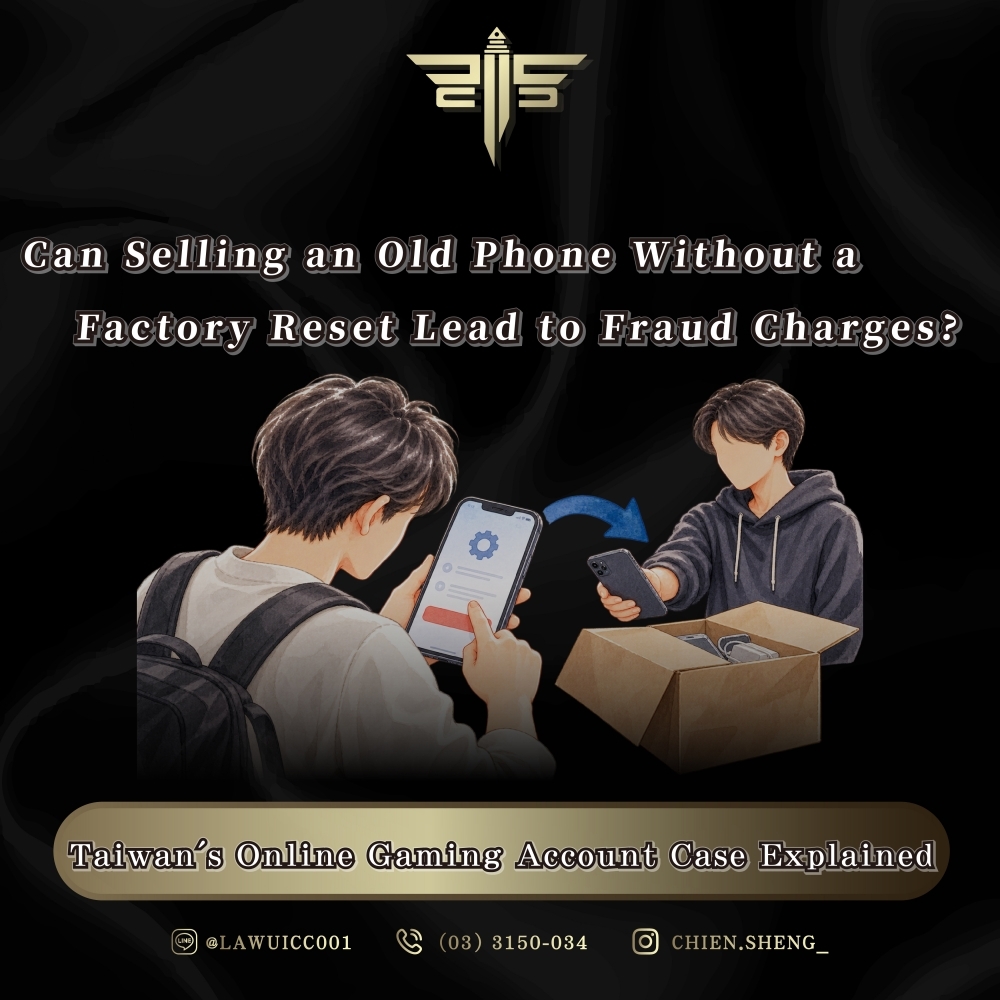
Can Selling an Old Phone Without a Factory Reset Lead to Fraud Charges? Taiwan's Online Gaming Account Case Explained
商品圖像
-
商品資訊
目錄
- 1. What Happened in the Online Gaming Fraud Case?
- 2. What Must Prosecutors Prove to Establish Aiding Fraud in Taiwan?
- 3. Why Was the Digital Evidence Insufficient?
- 4. Is Failing to Factory Reset a Phone a Criminal Offense?
- 5. Does Offering Compensation Mean Admitting Fraud?
- 6. What Digital Evidence Matters Most in an Aiding Fraud Case?
- 7. How to Safely Sell a Used Smartphone
- 8. Frequently Asked Questions
- 9. How Chien Sheng International Law Firm Can Assist
Can selling an old smartphone without signing out of your accounts or performing a factory reset make you an accomplice to fraud in Taiwan?
According to recent media reports, a woman in Taichung faced charges of aiding fraud after an online gaming account previously linked to her phone number was allegedly used to scam another player. She claimed that she had sold her old phone without erasing its data and had never knowingly provided the account to scammers.
The Taichung District Court reportedly acquitted her because the available evidence did not establish that she had provided the account to a fraud group or intended to facilitate fraud. The reported judgment was still subject to appeal.
The central legal principle is straightforward: poor account security does not automatically constitute aiding fraud. Criminal liability requires proof of both an act of assistance and the necessary criminal intent.
※ Note: This article is based on publicly reported facts. The complete judgment number and case record have not been independently confirmed, and the discussion should not be treated as a definitive account of every factual finding.
1. What Happened in the Online Gaming Fraud Case?
According to media reports, prosecutors alleged that the woman had provided an online gaming account linked to her mobile number to a fraud group before September 2023.
The scammers allegedly used the account to offer another player NT$14,000 for 2.8 million units of in-game currency. After transferring the virtual currency, the victim received no payment and reported the incident to police.
Investigators traced the account registration information to the woman.
She denied involvement, explaining that she had stopped playing the game, that her former phone number had been disconnected, and that she had sold her old smartphone around January 2023 without performing a factory reset.
The court reportedly found insufficient evidence to establish that she had knowingly transferred the account to scammers or participated in their activities.
The case illustrates why account ownership and actual account use must be distinguished in digital fraud investigations.
2. What Must Prosecutors Prove to Establish Aiding Fraud in Taiwan?
Under Taiwan's Criminal Code, aiding fraud generally involves three essential elements.
1. An Underlying Fraud Offense
Article 339 of the Criminal Code addresses fraud involving deception that causes another person to transfer property or provide an unlawful financial benefit.
Depending on the circumstances, aggravated fraud under Article 339-4 may also be relevant.
In an online gaming transaction, investigators must determine whether deception occurred, whether the victim transferred valuable virtual assets because of that deception, and how the fraudulent transaction was carried out.
2. An Actual Act of Assistance
Under Article 30 of the Criminal Code, a person may be criminally liable for intentionally assisting another person's offense.
Assistance may involve providing an account, device, phone number, login credentials, payment method, or other resources that facilitate the crime.
However, an account being registered under someone's name does not prove that the person knowingly provided it to criminals.
The account may have been accessed through a previously sold device, compromised credentials, or unauthorized third-party use.
3. Criminal Intent
Article 13 of the Criminal Code recognizes both direct intent and conditional intent.
➡︎ For aiding fraud, prosecutors must establish that the defendant knew, or foresaw and accepted, that their conduct could facilitate fraudulent activity.
Forgetting to erase a smartphone may demonstrate carelessness, but carelessness alone does not establish intentional assistance.
Criminal liability cannot be inferred solely from the fact that fraud occurred after the phone was sold.
3. Why Was the Digital Evidence Insufficient?
According to the reported case, two major evidentiary issues affected the prosecution.
1. Missing Login IP Addresses and Device Records
An account's registration details do not necessarily identify the person who used it during a particular transaction.
Relevant evidence may include login IP addresses, access times, device identifiers, password changes, account recovery records, and unusual login activity.
➡︎ However, an IP address alone does not conclusively identify an individual. Shared networks, dynamic IP addresses, VPNs, and other technical factors may complicate attribution.
Investigators must evaluate these records alongside communications, transactions, device information, and other evidence.
2. Missing Account-Binding and Activity Logs
Gaming platforms may retain records of changes to linked phone numbers, email addresses, passwords, devices, and account recovery settings.
Such records can help determine when control of an account changed and whether the original owner accessed it during the alleged fraud.
Media reports indicated that some relevant records could no longer be obtained because the platform's retention period had expired.
Under Articles 154 and 161 of Taiwan's Code of Criminal Procedure, defendants are presumed innocent, and prosecutors bear the burden of proving the charged offense.
➡︎ If the evidence cannot establish who controlled the account, whether the defendant assisted the scammers, and whether the required intent existed, a conviction cannot rest merely on account registration information.
4. Is Failing to Factory Reset a Phone a Criminal Offense?
Simply forgetting to perform a factory reset does not automatically constitute aiding fraud.
The legal distinction is between negligent account management and knowingly facilitating criminal activity.
For example, criminal concerns may arise where a seller:
■ Knowingly provides passwords or verification codes for suspicious purposes.
■ Agrees to preserve account access so another person can conduct fraudulent transactions.
■ Helps change account-binding information to support the scheme.
■ Receives suspicious payments connected to the account's criminal use.
■ Maintains communications or financial arrangements with the actual scammers.
These circumstances may support further investigation, but they do not automatically establish guilt.
Conversely, a genuine secondhand transaction, documented device delivery, discontinued phone service, and evidence of prolonged account inactivity may support the seller's defense.
The court must evaluate the complete circumstances rather than treating the failure to reset a phone as proof of criminal intent.
5. Does Offering Compensation Mean Admitting Fraud?
According to media reports, the defendant expressed willingness to compensate the victim because she felt responsible for failing to secure her old phone and account.
However, offering compensation does not necessarily amount to admitting criminal guilt.
A person may offer compensation out of sympathy, a sense of responsibility, or a desire to resolve a dispute without acknowledging intentional wrongdoing.
Courts must examine the full context of the statement and other evidence before determining its legal significance.
Nevertheless, compensation and settlement discussions may become part of the case record. Defendants should clearly distinguish between acknowledging poor account management and admitting intentional participation in fraud.
6. What Digital Evidence Matters Most in an Aiding Fraud Case?
Digital evidence may establish who actually controlled an account and when that control changed.
For someone accused of aiding fraud after selling a smartphone, important records may include:
■ Secondhand marketplace listings and transaction messages.
■ Payment records and proof of device delivery.
■ The buyer's available identification and contact details.
■ Phone service termination or suspension records.
■ The device's serial number or IMEI.
■ Gaming account login and binding-change histories.
■ Password reset and device authorization records.
■ Evidence showing the defendant's location during the alleged offense.
■ Records indicating whether the defendant communicated with or received money from the scammers.
For victims, relevant evidence may include in-game conversations, account names, virtual currency transfer records, payment agreements, timestamps, and communications with platform support.
Why Early Preservation Matters
Digital records are not always retained indefinitely.
Once a platform deletes historical login or device records, later requests from lawyers, investigators, or courts may not recover them.
Anyone involved in such a case should therefore preserve available devices, transaction records, screenshots, and original electronic communications as early as possible.
Defendants should avoid deleting or altering potentially relevant evidence and should seek legal assistance when requesting platform records or submitting evidence investigation applications.
7. How to Safely Sell a Used Smartphone
Selling a smartphone safely requires more than removing a few applications.
Before transferring ownership, follow these precautions:
■ Back up personal data. Save important photos, contacts, documents, and authentication information securely.
■ Sign out of important accounts. Remove access to email, gaming platforms, social media, banking applications, and digital wallets.
■ Remove SIM cards and eSIM profiles. Ensure that phone numbers and authentication services are properly transferred or disconnected.
■ Disable device tracking and activation locks. Remove the phone from the relevant Apple, Google, or other device management account.
■ Perform a factory reset. Confirm that the device returns to its initial setup screen without exposing personal information.
■ Keep proof of the transaction. Preserve the sale date, payment record, buyer communications, and device identification information.
These steps reduce cybersecurity risks and may help establish when control of the device passed to another person if a dispute later arises.
8. Frequently Asked Questions
Q1: Can I be charged with aiding fraud simply because I forgot to reset my old phone?
Not automatically. Prosecutors must prove an actual act of assistance and the necessary criminal intent. Negligent account management alone is insufficient.
Q2: Am I responsible if scammers use a gaming account registered under my name?
Not necessarily. Registration records do not conclusively establish who controlled or operated the account during the offense.
Q3: Can an IP address prove who committed online fraud?
An IP address may provide an investigative lead, but it generally needs to be evaluated alongside device records, login activity, communications, and other evidence.
Q4: How can I prove that someone else used my account after I sold my phone?
Preserve the sales agreement, transaction messages, payment records, delivery date, phone service records, and available account login or binding-change information.
Q5: Can fraud involving virtual gaming currency lead to criminal charges?
Yes. Virtual currency and digital gaming assets may have legally recognized economic value. The applicable offense depends on the nature of the assets and the circumstances of the transaction.
Q6: Does offering to compensate the victim mean I have confessed?
No. Compensation may reflect sympathy or a desire to settle the dispute rather than an admission of intentional fraud. The full context matters.
Q7: Does missing IP or device evidence guarantee an acquittal?
No. Courts consider all available evidence. Other reliable evidence may still establish the defendant's conduct and intent.
Q8: Can a buyer use accounts left logged in on a secondhand phone?
A buyer should not assume that purchasing a device authorizes access to the previous owner's accounts or personal information. Unauthorized access or misuse may separate legal risks.
9. How Chien Sheng International Law Firm Can Assist
Aiding fraud cases involving smartphones and online accounts often require careful analysis of digital evidence, account ownership, device transfers, and criminal intent.
 Chien Sheng International Law Firm can assist clients by:
■ Reviewing whether the evidence establishes actual assistance and criminal intent.
■ Reconstructing the timeline of a phone sale and subsequent account activity.
■ Examining login records, device identifiers, and account-binding changes.
■ Identifying missing or potentially unreliable digital evidence.
■ Preparing evidence preservation and investigation requests.
■ Representing clients during police questioning, prosecutorial investigations, and court proceedings.
■ Evaluating the legal implications of compensation or settlement discussions.
■ Assisting victims in documenting losses involving virtual currency and other digital assets
Conclusion: Account Ownership Does Not Automatically Establish Fraud Liability
The reported Taichung gaming account case highlights two important lessons.
➡︎ First, selling a smartphone without properly removing personal information creates significant cybersecurity and legal risks. Sellers should sign out of accounts, remove device authorizations, perform a factory reset, and retain transaction records.
➡︎ Second, criminal liability cannot be established merely because an account was once registered under the defendant's name or because a phone was sold without being reset.
Prosecutors must prove the defendant's actual conduct and the required criminal intent. Courts must carefully assess whether another person gained control of the account and whether the available digital evidence reliably identifies the person responsible.
When an individual faces a fraud investigation involving a previously sold device or account, preserving transaction records and digital evidence promptly may be essential to an effective defense.
※ This article is provided by Chien Sheng International Law Firm for general legal information and educational purposes. The reported case is discussed based on media information available as of September 24, 2026. The complete judgment number and full case record have not been independently verified. The outcome of any criminal case depends on its specific facts, applicable law, and available evidence. This article does not guarantee an acquittal or any other legal result and does not replace individualized legal advice.
This reduces both medical risks and potential legal exposure.
Chien Sheng International Law Firm

LINE Online Legal Consultation: @lawuicc001 (Click to consult)
Welcome to call to schedule a meeting: 03-3150-034
Multiple payment methods available: Cash, Credit Card, Bank Transfer
Facebook: Chien Sheng International Law Firm
Instagram: chien.sheng_
-
商品Q&A