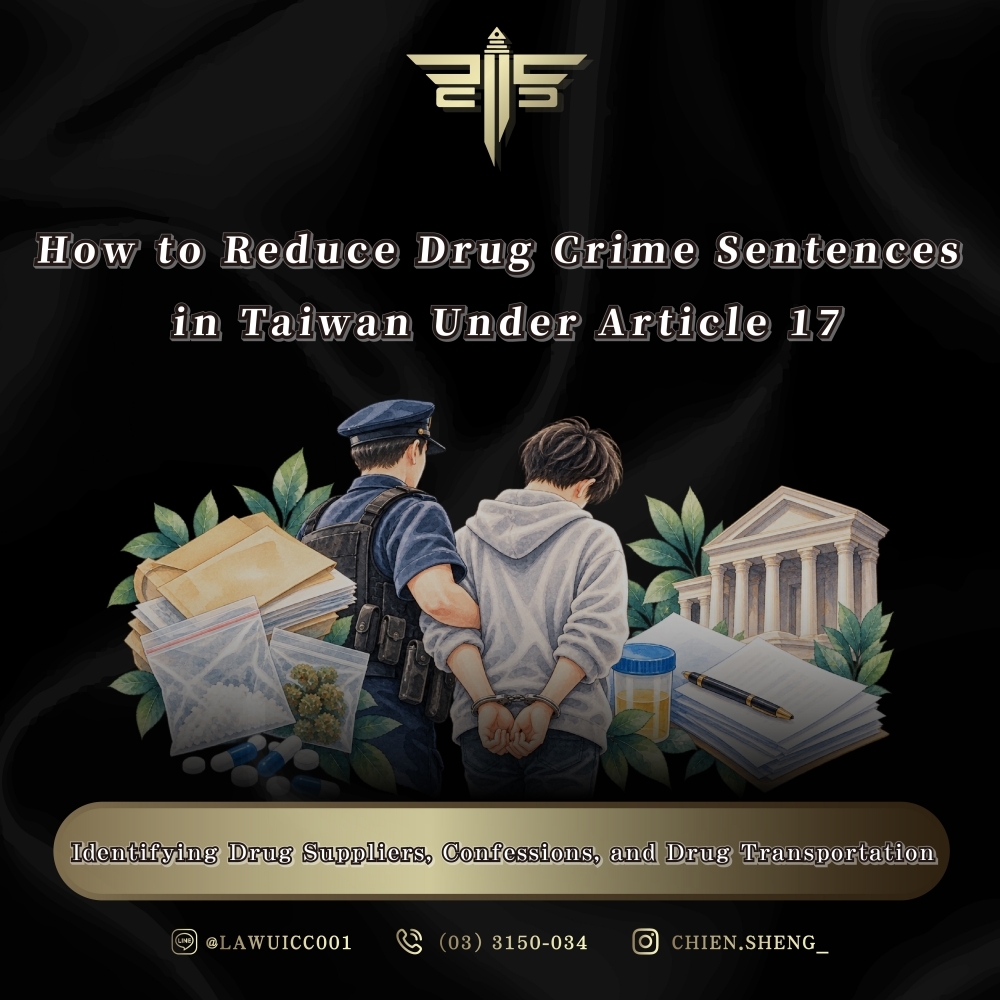
How to Reduce Drug Crime Sentences in Taiwan Under Article 17: Identifying Drug Suppliers, Confessions, and Drug Transportation
商品圖像
-
商品資訊
目錄
- 1. What Are the Three Sentence Reduction Provisions Under Article 17?
- 2. Article 17(1): Legal Requirements for Identifying Drug Suppliers
- 3. Court Decisions on Identifying Drug Suppliers
- 4. How Should a Defense Lawyer Prepare an Article 17(1) Argument?
- 5. Article 17(2): Requirements for Sentence Reduction Through Confession
- 6. Court Decisions on Confession-Based Sentence Reduction
- 7. Article 17(3): Transporting Drugs Solely for Personal Use
- 8. Court Decisions on Personal-Use Drug Transportation
- 9. Can Multiple Article 17 Sentence Reductions Apply Together?
- 10. How Should Defense Lawyers Prepare an Article 17 Strategy?
- 11. Frequently Asked Questions About Article 17 Sentence Reduction
- 12. Criminal Defense Assistance from Chien Sheng International Law Firm
- 13. Conclusion: Article 17 Sentence Reduction Requires Evidence, Not Just Cooperation
Can identifying a drug supplier reduce a criminal sentence in Taiwan? Does confessing to a drug offense automatically qualify a defendant for a lighter sentence? What if drugs were transported solely for personal use?
Article 17 of Taiwan's Narcotics Hazard Prevention Act provides three separate grounds for sentence reduction. However, each provision has different legal requirements and consequences.
Article 17 addresses three situations:
■ Paragraph 1: Identifying the source of drugs and enabling authorities to apprehend another principal offender or accomplice.
■ Paragraph 2: Confessing to qualifying drug offenses during the investigation and throughout the relevant trial proceedings.
■ Paragraph 3: Transporting drugs solely for personal use under minor circumstances.
A defendant cannot automatically obtain a reduced sentence simply by cooperating with investigators or admitting guilt. Courts must examine the specific offense, statements, evidence, drug quantities, and circumstances of the case.
1. What Are the Three Sentence Reduction Provisions Under Article 17?
1. Article 17(1): Identifying the Source of Drugs
For offenses covered by Articles 4 through 8, 10, or 11 of the Narcotics Hazard Prevention Act, a defendant who identifies the source of the drugs and thereby enables authorities to apprehend another principal offender or accomplice may qualify for a reduced sentence or exemption from punishment.
The information must relate to the drugs involved in the defendant's own case. Merely identifying a suspected dealer or providing unrelated intelligence is insufficient.
2. Article 17(2): Confession During Investigation and Trial
Defendants convicted of offenses under Articles 4 through 8 may qualify for a mandatory sentence reduction if they confess during the investigation and throughout the required trial proceedings.
The confession must address the essential facts of the offense ultimately established by the court.
Unlike Paragraph 1, this provision provides for sentence reduction rather than exemption from punishment.
3. Article 17(3): Drug Transportation for Personal Use
A defendant who commits a drug transportation offense under Article 4 solely for personal consumption may receive a reduced sentence if the circumstances are minor.
However, personal use alone is insufficient. The court must separately determine whether the transportation offense was committed and whether the overall circumstances qualify as minor.
This reduction is discretionary rather than automatic.
2. Article 17(1): Legal Requirements for Identifying Drug Suppliers
1. The Supplier Must Be Connected to the Drugs in the Case
The most important requirement is a direct connection between the identified supplier and the drugs involved in the defendant's offense.
➠ For example, if a defendant identifies the person who supplied the methamphetamine seized in the case, and investigators subsequently establish the relevant transaction, Article 17(1) may apply.
However, identifying someone involved in unrelated drug transactions generally does not satisfy this requirement.
2. The Information Must Be Specific and Verifiable
Useful information may include the supplier's identity, contact details, transaction dates, delivery locations, drug types, quantities, payment methods, and role in the transaction.
Vague statements such as knowing only a nickname or general location may be insufficient if investigators cannot verify the information.
3. Authorities Must Apprehend the Offender Because of the Disclosure
Article 17(1) requires a causal connection between the defendant's disclosure and the authorities' subsequent discovery of another offender and the relevant criminal conduct.
Courts may examine:
■ When the defendant provided the information
■ Whether the information identified a specific supplier
■ Whether investigators acted on that information
■ Whether the resulting investigation concerned the drugs in the defendant's case
■ Whether the supplier's criminal conduct was actually established through the investigation
If authorities already possessed sufficient evidence independently, the required causal connection may be disputed.
4. Multiple Drug Transactions Must Be Evaluated Separately
A defendant charged with several drug transactions does not automatically receive the same reduction for every offense.
In Supreme Court Judgment No. 109 Tai-Shang 5027, the court examined the relationship between the disclosed supplier and individual drug transactions.
The reduction applied to the offense supported by the relevant supplier information, rather than automatically extending to unrelated transactions.
3. Court Decisions on Identifying Drug Suppliers
1. Successful Reduction After Identifying a Supplier
In Taiwan High Court Kaohsiung Branch Retrial Case No. 113 Zai 1, the defendant identified a supplier connected to drugs purchased for NT$114,000.
Investigators subsequently identified the supplier, and the court compared the transaction details with evidence from the supplier's separate criminal case.
The court found that the information established the required connection and applied Article 17(1), reducing the sentence from three years to one year and six months.
The publicly reported appellate decision should not automatically be described as a final, unappealable judgment.
2. Identifying an Unrelated Drug Dealer Was Insufficient
In Supreme Court Judgment No. 109 Tai-Shang 2620, investigators identified and prosecuted a person based on the defendant's information.
However, the prosecution concerned drug sales to other individuals, not the drugs involved in the defendant's own case.
The court therefore found that the requirements of Article 17(1) were not satisfied.
The decisive issue is not merely whether someone was caught, but whether the person was apprehended for conduct connected to the defendant's drug source.
3. Supplier Disclosure Does Not Automatically Reopen a Final Judgment
Supreme Court Criminal Ruling No. 108 Tai-Kang 1297 addressed a defendant's attempt to seek a retrial based on supplier-related information.
The ruling illustrates that Article 17(1) does not automatically grounds for reopening a final criminal judgment.
Relevant supplier evidence should therefore be presented during the investigation and ordinary trial or appeal proceedings whenever possible.
4. Drug Manufacturing Cases May Involve Different Types of Sources
In its Sixth Criminal Division Meeting of 2014, the Supreme Court discussed how the concept of a drug source may apply to manufacturing offenses.
Depending on the circumstances, relevant sources may include precursor materials, intermediate products, or persons knowingly supplying essential resources for drug production.
Nevertheless, the defendant must still establish the required connection and show that the disclosure led authorities to apprehend the relevant offender.
4. How Should a Defense Lawyer Prepare an Article 17(1) Argument?
Identifying a supplier should not involve speculation, exaggeration, or fabricated accusations.
A defense lawyer should organize the evidence into a verifiable timeline covering the drug transaction, supplier identification, defendant's statements, subsequent investigation, and discovery of the supplier's criminal conduct.
Relevant evidence may include communication records, payment information, delivery arrangements, investigation reports, and judgments concerning the supplier.
The objective is to establish a reliable evidentiary connection between the defendant's disclosure and the authorities' findings.
Providing more information is not necessarily better. The information must be truthful, relevant, and capable of verification.
5. Article 17(2): Requirements for Sentence Reduction Through Confession
1. Admitting Guilt Does Not Automatically Qualify
Article 17(2) generally requires a confession to an offense covered by Articles 4 through 8 during the investigation and throughout the relevant trial proceedings.
The confession must be voluntary and must address the essential elements of the offense ultimately established.
For example, admitting possession while denying the essential facts of drug trafficking will not necessarily qualify as a confession to trafficking.
2. Confessions Must Be Examined at Every Relevant Stage
Defense counsel should review statements made during:
■ Police questioning and prosecutorial investigation
■ First-instance proceedings
■ Second-instance proceedings
■ Any retrial or remanded fact-finding proceedings
The defendant's statements must be evaluated against the final offense, including the drug classification, conduct, and required criminal intent.
A confession first made at the Supreme Court stage generally cannot simply cure the absence of a required confession during earlier fact-finding proceedings.
3. Voluntary Confession and Improper Inducement
A defendant's hope of obtaining bail or a lighter sentence does not automatically make a confession involuntary.
However, violence, threats, unlawful inducements, coercion, or improper interrogation methods may raise questions about admissibility.
Defense lawyers must distinguish between whether a particular confession can be used as evidence and whether the defendant otherwise satisfies the statutory requirements for sentence reduction.
6. Court Decisions on Confession-Based Sentence Reduction
1. Improper Promises During Investigation
In Supreme Court Judgment No. 106 Tai-Shang 2370, a prosecutor repeatedly suggested a particular sentencing outcome to encourage the defendant's confession in an attempted drug trafficking case.
The Supreme Court found that the prosecutor could not promise a sentence beyond prosecutorial authority, raising an unlawful inducement issue.
The case also distinguished the inadmissibility of improperly obtained investigative statements from the legal significance of later voluntary admissions made during trial.
2. Confessing to Obtain Bail Does Not Automatically Make a Statement Involuntary
In Supreme Court Judgment No. 106 Tai-Shang 4085, the defendant argued that the confession had been motivated by a desire to obtain bail.
The court emphasized that such a motive alone did not establish coercion or improper inducement.
The actual interrogation circumstances, available recordings, and subsequent statements remained important.
3. Consistent Confessions Supported by Evidence
In Taiwan High Court Judgment No. 112 Shang-Su 2226, the defendant admitted involvement in attempted manufacturing of second-category narcotics throughout the investigation and trial proceedings.
The court considered the confessions together with seized materials, forensic reports, and purchase records.
After applying the relevant sentence reduction provisions, the case resulted in a sentence of one year and ten months, suspended for four years.
This does not mean that every confession results in probation or a suspended sentence.
4. Confession Reduction May Still Apply When Another Statute Governs the Conviction
In Supreme Court Grand Chamber Judgment No. 109 Tai-Shang-Da 4243, the court addressed drug transfers prosecuted under the Pharmaceutical Affairs Act because of overlapping statutory provisions.
The ruling recognized that the applicable statutory classification does not necessarily eliminate the possibility of Article 17(2) sentence reduction when the underlying conduct and confession requirements are satisfied.
7. Article 17(3): Transporting Drugs Solely for Personal Use
1. Transportation Must First Be Distinguished from Possession
Article 17(3) applies only when a drug transportation offense under Article 4 has been established.
Moving drugs from one location to another does not always resolve whether the conduct legally constitutes transportation rather than possession.
Courts must examine the defendant's intent and the surrounding circumstances, including the drug quantity, transportation distance, concealment methods, and purpose of the movement.
2. Personal Consumption Alone Is Insufficient
Even if the defendant uses drugs, that does not prove that all transported drugs were intended exclusively for personal consumption.
Courts may consider the defendant's usage history, quantity transported, existing drug supply, purchase frequency, and evidence suggesting distribution to others.
A positive urine test may support evidence of drug use, but it does not automatically establish that an entire shipment was intended for personal consumption.
3. What Qualifies as Minor Circumstances?
There is no fixed statutory weight threshold guaranteeing a reduction under Article 17(3).
Courts may consider:
■ Total drug weight and pure drug content
■ Domestic or international transportation
■ Transportation distance and concealment methods
■ Use of false identities or indirect delivery arrangements
■ Evidence of resale or distribution
■ The defendant's role in organizing the transportation
■ The risk of drugs entering wider circulation
Even where personal use is established, substantial quantities or sophisticated transportation arrangements may prevent a finding that the circumstances were minor.
8. Court Decisions on Personal-Use Drug Transportation
1. Large International Shipment Did Not Qualify
In Supreme Court Judgment No. 110 Tai-Shang 3143, the case involved approximately 980 grams of ketamine-containing material, with a pure drug weight of approximately 177 grams.
The drugs were concealed in stationery and shipped internationally. The defendant also played a leading role in the transportation arrangement.
The court found that the overall circumstances were not minor, even considering the personal-use argument.
2. Appellate Court Rejected a First-Instance Reduction
In Taiwan High Court Taichung Branch Judgment No. 110 Shang-Su 692, the defendant transported approximately 496 grams of methamphetamine, with a pure drug weight of approximately 476 grams, between cities in Taiwan.
Although the first-instance court applied Article 17(3), the appellate court reconsidered the drug quantity, purity, transportation distance, and distribution risk.
The appellate court rejected the reduction and imposed a sentence of five years and two months.
3. International Cannabis Shipment Was Not Considered Minor
In Taiwan High Court Taichung Branch Judgment No. 110 Shang-Su 1309, the defendant arranged an international cannabis shipment using cryptocurrency, a false name, and a telephone number not registered in the defendant's own name.
The court considered the shipment's international nature, concealment arrangements, quantity, and defendant's control over the delivery.
Despite the personal-use argument, the court found that the circumstances did not qualify as minor under Article 17(3).
9. Can Multiple Article 17 Sentence Reductions Apply Together?
A defendant may potentially raise more than one Article 17 argument in the same case.
➠ For example, a drug trafficking defendant may both identify the supplier and confess throughout the required proceedings.
A transportation case may involve arguments concerning confession and personal-use transportation.
However, each provision must be evaluated independently.
The court must determine whether the statutory requirements are satisfied and how any applicable reductions interact with attempted offenses, multiple convictions, or other sentencing provisions.
Raising several reduction arguments does not guarantee that every reduction will be granted.
10. How Should Defense Lawyers Prepare an Article 17 Strategy?
An effective Article 17 defense begins by identifying the exact offense and reviewing the evidence supporting the prosecution's allegations.
The defense strategy should address:
■ Whether the charged conduct falls within the relevant Article 17 provision
■ Whether supplier information is directly connected to the drugs in the case
■ Whether the disclosure actually led to another offender being apprehended
■ Whether confessions were complete, consistent, and voluntary
■ Whether the alleged transportation was exclusively for personal use
■ Whether the overall transportation circumstances were minor
Defense counsel should also examine the defendant's role, drug quantities, financial benefits, prior record, treatment history, and other sentencing factors.
Article 17 arguments should be supported by specific evidence rather than general requests for leniency.
11. Frequently Asked Questions About Article 17 Sentence Reduction
Q1: Can I receive a reduced sentence simply by naming my drug supplier?
No. The supplier must be connected to the drugs involved in your case, and the information must lead authorities to apprehend another principal offender or accomplice for relevant criminal conduct.
Q2: Must the supplier be convicted before Article 17(1) can apply?
Not necessarily. The key issue is whether the defendant's disclosure led investigators to identify and apprehend the relevant offender and establish the required connection to the case.
Q3: What if I confessed to the police but denied the offense in court?
Article 17(2) may not apply if the defendant denies essential facts of the offense during a required trial stage. The exact statements and issues disputed must be examined.
Q4: Does confessing to obtain bail invalidate the confession?
Not automatically. Wanting bail or a lighter sentence does not itself establish coercion. Courts examine whether improper interrogation methods or unlawful inducements were involved.
Q5: Does a positive urine test prove the transported drugs were for personal use?
No. A positive test may support evidence of drug consumption, but it does not prove that all transported drugs were intended exclusively for the defendant.
Q6: Is drug transportation for personal use always eligible for sentence reduction?
No. Article 17(3) also requires minor circumstances. Large quantities, international shipments, concealment methods, and substantial distribution risks may prevent the reduction.
Q7: Can Article 17(1) result in exemption from punishment?
Potentially. Article 17(1) permits sentence reduction or exemption from punishment when its requirements are satisfied. However, exemption is not automatic.
Q8: Can Article 17(1) and Article 17(2) apply to the same case?
Potentially, yes. Each provision has separate requirements, and the court must independently determine whether both apply and how the reductions should be calculated.
12. Criminal Defense Assistance from Chien Sheng International Law Firm
Article 17 sentence reduction cases often require detailed analysis of supplier identification, investigation records, confessions, forensic evidence, drug quantities, transportation arrangements, and sentencing considerations.
 Chien Sheng International Law Firm provides criminal defense assistance in Taiwan, including:
■ Assessing eligibility under Article 17(1), (2), and (3)
■ Reviewing evidence connecting identified suppliers to the charged offenses
■ Establishing timelines of supplier disclosures and subsequent investigations
■ Examining confessions made during investigations and trials
■ Challenging involuntary statements or improper interrogation methods
■ Distinguishing drug possession from drug transportation
■ Evaluating personal-use claims and minor-circumstance arguments
■ Preparing sentencing submissions and appeals
■ Assessing other potentially applicable sentence reduction provisions
Defendants and family members facing drug trafficking, transportation, manufacturing, possession, or transfer allegations should seek legal advice before making statements that may affect their defense.
Early review of interrogation records, forensic reports, transaction evidence, and court documents can help identify appropriate legal strategies.
13. Conclusion: Article 17 Sentence Reduction Requires Evidence, Not Just Cooperation
Article 17 of Taiwan's Narcotics Hazard Prevention Act provides important sentencing protections, but its three provisions serve different purposes.
Identifying a supplier requires a proven connection to the drugs in the case and a qualifying investigative result. Confession-based reduction requires compliance with the relevant procedural and substantive requirements. Personal-use transportation reduction requires both an established personal-use purpose and minor circumstances.
The key to an Article 17 defense is not blindly confessing or providing unsupported accusations. It is selecting the appropriate legal argument and presenting truthful, verifiable evidence at the proper stage of criminal proceedings.
※ This article is provided by Chien Sheng International Law Firm for general legal information concerning Article 17 of Taiwan's Narcotics Hazard Prevention Act and related judicial decisions.
Whether a defendant qualifies for sentence reduction, exemption from punishment, a suspended sentence, or any other legal outcome depends on the offense, evidence, applicable law, statements, investigation results, and judicial findings.This article does not guarantee any particular result and does not replace individualized legal advice from a qualified attorney.
This reduces both medical risks and potential legal exposure.
Chien Sheng International Law Firm

LINE Online Legal Consultation: @lawuicc001 (Click to consult)
Welcome to call to schedule a meeting: 03-3150-034
Multiple payment methods available: Cash, Credit Card, Bank Transfer
Facebook: Chien Sheng International Law Firm
Instagram: chien.sheng_
-
商品Q&A


