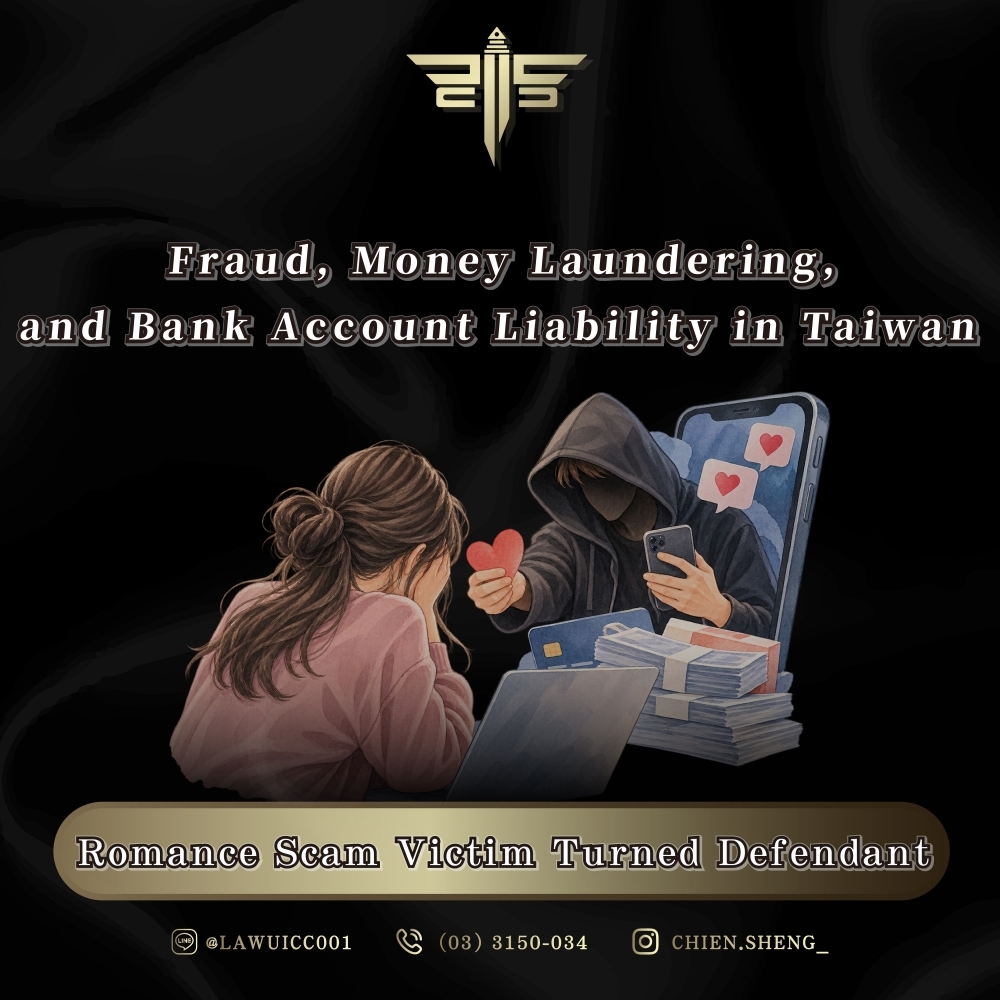
Romance Scam Victim Turned Defendant: Fraud, Money Laundering, and Bank Account Liability in Taiwan
商品圖像
-
商品資訊
目錄
- 1. Why Can a Romance Scam Victim Become a Criminal Defendant?
- 2. What Criminal Charges May Arise?
- 3. What Is Conditional Intent?
- 4. Can You Be Both a Victim and a Suspect?
- 5. What Should You Do After Receiving a Police Notice or Prosecutor’s Summons?
- 6. What Evidence Is Most Important in a Romance Scam Defense?
- 7. Five Things to Do If You Suspect You Were Used
- 8. Common Mistakes During Police Questioning
- 9. Flagged Accounts, Administrative Warnings, and Criminal Liability
- 10. Can a Romance Scam Defendant Seek Non-Prosecution?
- 11. Frequently Asked Questions
- 12. How Chien Sheng International Law Firm Can Assist
“I was also a victim of a romance scam. Why am I now being investigated as a fraud suspect?”
“I trusted someone I met online and only helped receive or transfer money. How did I become involved in a fraud or money laundering case?”
Romance scams do not always begin with an immediate request for money. Scammers may spend weeks or months building trust through dating apps, social media, or messaging platforms before asking the victim to provide a bank account, receive money, make transfers, or handle funds on their behalf.
➡︎ If the money actually comes from other fraud victims, the person who believed they were helping a romantic partner may suddenly find their account flagged and become the subject of an investigation for aiding fraud, money laundering, or unlawfully providing an account.
However, the fact that an account appears in a fraudulent money trail does not automatically establish guilt. Likewise, being a romance scam victim does not automatically eliminate criminal liability.
The key question is what the person knew or foresaw when providing the account, receiving the money, or making the transfer.
1. Why Can a Romance Scam Victim Become a Criminal Defendant?
A person may be both a victim of deception and a suspect in a related criminal investigation.
➠ For example, a person may genuinely believe they are in a romantic relationship and may even have sent their own money to the scammer. Later, the scammer may ask that person to receive funds from someone else and forward the money to another account.
If those funds came from another fraud victim, police and prosecutors may investigate whether the account holder knowingly assisted the fraudulent scheme.
Common situations include:
■ providing a bank account or online banking information;
■ receiving money and transferring it elsewhere;
■ withdrawing cash at the scammer’s request;
■ believing the funds relate to investments, loans, business operations, or emergencies;
■ receiving commissions or other benefits;
■ continuing to handle money after suspicious circumstances appear; or
■ providing multiple accounts or introducing other account holders.
Each situation requires a separate analysis. The defense must distinguish between a person who was genuinely deceived and a person who knew or foresaw that their conduct was assisting criminal activity.
2. What Criminal Charges May Arise?
■ Under Article 339 of Taiwan’s Criminal Code, fraud generally involves using deception to cause another person to transfer property or provide an unlawful financial benefit.
A person who directly deceives the victim may be prosecuted for fraud. A romance scam victim who merely provided an account or transferred money, however, requires a different analysis.
■ Under Article 30, a person who intentionally assists another person in committing an offense may be treated as an aider.
Providing an account, receiving funds, withdrawing money, or making transfers may constitute assistance, but prosecutors must still establish the required criminal intent.
Where fraud is committed by three or more persons or through certain internet or electronic communication methods, aggravated fraud under Article 339-4 may become relevant.
The statutory penalty is significantly more serious than ordinary fraud. However, the mere fact that a defendant handled money does not automatically establish knowledge of the broader fraud organization or all aggravating circumstances.
➡︎ If a person knows that money may constitute criminal proceeds and nevertheless helps transfer, withdraw, split, conceal, or otherwise handle those funds, prosecutors may investigate possible money laundering liability.
The critical issue remains the defendant’s knowledge and intent at the time of the transaction. Criminal intent should not be inferred solely from the fact that fraudulent proceeds later passed through the account.
■ Article 22 of Taiwan’s Money Laundering Control Act generally restricts providing financial, virtual asset, or third-party payment accounts for another person’s use without legitimate justification.
Depending on the circumstances, providing an account may lead to an administrative warning or, in specified situations involving compensation, multiple accounts, or repeat conduct after a warning, criminal liability.
A romantic relationship does not automatically make providing an account lawful, but it may be relevant when evaluating whether there was a genuine relationship of trust and whether the defendant understood the account would be used unlawfully.
3. What Is Conditional Intent?
One of the most important issues in romance scam cases is whether the defendant had “conditional intent.”
Under Article 13 of the Criminal Code, a person may act intentionally not only when they directly desire a criminal result, but also when they foresee that the result may occur and nevertheless accept that possibility.
Prosecutors may therefore examine whether warning signs existed, such as:
■ the romantic partner repeatedly refusing to reveal their real identity;
■ inconsistent explanations for receiving money;
■ transfers from strangers that did not match the claimed purpose;
■ requests for ATM cards, passwords, online banking credentials, or verification codes;
■ instructions to immediately transfer unknown funds;
■ repeated use of multiple accounts; or
■ payment for handling transactions.
However, suspicious circumstances alone do not automatically establish conditional intent.
Courts must still determine what the defendant actually knew and understood at the relevant time.
Facts that may support a genuine romance-scam explanation include a long-term relationship, frequent communication, apparently credible identity information, the defendant’s own financial losses, lack of compensation, and prompt action after discovering suspicious activity.
The defense should therefore explain not merely that “I trusted this person,” but why that trust existed and how the scammer created it.
4. Can You Be Both a Victim and a Suspect?
➡︎ Yes. These two legal positions can exist at the same time.
Consider a person who meets someone through a dating app, develops a relationship over several months, sends their own money to that person, and later agrees to receive and forward funds believed to be related to the partner’s business.
If those funds actually came from another fraud victim, the account holder may still be investigated.
Investigators may examine:
■ how long the relationship existed;
■ how trust was established;
■ whether the parties ever met or video-called;
■ what explanation was given for receiving the money;
■ whether the defendant knew the sender;
■ whether the defendant received compensation;
■ who controlled the account;
■ what happened after suspicious activity was discovered; and
■ whether other accounts or participants were involved.
The defense should therefore connect the fact that the defendant was deceived with evidence showing the absence of criminal intent.
5. What Should You Do After Receiving a Police Notice or Prosecutor’s Summons?
First, determine whether you are being questioned as a witness, suspect, or defendant.
Before attending questioning, organize relevant evidence, including:
■ the police notice or prosecutor’s summons;
■ bank and electronic payment records;
■ dating app or social media account information;
■ complete conversations with the scammer;
■ messages explaining why the account or transfer was requested;
■ records showing money you personally sent to the scammer;
■ incoming and outgoing transactions;
■ communications with the bank or police; and
■ evidence explaining why you believed the relationship was genuine.
Under Article 95 of Taiwan’s Code of Criminal Procedure, a defendant must be informed of the suspected offense and has rights including the right to remain silent, retain defense counsel, and request investigation of favorable evidence.
When answering questions, do not guess or turn uncertain memories into definite statements. The purpose of legal preparation is not to memorize a story, but to accurately distinguish what you knew at the time from what you learned only afterward.
6. What Evidence Is Most Important in a Romance Scam Defense?
■ Preserve complete conversations rather than only selected screenshots.
Romance scams often rely on a long process of emotional manipulation. Earlier messages may show how the scammer created trust, presented a false identity, discussed daily life, and gradually introduced financial requests.
■ Bank statements, transfer records, withdrawal records, electronic payment histories, and virtual asset transactions may help establish who controlled the money and whether the defendant actually profited.
If the defendant personally lost money to the scammer, those records may also help explain the defendant’s state of mind.
■ Photos, social media profiles, voice calls, video calls, claimed employment information, and plans to meet may help explain why the defendant believed the relationship was genuine.
■ Records showing that the defendant stopped transactions, contacted the bank, reported the matter to police, preserved evidence, or refused further instructions may also be relevant.
These actions do not automatically establish innocence, but they can help reconstruct the defendant’s actual knowledge and reaction.
7. Five Things to Do If You Suspect You Were Used
■ First, stop providing accounts and stop handling money for the other person. If unknown funds have already entered your account, do not withdraw or privately redirect them without first obtaining appropriate guidance.
■ Second, preserve all original evidence. Do not delete conversations, reset devices, screenshots, or destroy account records.
■ Third, contact your bank if suspicious transactions have occurred and preserve records of your communications with the bank.
■ Fourth, a timeline showing when the relationship began, when money was first discussed, each transaction, and when you first became suspicious.
■ Fifth, consider obtaining legal advice before police or prosecutor questioning, particularly where multiple victims, accounts, or transactions are involved.
8. Common Mistakes During Police Questioning
Several mistakes can make a romance scam case more difficult to explain:
■ describing a later suspicion as something you “already knew” at the time;
■ repeatedly saying “I trusted them” without explaining why;
■ concealing your own transfers, withdrawals, or benefits;
■ contacting other suspects to coordinate statements;
■ deleting unfavorable conversations; or
■ submitting only favorable screenshots without the surrounding context.
The distinction between what the defendant knew at the time and what became clear afterward is particularly important.
9. Flagged Accounts, Administrative Warnings, and Criminal Liability
➡︎ A flagged account, an administrative warning under the Money Laundering Control Act, and a criminal prosecution are not the same thing.
➡︎ A flagged account involves financial restrictions. An Article 22 warning is an administrative disposition issued by the police. Criminal liability for aiding fraud or money laundering is investigated separately by prosecutors.
These procedures may overlap factually, but each has its own legal requirements and remedies.
If an administrative warning has been issued, the date of service should be checked immediately because administrative appeal deadlines may apply.
The criminal case should not simply be treated as resolving every banking or administrative restriction automatically.
10. Can a Romance Scam Defendant Seek Non-Prosecution?
➡︎ Yes, depending on the evidence.
Under Articles 154 and 161 of Taiwan’s Code of Criminal Procedure, the defendant is presumed innocent and the prosecution bears the burden of proving the alleged criminal conduct.
If the evidence supports that the defendant was genuinely deceived, did not participate in advance planning, and did not know or foresee that the account or transactions would be used for fraud or money laundering, the defense may argue that the required criminal intent has not been established.
During the investigation, relevant issues may include:
■ how the romantic relationship and trust developed;
■ why the defendant believed the financial request was legitimate;
■ whether the defendant personally lost money;
■ whether any compensation or criminal proceeds were received;
■ who controlled the account and transactions;
■ what the defendant did after discovering suspicious activity; and
■ whether objective evidence supports the absence of criminal intent.
A non-prosecution disposition cannot be obtained merely by saying, “I was also a victim.” The evidence must show why that fact matters to the defendant’s knowledge and intent.
11. Frequently Asked Questions
Q1: I was also scammed. Can I still become a defendant?
Yes. A person may genuinely be a romance scam victim while also being investigated because their account was used to receive or transfer another victim’s money. Investigation does not automatically mean guilt.
Q2: Does receiving fraudulent money in my account mean I committed fraud?
No. Prosecutors must still establish your conduct and criminal intent. The presence of fraudulent proceeds in an account alone does not prove that the account holder knowingly participated.
Q3: What if I transferred the money because my online partner asked me to?
The reason for the transfer, your understanding of the money’s source, the relationship history, and surrounding warning signs will all be relevant.
Q4: Does losing my own money prove that I am innocent?
Not automatically. However, personal financial loss may be important evidence showing that you were also being deceived.
Q5: What if I never received any commission?
Lack of compensation may support the defense, but it does not by itself eliminate criminal liability. The complete circumstances must still be examined.
Q6: Can I seek non-prosecution?
Potentially. If prosecutors cannot establish that you knowingly or intentionally assisted fraud or money laundering, there may be grounds to seek non-prosecution based on insufficient evidence.
Q7: What if I have already been indicted?
Indictment does not mean conviction. The defense may still challenge criminal intent, knowledge of the money’s source, account control, financial transactions, evidence, the applicable offense, and sentencing.
12. How Chien Sheng International Law Firm Can Assist
 Chien Sheng International Law Firm assists clients who became criminal suspects after being deceived through online relationships and then providing accounts, receiving money, making transfers, or withdrawing funds.
Depending on the case, legal assistance may include:
■ defending allegations of aiding fraud and money laundering;
■ reviewing liability under Article 22 of the Money Laundering Control Act;
■ preparing for police and prosecutor questioning;
■ reconstructing the relationship and transaction timeline;
■ reviewing chats, banking records, and account activity;
■ seeking non-prosecution or deferred prosecution where appropriate;
■ defending the case after indictment;
■ handling administrative warnings and related financial restrictions; and
■ assisting with flagged-account issues and subsequent procedures.
In romance scam cases, the central issue is often not simply whether money entered or left the defendant’s account, but what the defendant actually knew when the account was provided or the transaction was made.
Preserving complete conversations, financial records, and the history of the relationship can help prosecutors and courts understand the defendant’s true role rather than viewing isolated transactions without context.
Being a Romance Scam Victim Does Not Automatically Make You Guilty—or Innocent
A romance scam victim may become a suspect when their account is used to receive or transfer fraudulent proceeds. However, criminal liability cannot be determined solely from the money trail.
The key question is whether the defendant knew or foresaw that their actions were assisting fraud or money laundering.
For this reason, the strongest defense usually requires a clear timeline connecting four elements: the relationship, the defendant’s actions, what the defendant knew at each stage, and the objective evidence supporting that explanation.
※ This article is provided by Chien Sheng International Law Firm for general legal information regarding romance scams, aiding fraud, money laundering, account provision, flagged accounts, and criminal investigations in Taiwan.
Whether a particular case results in non-prosecution, acquittal, administrative relief, or another outcome depends on the actual communications, financial transactions, account activity, reporting records, and complete investigative evidence.
This article does not guarantee any specific legal result and does not replace individualized advice from a qualified attorney.
This reduces both medical risks and potential legal exposure.
Chien Sheng International Law Firm

LINE Online Legal Consultation: @lawuicc001 (Click to consult)
Welcome to call to schedule a meeting: 03-3150-034
Multiple payment methods available: Cash, Credit Card, Bank Transfer
Facebook: Chien Sheng International Law Firm
Instagram: chien.sheng_
-
商品Q&A