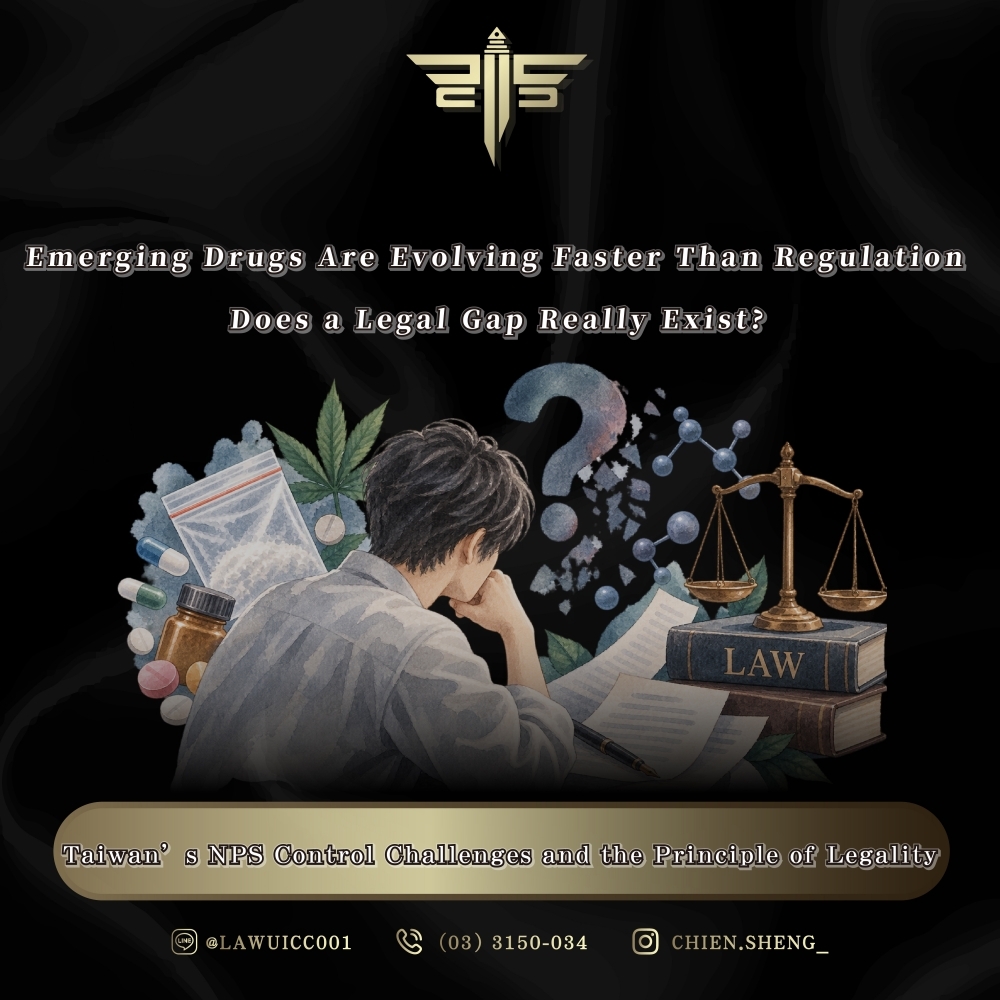
Emerging Drugs Are Evolving Faster Than Regulation: Does a Legal Gap Really Exist? Taiwan’s NPS Control Challenges and the Principle of Legality
商品圖像
-
商品資訊
目錄
- 1. The Problem Is Not Just More Drugs—It Is Whether the Law Can Keep Up
- 2. Taiwan’s Current Drug Scheduling System: From Substance Identification to Effective Regulation
- 3. Does Conduct Before a Substance Is Scheduled Automatically Escape Drug Liability?
- 4. Can Taiwan Introduce Emergency Scheduling or Temporary Bans?
- 5. Reform Options Beyond Simply Expanding Criminal Penalties
- 6. Key Defense Issues in Emerging Substance Cases
- 7. Conclusion: Rapid Drug Control and the Principle of Legality Must Both Be Protected
※ This article provides general legal analysis of issues raised by recent news reports and does not constitute legal advice for any individual case. Each case must be evaluated based on the substance involved, the date of the alleged conduct, laboratory findings, quantity, criminal intent, and investigative evidence.
1. The Problem Is Not Just More Drugs—It Is Whether the Law Can Keep Up
New Psychoactive Substances (NPS) can enter the market rapidly through modifications to their chemical structures, changes in packaging, or new street names. Recent news reports have raised concerns that Taiwan’s existing drug-scheduling process may not keep pace with the emergence of new substances, prompting proposals to consider rapid or temporary control systems similar to those used in Japan, the United States, the United Kingdom, and New Zealand.
This discussion involves two separate legal questions.
■ First, even if a substance is highly addictive, prone to abuse, or harmful to health, that does not automatically make it a legally controlled “narcotic drug” under Taiwan’s Narcotics Hazard Prevention Act.
■ Second, although the government has a legitimate interest in rapidly preventing dangerous substances from circulating, expedited controls must still comply with constitutional requirements such as the principle of statutory reservation, legal certainty, and the principle of legality in criminal law.
Accordingly, the “legal gap” discussed in the media is more accurately understood as a potential gap in the application of certain drug-specific criminal penalties before a new substance has completed the statutory scheduling process and the relevant regulation has taken effect.
This does not mean that all conduct involving an unscheduled substance is necessarily lawful. Nor does it mean that the government may retroactively punish earlier conduct merely by scheduling the substance later.
2. Taiwan’s Current Drug Scheduling System: From Substance Identification to Effective Regulation
Article 2 of Taiwan’s Narcotics Hazard Prevention Act defines narcotics as addictive narcotic drugs and their products, psychoactive substances and their products that are subject to abuse and harmful to society. Controlled substances are divided into four categories according to their potential for abuse and harm.
The same provision establishes a review mechanism involving the Ministry of Justice and the Ministry of Health and Welfare. Substances that may be addictive, subject to abuse, harmful to society, or chemically similar to existing controlled drugs may be reviewed for addition, adjustment, or removal from the controlled-substance schedules, followed by official announcement by the Executive Yuan.
From a legal perspective, at least three points in time and substance status must be examined.
■ First is the identity of the substance. Authorities must determine whether the seized material actually contains a particular controlled ingredient. A street name, appearance, or package design alone cannot establish its legal classification.
■ Second is the legal basis for control. It must be determined whether the identified substance was included in an applicable drug schedule or otherwise subject to an effective legal control regime.
■ Third is the effective date. The date on which the relevant announcement or statutory amendment took legal effect must be established. If the alleged conduct occurred before the criminal regulation became effective, a later rule generally cannot be applied retroactively to punish that earlier conduct.
This is why chemical analysis, sampling procedures, chain of custody, and laboratory reports are particularly important in drug cases.
The issue is not merely whether a substance was detected. It is also necessary to determine whether the tested sample is the same material that was seized, whether the chemical name corresponds to the substance listed in the applicable schedule, whether contamination or misidentification can reasonably be excluded, and whether the substance was legally controlled at the time of the alleged conduct.
3. Does Conduct Before a Substance Is Scheduled Automatically Escape Drug Liability?
The answer cannot simply be “it was not scheduled, so everything was legal,” nor can it be “it was dangerous, so it must have been criminal.”
Article 1 of Taiwan’s Criminal Code provides that conduct may be punished only when expressly prohibited by law at the time it was committed. This is a fundamental expression of the principle of legality in criminal law.
Judicial Yuan Interpretation No. 522 further explained that the elements of a criminal offense must be prescribed by law. Where legislation authorizes administrative agencies to supplement technical details through regulations, the purpose, substance, and scope of that authorization must be sufficiently specific so that individuals can reasonably foresee what conduct may result in criminal punishment.
Accordingly, if a substance had not yet been legally scheduled when the alleged conduct occurred, later scheduling generally cannot retroactively transform earlier possession, use, sale, or transportation into a drug offense that did not exist at the time.
This principle is fundamental to the protection of personal liberty and the rule of law.
Criminal liability under the Narcotics Hazard Prevention Act is closely connected to both the category of the controlled substance and the type of conduct involved.
Manufacturing, transporting, or selling Category 1 through Category 4 narcotics carries different criminal penalties. Possession of Category 1 or Category 2 narcotics may also constitute a criminal offense, while possession of Category 3 or Category 4 narcotics exceeding statutory pure-net-weight thresholds may likewise result in criminal liability.
Unauthorized possession or use of Category 3 or Category 4 narcotics may, in other circumstances, result in administrative fines and mandatory drug-harm prevention education.
Therefore, determining liability requires asking:
■ Was the alleged conduct possession, use, transfer, sale, transportation, or manufacturing?
■ What category did the substance fall under, and were any statutory weight or other thresholds satisfied?
■ Had the relevant scheduling announcement already taken effect when the conduct occurred?
■ What was the defendant’s subjective purpose or intent?
■ Even if no drug offense applies, could another law still govern the conduct?
The fact that a substance was not yet listed under the Narcotics Hazard Prevention Act does not necessarily mean that every related act was lawful.
Depending on the substance, its source, the manner of use, the transaction, and any resulting harm, other pharmaceutical, public safety, traffic safety, or criminal laws may still apply.
4. Can Taiwan Introduce Emergency Scheduling or Temporary Bans?
From a public-health perspective, creating a rapid-response mechanism for dangerous emerging substances may be reasonable.
Other jurisdictions have adopted expedited mechanisms to control newly identified substances. Such systems may temporarily restrict manufacturing, importation, sale, possession, or use while authorities conduct further scientific and regulatory review.
➡︎ However, foreign regulatory systems cannot substitute for a valid legal basis under Taiwanese law.
If Taiwan introduces an emergency scheduling mechanism for NPS, at least five issues should be clearly addressed.
■ First, the triggering conditions should be clearly defined, including the level of health risk, evidence of abuse, or circulation necessary to activate emergency measures.
■ Second, the responsible authority should be expressly identified so that the power to announce, review, and supervise temporary controls is clearly allocated.
■ Third, the scope of restrictions should be specified. The law should clarify whether the temporary measure prohibits manufacturing, importing, selling, possessing, using, or only certain activities.
■ Fourth, temporary measures should have defined time limits, periodic review requirements, and a mechanism for transitioning to formal scheduling.
■ Fifth, the system should provide exceptions and remedies for legitimate medical, scientific, research, and testing purposes, as well as procedures through which affected individuals may challenge government action.
Most importantly, administrative agencies may supplement technical or detailed matters within the scope of statutory authorization, but they should not be able to unforeseeable criminal offenses and penalties solely through an administrative announcement.
If emergency scheduling is intended to trigger criminal liability, the legislature must provide sufficiently clear statutory rules governing the elements of the offense, the scope of delegated authority, and the applicable criminal consequences.
5. Reform Options Beyond Simply Expanding Criminal Penalties
■ One option would be to establish a statutory emergency-control mechanism with clear triggering thresholds, publication requirements, maximum duration, periodic review, and sunset provisions.
During the emergency period, authorities could prioritize high-risk activities such as manufacturing, importing, and commercial distribution while scientific agencies complete formal testing and scheduling procedures.
If possession or use is also to be criminalized, however, the essential elements of the offense should be clearly established by legislation rather than left entirely to administrative regulations.
■ A second option is to develop clearer standards for substances that are structurally similar to already controlled drugs.
Any analogue-based system should include workable chemical criteria, professional identification procedures, exceptions for legitimate medical or scientific use, and accessible mechanisms for inquiries and challenges.
An overly vague concept of “structural similarity” may uncertainty not only for defendants but also for investigators, prosecutors, laboratories, and courts.
■ A third reform direction is to integrate seizure data, toxicological analysis, international alerts, and medical harm reports into a cross-agency real-time database.
Such a system should function as an early-warning and case-screening mechanism rather than allowing an internal government list to substitute for formal legal regulation.
Any classification capable of affecting criminal liability should still be established through a public, legally defined, and judicially reviewable process.
■ Finally, new scheduling announcements should clearly identify the substance name, aliases, chemical structure, applicable exceptions, publication date, and effective date.
Where existing cases may be affected, transitional rules should clearly address the applicable law and the prohibition against retroactive criminal punishment.
6. Key Defense Issues in Emerging Substance Cases
Legal issues in emerging-drug cases often arise at the earliest stages of an investigation.
A suspect or family member should preserve objective evidence such as purchase records, communications, packaging, product labels, documents showing medical or research purposes, and information concerning the source and intended use of the substance.
Defense counsel should generally examine at least seven issues:
■ Substance Identification: Has laboratory testing identified the exact chemical substance, and does the testing method adequately support the conclusion?
■ Evidence Integrity: Were seizure, sealing, sampling, transportation, and storage procedures properly documented?
■ Legal Status: Was the substance legally controlled when the alleged conduct occurred, and what were the publication and effective dates?
■ Type of Conduct: Does the case concern possession or use, or is the defendant accused of transfer, sale, transportation, or manufacturing?
■ Quantity and Purity: Does the relevant threshold concern the total mixture weight or statutory pure net weight, and is the calculation supported by laboratory evidence?
■ Criminal Intent: Is there evidence of intent to sell, profit, transfer, or personally use the substance?
■ Search and Seizure: Were the search, seizure, and evidence-gathering procedures legally authorized, and are there issues concerning admissibility?
In emerging-substance cases, a street name and the substance identified by laboratory analysis are often not the same thing.
Online product descriptions, chat messages, or preliminary police descriptions cannot substitute for formal chemical testing and comparison with the applicable legal schedules.
For this reason, a defense should not rely solely on statements such as “everyone calls it this” or “it was not controlled before.” The chemical identity, applicable date, alleged conduct, and evidence should each be examined separately.
7. Conclusion: Rapid Drug Control and the Principle of Legality Must Both Be Protected
The rapid evolution of New Psychoactive Substances creates a genuine challenge for Taiwan’s early-warning, laboratory testing, and regulatory systems.
However, criminal law cannot focus solely on speed. Individuals must also be able to foresee what conduct is criminally punishable. Public-health risk assessments and the legal elements of a criminal offense may be related, but one cannot replace the other.
If Taiwan develops an emergency scheduling or temporary-control mechanism for NPS, it should be built around clear statutory authorization, defined time limits, public notice, professional chemical analysis, and meaningful judicial remedies.
Such a framework would allow the government to respond more quickly to dangerous emerging substances while preserving the principle of legality and preventing administrative measures from replacing criminal legislation.
 If you or a family member is involved in a case concerning emerging drugs, NPS testing, possession, use, transfer, sale, transportation, or manufacturing, consider seeking criminal defense advice before police questioning, prosecutorial interrogation, or responding to a summons.Chien Sheng International Law Firm can assist in identifying these issues and evaluating appropriate criminal-procedure and defense strategies based on the specific evidence in each case.
This reduces both medical risks and potential legal exposure.
Chien Sheng International Law Firm

LINE Online Legal Consultation: @lawuicc001 (Click to consult)
Welcome to call to schedule a meeting: 03-3150-034
Multiple payment methods available: Cash, Credit Card, Bank Transfer
Facebook: Chien Sheng International Law Firm
Instagram: chien.sheng_
-
商品Q&A