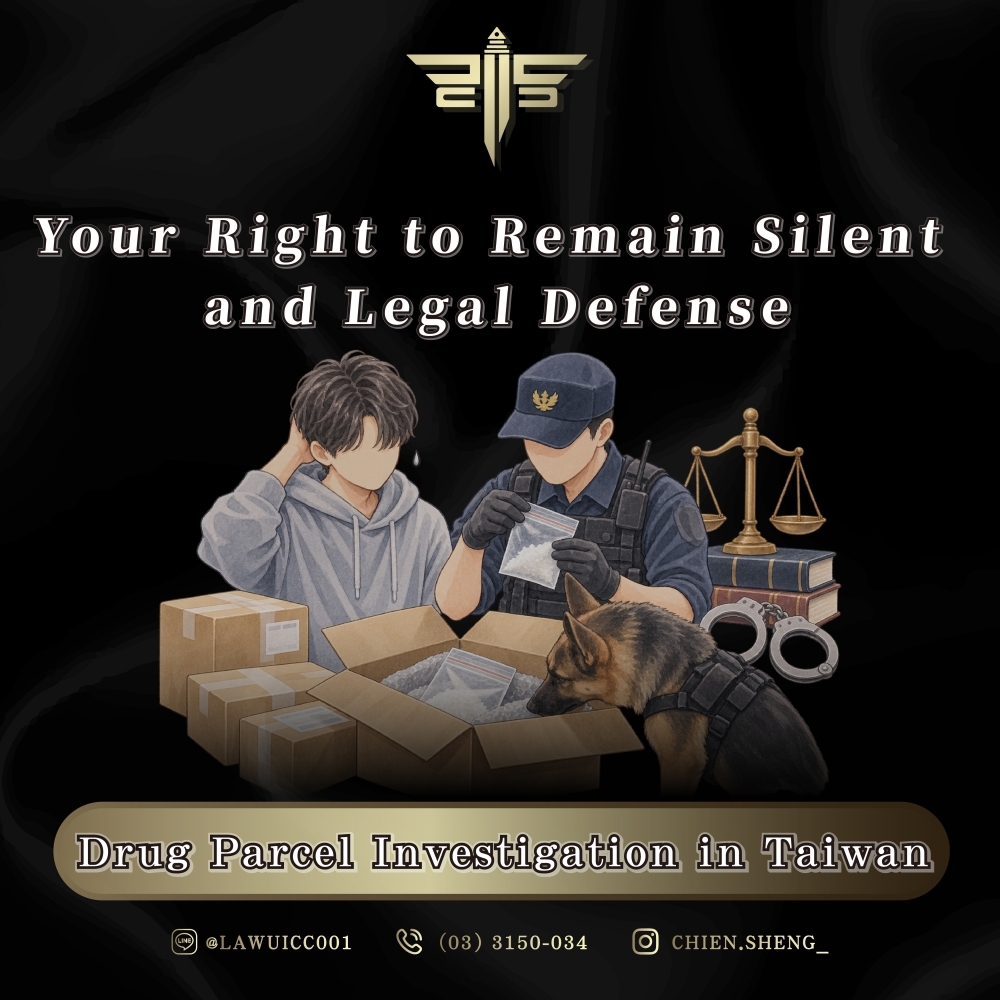
Drug Parcel Investigation in Taiwan: Your Right to Remain Silent and Legal Defense
商品圖像
-
商品資訊
目錄
- 1. What Charges Could Arise from Receiving a Parcel Containing Drugs?
- 2. Joint Principal Offenders, Accomplices, and Parcel Recipients: Knowledge, Intent, and Actual Involvement
- 3. Questioned by Police? First Understand What You Are Being Asked
- 4. Can You Remain Silent? Understanding Your Right to Silence
- 5. Do You Need a Lawyer Immediately? Why Early Legal Representation Matters
- 6. Reviewing Your Police Interview Record: What to Check Before Signing
- 7. Preserving Favorable Evidence: Why Complete Records Matter
A friend asks you to receive a parcel on their behalf. Later, you receive a notice from the police, an investigative agency, or a prosecutor informing you that the parcel may contain illegal drugs.
Many people panic and immediately insist, “I really didn’t know.” Others assume that remaining silent will make the problem disappear. In reality, receiving a parcel suspected of containing drugs may lead to serious allegations, including drug transportation, joint criminal liability, or aiding a drug offense. Your initial statements, preservation of evidence, and review of interview records may all affect the subsequent investigation.
Being summoned for questioning does not mean you are guilty, and receiving a parcel does not automatically constitute drug transportation.
However, if drugs are found in the parcel, investigators will generally examine whether you knew or foresaw that it contained drugs, communicated with other participants, received compensation, agreed to deliver it, or played a role in receiving, storing, forwarding, or coordinating its delivery.
Do not guess, agree with inaccurate suggestions, or fabricate an explanation out of fear. If the facts remain unclear, you may exercise your legal right to remain silent and seek legal assistance as early as possible.
1. What Charges Could Arise from Receiving a Parcel Containing Drugs?
The classification of the alleged offense depends on the type of drug, its origin, the shipping method, recipient information, delivery arrangements, and relevant communications.
If the parcel was shipped from overseas or involved cross-border movement, investigators may examine possible drug transportation or unlawful importation of controlled goods. Domestic shipment or forwarding may also raise questions concerning transportation, sale, transfer, possession, joint principal liability, or aiding an offense.
Manufacturing, transporting, or selling Category 2 narcotics carries particularly severe statutory penalties.
Article 4 provides the following penalties:
■ Manufacturing, transporting, or selling Category 1 narcotics: death or life imprisonment. Where life imprisonment is imposed, an additional fine of up to NT$30 million may be imposed.
■ Manufacturing, transporting, or selling Category 2 narcotics: life imprisonment or imprisonment for at least ten years, with a possible additional fine of up to NT$15 million.
■ Manufacturing, transporting, or selling Category 3 narcotics: imprisonment for at least seven years, with a possible additional fine of up to NT$10 million.
■ Manufacturing, transporting, or selling Category 4 narcotics: imprisonment for five to twelve years, with a possible additional fine of up to NT$5 million.
■ Manufacturing, transporting, or selling equipment exclusively intended for manufacturing or using narcotics: imprisonment for one to seven years, with a possible additional fine of up to NT$1.5 million.
Attempts to commit the offenses listed above are also punishable.
These provisions do not mean that anyone who receives a parcel for another person is automatically guilty of drug transportation.
Criminal liability still requires proof of the individual’s criminal intent and whether they jointly committed the offense or intentionally assisted another person.
A parcel delivered to your address is a fact that warrants investigation, not automatic proof of guilt.
2. Joint Principal Offenders, Accomplices, and Parcel Recipients: Knowledge, Intent, and Actual Involvement
A central issue in drug-parcel cases is whether the recipient merely helped someone receive a package or knew that it contained drugs and participated in the criminal arrangement.
Courts do not look only at whether the person personally shipped the parcel or physically handled the drugs. They examine both the person’s state of mind and their actual conduct.
Article 13 provides:
■ A person acts intentionally when they knowingly and willingly cause the facts constituting an offense to occur.
■ Intent is also established where a person foresees the occurrence of those facts and their occurrence is not contrary to the person’s will.
Criminal intent is not limited to someone who clearly knows that a parcel contains drugs and wants it to arrive.
It may also include circumstances where a person foresees that the parcel could contain drugs but nevertheless accepts or cooperates with the arrangement, indifferent to whether that possibility becomes reality.
Whether the person actually knew or foresaw the relevant circumstances must be assessed through communications, delivery arrangements, payment records, parcel information, the parties’ relationship, and other objective evidence.
Article 28 provides:
Where two or more persons jointly commit a criminal offense, each shall be a principal offender.
Joint principal liability focuses on whether the participants shared criminal intent and divided responsibility for carrying out the offense.
A person who did not participate in every stage may still be alleged to be a joint principal if they knowingly assumed an important role in receiving, storing, forwarding, or coordinating the transportation of drugs.
However, shared intent and participation must be established by evidence. Receiving a parcel alone does not conclusively establish joint principal liability.
Article 30 provides:
■ A person who assists another in committing a criminal offense is an accomplice, even if the principal offender is unaware of the assistance.
■ The punishment of an accomplice may be reduced from that prescribed for the principal offender.
➡︎ A person who does not share the intent to jointly commit an offense but knowingly assists another person may still face accomplice liability. Assistance may include providing an address, receiving or storing a parcel, forwarding it, lending an account, or otherwise facilitating the offense.
The possibility of a reduced sentence does not eliminate criminal liability.
Conversely, where the recipient genuinely did not know that the parcel contained drugs and did not foresee, accept, or intentionally assist drug transportation, the requirements for intent, joint principal liability, and accomplice liability must be carefully examined against the evidence.
3. Questioned by Police? First Understand What You Are Being Asked
If you receive a telephone call, written notice, or request to appear, first establish whether you are being questioned as a witness, criminal suspect, or defendant.
Clarify the alleged offense, when and by whom the parcel was sent, what type of drug is suspected, and the basic facts currently known to the investigating authority.
Avoid speculating over the telephone or repeatedly explaining uncertain details. Do not agree with a suggested answer simply because you want the interview to end quickly.
A defendant has the right to be informed of the suspected offense and charges before questioning.
Before questioning a defendant, the authorities must inform the defendant of:
1. The suspected criminal conduct and all alleged offenses. If the charges are subsequently changed, the defendant must be informed again.
2. The right to remain silent and not to make statements against their will.
3. The right to appoint defense counsel. Persons eligible for legal aid under applicable law, including qualifying low-income individuals and Indigenous persons, may request such assistance.
4. The right to request the investigation of evidence favorable to their defense.
Where a defendant without counsel states that they have appointed defense counsel, questioning must stop immediately unless the defendant agrees to continue.
➡︎ If you do not understand which time, person, parcel, or event a question refers to, ask the interviewer to clarify it.
You may truthfully explain facts you know with certainty. If you are unsure, cannot remember, or need to verify something, say so clearly.
Do not fill gaps in your memory with guesses or invent an explanation because you fear being suspected.
4. Can You Remain Silent? Understanding Your Right to Silence
Yes. A defendant has the legal right to remain silent during questioning and is not required to make statements against their will.
Exercising this right is neither an admission of guilt nor an attempt to evade responsibility. It is a procedural protection expressly recognized under criminal law.
Article 156 establishes the following principles:
■ A defendant’s confession may be admitted as evidence only if it was not obtained through violence, threats, inducement, deception, prolonged or exhausting questioning, unlawful detention, or other improper means, and if it is consistent with the facts.
■ A confession by the defendant or an accomplice cannot serve as the sole basis for a conviction. Other necessary evidence must be examined to determine whether it is consistent with the facts.
■ Where a defendant alleges that a confession was obtained improperly, that allegation must be investigated before other evidence. If the prosecutor submits the confession, the court must require the prosecutor to identify how its voluntary nature will be established.
■ Where a defendant has not confessed and there is no evidence of guilt, guilt cannot be inferred solely from the defendant’s refusal to answer or decision to remain silent.
➡︎ If you are confused, do not understand the questions, have not verified important information, or have not had an opportunity to consult a lawyer, you may clearly state:
“I wish to exercise my right to remain silent and would like to contact my defense attorney or wait until my attorney is present.”
The exercise of the right to silence cannot, by itself and without other evidence, establish guilt.
The right to remain silent does not permit a person to ignore a lawful summons, refuse to comply with lawful procedures, delete conversations, evidence, conceal objects, coordinate false accounts, or interfere with witnesses.
Such conduct may complicate the investigation or additional legal risks.
The appropriate approach is to comply with lawful procedural requirements while exercising the right against self-incrimination where necessary and obtaining legal assistance promptly.
5. Do You Need a Lawyer Immediately? Why Early Legal Representation Matters
If you are involved in a parcel containing suspected drugs, an international shipment concealing narcotics, questioning by the Investigation Bureau, or a prosecutor’s investigation into a drug offense, you should consider retaining an attorney or at least obtaining legal advice as early as possible.
The purpose is not to prevent lawful investigation. Rather, drug offenses carry severe penalties, interview records can have lasting evidentiary significance, and questions such as what you knew, when you knew it, why you received the parcel, whom you contacted, whether you were paid, and whether you forwarded it may be decisive.
Article 27 provides:
■ A defendant may appoint defense counsel at any time. The same applies to a criminal suspect being investigated by a judicial police officer or judicial police.
■ A defendant’s or suspect’s legal representative, spouse, lineal blood relative, collateral blood relative within the third degree, or qualifying household or family member may independently appoint defense counsel on their behalf.
■ Where a defendant or suspect is unable to make a complete statement due to a physical or mental disability, the persons listed above must be informed of their right to appoint defense counsel, unless notification is impossible.
An attorney accompanying a client during police questioning, an Investigation Bureau interview, or a prosecutor’s examination can help the client understand the alleged offenses and procedural status, organize the facts they genuinely know, distinguish established facts from speculation, and check whether the interview record accurately reflects their statements.
Where the case involves searches and seizures, detention applications, communications or mobile-phone evidence, international shipments, foreign-language documents, or financial transactions, early assessment of the defense is particularly important.
For those searching for an attorney to accompany them to an Investigation Bureau interview, the important consideration is not simply having someone present.
It is finding counsel who can analyze the specific charges, legal elements, evidence, and investigative procedures.
Statements made and records created during the early stages of a drug investigation may be examined repeatedly throughout the case.
6. Reviewing Your Police Interview Record: What to Check Before Signing
A police interview record is not a document that should be signed automatically.
It may later be examined as evidence during the investigation and trial. Before signing, read the record carefully or request that it be reviewed with you to confirm that it accurately reflects what you said.
For example, “I did not know what was inside the parcel” is not necessarily equivalent to “I did not specifically ask what was inside.”
Similarly, “I received a parcel for that person once” may carry a different meaning from “I regularly handled deliveries for that person.”
➡︎ If the record omits important timing, background, identities, or your denial of knowledge—or turns an uncertain statement into a definite one—request a correction or addition before signing.
➡︎ If you cannot understand the language, written content, or interpretation, raise the issue immediately.
Requesting a correction does not mean fabricating facts.
The central principle is truthful communication: explain what you actually knew, did, and did not do.
➡︎ If you cannot remember, say that you cannot remember. If you are uncertain, say that you are uncertain. Do not allow someone else to fill gaps with a speculative account.
7. Preserving Favorable Evidence: Why Complete Records Matter
If you genuinely received a parcel as a favor or did not know it contained drugs, potentially relevant evidence may include:
■ Complete conversations concerning the request to receive the parcel.
■ Agreed delivery and collection arrangements.
■ The other person’s identity and contact records.
■ Parcel and delivery notifications.
■ Objective records showing whether payment was made.
■ Travel records and work schedules.
■ Other original information that helps reconstruct the complete circumstances.
Preserve complete conversations, original files, and timestamps rather than selecting only a small screenshot that appears favorable.
Do not delete, rewrite, combine, or fabricate records, or ask others to coordinate their statements.
If a mobile phone, computer, email account, or other device has been seized, do not attempt to erase its contents remotely.
How the materials should be presented, their evidentiary value, and whether they support a lack-of-knowledge defense must be assessed in light of the individual case.
Receiving a Parcel Does Not Automatically Mean Guilt—Evidence and Your Response Matter
Discovering that a parcel you received contains drugs can place you under considerable pressure.
However, criminal liability is not determined solely by the delivery address, nor can the matter be resolved solely by saying, “I didn’t know.”
Investigators must examine whether the recipient knew, foresaw, or accepted the circumstances; shared criminal intent with others; and actually participated in transportation, storage, forwarding, or other relevant conduct.
 Chien Sheng International Law Firm handles drug offenses, fraud, money laundering, warning accounts, administrative account warnings, money-mule cases, fund collection, fraud operations, and other criminal matters.
When facing an investigation involving a suspected drug parcel, international shipment, police interview, Investigation Bureau questioning, interview record, prosecutor’s examination, or detention proceedings, early assessment based on the actual facts and evidence can help protect procedural and defense rights.It can also reduce the risk of misunderstandings caused by panic, speculation, or inaccurate interview records.
※ Every case involves different parcel origins, communications, financial transactions, delivery arrangements, search and seizure circumstances, and statements by the individuals concerned.This article provides general legal information. It does not guarantee an acquittal, non-prosecution, or any particular outcome.The appropriate legal response must be assessed individually by an attorney based on the case file, available evidence, and current procedural stage.
This reduces both medical risks and potential legal exposure.
Chien Sheng International Law Firm

LINE Online Legal Consultation: @lawuicc001 (Click to consult)
Welcome to call to schedule a meeting: 03-3150-034
Multiple payment methods available: Cash, Credit Card, Bank Transfer
Facebook: Chien Sheng International Law Firm
Instagram: chien.sheng_
-
商品Q&A