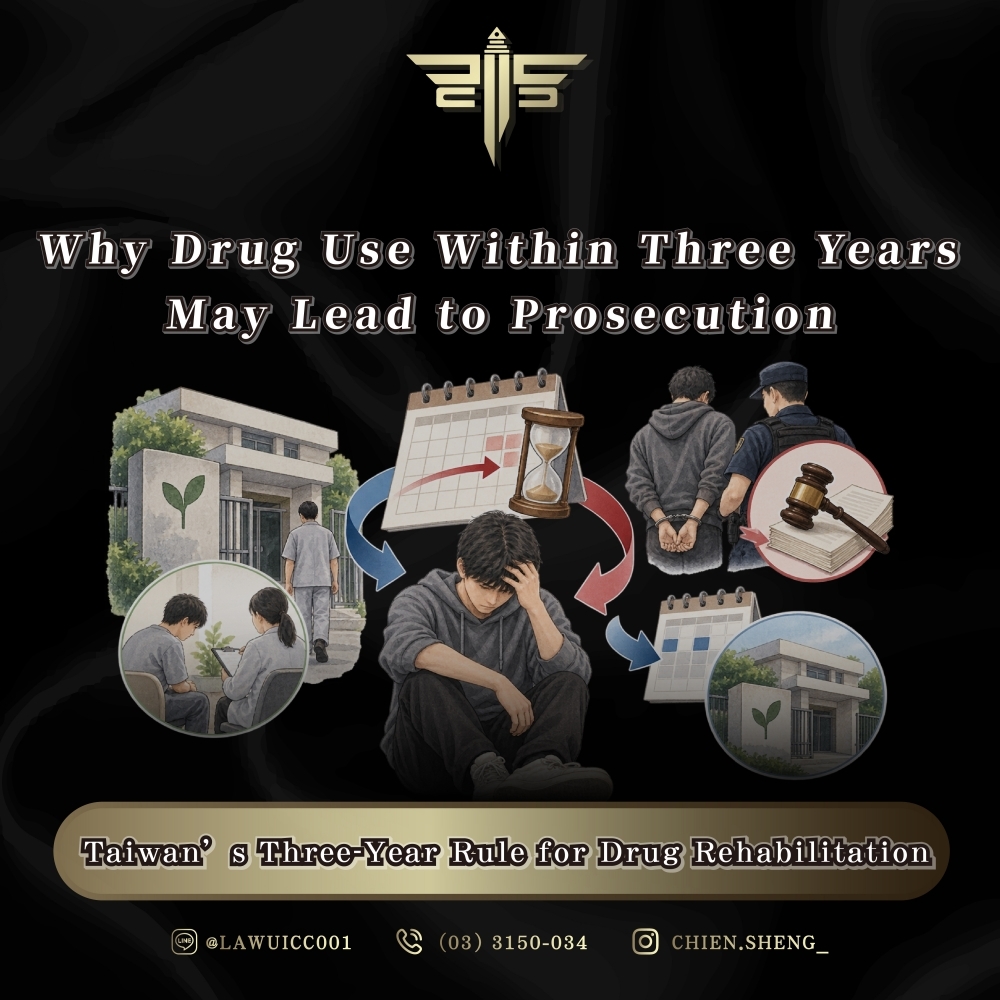
Taiwan’s Three-Year Rule for Drug Rehabilitation: Why Drug Use Within Three Years May Lead to Prosecution
商品圖像
-
商品資訊
目錄
- 1. The Most Important Point: Three Years Is Not a Deadline for Receiving Treatment
- 2. What Is the Difference Between Observation and Rehabilitation, Compulsory Treatment, and Deferred Prosecution with Addiction Treatment?
- 3. When Does the Three-Year Period Begin? Not From Every Drug Test or the Date a Judgment Becomes Final
- 4. Drug Use Within Three Years: Why Is Observation and Rehabilitation Generally Not Repeated?
- 5. Drug Use After Three Years: Why May Observation and Rehabilitation Apply Again?
- 6. The Most Common Calculation Mistake: Does Completing Addiction Treatment Under Deferred Prosecution Restart the Three-Year Period?
- 7. Does Drug Use Within Three Years Automatically Mean a Prison Sentence?
- 8. Why Was the Original Five-Year Period Changed to Three Years?
- 9. What Should You Check First After Receiving a Drug-Case Summons, Indictment, or Observation and Rehabilitation Notice?
- 10. Drug Cases Are Not Just About Counting Dates—You Need to Understand the Entire Timeline
When people receive a summons, a petition for observation and rehabilitation, or an indictment in a drug-use case, one of the most common questions is:
“I already went through observation and rehabilitation before. Why can’t I go through it again this time?”
Others ask the opposite question:
“I already completed addiction treatment before. Why does the prosecutor say I can still be ordered into observation and rehabilitation?”
The answers to these questions often lie in the three-year rule under Articles 20 and 23 of Taiwan’s Narcotics Hazard Prevention Act.
Although the rule may appear to involve nothing more than calculating dates, it actually serves as an important dividing line between a treatment-oriented procedure and criminal prosecution in drug-use cases.
A miscalculated date—or confusing different forms of treatment with one another—may send a case down an entirely different procedural path.
It may affect whether prosecutors can proceed directly with prosecution, whether they should petition for observation and rehabilitation, and whether deferred prosecution with addiction treatment may be available.
※ Chien Sheng International Law Firm explains the three-year rule in plain language: When does the three-year period begin? Why does the law not allow the same person to undergo observation and rehabilitation indefinitely? Does using drugs again within three years automatically mean imprisonment? And how should the period be calculated after completing addiction treatment?
1. The Most Important Point: Three Years Is Not a Deadline for Receiving Treatment
Many people assume that if someone uses drugs again within three years, the law considers that person “unworthy of further treatment” and therefore does not allow another observation and rehabilitation procedure.
That is not a complete understanding of the rule.
The three-year rule primarily determines which legal procedure should generally apply to the new case.
It is not a medical standard for determining whether addiction remains treatable, nor does it mean that someone who relapses within three years no longer needs medical assistance.
The Narcotics Hazard Prevention Act provides different procedural approaches for people who use Category 1 or Category 2 narcotics.
One approach emphasizes treatment-oriented measures such as observation and rehabilitation and compulsory treatment.
Another involves criminal prosecution, with other mechanisms—such as deferred prosecution, suspended sentences, probation, or other legally available measures—potentially operating alongside the criminal process.
The law uses whether more than three years have passed since the person most recently completed observation and rehabilitation or compulsory treatment and was released as an important procedural dividing line.
The purpose is not simply to punish relapse, but to avoid repeatedly relying on exactly the same intervention for an addiction problem.
2. What Is the Difference Between Observation and Rehabilitation, Compulsory Treatment, and Deferred Prosecution with Addiction Treatment?
To understand the three-year rule, the first step is to avoid treating every form of “drug treatment” as the same legal procedure.
1. Observation and Rehabilitation
Observation and rehabilitation is an institutional procedure ordered by a court.
The person is placed in an observation and rehabilitation facility, where professionals assess whether there is a continuing tendency to use narcotics.
If the assessment concludes that there is no continuing tendency to use narcotics, the prosecutor will generally issue a non-prosecution disposition.
If the assessment concludes that such a tendency remains, the person may proceed to compulsory treatment.
2. Compulsory Treatment
Compulsory treatment is also an institutional form of intervention, but it involves more extensive treatment than observation and rehabilitation and is intended to address more persistent or significant addiction-related problems.
3. Deferred Prosecution with Addiction Treatment
Deferred prosecution with addiction treatment is different.
Where the statutory requirements are satisfied, the prosecutor temporarily refrains from bringing the case to court and instead requires the person to complete designated addiction treatment, attend regular medical appointments, receive psychological counseling, undergo urine testing, or comply with other measures intended to prevent repeated drug use.
This is generally a community- and medical-treatment-based approach rather than an institutional placement.
A simple way to understand the distinction is to think of two different treatment paths.
Observation and rehabilitation or compulsory treatment: The person enters a designated institution for assessment or treatment.
Deferred prosecution with addiction treatment: The person generally remains in the community while receiving treatment and complying with medical and prosecutorial requirements.
Both paths may address addiction, but their legal effects are not identical.
This distinction becomes particularly important when calculating the three-year period.
3. When Does the Three-Year Period Begin? Not From Every Drug Test or the Date a Judgment Becomes Final
Under the Narcotics Hazard Prevention Act, the three-year period is generally calculated from the most recent date on which the person completed observation and rehabilitation or compulsory treatment and was released.
In other words, the critical date is the actual release following completion of observation and rehabilitation or compulsory treatment.
It is not simply:
■ the date the police discovered the drug use;
■ the date of a positive urine test;
■ the date the prosecutor issued a disposition;
■ the date a court judgment became final; or
■ the date a notice was received.
The Supreme Court has clarified that where the current act of drug use occurs more than three years after the person most recently completed observation and rehabilitation or compulsory treatment and was released, the case falls within the statutory framework applicable to drug use occurring after the three-year period.
As a general matter, intervening drug-use cases that resulted in prosecution, conviction, or execution of a sentence do not by themselves replace this calculation point.
For this reason, it is not enough to look at a prior-record sheet and simply see the words “drug offense.”Each previous case must be examined to determine whether it involved observation and rehabilitation, compulsory treatment, a criminal sentence, ordinary deferred prosecution, or deferred prosecution with addiction treatment.
These different dispositions can have very different legal consequences.
4. Drug Use Within Three Years: Why Is Observation and Rehabilitation Generally Not Repeated?
If a person uses a Category 1 or Category 2 narcotic again within three years after recently completing observation and rehabilitation or compulsory treatment, Article 23, Paragraph 2 of the Narcotics Hazard Prevention Act generally directs the case toward criminal prosecution.
In plain language, the law recognizes that if institutional treatment has only recently ended and the person quickly returns to drug use, simply sending that person through the same observation and rehabilitation procedure again may not effectively address the underlying problem.
The case therefore generally shifts toward the criminal process rather than creating an endless cycle of observation and rehabilitation, release, and repeated observation and rehabilitation.
1. Preventing an Endless Cycle of the Same Intervention
If every relapse within three years simply resulted in another short institutional intervention, a person might repeatedly spend time in a facility and then return to the same high-risk environment without sufficient long-term support, legal supervision, or meaningful changes in daily life.
The law therefore allows criminal responsibility and treatment-oriented measures to operate together when repeated drug use occurs within a relatively short period.
2. Providing a Different Legal Response to Recent Repeated Drug Use
Where a person returns to drug use soon after completing institutional treatment, the law treats that circumstance differently because the previous intervention did not produce the intended result.
This does not mean labeling the person as beyond help.
Rather, criminal procedure, probation, suspended-sentence conditions, treatment, or other measures may be used to provide additional structure intended to reduce the risk of repeated drug use.
3. Recognizing That Neither Prison Nor Rehabilitation Facilities Are the Only Solution
Drug dependence and relapse may involve physical dependence, psychological dependence, family circumstances, employment, social relationships, mental health, and other factors.
Short-term isolation alone may not address those issues, while punishment alone may also be insufficient.
Taiwan’s legal framework therefore uses different combinations of treatment and criminal procedures depending on the circumstances.
5. Drug Use After Three Years: Why May Observation and Rehabilitation Apply Again?
If more than three years have passed since the person most recently completed observation and rehabilitation or compulsory treatment and was released, and the person is later found using narcotics again, the law generally returns the case to a treatment-oriented assessment framework.
The underlying idea is that where a person has remained outside institutional treatment for a substantial period, the previous intervention may have helped separate that person from the earlier pattern of drug use for some time.
Even if the person later relapses, the law recognizes the need to reassess the person’s current addiction and treatment needs rather than automatically proceeding directly to criminal punishment.
This does not mean that “more than three years means nothing will happen.”Nor does it mean that the person will automatically receive a non-prosecution disposition.Observation and rehabilitation, compulsory treatment, or other legally authorized measures may still follow.
The key point is that the statutory treatment and assessment procedure cannot simply be bypassed where the law requires it.
Example 1: Drug Use Again Within Two Years
Suppose Person A completed observation and rehabilitation and was released in April 2024.
In January 2026, A is again found using a Category 2 narcotic.
Fewer than three years have passed.
As a general rule, this would fall within the framework for drug use occurring within three years, and the prosecutor would proceed according to the criminal prosecution provisions rather than automatically petitioning for another observation and rehabilitation order.
However, this does not automatically mean that A must serve a prison sentence.
Depending on the applicable statutory requirements and individual circumstances, the case may still require consideration of deferred prosecution with addiction treatment, a suspended sentence, conversion of a sentence into a fine, community service, or other legally available measures.
The outcome may depend on the circumstances of the offense, prior record, other alleged offenses, pattern of drug use, willingness to undergo treatment, and compliance with treatment requirements.
Example 2: Relapse More Than Four Years Later
Suppose Person B completed compulsory treatment and was released in February 2021.
B is not found using a Category 2 narcotic again until March 2025.
More than three years have passed since the most recent release following compulsory treatment.
As a general matter, this falls within the statutory framework for drug use occurring after three years.
The prosecutor should therefore follow the procedures prescribed by the Narcotics Hazard Prevention Act and evaluate the applicable treatment-oriented options rather than relying solely on the existence of a prior drug record to proceed directly to punishment.
If a prosecutor bypasses a procedure that should legally have been followed and proceeds directly with prosecution, defense counsel should carefully review the nature and dates of the prior proceedings.
A procedural error may directly affect whether the prosecution was lawfully initiated.
6. The Most Common Calculation Mistake: Does Completing Addiction Treatment Under Deferred Prosecution Restart the Three-Year Period?
The Answer: Generally, No.
Taiwan Supreme Court Criminal Judgment No. 100 of 2026 reaffirmed that completing addiction treatment under deferred prosecution cannot simply be treated as equivalent to completing observation and rehabilitation or compulsory treatment.
Although addiction treatment is an important therapeutic intervention, its completion does not automatically become the new starting point for the three-year period applicable to completion and release from institutional treatment.
➡︎ For example, suppose Person C completed observation and rehabilitation and was released in 2017.
➡︎ In 2023, C received deferred prosecution with addiction treatment and successfully completed the required treatment.
➡︎ In 2025, C is again found using narcotics.
If one looks only at the completion of addiction treatment in 2023, it may appear that fewer than three years had passed and that direct prosecution was therefore permitted.
That calculation would be incorrect.
For purposes of this three-year rule, the relevant reference point is not simply the date addiction treatment under deferred prosecution was completed.
C’s most recent institutional treatment was completed in 2017, and more than three years had passed by 2025.
Accordingly, the prosecutor cannot bypass the legally required treatment procedure solely because the addiction treatment under deferred prosecution had ended less than three years earlier.
This is why every prior drug case must be reviewed individually.
Confusing deferred prosecution with addiction treatment with observation and rehabilitation can lead to an entirely incorrect conclusion about which procedure applies.
7. Does Drug Use Within Three Years Automatically Mean a Prison Sentence?
No.
The significance of drug use within three years is that the case generally moves into the legally prescribed prosecution framework.
It does not automatically mean that the person will receive an immediate custodial sentence or necessarily be imprisoned.
Whether the case is prosecuted, what sentence may ultimately be imposed, whether deferred prosecution may be available, whether a suspended sentence may be granted, or whether other forms of sentence execution may apply depends on the applicable statutory requirements and the facts of the individual case.
In particular, Article 24 of the Narcotics Hazard Prevention Act preserves a statutory framework for conditional deferred prosecution involving addiction treatment.
Where legally available and appropriate, prosecutors may use addiction treatment, regular medical appointments, psychological counseling, urine testing, community service, or other relapse-prevention measures rather than simply pushing every case directly toward a criminal sentence.
Accordingly, hearing the phrase “within three years” does not mean that the person has no legal options.
Likewise, hearing “after three years” does not mean that the case will automatically disappear.
The important questions are:
■ What procedural stage is the case currently in?
■ What treatment or disposition was imposed in the previous case?
■ Has the three-year period been calculated correctly?
■ What concrete treatment and rehabilitation evidence can be presented?
8. Why Was the Original Five-Year Period Changed to Three Years?
Taiwan’s Narcotics Hazard Prevention Act previously used a five-year period as part of the framework for handling repeated drug use.
The law was later amended to use a three-year period.
This change should not be understood simply as making the law “harsher” or “more lenient.”
Rather, it reflects the development of drug policy toward recognizing both criminal responsibility and the treatment needs associated with addiction.
The legislative reasoning recognized that psychological dependence associated with drug addiction can be difficult to eliminate.
Placing a person in prison may temporarily separate that person from narcotics, but it does not necessarily address the long-term risk of relapse.
As medical addiction treatment, community support, professional services, and follow-up resources have developed, the law has increasingly sought to use institutional treatment, community-based addiction treatment, and criminal sanctions more flexibly.
The three-year period therefore functions as a legal point for periodic reassessment.
Where relapse occurs within a relatively short period, criminal prosecution generally becomes more prominent.
Where drug use occurs again after a longer interval, the system may return to treatment, assessment, and rehabilitation mechanisms.
The structure is therefore better understood as an alternating treatment framework, rather than a single formula based solely on punishment.
9. What Should You Check First After Receiving a Drug-Case Summons, Indictment, or Observation and Rehabilitation Notice?
1. Confirm the Date of the Current Alleged Drug Use
This is essential when determining whether the current case falls within or outside the three-year period.
2. Identify the Most Recent Date of Release After Completing Observation and Rehabilitation or Compulsory Treatment
Do not look only at the date deferred prosecution ended or the date a criminal judgment became final.
The nature of the prior procedure and the relevant completion and release date must be identified accurately.
3. Identify the Actual Disposition in Every Prior Case
A prior case may have involved:
■ observation and rehabilitation;
■ compulsory treatment;
■ deferred prosecution with addiction treatment;
■ a criminal sentence;
■ probation or supervision; or
■ an offense unrelated to drug use.
Each has a different legal significance.
4. Determine What Procedure the Prosecutor Is Currently Using
If the law required the prosecutor first to seek observation and rehabilitation or evaluate a treatment-based disposition, but the prosecutor instead proceeded directly with prosecution or applied for a summary judgment, the legality of that procedure may become a significant issue.
5. Prepare Genuine Medical and Life-Stability Evidence Early
Relevant materials may include:
■ medical records;
■ certificates of addiction treatment;
■ psychological counseling records;
■ employment records;
■ evidence of family support;
■ stable housing information; and
■ a concrete plan demonstrating willingness to comply with testing or treatment.
These materials do not change what has already happened, but they may affect how prosecutors and courts evaluate treatment options, sentencing, and the risk of repeated drug use.
10. Drug Cases Are Not Just About Counting Dates—You Need to Understand the Entire Timeline
On the surface, the three-year rule in drug cases appears to be a simple calculation.
In practice, however, it determines which procedural path the case may follow.
A difference of even a short period, a different characterization of a prior case, or incorrectly treating addiction treatment as equivalent to observation and rehabilitation may significantly change the legal analysis.
For the person involved, the first question should not simply be:
“Am I going to prison?”
Instead, the person should first reconstruct the complete history of each prior case, including:
■ the date of the alleged drug use;
■ the type of treatment or legal disposition;
■ the court order or prosecutorial disposition;
■ the actual date of release from institutional treatment; and
■ the date of the current alleged offense.
Only after the timeline is accurately reconstructed can the parties determine whether the prosecutor has followed the correct procedure and whether observation and rehabilitation, deferred prosecution with addiction treatment, a suspended sentence, or another legally appropriate resolution should be considered.
 Chien Sheng International Law Firm regularly handles criminal cases involving drug use, drug trafficking, drug possession, drugged driving, observation and rehabilitation, deferred prosecution with addiction treatment, and other narcotics-related matters.When a case involves prior drug use and a subsequent alleged offense, effective criminal defense requires more than submitting a standardized written argument.
※ Every case involves different prior proceedings, timelines, and evidence. This article provides general legal information only. The appropriate procedure and legal strategy in an individual case should be determined after reviewing the complete case record and the law applicable at the relevant time.
This reduces both medical risks and potential legal exposure.
Chien Sheng International Law Firm

LINE Online Legal Consultation: @lawuicc001 (Click to consult)
Welcome to call to schedule a meeting: 03-3150-034
Multiple payment methods available: Cash, Credit Card, Bank Transfer
Facebook: Chien Sheng International Law Firm
Instagram: chien.sheng_
-
商品Q&A