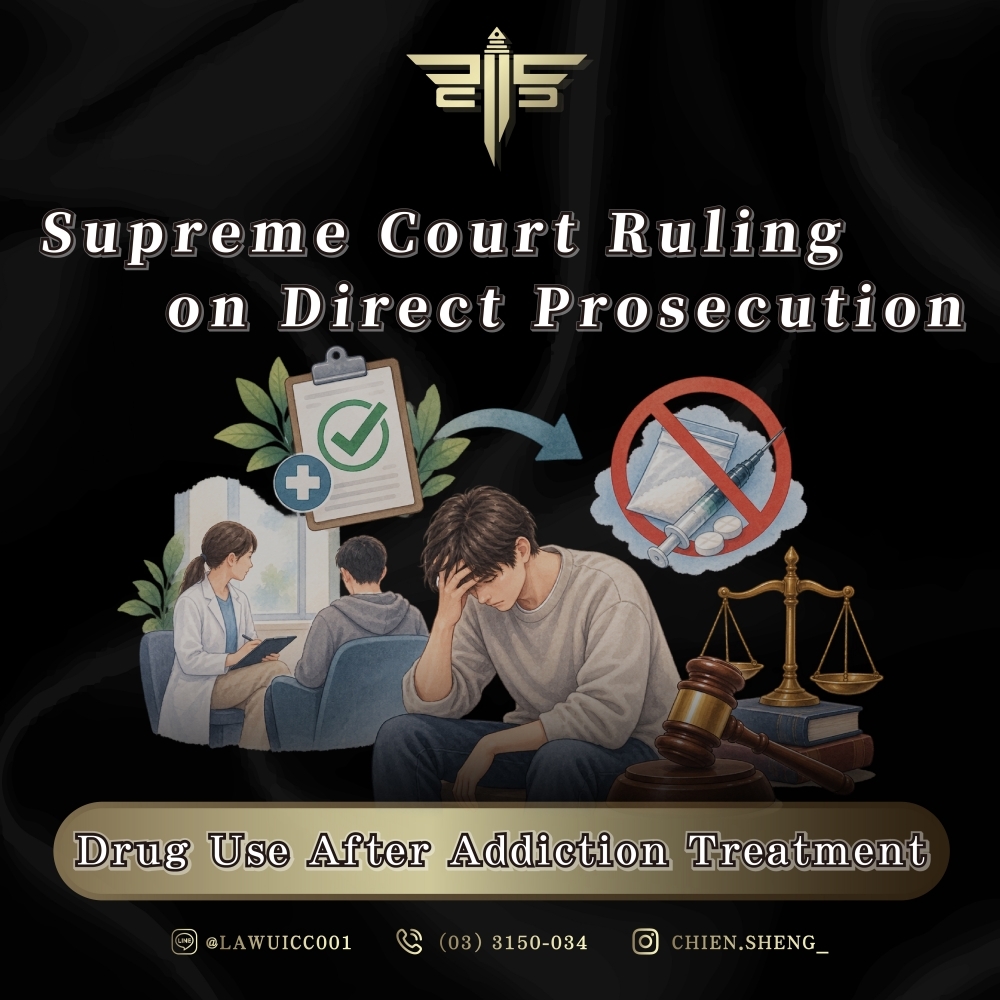
Drug Use After Addiction Treatment: Supreme Court Ruling on Direct Prosecution
商品圖像
-
商品資訊
目錄
- 1. What Happened in This Case?
- 2. Supreme Court’s Core Reasoning: Deferred Prosecution with Addiction Treatment Is Not the Same as Observation and Rehabilitation
- 3. Article 20 of the Narcotics Hazard Prevention Act: When Must Observation and Rehabilitation Come First?
- 4. Article 24 of the Narcotics Hazard Prevention Act: Deferred Prosecution with Addiction Treatment Is a Separate Treatment Path
- 5. Why Did the Court Dismiss the Prosecution Instead of Finding the Defendant Not Guilty?
- 6. What Is an Extraordinary Appeal, and Why Can a Final Judgment Still Be Reversed?
- 7. When Drug Use Happens Again, the Question Is Not Simply Whether It Was Within or Beyond Three Years
This article discusses the legal reasoning in Supreme Court Judgment No. 100 of 2026 (Extraordinary Appeal), a publicly available decision. This was not a case handled by Chien Sheng International Law Firm. To protect personal privacy, the names, addresses, and other identifying information of the parties are not disclosed.
In cases involving the use of Category 1 or Category 2 narcotics, many people assume that once a person has previously received deferred prosecution with mandatory addiction treatment, any later drug use will automatically result in direct prosecution and imprisonment.
The Supreme Court explained in this case that this understanding is not entirely correct.
The key point is that completing deferred prosecution with addiction treatment is not the same as having completed observation and rehabilitation or compulsory treatment.
Although both systems are related to drug treatment, they have different legal characteristics, are carried out in different settings, and lead to different procedural consequences if the person later uses drugs again.
If a prosecutor skips a legally required preliminary procedure and directly applies for a summary judgment, the court may be required to set aside the original conviction and issue a judgment dismissing the prosecution on procedural grounds.
1. What Happened in This Case?
The individual in this case had previously been investigated for using a Category 2 narcotic. At that time, the person received conditional deferred prosecution and completed the required addiction treatment. The deferred-prosecution period expired without revocation.
Later, the person was again found to have used a Category 2 narcotic.
The prosecutor concluded that the person had reoffended within three years after completing addiction treatment and therefore directly applied to the court for a summary judgment.
The district court followed the prosecutor’s application, convicted the defendant of using a Category 2 narcotic, and the judgment became final.
➡︎ However, the Prosecutor General of the Supreme Prosecutors Office later concluded that the final judgment may have violated the law and filed an extraordinary appeal.
After reviewing the case, the Supreme Court set aside the original judgment and issued a judgment dismissing the prosecution on procedural grounds.
2. Supreme Court’s Core Reasoning: Deferred Prosecution with Addiction Treatment Is Not the Same as Observation and Rehabilitation
Taiwan’s current system under the Narcotics Hazard Prevention Act provides different forms of treatment for people who use narcotics.
One form is institutional treatment, including observation and rehabilitation and, where necessary, compulsory treatment. After a prosecutor applies to the court and the court issues an order, the person enters an observation, rehabilitation, or treatment facility.
The other form is community-based or medical treatment outside an institution. Depending on the circumstances, a prosecutor may grant deferred prosecution subject to addiction treatment, regular reporting, counseling, community service, or other measures intended to reduce the risk of reoffending.
Both systems are intended, at least in part, to address drug dependence, but they are not legally identical.
The Supreme Court held that completing deferred prosecution with mandatory addiction treatment cannot be treated as equivalent to completing observation and rehabilitation or compulsory treatment.
➡︎ Therefore, when determining whether the statutory rule concerning drug use after a three-year period applies, the relevant point is the date on which the person was most recently released after actually completing observation and rehabilitation or compulsory treatment.The calculation cannot be based merely on the date on which addiction treatment under deferred prosecution was completed.
In this case, more than three years had passed since the defendant’s most recent release from observation and rehabilitation before the new drug use occurred.
Even though the defendant later completed addiction treatment under deferred prosecution, that treatment could not be treated as if observation and rehabilitation had been completed again.
Accordingly, the prosecutor should have considered the legally required treatment procedures, including applying for observation and rehabilitation or evaluating whether another form of conditional deferred prosecution was appropriate, rather than proceeding directly with prosecution.
3. Article 20 of the Narcotics Hazard Prevention Act: When Must Observation and Rehabilitation Come First?
Article 20 of the Narcotics Hazard Prevention Act provides, in substance, that a person who commits the offense of drug use under Article 10 shall generally first be ordered into an observation and rehabilitation facility for a period not exceeding two months.
After observation and rehabilitation, if the competent authority concludes that the person does not have a tendency to continue using narcotics, the person shall be released and a non-prosecution disposition or equivalent juvenile disposition shall be issued.
If the person is found to have a continuing tendency to use narcotics, the prosecutor may apply for compulsory treatment, which may continue for six months or more, but generally may not exceed one year.
The Act also provides that where a person again commits the offense under Article 10 more than three years after being released upon completion of observation and rehabilitation or compulsory treatment, the same treatment procedures apply again.
The key point is that the statute does not simply say:
“If the person reoffends within three years, the prosecutor may automatically prosecute.”
Instead, the statutory three-year reference point is tied to the date of release after completion of observation and rehabilitation or compulsory treatment.
If the previous case involved only deferred prosecution with addiction treatment, that treatment does not automatically replace the statutory reference point established under Article 20.
4. Article 24 of the Narcotics Hazard Prevention Act: Deferred Prosecution with Addiction Treatment Is a Separate Treatment Path
Article 24 of the Narcotics Hazard Prevention Act allows prosecutors, in appropriate cases, to grant conditional deferred prosecution under the Code of Criminal Procedure instead of first using the procedures provided under Article 20 and the relevant provisions of Article 23.
Where such a deferred-prosecution disposition is later revoked, the prosecutor shall continue the investigation or proceed with prosecution.
➡︎ Before imposing addiction treatment as a condition of deferred prosecution, the prosecutor must seek the opinion of a medical institution and may, where necessary, consult other relevant agencies or institutions.
The specific types of addiction treatment, eligible persons, treatment content, methods, implementing institutions, and standards for determining completion are governed by regulations established by the Executive Yuan.
The purpose of Article 24 is to allow prosecutors, depending on the circumstances of the individual case, to choose a treatment-oriented and community-based approach rather than automatically sending every person to an institutional rehabilitation facility.
This may be more favorable to the individual in some cases.
➡︎ However, it also has an important legal consequence: because the two systems are separate treatment paths, completing deferred prosecution with addiction treatment cannot simply be treated as completing observation and rehabilitation.
5. Why Did the Court Dismiss the Prosecution Instead of Finding the Defendant Not Guilty?
This case was not decided on the ground that the defendant had not used drugs.
Nor did the Supreme Court conclude that the laboratory evidence was insufficient.
The legal defect identified by the Supreme Court concerned the prosecution procedure.
Under Article 451, Paragraph 3 of the Code of Criminal Procedure, an application for a summary judgment has the same legal effect as a prosecution.
Article 303, Paragraph 1, Subparagraph 1 of the Code of Criminal Procedure provides that where the prosecution procedure violates legal requirements, the court shall issue a judgment of dismissal.
In other words, if the prosecutor was not legally permitted to proceed directly with prosecution before completing the required treatment procedure, an application for summary judgment would suffer from the same procedural defect.
In that situation, the court should not proceed directly to determine guilt, innocence, or sentencing. Instead, it should issue a judgment dismissing the prosecution on procedural grounds.
A dismissal in this context means that the procedure used in this particular prosecution was legally improper.
It does not necessarily mean that the case can never be handled again.
Whether the prosecutor should later apply for observation and rehabilitation, consider another form of conditional deferred prosecution, or take another legally authorized step must still be determined according to the facts and the law then in force.
6. What Is an Extraordinary Appeal, and Why Can a Final Judgment Still Be Reversed?
Article 441 of the Code of Criminal Procedure provides that, after a judgment has become final, if the trial or judgment is found to have violated the law, the Prosecutor General of the Supreme Prosecutors Office may file an extraordinary appeal with the Supreme Court.
An extraordinary appeal is not an ordinary third-instance appeal that can be filed directly by a defendant.
Nor is it a procedure for completely retrying the facts of the case.
Its purpose is to correct legal errors in final judgments.
Where the legal error is unfavorable to the defendant, the Supreme Court may set aside the unlawful judgment and issue a disposition favorable to the defendant.
In this case, although the original judgment had already become final, the direct prosecution procedure violated the sequence of treatment required under the Narcotics Hazard Prevention Act.
➡︎ Because this legal error was unfavorable to the defendant, the Supreme Court set aside the final conviction and issued a judgment dismissing the prosecution.
7. When Drug Use Happens Again, the Question Is Not Simply Whether It Was Within or Beyond Three Years
One of the most common misunderstandings in drug-use cases is to assume that the “three-year period” always begins from the date of any previous deferred prosecution, treatment, conviction, or release from prison.
That is not necessarily correct.
The first step is to determine what type of treatment or procedure the person previously underwent.
If the person previously completed observation and rehabilitation or compulsory treatment, the date of the most recent release after completion becomes highly important.
If the person previously received deferred prosecution with mandatory addiction treatment, the analysis must also consider whether the deferred prosecution was revoked, whether treatment was completed, and when the most recent institutional treatment occurred.
Different procedures and different dates may directly affect whether the prosecutor may proceed immediately with prosecution, whether observation and rehabilitation must first be sought, and whether deferred prosecution with addiction treatment may still be available.
Accordingly, after receiving a police summons, prosecutor’s summons, application for observation and rehabilitation, summary judgment, or indictment, the person should promptly gather all relevant records from prior cases, including:
■ previous non-prosecution or deferred-prosecution dispositions;
■ observation and rehabilitation orders;
■ compulsory treatment orders;
■ proof of release from treatment facilities;
■ deferred-prosecution documents;
■ records showing completion of addiction treatment; and
■ criminal history records.
The exact type of treatment and the dates shown in these documents may determine whether the current prosecution procedure is lawful.
Drug defense is not limited to challenging laboratory reports or asking the court for a lighter sentence.
In drug-use cases, important issues may also include whether the police and prosecution obtained evidence lawfully, whether the evidence sufficiently proves drug use, whether the previous case involved observation and rehabilitation or deferred prosecution with addiction treatment, the date of the most recent release from institutional treatment, whether the prosecutor has legal authority to prosecute directly, and whether conditional deferred prosecution with addiction treatment should instead be considered.
 When handling narcotics cases, Chien Sheng International Law Firm first reviews the complete timeline of the client’s prior cases and treatment history in order to determine the correct procedural position.
Based on the evidence, willingness to undergo treatment, personal circumstances, and risk factors, the firm then develops an appropriate defense strategy.
※ For cases involving drug use, observation and rehabilitation, deferred prosecution with addiction treatment, drugged driving, or allegations of drug trafficking or transportation, early review of prior-case records and the current procedural stage can help prevent harmful mistakes at critical points in the proceedings.
This reduces both medical risks and potential legal exposure.
Chien Sheng International Law Firm

LINE Online Legal Consultation: @lawuicc001 (Click to consult)
Welcome to call to schedule a meeting: 03-3150-034
Multiple payment methods available: Cash, Credit Card, Bank Transfer
Facebook: Chien Sheng International Law Firm
Instagram: chien.sheng_
-
商品Q&A