Zombie Vapes and Etomidate: Taiwan’s Category 1 Narcotic Laws
商品圖像
-
商品資訊
目錄
- 1. What Is Drugged Driving?
- 2. Criminal Penalties for Drugged Driving
- 3. Does a Positive Drug Test Automatically Mean Guilt?
- 4. No Actual Driving: Can You Seek Non-Prosecution?
- 5. What Should You Do After Being Investigated?
- 6. Can a First-Time Offender Receive Deferred Prosecution?
- 7. Can You Seek a Suspended Sentence After Indictment?
- 8. Other Ways a Case May End Without Imprisonment
- 9. Common Drugged Driving Situations
- 10. How Can a Drugged Driving Attorney Help?
If you are stopped by police for suspected drugged driving, receive a positive urine test, or are summoned for police questioning or prosecutorial investigation, the first question is often: “Will I go to prison?”
Drugged driving is not merely a traffic violation. If the requirements of Article 185-3 of Taiwan’s Criminal Code are satisfied, the conduct may constitute an offense against public safety. Depending on the circumstances, the case may also involve drug use, possession, administrative penalties, driver’s license issues, or other related offenses.
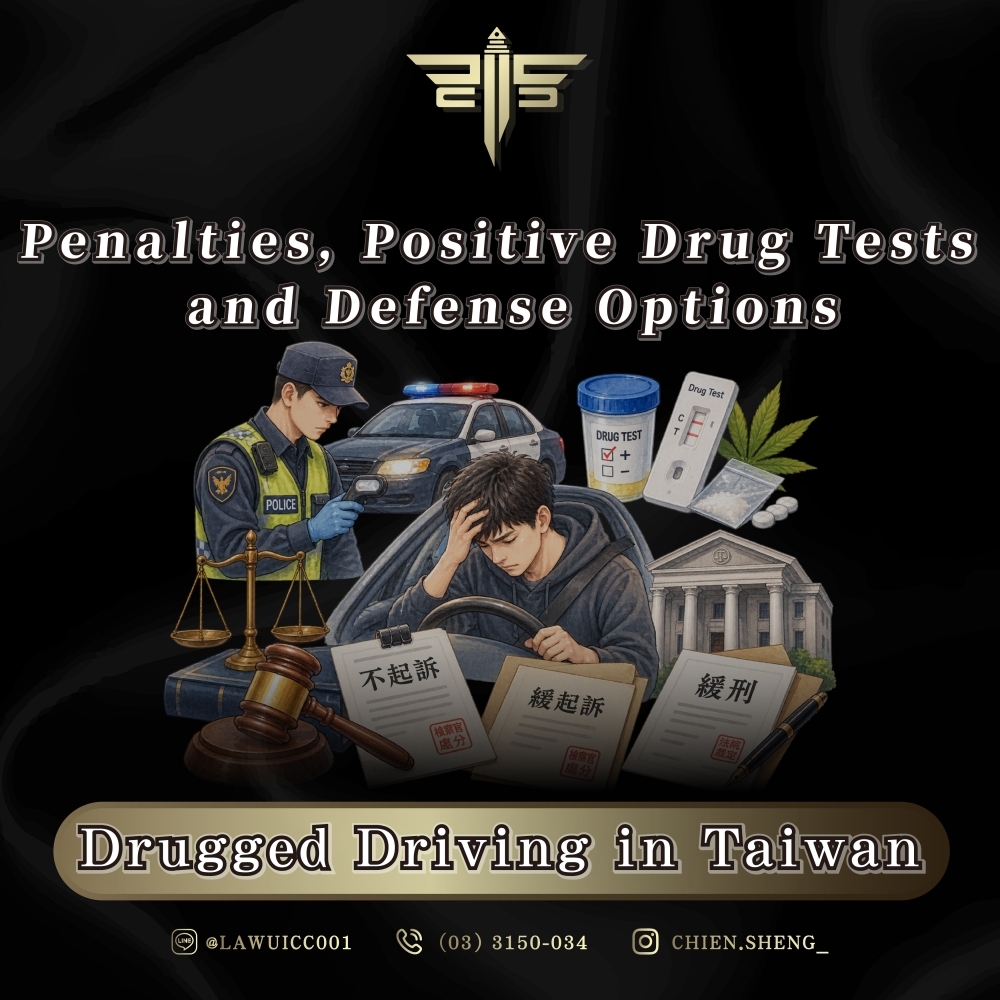
However, a positive drug test does not automatically establish drugged driving, and merely sitting inside a vehicle does not necessarily mean that a person has driven. Whether a case may result in non-prosecution, deferred prosecution, a suspended sentence, or another outcome depends on the actual driving evidence, laboratory results, procedural records, and the circumstances of the case.
1. What Is Drugged Driving?
Article 185-3 of the Criminal Code applies when a person drives a motor-powered vehicle under legally defined unsafe-driving conditions.
■ Drugged driving may be established where a driver’s urine or blood contains a specified drug, controlled substance, similar substance, or metabolite at or above an officially announced concentration threshold. In such cases, prosecutors may not need additional proof that the driver was visibly swerving or losing control.
■ Even where the concentration threshold is not met, prosecutors may still rely on other evidence showing that drug use affected the person’s ability to drive safely, including driving behavior, reaction ability, speech, coordination, accident circumstances, video footage, and police observations.
Most importantly, the law still requires actual driving. Drug use, a positive urine test, sitting in a vehicle, or having the key nearby does not automatically replace this legal requirement.
2. Criminal Penalties for Drugged Driving
Ordinary drugged driving under Article 185-3, Paragraph 1 is punishable by imprisonment for up to three years, together with a possible fine of up to NT$300,000.
If drugged driving causes serious bodily injury, the penalty may increase to imprisonment for one to seven years. If it causes death, the penalty may increase to imprisonment for three to ten years. Repeat offenses within the statutory period may result in even heavier punishment.
Accordingly, whether a first-time offender will be imprisoned cannot be determined solely by the absence of a criminal record. The result depends on whether an accident occurred, the degree of harm, the substance involved, the concentration level, the defendant’s conduct, and whether other offenses such as drug possession or drug use are also involved.
3. Does a Positive Drug Test Automatically Mean Guilt?
A positive urine or blood test does not automatically mean that drugged driving has been established.
➡︎ The case must first distinguish between an on-site preliminary screening and a formal confirmation test. Preliminary results may provide grounds for further investigation, but criminal liability should be assessed based on the formal laboratory report, including the substance detected, concentration, testing method, specimen identification, and applicable legal threshold.
➡︎ Sampling procedures are also important. The timing of collection, legality of the procedure, specimen custody, testing process, and whether the sample can reliably be linked to the defendant may all affect the evidentiary value of the result.
➡︎ Different substances and metabolites may also have different legal thresholds. Therefore, a media label such as “zombie vape,” a friend’s description, or the appearance of a product is not enough by itself to prove drugged driving.
4. No Actual Driving: Can You Seek Non-Prosecution?
Potentially, yes.
Article 185-3 requires proof that the defendant actually drove a motor-powered vehicle. Merely sitting in the driver’s seat, resting inside a parked vehicle, or being found in a car that was not moving does not automatically establish the driving element.
However, prosecutors may still rely on circumstantial evidence such as surveillance footage, dashcam recordings, engine status, vehicle location, mobile phone records, witnesses, parking records, and the defendant’s earlier statements to establish that the vehicle had been driven.
Where the case file genuinely lacks sufficient evidence of actual driving, the defense may argue that the prosecution has failed to prove an essential element of the offense.
Chien Sheng International Law Firm attorney Wang Sheng-Chieh previously handled a drugged driving case in which the client tested positive for drugs but the evidence did not establish that the client had actually operated and driven the vehicle after use. By reviewing the police records, scene footage, vehicle condition, and timeline, the defense successfully obtained non-prosecution for the drugged driving allegation.
※ This result was based on the specific evidence in that case and does not mean that every person found inside a vehicle with a positive drug test will receive non-prosecution.
5. What Should You Do After Being Investigated?
When facing a roadside stop, police interview, or prosecutor’s questioning, first determine which offense is actually under investigation. Drugged driving, drug use, and drug possession involve different legal elements and should not be treated as the same issue.
If police request urine, blood, or another specimen, pay attention to the legal basis, timing, documents, and collection procedure. Do not respond with violence or attempt to flee, but also do not guess or admit facts that you are uncertain about simply because you feel pressured.
The timeline is often critical. Statements about when the substance was used, when the person last drove, who was driving, when the vehicle stopped, and where it traveled can later become important evidence. If a police record is inaccurate or incomplete, the issue should be raised before signing.
➡︎ Relevant materials such as dashcam footage, ride-hailing records, parking records, messages, and communications with companions should also be preserved lawfully. Evidence should never be deleted, altered, or fabricated.
6. Can a First-Time Offender Receive Deferred Prosecution?
Deferred prosecution is a disposition made by a prosecutor during the investigation stage, not a court judgment.
Under Article 253-1 of the Code of Criminal Procedure, a prosecutor may grant deferred prosecution for certain offenses where the statutory conditions are met and the disposition is considered appropriate.
Because ordinary drugged driving carries a basic maximum sentence of three years, deferred prosecution may be legally available in appropriate cases. However, being a first-time offender does not automatically guarantee this result.
Prosecutors may consider the defendant’s prior record, whether an accident occurred, whether anyone was harmed, the substance and concentration involved, driving circumstances, attitude after the offense, risk of reoffending, and whether the defendant is willing to undergo treatment, counseling, or other preventive measures.
Deferred prosecution may also include conditions such as payment, community service, legal education, addiction treatment, or psychological counseling.
7. Can You Seek a Suspended Sentence After Indictment?
Yes, depending on the sentence and the defendant’s circumstances.
A suspended sentence is different from deferred prosecution. It is granted by a court after a guilty judgment has been entered.
Under Article 74 of the Criminal Code, where the imposed sentence does not exceed two years and the statutory criminal-record requirements are satisfied, the court may suspend execution of the sentence for a specified period.
The court may consider whether the defendant caused an accident, compensated any victims, accepted responsibility, received treatment or counseling, maintained stable employment and family life, and showed a low risk of reoffending.
Where drugged driving causes serious injury or death, however, the substantially heavier penalties make deferred prosecution or a suspended sentence more difficult to obtain.
8. Other Ways a Case May End Without Imprisonment
“Not going to prison” can refer to several different legal outcomes.
A defendant may receive non-prosecution where the statutory elements or evidence are insufficient. During the investigation stage, deferred prosecution may be available in appropriate cases. After a conviction, the court may grant a suspended sentence if the statutory requirements are met.
➡︎ Depending on the final sentence and applicable enforcement rules, some cases may also involve conversion of imprisonment into a fine or community service.
These outcomes are legally different. The correct strategy should first be based on whether actual driving can be proven, whether the test evidence is reliable, whether additional narcotics offenses are involved, and what stage the case has reached.
9. Common Drugged Driving Situations
Being found sleeping or resting inside a parked vehicle does not automatically establish drugged driving. However, if surveillance footage, witnesses, dashcam data, or other evidence shows that the person previously drove the vehicle, criminal liability may still arise.
Using a designated driver or ride-hailing service after drug use may help avoid driving while impaired, but it does not erase any earlier driving that can be proven.
➡︎ Prescription medication also requires individual assessment. A lawfully prescribed medication is not automatically treated as an illegal narcotic, but driving may still legal risk if the medication causes severe drowsiness, dizziness, delayed reaction, or another condition affecting safe operation.
10. How Can a Drugged Driving Attorney Help?
Effective defense begins before trial.
During the investigation stage, an attorney may review whether actual driving can be established, whether the specimen was lawfully collected, whether the laboratory evidence is reliable, and whether police reports, body-camera footage, surveillance footage, dashcam recordings, and the overall timeline are consistent.
If an accident occurred, criminal liability may also need to be coordinated with insurance, compensation, settlement, and civil claims.
Where a complete defense is difficult, counsel may still evaluate whether deferred prosecution, treatment, sentencing mitigation, or a suspended sentence is available. Each stage requires a different legal strategy.
 Chien Sheng International Law Firm handles criminal cases involving drugged driving, narcotics, offenses against public safety, drug use, possession, etomidate, ketamine, methamphetamine, marijuana, addiction treatment, deferred prosecution, and suspended sentences.
In every case, the analysis should return to the actual facts: the time of the conduct, laboratory evidence, proof of driving, procedural records, accident consequences, and the defendant’s prior history.
※ This article provides general legal information and includes a de-identified successful case handled by our firm. It does not mean that every drugged driving case will result in non-prosecution, deferred prosecution, a suspended sentence, or another specific outcome.
Actual legal responsibility must be determined individually based on the law in effect at the time, the substance involved, testing results, actual driving circumstances, accident consequences, prior record, and the evidence in the case file.
【Related Chien Sheng Cases】
► Arrested for Drugged Driving — Attorney Successfully Obtained Deferred Prosecution
► Arrested for Driving After Ketamine Use — Deferred Prosecution Successfully Obtained
► Drug Concentration Above the Legal Threshold — Non-Prosecution Successfully Obtained
► Drugged Driving Case — Deferred Prosecution Successfully Obtained Through Criminal Defense
► Single-Vehicle Crash After Ketamine Use — Non-Prosecution Obtained for Suspected Drugged Driving
This reduces both medical risks and potential legal exposure.
Chien Sheng International Law Firm

LINE Online Legal Consultation: @lawuicc001 (Click to consult)
Welcome to call to schedule a meeting: 03-3150-034
Multiple payment methods available: Cash, Credit Card, Bank Transfer
Facebook: Chien Sheng International Law Firm
Instagram: chien.sheng_
-
商品Q&A