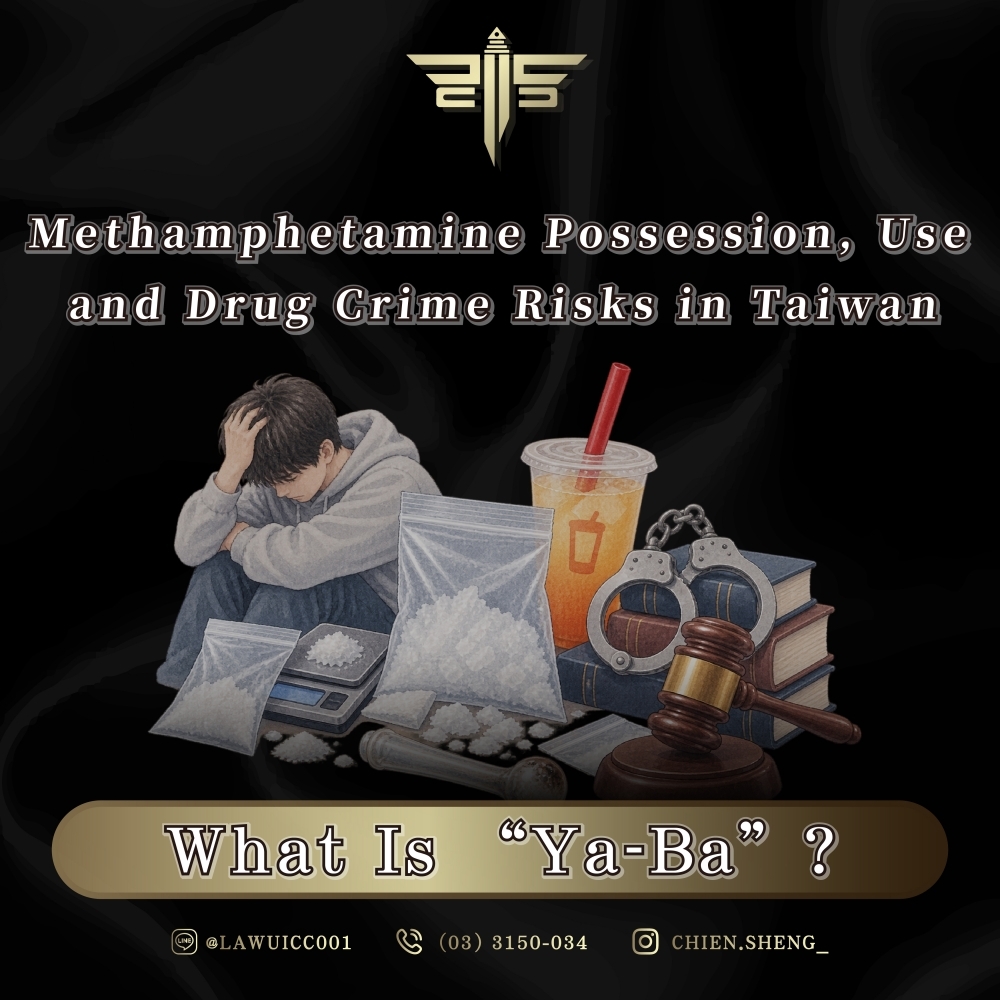
What Is “Ya-Ba”? Methamphetamine Possession, Use, and Drug Crime Risks in Taiwan
商品圖像
-
商品資訊
目錄
- 1. What Does “Ya-Ba” Mean in Drug Cases?
- 2. Why Is Ya-Ba Treated as a Category 2 Narcotic?
- 3. What Happens If You Possess Ya-Ba? Even a Small Amount May Be Criminal
- 4. Is Holding or Delivering Drugs for a Friend Really Not a Crime?
- 5. Giving a Friend One Pill for Free May Still Constitute Drug Transfer
- 6. Possession with Intent to Sell, Transportation, and Sale Carry Much Heavier Penalties
- 7. Does Using Ya-Ba Always Mean Imprisonment?
- 8. Does Mentioning “Ya-Ba” in a Chat Automatically Prove Drug Dealing?
- 9. Five Issues to Clarify First in a Ya-Ba Drug Case
- 10. The Greatest Risk Is Not the Street Name, but Misunderstanding the Legal Consequences
In everyday life, the Chinese term “Ma-Gu” may remind people of an ordinary commercial or beverage brand. In drug investigations, police records, messaging-app conversations, or news reports, however, “Ma-Gu” may also be used as a street name for an illegal drug.
➡︎ These two meanings are entirely unrelated, and the use of the same name should never suspicion toward any legitimate business.
In criminal cases, however, terms such as “Ma-Gu,” “Ya-Ba,” or “Yaba” may refer to tablets containing methamphetamine, a substance classified as a Category 2 narcotic under Taiwan law.
Chien Sheng International Law Firm emphasizes that drug cases cannot be decided merely by street names.Police, prosecutors, and courts ultimately examine the chemical composition, purity, weight, purpose of possession or delivery, communications, financial transactions, conduct of the parties, and other evidence.
1. What Does “Ya-Ba” Mean in Drug Cases?
“Ma-Gu” is not a statutory drug name under Taiwan’s Narcotics Hazard Prevention Act. It is a commonly used street term.
According to publicly available information from Taiwan’s Criminal Investigation Bureau, tablets made by mixing methamphetamine with excipients, coloring agents, or other substances are often referred to as Ya-Ba, Yaba, or Ma-Gu.
In practice, the term generally refers to colorful tablet-form drugs containing methamphetamine.
Methamphetamine is classified as a Category 2 narcotic in Taiwan.
It does not always appear as white crystals or what is commonly called “ice.” When mixed with other substances and pressed into tablets, it may appear in various colors and shapes or contain imprinted symbols.
Because appearance varies significantly, the actual substance cannot be reliably identified from photographs or visual inspection alone. A forensic laboratory report is necessary to determine the chemical composition.
A fundamental principle in drug cases is that a street name is only an investigative clue—it is not proof of guilt by itself.Whether a seized substance contains a controlled narcotic, the type of controlled substance involved, and its concentration must generally be established through lawful collection and forensic testing.
Where no drugs are seized, prosecutors must rely on other corroborating evidence to prove the specific criminal conduct. A person should not be convicted merely because a street term appeared in a conversation.
2. Why Is Ya-Ba Treated as a Category 2 Narcotic?
Under Article 2 of the Narcotics Hazard Prevention Act, controlled drugs are divided into four categories based on factors such as addictiveness, potential for abuse, and social harm.
Methamphetamine is classified as a Category 2 narcotic.
Accordingly, where forensic testing confirms that a seized tablet contains methamphetamine, the conduct will generally be evaluated under the provisions governing Category 2 narcotics.
Methamphetamine is a central nervous system stimulant.
Public information from Taiwan’s Criminal Investigation Bureau indicates that its use may cause effects such as excessive talking, increased activity, decreased appetite, insomnia, agitation, hallucinations, rapid heartbeat, high blood pressure, seizures, and psychiatric symptoms.
For criminal cases, however, the most immediate legal issue is not simply the health effect of the substance. Different conduct—such as possession, use, transfer, transportation, or sale—can result in very different criminal charges and penalties.
3. What Happens If You Possess Ya-Ba? Even a Small Amount May Be Criminal
➡︎ If forensic testing confirms that the substance contains methamphetamine, simple possession of a Category 2 narcotic may be punishable under Article 11, Paragraph 2 of the Narcotics Hazard Prevention Act by imprisonment for up to two years, detention, or a fine of up to NT$200,000.
➡︎ Many people ask: “What if the amount is very small?”
Taiwan law does not provide a general rule that possession of a small amount of a Category 2 narcotic is automatically exempt from criminal liability.
The quantity, purity, duration of possession, packaging, circumstances of use, and other evidence may affect how the case is handled or sentenced, but a small quantity does not automatically mean that no offense has occurred.
➡︎ Where the pure net weight of a Category 2 narcotic reaches 20 grams or more, the statutory penalty becomes substantially more severe.
The offense may be punishable by imprisonment for six months to five years, with a possible fine of up to NT$700,000.
The key concept is pure net weight, not the total weight of the packaging, tablets, or mixture.Accordingly, the laboratory report concerning composition and purity may be critical to the charge, sentencing range, and defense strategy.
4. Is Holding or Delivering Drugs for a Friend Really Not a Crime?
One of the most common and dangerous misunderstandings in drug cases is the belief that:
■ “The drugs were not mine.”
■ “I was only holding them for a friend.”
■ “I was just delivering them.”
■ “I did not receive any money.”
These statements do not automatically eliminate criminal liability.
The law does not look only at who ultimately owned the drugs.
Authorities may examine whether the person:
■ knew the item was a controlled drug;
■ actually possessed or controlled it;
■ received or stored it for another person;
■ transported or delivered it at another person’s instruction; and
■ played a particular role in the overall transaction.
If a person knowingly receives, stores, carries, or delivers Ya-Ba or another Category 2 narcotic, the conduct may potentially be characterized as possession, transportation, transfer, sale, aiding, or joint criminal participation depending on the facts.
At the same time, prosecutors cannot automatically conclude that a person knowingly possessed drugs merely because the drugs were found in that person’s bag, vehicle, residence, or nearby area.
The court must still examine issues such as:
■ who actually controlled the drugs;
■ when and how the drugs were placed there;
■ whether the defendant knew of their presence;
■ communications between the parties;
■ fingerprints;
■ surveillance footage;
■ financial transactions;
■ statements from alleged accomplices; and
■ other corroborating evidence.
Criminal liability must be proven through evidence of both conduct and intent, not speculation.
5. Giving a Friend One Pill for Free May Still Constitute Drug Transfer
Some people believe that only selling drugs is criminal and that giving a drug to a friend for free, sharing drugs at a gathering, or asking another person to “try one” is merely a social gesture.
That is a serious misunderstanding.
Under Article 8, Paragraph 2 of the Narcotics Hazard Prevention Act, transferring a Category 2 narcotic may be punishable by imprisonment for six months to five years and a possible fine of up to NT$700,000.
Payment is not required for the offense of transfer.Where a person hands over a Category 2 narcotic that he or she possesses or controls to another person, the conduct may constitute an unlawful transfer even if no money changes hands.
If the amount transferred reaches a statutory threshold, additional penalties may also apply.
Accordingly, handing Ya-Ba to another person at a party, nightclub, residence, or inside a vehicle should not be treated as legally harmless merely because there was no payment.
Whether the conduct constitutes transfer, joint use, sale, or another offense will depend on factors such as:
■ the method of delivery;
■ quantity;
■ price;
■ communications;
■ money flow;
■ repeated transactions; and
■ other evidence.
6. Possession with Intent to Sell, Transportation, and Sale Carry Much Heavier Penalties
In Category 2 narcotic cases, the most important issue is often not simply whether drugs were present, but why the person possessed them and what conduct actually occurred.
If prosecutors establish that a person possessed a Category 2 narcotic with intent to sell, Article 5, Paragraph 2 of the Narcotics Hazard Prevention Act provides for imprisonment of at least five years and a possible fine of up to NT$5 million.
A completed sale is not required. If the evidence proves that the purpose of possession was resale, the offense may already be established.
Where a case involves the manufacture, transportation, or sale of a Category 2 narcotic, the penalty under Article 4, Paragraph 2 of the Narcotics Hazard Prevention Act is much more severe.
The statutory penalty is life imprisonment or imprisonment for at least ten years, with a possible fine of up to NT$15 million.
Transportation is not limited to international smuggling or extremely long-distance movement. Whether transportation is established depends on the nature of the movement, the defendant’s knowledge, and the overall criminal plan.
In practice, investigators may examine evidence such as:
■ drug quantity and packaging;
■ electronic scales;
■ small packaging bags;
■ messaging records;
■ transaction history;
■ payment methods;
■ surveillance footage;
■ movement and location records; and
■ statements from co-defendants.
These materials may be used to determine whether the conduct was merely possession or personal use, or whether the evidence supports sale, transportation, or participation in a larger drug offense.
A defendant’s explanation is important, but simply saying “it was for my own use” does not automatically eliminate an allegation of intent to sell.
Conversely, prosecutors should not infer drug dealing solely from quantity or a single isolated conversation without reviewing the complete evidentiary picture.
7. Does Using Ya-Ba Always Mean Imprisonment?
Methamphetamine is a Category 2 narcotic.
Under Article 10, Paragraph 2 of the Narcotics Hazard Prevention Act, use of a Category 2 narcotic is punishable by imprisonment for up to three years.
However, Taiwan’s legal system also provides treatment- and rehabilitation-oriented procedures for users of Category 1 and Category 2 narcotics.
Accordingly, the actual outcome should not be simplified as either “you will definitely go to prison” or “nothing will happen.”
Depending on the circumstances, a drug-use case may involve:
■ observation and rehabilitation;
■ compulsory treatment;
■ deferred prosecution subject to addiction treatment; or
■ other procedures provided by law.
The applicable procedure may depend on matters such as:
■ prior observation or rehabilitation history;
■ prior compulsory treatment;
■ the timing of any repeat offense;
■ the defendant’s personal circumstances;
■ prosecutorial decisions; and
■ procedural eligibility.
A person who reoffends within a statutory period after completing a prior treatment-oriented disposition may also face a different legal process.
Therefore, if you receive a summons or learn that a urine test was positive, it is important not to rely solely on online discussions or copy another person’s defense.
The proper approach is to review:
■ the collection and testing records;
■ prior drug-related cases;
■ the current procedural stage; and
■ whether addiction treatment or another treatment-oriented disposition may be available.
8. Does Mentioning “Ya-Ba” in a Chat Automatically Prove Drug Dealing?
Not necessarily.Terms such as “Ya-Ba,” “candy,” “medicine,” or other code words appearing in messaging apps may become investigative clues, but a criminal conviction still requires support from the overall body of evidence.
Relevant factors may include:
■ when the conversation occurred;
■ who participated;
■ the surrounding context;
■ whether an actual delivery occurred;
■ whether money changed hands;
■ whether drugs were seized;
■ whether forensic testing was completed;
■ whether the messaging account was actually used by the defendant; and
■ other objective evidence.
At the same time, a person cannot assume that there is no legal risk simply because the messages did not spell out the full term “methamphetamine.”
Investigators may combine chat records with transaction patterns, locations, surveillance footage, positioning data, financial records, and witness statements to reconstruct what actually happened.
A major risk in drug investigations is responding impulsively before understanding the evidence, which may inconsistencies or additional unfavorable interpretations.
9. Five Issues to Clarify First in a Ya-Ba Drug Case
1. Was the Seized Substance Actually Tested?
The first question is whether the seized material was formally tested and confirmed to contain methamphetamine or another controlled narcotic.
Street names, appearance, and statements from other people cannot replace a proper forensic examination.
2. What Are the Composition, Purity, and Pure Net Weight?
The laboratory report should be reviewed carefully to determine:
■ the identified substance;
■ purity; and
■ pure net weight.
These factors may affect drug classification, aggravated possession, and other criminal charges.
3. What Offense Is Being Alleged?
It is essential to determine whether the person is suspected of:
■ use;
■ possession;
■ transfer;
■ possession with intent to sell;
■ transportation; or
■ sale.
Each offense has different legal elements and substantially different penalties.
4. What Objective Evidence Do Police and Prosecutors Have?
Relevant evidence may include:
■ seized items;
■ mobile phone conversations;
■ call records;
■ surveillance footage;
■ financial transactions;
■ forensic reports;
■ witnesses; and
■ statements from alleged accomplices.
Each item of evidence may prove a different fact and should be examined separately.
5. What Stage Has the Case Reached?
The available legal strategy depends heavily on whether the case is currently at the stage of:
■ police questioning;
■ prosecutorial interrogation;
■ a detention hearing;
■ indictment;
■ trial; or
■ post-judgment appeal or other remedies.
The earlier the evidence and procedural posture are understood, the easier it is to avoid missing important opportunities for defense.
10. The Greatest Risk Is Not the Street Name, but Misunderstanding the Legal Consequences
The fact that “Ya-Ba” is a street term that may sound informal or that the substance may resemble an ordinary tablet does not reduce its legal seriousness.
Where forensic testing confirms methamphetamine, the case may range from simple possession or use to transfer, possession with intent to sell, transportation, or sale.
Each offense has different elements and dramatically different sentencing exposure.
 Chien Sheng International Law Firm regularly handles a wide range of drug-related criminal cases, When facing a case involving Ya-Ba, methamphetamine, crystal meth, or another suspected Category 2 narcotic, the first step should not be to assume the outcome.
※ This article provides general legal information only.The outcome of a drug case may depend on the seized substance, forensic composition, purity, weight, purpose of possession, communications, prior records, and other circumstances.Every case should therefore be evaluated individually based on the complete evidence and procedural record.
This reduces both medical risks and potential legal exposure.
Chien Sheng International Law Firm

LINE Online Legal Consultation: @lawuicc001 (Click to consult)
Welcome to call to schedule a meeting: 03-3150-034
Multiple payment methods available: Cash, Credit Card, Bank Transfer
Facebook: Chien Sheng International Law Firm
Instagram: chien.sheng_
-
商品Q&A