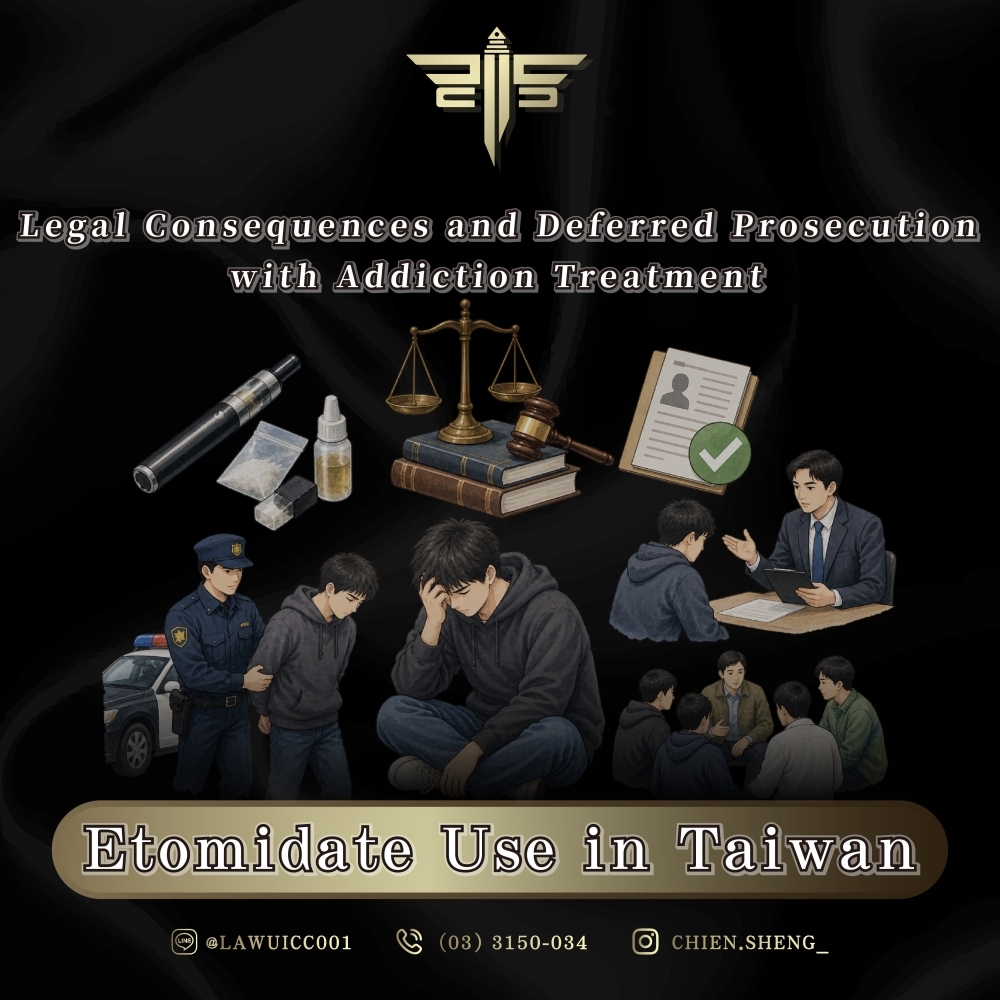
Etomidate Use in Taiwan: Legal Consequences and Deferred Prosecution with Addiction Treatment
商品圖像
-
商品資訊
目錄
- 1. Legal Regulation of Etomidate
- 2. Legal Procedures in Drug Use Cases
- 3. Legal Basis for Deferred Prosecution with Addiction Treatment
- 4. Key Factors in Seeking Deferred Prosecution
- 5. What Does Addiction Treatment Involve?
- 6. Consequences of Failing to Complete Deferred Prosecution
- 7. How Chien Sheng International Law Firm Can Help
- 8. Conclusion
Etomidate is a central nervous system depressant originally used as a medical anesthetic. In recent years, however, it has been illegally added to e-cigarette cartridges and sold as so-called “zombie vapes.”
On June 17, 2026, Taiwan’s narcotics review committee approved the reclassification of etomidate-related substances from Category 2 to Category 1 narcotics. Manufacturing, transporting, or selling Category 1 narcotics may carry penalties as severe as death or life imprisonment.
➡︎ One important option is deferred prosecution subject to addiction treatment, which may allow eligible individuals to receive treatment instead of immediately proceeding through ordinary criminal prosecution.
This article explains the legal consequences of etomidate use and the key factors involved in seeking deferred prosecution with addiction treatment.
1. Legal Regulation of Etomidate
Classification of Etomidate
Taiwan has rapidly tightened its regulation of etomidate in recent years.
Etomidate was classified as a Category 3 narcotic in August 2024, upgraded to Category 2 on November 27, 2024, and subsequently reclassified as a Category 1 narcotic in June 2026.
Criminal Penalties for Category 1 Narcotics
■ Use: Under Article 10, Paragraph 1 of the Narcotics Hazard Prevention Act, use of a Category 1 narcotic is punishable by imprisonment for six months to five years.
■ Possession of 10 Grams or More in Pure Net Weight: Under Article 11 of the Narcotics Hazard Prevention Act, possession reaching the statutory pure-net-weight threshold may result in imprisonment for one to seven years and a possible fine of up to NT$1 million.
■ Manufacturing, Transporting, or Selling: Under Article 4, Paragraph 1 of the Narcotics Hazard Prevention Act, manufacturing, transporting, or selling a Category 1 narcotic is punishable by death or life imprisonment. Where life imprisonment is imposed, a fine of up to NT$30 million may also be imposed.
Testing Standard
■ Taiwan’s competent health authority has announced a urine testing threshold of 25 ng/mL for etomidate-related substances, effective June 26, 2026.
2. Legal Procedures in Drug Use Cases
Investigation Stage
➡︎ Police Questioning: Police may ask about the circumstances of drug use, frequency of use, and the source of the substance. Statements made during this stage may significantly affect the subsequent investigation and legal strategy.
➡︎ Urine Testing: Samples may be collected and submitted to an accredited laboratory to determine whether etomidate-related substances are present.
➡︎ Referral to Prosecutors: After completing the initial investigation, police may refer the case and supporting evidence to the prosecutor’s office.
Prosecutorial Review
➡︎ The prosecutor will evaluate the evidence, the defendant’s history, and the circumstances of the case before determining the appropriate legal procedure.
➡︎ Depending on the case, possible outcomes may include treatment-oriented procedures, deferred prosecution subject to addiction treatment, prosecution, or another disposition permitted by law.
3. Legal Basis for Deferred Prosecution with Addiction Treatment
Legal Basis
The Narcotics Hazard Prevention Act provides treatment-oriented mechanisms for individuals involved in drug-use cases.
Where the statutory requirements are satisfied and treatment is considered appropriate, prosecutors may consider deferred prosecution subject to completion of addiction treatment.
Key Features
■ Treatment-Oriented: The primary objective is rehabilitation and addiction treatment rather than punishment alone.
■ Avoiding an Immediate Criminal Conviction: Successful completion may allow the individual to avoid a criminal conviction arising from ordinary prosecution of the drug-use offense.
■ Community-Based Treatment: Treatment is generally provided through outpatient or community-based programs, allowing participants to maintain much of their normal daily life.
■ Conditional: Participants must comply with treatment requirements and other conditions imposed during the deferred prosecution period.
Duration
The deferred prosecution period is generally determined by the prosecutor based on the applicable law and circumstances of the individual case.
4. Key Factors in Seeking Deferred Prosecution
1. Circumstances of Drug Use
Factors that may be relevant include:
■ whether the quantity involved is consistent with personal use;
■ whether there is evidence of sale or distribution;
■ whether other criminal offenses are involved; and
■ the overall circumstances surrounding the drug use.
2. Willingness to Stop Using Drugs and Receive Treatment
Relevant considerations may include:
■ acknowledging the drug-use conduct where supported by the evidence;
■ understanding the physical and psychological risks of drug use;
■ demonstrating a genuine willingness to stop using drugs;
■ cooperating with treatment; and
■ having support from family members or others.
3. Personal and Social Circumstances
Prosecutors may also consider factors such as:
■ stable employment or education;
■ prior criminal or drug-related records;
■ family responsibilities;
■ social support; and
■ the individual’s prospects for rehabilitation.
4. Assistance from an Experienced Drug Crime Lawyer
A lawyer may assist by:
■ Preparing for Questioning: Helping the client understand the investigation process and accurately explain the relevant facts while protecting their procedural rights.
■ Preparing Written Submissions: Presenting the client’s personal circumstances, treatment willingness, family support, and other favorable factors to the prosecutor.
■ Communicating with Prosecutors: Explaining why treatment may be more appropriate than ordinary prosecution in the particular case.
■ Responding to Adverse Decisions: Where necessary, counsel may submit additional legal arguments or request another opportunity to present relevant information.
5. What Does Addiction Treatment Involve?
Addiction treatment programs are generally designed by medical and mental health professionals to help participants understand substance dependence and develop strategies for maintaining abstinence.
Treatment may include:
■ individual or group counseling;
■ medical examinations and assessments;
■ psychological counseling;
■ substance-use education;
■ relapse-prevention strategies;
■ lifestyle and behavioral training; and
■ family counseling or support where appropriate.
Treatment is commonly provided on an outpatient basis through designated hospitals, clinics, or other approved treatment providers.
Because hospitalization is generally not required for outpatient treatment, participants may often continue working or studying while completing the program.
Participants are generally expected to attend scheduled treatment sessions, cooperate with medical and counseling professionals, undergo required drug testing, and comply with the conditions imposed by the prosecutor and treatment institution.
Successful completion depends on satisfying the specific requirements applicable to the individual treatment program.
6. Consequences of Failing to Complete Deferred Prosecution
Deferred prosecution may be revoked if the individual fails to comply with the required conditions—for example, by abandoning treatment, repeatedly failing required drug tests, or seriously violating treatment requirements.
If deferred prosecution is revoked, the case may return to the criminal justice process, and the individual may face further investigation, prosecution, or other procedures available under the Narcotics Hazard Prevention Act.
For this reason, compliance with all treatment and testing requirements is extremely important.
7. How Chien Sheng International Law Firm Can Help
Initial Case Assessment
In etomidate use cases, our attorneys evaluate factors such as:
■ whether the individual is a first-time or repeat offender;
■ the amount and nature of the substance involved;
■ whether other offenses are involved;
■ prior drug-related or criminal records;
■ employment and family circumstances; and
■ willingness and ability to undergo treatment.
Based on this assessment, we develop an appropriate defense and treatment strategy.
Assistance During Police Questioning
Our attorneys can assist clients during police questioning and investigations, protect their procedural rights, and help ensure that statements accurately reflect the facts of the case.
Early legal assistance can also help identify issues that may affect a later request for deferred prosecution with addiction treatment.
Seeking Deferred Prosecution with Addiction Treatment
Where appropriate, our attorneys may submit written arguments to the prosecutor addressing:
■ the circumstances of the alleged drug use;
■ the client’s background and prior record;
■ willingness to receive treatment;
■ family and social support;
■ rehabilitation prospects; and
■ why addiction treatment may be an appropriate disposition.
If an unfavorable decision is made, our attorneys can evaluate the available legal options, submit additional arguments where appropriate, and provide criminal defense representation if the case proceeds to court.
8. Conclusion
Although etomidate is now subject to the strict legal controls applicable to Category 1 narcotics in Taiwan, individuals accused of drug use may still have access to treatment-oriented procedures depending on their circumstances.
➡︎ Deferred prosecution with addiction treatment may provide an opportunity to address substance dependence while avoiding the consequences of an immediate criminal conviction.
 Chien Sheng International Law Firm has extensive experience handling drug-related criminal cases and applications for treatment-oriented dispositions.
If you or a family member is facing an etomidate use investigation, our attorneys can assess the case, explain the available options, and develop an appropriate legal strategy.
► Etomidate Reclassified as a Category 1 Narcotic
Chien Sheng International Law Firm

LINE Online Legal Consultation: @lawuicc001 (Click to consult)
Welcome to call to schedule a meeting: 03-3150-034
Multiple payment methods available: Cash, Credit Card, Bank Transfer
Facebook: Chien Sheng International Law Firm
Instagram: chien.sheng_
-
商品Q&A