What Should Foreigners Do If They Are Involved in a Fraud or Scam Case in Taiwan?
商品圖像
-
商品資訊
目錄
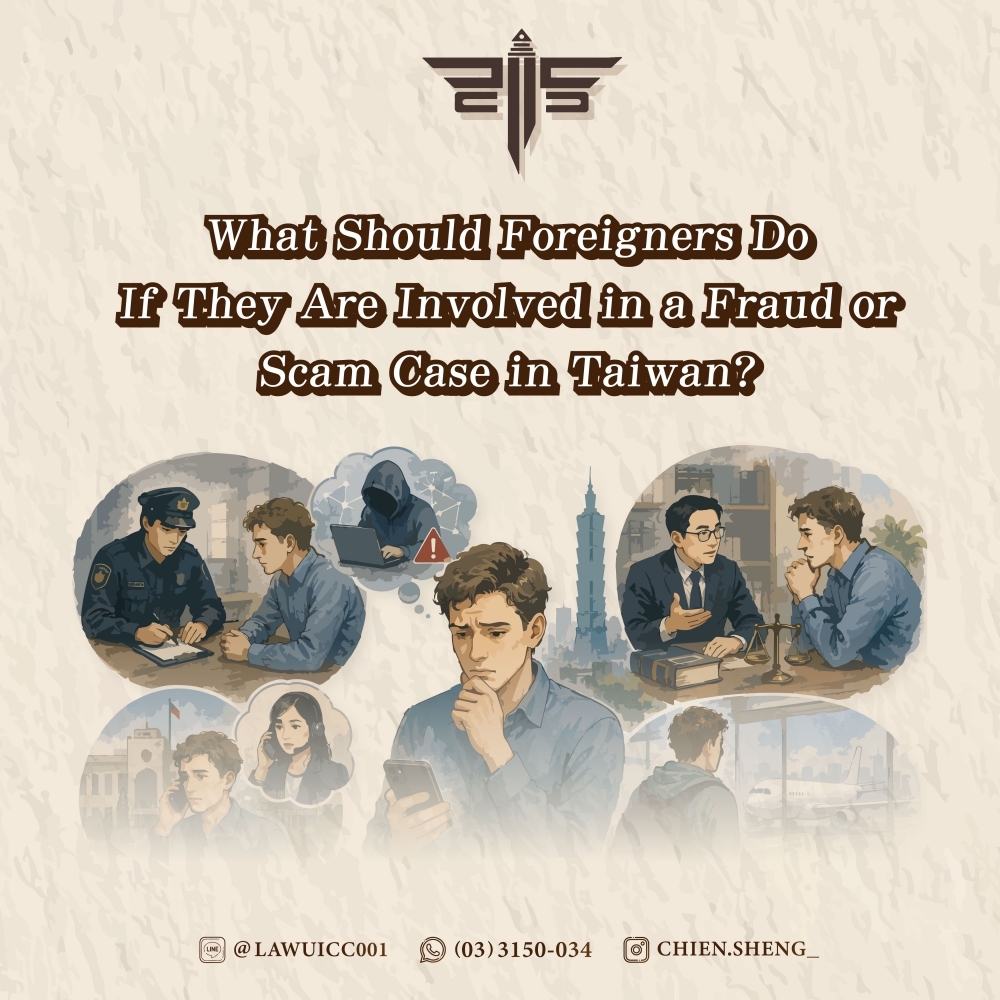
Foreigners living, working, studying, investing, or traveling in Taiwan may sometimes become involved in fraud or scam cases without fully understanding the local legal system. Some may be victims of online scams, investment fraud, romance scams, rental scams, cryptocurrency fraud, or business-related deception. Others may unexpectedly become criminal suspects because their bank account, phone number, company registration, payment account, or online identity was used in a fraud scheme.
In Taiwan, fraud cases are treated seriously by prosecutors, police officers, and courts. A foreign national who becomes involved in a fraud case should not assume that the matter is only a private dispute or a simple misunderstanding. The case may quickly become a criminal investigation, and the foreigner may face police questioning, prosecutorial summons, asset freezing, travel restrictions, or criminal charges.
This article explains what foreigners should do when they encounter fraud-related legal problems in Taiwan, and why early legal assistance is critical. Qiansheng International Law Firm regularly handles fraud and scam-related criminal cases and provides full English-language legal services through our offices in Taipei, Taoyuan, and Kaohsiung.
1. Fraud in Taiwan Is a Criminal Matter, Not Just a Civil Dispute
Under Taiwanese law, fraud is primarily regulated by the Criminal Code of the Republic of China. Article 339 of the Criminal Code provides:
▪️Article 339
A person who by fraud causes another to deliver to him property belonging to such other or to a third person for purpose to exercise unlawful control over other’s property for himself or for a fourth person shall be sentenced to imprisonment for not more than five years or short-term imprisonment; in lieu thereof, or in addition thereto, a fine of not more than five hundred thousand yuan may be imposed.A person who by the means specified in the preceding paragraph takes an illegal benefit for himself or for a third person shall be subject to the same punishment.An attempt to commit an offense specified in one of the two preceding paragraphs is punishable.
In many modern scam cases, prosecutors may also consider whether the case falls under aggravated fraud. Article 339-4 of the Criminal Code provides:
▪️Article 339-4
A person who commits the offense of fraud under Article 339 and who has any of the following events shall be sentenced to imprisonment for no less than one year and no more than seven years; in addition thereto, a fine of no more than one million yuan may be imposed:
▪️Offense in the name of a government agency or public official without authorization.
▪️Offense by three or more persons.
▪️Offense by dissemination of false information to the general public through broadcasting TV, electronic communication, Internet or other media.
▪️The offense by using computer synthesis or other technological methods to produce synthetic images, sounds, or electromagnetic records about others is punishable.
An attempt to commit an offense specified in the preceding paragraph is punishable.These provisions are especially important for foreigners because many fraud investigations in Taiwan involve online communication, multiple participants, bank transfers, cryptocurrency transactions, or the use of financial accounts. Even if a foreigner believes he or she did not personally deceive anyone, the authorities may still investigate whether the foreigner knowingly assisted the fraud scheme, provided an account to a scam group, received suspicious funds, or helped transfer illegal proceeds.
2. If You Are a Victim of a Scam in Taiwan
If you are a foreigner who has been deceived into transferring money, cryptocurrency, personal documents, or account information, you should act quickly. Time is often critical in fraud cases because funds may be moved between multiple bank accounts, converted into cryptocurrency, withdrawn in cash, or transferred abroad.The first step is to preserve all evidence. You should keep screenshots of conversations, transaction records, bank transfer receipts, cryptocurrency wallet addresses, e-mail headers, phone numbers, social media accounts, website links, delivery records, contracts, invoices, and any identity information used by the scammer. Do not delete messages even if they are embarrassing, personal, or emotionally difficult. In a criminal fraud case, the full context of communications may become important evidence.The second step is to contact your bank or payment service provider as soon as possible. If the transfer was recent, there may still be a possibility to flag the transaction, freeze suspicious funds, or obtain transaction records. If cryptocurrency is involved, you should preserve wallet addresses, transaction hashes, exchange account information, and any Know Your Customer records available from the platform.The third step is to report the case to the police or prosecutor. Foreigners should be careful when making a police report in a language they do not fully understand. A poorly drafted statement may omit important facts or confusion about the timeline, the amount of loss, or the identity of the suspect. If the amount is significant, if the case involves cross-border transactions, or if the police report must be prepared in Chinese, it is often advisable to consult a Taiwanese lawyer before or during the reporting process.
Qiansheng International Law Firm can assist foreign victims by organizing evidence, preparing a clear legal narrative, filing criminal complaints, communicating with police and prosecutors, and advising whether civil claims or provisional remedies should be considered to recover losses.
3. If You Are Accused of Fraud in Taiwan
Some foreigners in Taiwan are not victims, but suspects or defendants in fraud investigations. This may happen when a foreigner’s bank account receives money from an unknown source, when a friend or business partner asks to use an account, when a company is suspected of investment fraud, or when a foreigner is involved in online marketing, payment processing, cryptocurrency trading, gaming transactions, or cross-border business arrangements.If you are contacted by the police, receive a summons, or learn that your bank account has been frozen due to suspected fraud, you should not ignore the situation. You should also avoid giving informal explanations to investigators without understanding the legal consequences. In Taiwan, statements made during police questioning may later become part of the criminal case file. A statement that seems harmless at the moment may later be interpreted as an admission of knowledge, intent, or participation.Foreign suspects should immediately clarify several key issues: whether they are being questioned as a witness, suspect, or defendant; what transaction or account is involved; whether the alleged victim has filed a complaint; whether the case concerns ordinary fraud or aggravated fraud; whether money laundering allegations are also involved; and whether there is any risk of detention or travel restriction.In many fraud-related cases, the central defense issue is whether the foreigner had criminal intent. The prosecution may need to prove that the person knowingly participated in the deception, knowingly provided tools to a fraud group, or knowingly handled criminal proceeds. A strong defense therefore requires careful reconstruction of the communications, business background, transaction history, banking records, identity verification process, and the foreigner’s actual state of knowledge at the time.
Qiansheng International Law Firm has extensive experience handling fraud defense cases, including cases involving bank accounts, online scams, investment disputes, cryptocurrency transactions, business partners, alleged accomplices, and cross-border misunderstandings. We help foreign clients explain the facts accurately, avoid unnecessary self-incrimination, and present a legally coherent defense strategy to prosecutors and courts.
4. Common Fraud Scenarios Foreigners May Encounter in Taiwan
Foreigners in Taiwan may encounter fraud-related legal issues in many different situations. Some are clearly victims from the beginning, while others may be drawn into a criminal investigation because the authorities suspect that they helped the scam operation.Common victim scenarios include online shopping scams, fake investment platforms, cryptocurrency trading scams, romance scams, employment scams, rental scams, fake government-official scams, business payment fraud, and impersonation scams. In these cases, the priority is to preserve evidence, identify the money flow, report the case properly, and explore whether any assets can be traced or frozen.
Common suspect scenarios include lending or selling a bank account, receiving money for someone else, helping withdraw or transfer funds, acting as a company representative for an unfamiliar business, promoting an investment project that later collapses, managing online advertisements for a suspicious platform, or participating in cryptocurrency transactions without proper verification. In these cases, the priority is to avoid careless statements, reconstruct the facts, identify who controlled the scheme, and show the absence of fraudulent intent.Foreigners should understand that language barriers can significantly affect fraud cases. A person may know what happened but still be unable to explain it clearly in Chinese legal terminology. Misunderstandings in police questioning, incomplete translations, or vague statements may serious problems later. This is one reason why English-language legal assistance can be extremely important.
5. What You Should Not Do After a Fraud Case Begins
 If you are involved in a fraud or scam case in Taiwan, you should avoid several common mistakes.
Chien Sheng International Law Firm

LINE Online Legal Consultation: @lawuicc001 (Click to consult)
Welcome to call to schedule a meeting: 03-3150-034
Multiple payment methods available: Cash, Credit Card, Bank Transfer
Facebook: Chien Sheng International Law Firm
Instagram: chien.sheng_
-
商品Q&A