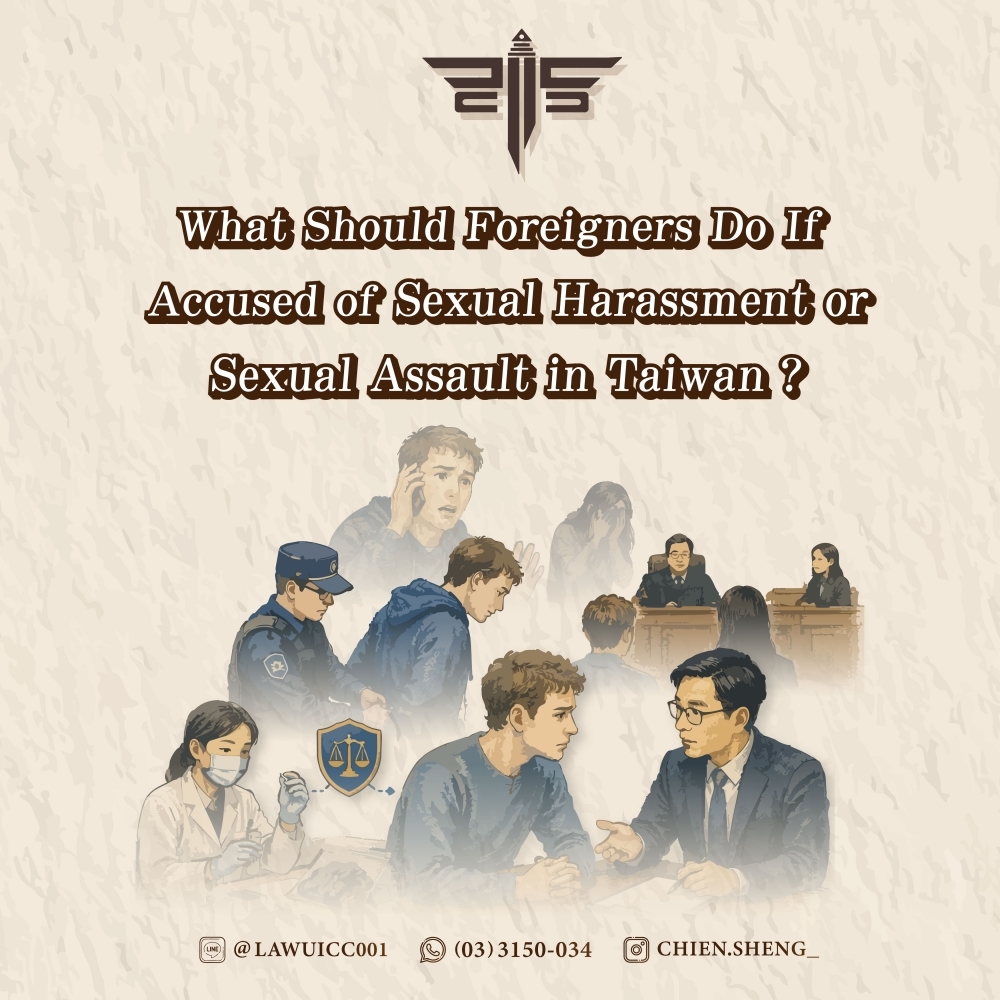
What Should Foreigners Do If Accused of Sexual Harassment or Sexual Assault in Taiwan?
商品圖像
-
商品資訊
目錄
- 1. Taiwan Law Applies to Foreigners in Taiwan
- 2. Sexual Harassment and Sexual Assault Are Different Legal Categories
- 3. Criminal Sexual Offenses Under Taiwan’s Criminal Code
- 4. Criminal Liability for Certain Sexual Harassment Conduct
- 5. Your Procedural Rights as an Accused Person in Taiwan
- 6. What Foreigners Should Do Immediately After an Accusation
- 7. Police, Prosecutor, and Court Process in Taiwan
For foreign nationals living, working, studying, or traveling in Taiwan, being accused of sexual harassment or sexual assault can be an extremely serious and stressful experience. Taiwan’s legal system treats sex-related allegations seriously, and the consequences may include police questioning, prosecutor investigation, criminal charges, detention, travel restrictions, civil compensation, workplace or school disciplinary proceedings, and long-term immigration or reputation concerns.
This article is written for English-speaking foreigners who need to understand what may happen in Taiwan after receiving a police notice, prosecutor summons, school complaint, workplace complaint, or direct accusation. It explains the basic legal framework, the difference between sexual harassment and sexual assault, and the practical steps a foreigner should take to protect their rights from the very beginning of the case.
1. Taiwan Law Applies to Foreigners in Taiwan
A common misunderstanding is that a foreign citizen accused of a sex-related offense in Taiwan may be handled mainly by the embassy or by the law of the foreigner’s home country. In most cases, this is not correct. If the alleged conduct happened in Taiwan, Taiwan authorities may investigate and prosecute the case under Taiwanese law, regardless of the accused person’s nationality.
This means that a foreigner may be investigated by Taiwan police, questioned by Taiwan prosecutors, and tried in Taiwan courts if the alleged incident occurred in Taiwan. Even if both the accused person and the complainant are foreigners, Taiwan may still have jurisdiction when the conduct or result occurred within Taiwan.A foreign office or consular representative may provide general assistance to its nationals, but it cannot replace a Taiwan criminal defense lawyer, appear as defense counsel, or control the Taiwan police, prosecutor, or court process. For this reason, foreigners facing sexual harassment or sexual assault allegations in Taiwan should seek local legal advice as early as possible.
2. Sexual Harassment and Sexual Assault Are Different Legal Categories
Taiwan law distinguishes between sexual harassment and sexual assault or other sexual offenses. Sexual harassment generally refers to sexual or gender-related behavior against another person’s will that affects the person’s dignity, creates fear or hostility, or improperly affects the person’s work, education, services, activities, or daily life.
★Taiwan also has different legal systems depending on where the alleged conduct occurred. General sexual harassment cases may fall under the Sexual Harassment Prevention Act. Workplace sexual harassment is usually handled under the Gender Equality in Employment Act. School-related cases may involve the Gender Equity Education Act. Criminal sexual assault and other serious sexual offenses are handled under Taiwan’s Criminal Code.
These categories may overlap. For example, a workplace sexual harassment complaint may also become a criminal case if the alleged conduct involves forced touching or sexual assault. A school complaint may lead to a campus investigation while police and prosecutors separately investigate possible criminal liability. Because multiple procedures may happen at the same time, foreign defendants should not assume that responding to only one authority is enough.
3. Criminal Sexual Offenses Under Taiwan’s Criminal Code
Taiwan’s Criminal Code punishes sexual intercourse committed against another person’s will through threats, violence, intimidation, hypnosis, or other means. Depending on the facts, this type of offense may carry a prison sentence of several years. The law also provides heavier penalties for aggravated circumstances, such as offenses committed by multiple persons, offenses involving minors, offenses involving drugs, offenses involving weapons, or offenses involving recording or dissemination of images.Taiwan law also punishes forced obscene acts. This may include non-consensual sexual touching or other sexual conduct that does not amount to sexual intercourse but is still treated as a criminal offense. If aggravating factors exist, the penalty may be significantly increased.
Other important criminal provisions involve sexual conduct with minors, sexual conduct by taking advantage of a person’s inability to resist, and sexual conduct involving abuse of authority or a supervisory relationship. These cases are especially serious because the legal focus may not only be on physical force, but also on age, power imbalance, mental or physical condition, intoxication, vulnerability, or the relationship between the parties.
★For foreigners, the most important point is that a sexual assault accusation should never be treated as a simple misunderstanding. Statements made to police or prosecutors may become important evidence. A poorly translated statement, an incomplete explanation, an emotional apology message, or casual communication with the complainant can significantly affect the direction of the case.
4. Criminal Liability for Certain Sexual Harassment Conduct
Not every sexual harassment complaint is a criminal case, but some forms of sexual harassment may carry criminal punishment. Under Taiwan law, conduct such as kissing, hugging, or touching another person’s private body parts in a way that prevents the person from immediately responding or resisting may result in criminal liability. If the conduct involves abuse of power or opportunity, the punishment may be increased.Sexual harassment complaints may also be filed after some time has passed. This means that a foreigner may be contacted by police, an employer, a school, or a local government agency about an incident that allegedly occurred months or even years earlier. In such situations, the accused person should immediately begin collecting records, messages, travel records, location history, witness information, and any other evidence that may help reconstruct what happened.
5. Your Procedural Rights as an Accused Person in Taiwan
Foreigners accused of sexual harassment or sexual assault in Taiwan have important procedural rights. A suspect or accused person has the right to retain a defense lawyer during the investigation. Before interrogation, the authorities should inform the accused of the alleged crimes and charges, the right to remain silent, the right not to make statements against their own will, the right to retain an attorney, and the right to request investigation of evidence favorable to the defense.
 If the accused person does not understand Mandarin or has difficulty understanding the language used in the procedure, an interpreter should be provided. This is extremely important for foreign defendants. Even if a foreigner can speak basic Mandarin, legal questioning is very different from ordinary conversation.
Misunderstanding a question, answering too quickly, or signing a Chinese-language statement without fully understanding it may serious problems later. A foreigner should not sign any written statement unless they understand its contents and legal effect. If the written record does not accurately reflect what was said, the accused should request correction before signing. In sex offense cases, details matter. Small differences in wording may later become major disputes in the prosecutor’s office or court.
6. What Foreigners Should Do Immediately After an Accusation
The first priority is to stay calm and avoid direct confrontation. Many foreigners instinctively want to contact the complainant to apologize, explain, negotiate, or ask why a complaint was filed. This may be risky. Direct contact can be misunderstood as pressure, intimidation, retaliation, or an attempt to influence testimony. In some cases, it may additional legal problems.The second priority is to preserve evidence. Sexual harassment and sexual assault cases often depend on details such as consent, context, timing, intoxication, communication before and after the event, CCTV footage, taxi records, hotel records, witness statements, social media messages, and phone location data. Digital evidence can disappear quickly. CCTV footage may be overwritten. Chat messages may be deleted. A lawyer can help identify what should be preserved and how to present it properly.
The third priority is to request English-language legal assistance before giving a substantive statement. A foreigner may understand conversational Mandarin but still misunderstand legal terms, police wording, or the consequences of a statement. In sex offense cases, phrases such as “I was drunk,” “I thought it was consensual,” “I touched her accidentally,” or “I do not remember clearly” may have very different legal implications depending on the facts.Foreigners should not ignore police, prosecutor, employer, or school notices. They should also avoid deleting messages, social media posts, photos, or call records. Deleting evidence may be interpreted negatively and may make the defense more difficult. Instead, the accused person should preserve all relevant materials and consult a lawyer before deciding how to respond.
7. Police, Prosecutor, and Court Process in Taiwan
A case may begin with a police report, an administrative sexual harassment complaint, a workplace complaint, a school complaint, or a hospital report in suspected sexual assault cases. After a criminal complaint is filed, police may ask the accused to appear for questioning. The case may then be transferred to the prosecutor, who has authority to investigate, summon the accused, question witnesses, request evidence, and decide whether to indict, defer prosecution, or issue a non-prosecution decision.
In serious criminal cases, the prosecutor may ask the court to detain a suspect if legal grounds exist, such as risk of flight, risk of evidence destruction, or risk of collusion with witnesses.Chien Sheng International Law Firm

LINE Online Legal Consultation: @lawuicc001 (Click to consult)
Welcome to call to schedule a meeting: 03-3150-034
Multiple payment methods available: Cash, Credit Card, Bank Transfer
Facebook: Chien Sheng International Law Firm
Instagram: chien.sheng_
-
商品Q&A