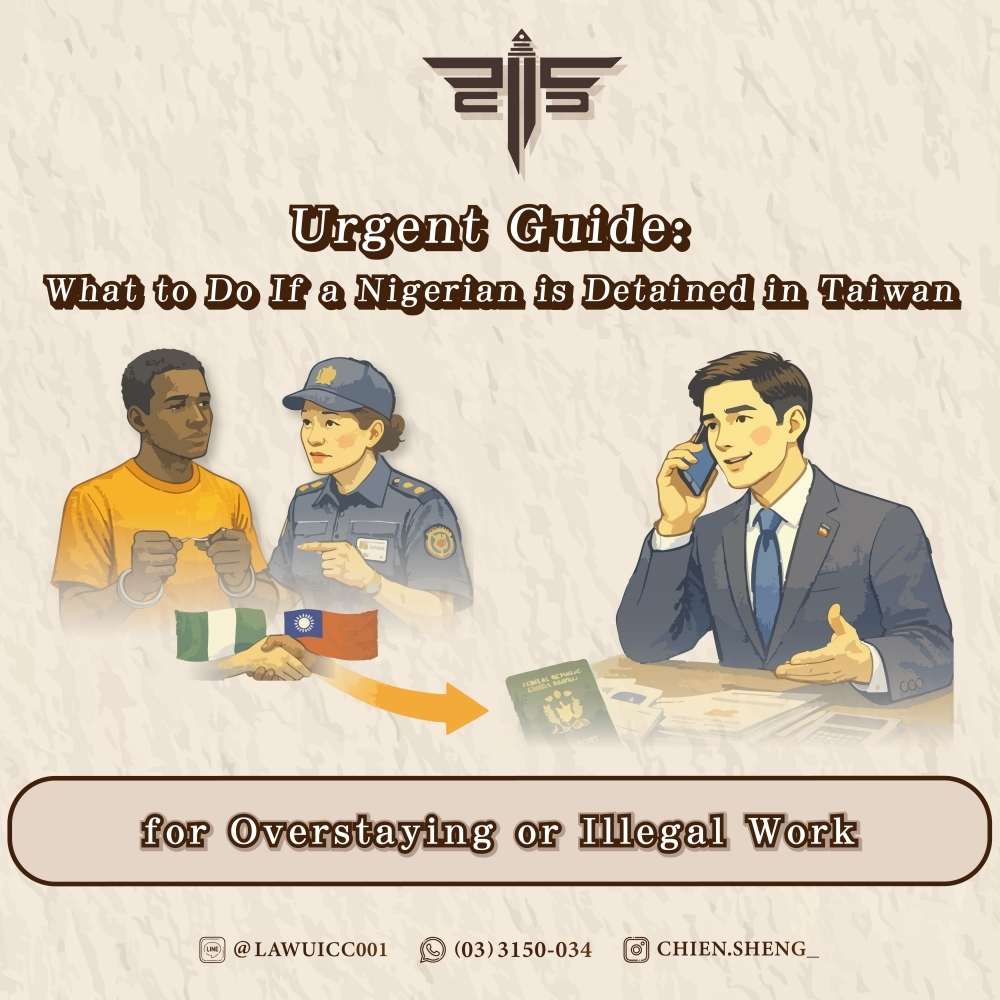
Urgent Guide: What to Do If a Nigerian is Detained in Taiwan for Overstaying or Illegal Work
商品圖像
-
商品資訊
目錄
- Understanding Immigration Detention in Taiwan: A Nightmare for Foreigners
- The Reality Inside Taiwan’s Detention Centers
- The Immediate Consequences: Fines, Deportation, and Entry Bans
- The 2024 Updates on Taiwan’s Immigration Act: Stricter Penalties You Must Know
- Why Ignorance of the Law is Not an Excuse
- The 24-Hour Rule: Challenging the Legality of Detention
In Taiwan, immigration laws are strictly enforced by the National Immigration Agency (NIA) and local police departments. Recent updates to the Immigration Act in 2024 have introduced even harsher penalties, including significantly higher fines and longer entry bans for violators. However, being detained does not mean you have lost all your rights. The law still provides mechanisms for defense, appeal, and humane treatment.
This comprehensive guide is designed specifically for Nigerian nationals and their families who are facing the nightmare of immigration detention in Taiwan. We will explain the legal framework, your fundamental rights, the deportation process, and most importantly, why hiring an experienced, English-speaking criminal defense lawyer from Chien Sheng Law Firm (謙聖國際法律事務所) is your best chance at navigating this crisis and protecting your future.
Understanding Immigration Detention in Taiwan: A Nightmare for Foreigners
Why Nigerians Get Detained: The Strict Immigration Laws of Taiwan
Taiwan has become an increasingly popular destination for foreign workers, students, and business people. However, the government maintains a tight grip on its borders and labor market to protect domestic employment and national security. For Nigerian nationals, the scrutiny can sometimes feel particularly intense due to strict visa regulations and document verification processes.
The two most common reasons for the detention of foreign nationals, including Nigerians, are:
1. Overstaying (逾期居留/停留): Remaining in Taiwan after your visa, Alien Resident Certificate (ARC), or visa-exempt period has expired. Even a miscalculation of one day is considered a violation of the law.
2. Illegal Work (非法打工): Engaging in employment without a valid work permit issued by the Ministry of Labor, or working for an employer other than the one specified on your permit. This includes part-time jobs, teaching English privately without authorization, or engaging in unauthorized business activities.
Once the police or immigration officers discover these violations, the individual is typically arrested on the spot and transferred to a detention facility pending investigation and deportation.
The Reality Inside Taiwan’s Detention Centers
When a foreign national is apprehended for immigration violations, they are not sent to a standard prison unless they are also facing serious criminal charges. Instead, they are transferred to one of the specialized immigration detention centers operated by the National Immigration Agency. Taiwan currently operates four main detention centers:
• Taipei Detention Centre (臺北收容所): Located in Sanxia District, New Taipei City.
• Yilan Detention Centre (宜蘭收容所): Located in Dongshan Township, Yilan County.
• Nantou Detention Centre (南投收容所): Located in Caotun Township, Nantou County.
• Kaohsiung Detention Centre (高雄收容所): Located in Yong’an District, Kaohsiung City.
Life inside these centers is highly regulated. Detainees are deprived of their freedom of movement, their personal belongings (including mobile phones) are confiscated, and communication with the outside world is heavily restricted. While the facilities provide basic necessities, the psychological toll of being locked up in a foreign country without knowing when you will be released or deported is immense.
The Immediate Consequences: Fines, Deportation, and Entry Bans
The moment you are detained for overstaying or illegal work, a chain of legal and administrative consequences is triggered. These are not merely slaps on the wrist; they have long-lasting impacts on your ability to travel, work, and live internationally.
1. Mandatory Deportation: Under Article 36 of the Immigration Act, the NIA has the authority to forcibly deport foreign nationals who have overstayed or worked illegally. You will be required to purchase your own flight ticket back to Nigeria or your country of origin.
2. Heavy Fines: Before you can leave the country, you must pay administrative fines for your violations. If you cannot pay, the process may be delayed.
3. Entry Bans (管制入境): This is perhaps the most devastating consequence. Once deported, you will be blacklisted and banned from re-entering Taiwan for a specific number of years. For many who have built lives, relationships, or businesses in Taiwan, this means an abrupt and forced end to their dreams.
The 2024 Updates on Taiwan’s Immigration Act: Stricter Penalties You Must Know
It is crucial to understand that the legal landscape in Taiwan has recently changed. In early 2024, the Taiwanese government implemented significant amendments to the Immigration Act, making the penalties for overstaying and illegal activities much harsher than before. Ignorance of these new rules will not save you from their enforcement.
Increased Fines for Overstaying (NT$10,000 to NT$50,000)
Previously, the fine for overstaying your visa or ARC in Taiwan ranged from NT$2,000 to NT$10,000. Under the newly revised Immigration Act, the financial penalties have increased dramatically.
★According to the new regulations, foreign nationals who overstay their permitted duration of stay or residence will now face fines ranging from NT$10,000 to NT$50,000, depending on the length of the overstay.
For a detained individual who may already be struggling financially, accumulating such a massive fine while locked in a detention center creates a significant barrier to resolving their case and returning home.
The Expanded Scope of Entry Bans (Up to 10 Years)
The “Operation Directions for the Entry Bans on Foreign Nationals” strictly outline the periods for which a deported foreigner will be banned from returning to Taiwan. The recent updates have expanded these bans:
• Overstaying for less than 1 year: Subject to a 1-year entry ban.
• Overstaying for 1 to 3 years: Subject to a 3-year entry ban.
• Overstaying for more than 3 years: The ban period increases proportionally.
• Engaging in Illegal Work: If you are deported for engaging in activities inconsistent with the purpose of your visit (such as illegal work), you shall be subject to an entry ban for 3 to 5 years.
• Using a False Passport or Visa: If you are caught holding or using an illegally obtained, counterfeited, or altered passport or visa, you shall be subject to a severe entry ban of 10 years.
Why Ignorance of the Law is Not an Excuse
Many detained foreign nationals attempt to argue that they were unaware their visa had expired, or that they were tricked by an agent who promised them a legal work permit. Unfortunately, under Taiwanese law, “ignorantia juris non excusat” (ignorance of the law excuses not). The administrative courts and the NIA will not waive your fines or cancel your deportation simply because you did not know the rules.
This is precisely why you cannot fight this battle alone. You need a legal expert who understands the nuances of the Immigration Act and can find valid legal grounds to challenge the detention or negotiate the penalties.
The Legal Rights of Detained Foreign Nationals in Taiwan
Despite the strict enforcement of immigration laws, Taiwan is a democratic society governed by the rule of law. The Constitution of the Republic of China (Taiwan) and the Immigration Act provide specific procedural safeguards for detained foreign nationals. Knowing these rights is the first step toward regaining your freedom.
The Right to Legal Representation: Why You Need a Lawyer Immediately
Your most fundamental right when detained in Taiwan is the right to legal counsel. You have the right to hire a lawyer to represent you, communicate with the authorities on your behalf, and challenge the legality of your detention.
Because detainees are not allowed to use their mobile phones freely, they are often permitted to make a brief phone call upon arrival at the detention center. If you receive a call from a detained friend or family member, the very first action you must take is to contact a professional law firm like Chien Sheng Law Firm. A lawyer can immediately visit the detention center, review the case files, and ensure that the detainee’s rights are not being violated during interrogations.
The 24-Hour Rule: Challenging the Legality of Detention
Following Constitutional Court Interpretation No. 708, Taiwan’s Immigration Act was amended to include strict judicial oversight over the detention of foreign nationals. This is a critical protection mechanism.
According to the law, when the NIA decides to temporarily detain a foreign national, the detainee has the right to object to the detention. If an objection is raised, the NIA must transfer the detainee to a district court within 24 hours. A judge will then hold a hearing to determine whether the detention is legally justified and absolutely necessary.
During this custody hearing, having an experienced lawyer present is vital. The lawyer can argue before the judge that the detention is unnecessary, perhaps because the detainee has a fixed residence, a Taiwanese spouse, or is willing to post a security bond (bail) to guarantee they will not abscond. If the judge agrees, they may order the release of the detainee under alternative measures, such as regular reporting to the local immigration service center.
Communication Rights: Contacting Family and the Nigerian Trade Office Detainees have the right to inform their designated relatives or other persons of their choice.
Chien Sheng International Law Firm

LINE Online Legal Consultation: @lawuicc001 (Click to consult)
Welcome to call to schedule a meeting: 03-3150-034
Multiple payment methods available: Cash, Credit Card, Bank Transfer
Facebook: Chien Sheng International Law Firm
Instagram: chien.sheng_
-
商品Q&A