Crucially, detention is not always inevitable or irreversible. The law provides several avenues for a detainee to be released. This is achieved by filing a petition to "stop detention" (停止收容). The legal grounds for stopping detention fall into three main categories.
Ground 1: The Reason for Detention Has Disappeared
This applies when the original justification for detention no longer exists. If the foundation of the detention is gone, the detention itself becomes unlawful.
•Examples: A valid travel document has been obtained, making deportation imminent and removing the need for long-term detention; the underlying deportation order has been successfully revoked through an administrative appeal; or a warrant from a foreign government has been withdrawn.
Ground 2: There is No Longer a "Necessity" for Detention
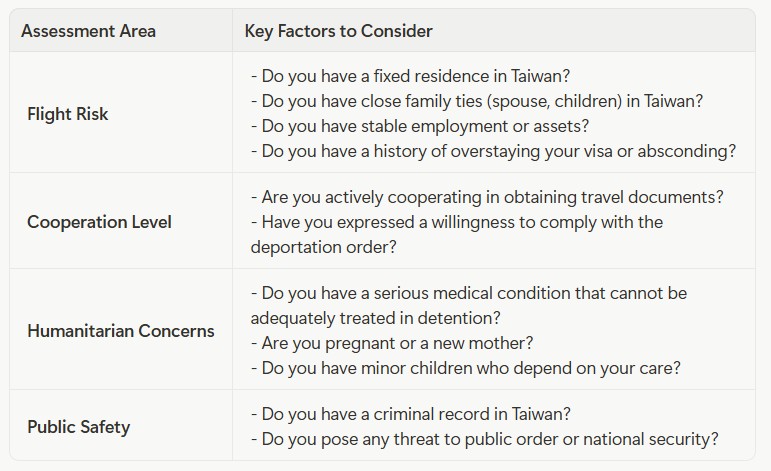
This is the most common and complex ground for release. It argues that even if the deportation order is valid, physically detaining the person is no longer necessary to ensure their eventual departure. The court and the NIA will assess various factors to determine if a less restrictive method, known as an "Alternative to Detention," is sufficient.
Factors Considered for "Necessity"
If it can be proven that the flight risk is low and that humanitarian factors weigh against detention, a strong case can be made for release.
Ground 3: Circumstances That Preclude Detention Exist
Article 38-1 of the Immigration Act lists specific conditions under which the NIA may choose not to detain a person, even if grounds for detention exist. These can also be used to argue for release if they arise during detention.
•Conditions: Serious illness, pregnancy (over 5 months) or recent childbirth, being a minor (under 12), having a specified infectious disease, or being elderly or disabled to the point of being unable to self-care.
When detention is stopped based on a lack of necessity, the individual is typically released under one or more legally binding conditions known as Alternatives to Detention (ATD). These are less restrictive measures intended to ensure you remain available for deportation.
•Common ATDs: Being restricted to a specific residence, reporting to the NIA on a regular basis, paying a security deposit, or having a guarantor who is responsible for you.
This is the most misunderstood aspect of the process. Stopping detention does not grant you the legal right to remain in Taiwan.
•Detention Order: This is a procedural measure to secure your physical person for deportation.
•Deportation Order: This is the substantive legal order requiring you to leave Taiwan.
When detention is stopped, only the detention order is terminated. The deportation order remains valid. You are still legally required to leave Taiwan, and you must continue to cooperate with the NIA's deportation procedures. You are not free to reside and work in Taiwan as you please. Violating the terms of your ATD can lead to the forfeiture of your deposit and re-detention.
 When Can You Legally Stay in Taiwan?
True legal status to remain can only be achieved if:
1.The Deportation Order is Revoked: You successfully challenge the deportation order itself through a separate administrative appeal or lawsuit and have it cancelled.
2.You Obtain a New Legal Status: While released on an ATD, you successfully apply for and are granted a new form of legal residence (e.g., through marriage to a Taiwanese national, a work permit, or on special humanitarian grounds).
If a foreign national in immigration detention is also facing a criminal investigation or trial in Taiwan, the situation becomes more complex. The principle of "priority to criminal procedure" applies.
•NIA's Duty to Notify: The NIA must inform the relevant judicial body (prosecutor's office or court) 10 days before any planned deportation.
•Judicial Authority's Power: The judicial body has the power to decide if the individual needs to be held for the criminal case (through criminal detention) or be formally restricted from leaving Taiwan. If they do, their authority supersedes the NIA's deportation power.
•Outcome: If the court or prosecutor decides to detain you for the criminal case, immigration detention will be stopped, and you will be transferred to the criminal justice system. The NIA cannot deport you until the criminal case is fully resolved.
Navigating Taiwan's immigration detention system is legally complex. An experienced immigration lawyer is essential and can provide critical assistance by:
•Assessing Your Case: Immediately evaluating the legality of your detention and identifying the strongest grounds for release.
•Filing Legal Petitions: Preparing and filing timely and persuasive petitions for detention objection or to stop detention.
•Representing You in Court: Arguing your case before a judge, presenting evidence, and cross-examining NIA officials.
•Negotiating Alternatives: Communicating with the NIA to arrange for the most favorable and least restrictive Alternatives to Detention.
•Challenging the Deportation Order: Filing a separate administrative appeal to challenge the underlying deportation order, which is the only way to secure your right to remain in Taiwan long-term.
•Coordinating with Criminal Counsel: If a criminal case is involved, ensuring the immigration and criminal legal strategies are aligned.
While Taiwan's immigration laws grant the government the power to detain and deport foreign nationals, they also provide a robust system of checks, balances, and legal remedies to protect individual rights. Understanding the stages of detention, the grounds for release, and your legal status after release is the first step to securing your freedom. Given the high stakes and legal complexities, seeking immediate assistance from a qualified immigration lawyer is not just recommended—it is essential.
If you or someone you know is facing immigration detention in Taiwan, contact our firm today for a consultation. We have the expertise and experience to defend your rights and guide you through every step of this challenging process.
♦ Taipei Office: 02-2388-8962
♦ Taoyuan Office: 03-3150-034

 Crucially, detention is not always inevitable or irreversible. The law provides several avenues for a detainee to be released. This is achieved by filing a petition to "stop detention" (停止收容). The legal grounds for stopping detention fall into three main categories.
 If it can be proven that the flight risk is low and that humanitarian factors weigh against detention, a strong case can be made for release.