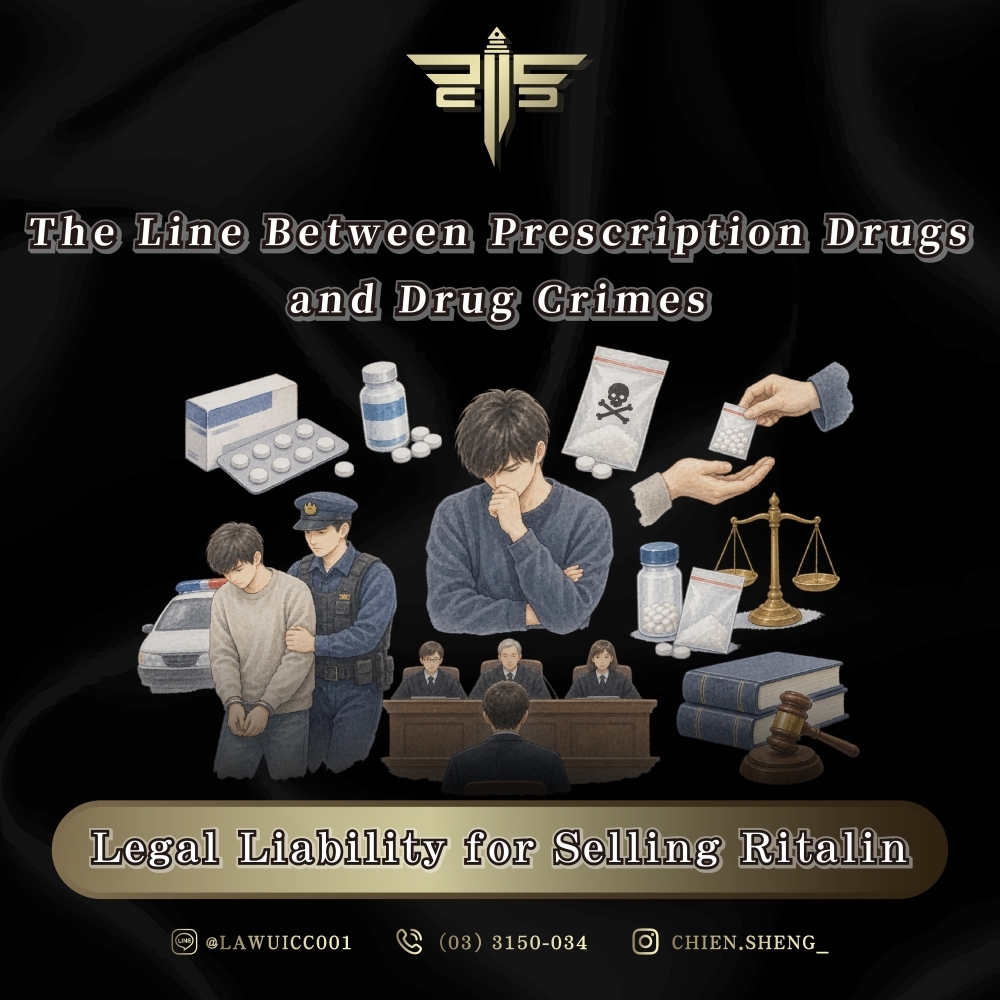
Legal Liability for Selling Ritalin: The Line Between Prescription Drugs and Drug Crimes
商品圖像
-
商品資訊
目錄
Many people are familiar with Ritalin, a commonly prescribed medication primarily used to treat attention deficit hyperactivity disorder (ADHD). In recent years, however, an increasing number of people have faced serious criminal charges for illegally selling Ritalin.
This raises an important legal question: Why can a legally prescribed medication lead to drug-related criminal charges?
This article examines a real court judgment to explain the potential criminal liability associated with the unauthorized sale and transportation of Ritalin in Taiwan.
1. The Legal Status of Ritalin: Prescription Medication or Controlled Drug?
To understand the legal consequences of selling Ritalin, it is first necessary to clarify its legal status.
The active ingredient in Ritalin is methylphenidate, a central nervous system stimulant. Under Taiwan’s Narcotics Hazard Prevention Act, methylphenidate is classified as a Category 3 narcotic.
The key point is that methylphenidate is not classified as a controlled drug because it lacks legitimate medical uses. On the contrary, methylphenidate has recognized medical applications. However, because it carries risks of dependence and abuse, it is subject to strict legal controls.
This means that although Ritalin tablets may be legally obtained with a valid medical prescription, unauthorized sale, distribution, or use outside legitimate medical purposes may result in violations of Taiwan’s drug control laws.
➙ In addition, methylphenidate is not only classified as a Category 3 narcotic under the Narcotics Hazard Prevention Act, but is also designated by Taiwan’s Executive Yuan as a controlled import and export item. Therefore, unauthorized transportation, sale, or smuggling of methylphenidate across national borders may result in additional criminal liability.
2. Real Case: From Domestic Sales to Cross-Border Transportation
To better illustrate the potential legal consequences of selling Ritalin, consider an actual court case.
The following case is based on Taiwan Taoyuan District Court Judgment No. 343 of 2023, issued on November 9, 2023. This case was not handled by Chien Sheng International Law Firm.
In this case, the defendant sold and transported Ritalin through several methods and was ultimately sentenced to 12 years in prison.
■ The first part of the case involved cross-border transportation.
The defendant and unidentified individuals jointly arranged to send Ritalin tablets containing methylphenidate to mainland China through the international postal system. This conduct was repeated 20 times, and the defendant received at least NT$1,200 for each shipment.
The defendant’s role was to receive the buyers’ information and personally deliver the packages to the post office for shipment.
Although the defendant was not the principal organizer of the operation, the court determined that using postal workers to transport the drugs constituted criminal conduct through an innocent intermediary. The defendant was therefore held criminally responsible together with the other participants.
■ The second part of the case involved domestic sales.
The defendant posted messages on social media advertising that “genuine Taiwan Ritalin was newly in stock,” actively offering Ritalin for sale to members of the public.
When an undercover police officer attempted to make a purchase, the defendant sent 20 Ritalin tablets through a convenience-store delivery service and charged NT$1,260.
Although the transaction was not legally completed because the undercover officer had no genuine intention to purchase the drugs, the defendant had already begun carrying out the sale. The conduct therefore constituted attempted sale of a controlled drug.
3. Laws and Criminal Liability for Selling Ritalin
Based on the case above, the unauthorized sale of Ritalin may involve several criminal provisions.
■ First, Article 4, Paragraph 3 of the Narcotics Hazard Prevention Act provides criminal penalties for the transportation or sale of Category 3 narcotics. This is the primary criminal provision applicable to the unauthorized sale or transportation of methylphenidate and carries severe penalties.
■ Second, if the conduct involves transporting the substance across national borders, it may also violate Article 2, Paragraph 1 of the Smuggling Penalty Act, which governs the unauthorized import or export of controlled items.
Because methylphenidate is designated as a controlled import and export item, transporting it out of Taiwan without authorization may constitute a smuggling offense.
➙ If the sale is attempted but not completed—for example, because law enforcement intervenes—the conduct may constitute attempted sale under Article 4, Paragraph 6 of the Narcotics Hazard Prevention Act.
Furthermore, when multiple individuals jointly participate in the offense, Article 28 of Taiwan’s Criminal Code may apply, meaning that those who jointly commit the offense may be treated as co-principals and held criminally responsible for their participation.
4. Sentencing Factors and Legal Consequences
In the case discussed above, the defendant was ultimately sentenced to 12 years in prison. The judgment demonstrates the serious legal consequences that may arise from the illegal sale and transportation of Ritalin.
Even though the defendant received the benefit of several grounds for sentence reduction—including reductions relating to an attempted offense, voluntary surrender, confession during the investigation and trial, and mitigating circumstances—the defendant still received a lengthy prison sentence.
When determining the sentence, the court considered factors including the defendant’s motive and purpose, the quantity of drugs transported, the duration and frequency of the criminal conduct, the defendant’s role in the offense, and the defendant’s attitude after the offense.
Although the defendant was not the principal organizer of the drug-smuggling operation and participated primarily in exchange for payment, the court nevertheless considered the conduct to pose a serious risk to public safety and the spread of illegal drugs.
➙ The court also ordered the confiscation of the defendant’s criminal proceeds and the seized Ritalin tablets. These confiscation measures added further financial consequences to the criminal penalties imposed.
5. Multiple Legal Liabilities for Selling Ritalin
The unauthorized sale of Ritalin may result in serious consequences because the conduct can involve multiple layers of criminal liability.
■ First, from the perspective of drug control laws, selling Ritalin containing methylphenidate may violate the Narcotics Hazard Prevention Act, which forms the core criminal charge.
■ Second, when the conduct involves cross-border transportation, it may also violate the Smuggling Penalty Act, making the case more legally complex and potentially increasing the criminal consequences.
■ Third, Ritalin sales may involve multiple participants. Sellers may work with upstream suppliers, intermediaries, or other individuals involved in the distribution process. Depending on each person’s knowledge, intent, and participation, multiple individuals may face criminal liability.
■ Fourth, if controlled drugs are distributed to minors or other legally protected groups, additional or enhanced penalties may apply depending on the circumstances of the case.
Chien Sheng International Law Firm reminds the public of the following important points:
★ First, the fact that Ritalin is a legal prescription medication does not mean that it may be freely sold, transferred, or transported. Unauthorized sale or distribution of Ritalin containing methylphenidate may result in serious drug-related criminal liability.
In addition, posting advertisements or sales messages through social media or messaging platforms may expose a person to criminal liability even if the transaction is ultimately not completed.
★ Second, if you unknowingly become involved in the sale or transportation of Ritalin—for example, if someone deceives you into mailing a package—you should stop participating immediately and seek legal advice.
If you are already under investigation or facing criminal charges involving the sale or transportation of Ritalin, you should consult an experienced criminal defense lawyer as early as possible so that the facts, evidence, and potential defense strategies can be properly evaluated during the investigation stage.
Chien Sheng International Law Firm

LINE Online Legal Consultation: @lawuicc001 (Click to consult)
Welcome to call to schedule a meeting: 03-3150-034
Multiple payment methods available: Cash, Credit Card, Bank Transfer
Facebook: Chien Sheng International Law Firm
Instagram: chien.sheng_
-
商品Q&A